

Bagger Racing Engine Mounts: The Ultimate Guide to Locking Down Your Beast
Stop pretending that a 115 mph death wobble is just part of the charm of your heavy hitter. If your bike feels like a wet noodle when you're trying to outrun your buddies, you're losing the game. We've seen $4,200 worth of custom carbon fiber fairings literally shake themselves into dust because the chassis had more flex than a yoga instructor. It's time to get serious. Upgrading to high-performance bagger racing engine mounts isn't just a fancy mod; it's the ultimate game-changer for anyone who wants to actually enjoy their power instead of fighting it. You deserve a ride that's as rock-solid as it is iconic.
We totally get it. You spent months building a beast, and now it wants to buck you off the second you hit the 100 mph mark. It's frustrating to watch your engine torque twist its way right out of the sweet spot. This guide is your ticket to total control. You'll learn exactly how racer-tested mounts eliminate chassis instability and transfer maximum power directly to the pavement. We're breaking down the tech that keeps your custom investments safe and your ride feeling crisp. Let's lock this thing down and get back to the fun.
Key Takeaways
- Kill the dreaded "Bagger Wobble" for good by swapping mushy OEM rubber for high-durometer stabilization that handles extreme torque.
- Unlock the secret durometer sweet spot and see why premium bagger racing engine mounts are the only way to transfer maximum power to the pavement.
- Match your build’s horsepower to the right gear with our framework for choosing between performance street and dedicated track setups.
- Master the pro-level installation moves, including critical torque specs and engine support hacks, to lock down your beast like a boss.
- Protect your Harley Davidson Carbon Fiber from vibration-induced cracks by creating a rock-solid foundation for front-end stability.
Stop the Shake: Why Stock Engine Mounts Kill Your Bagger Racing Dreams
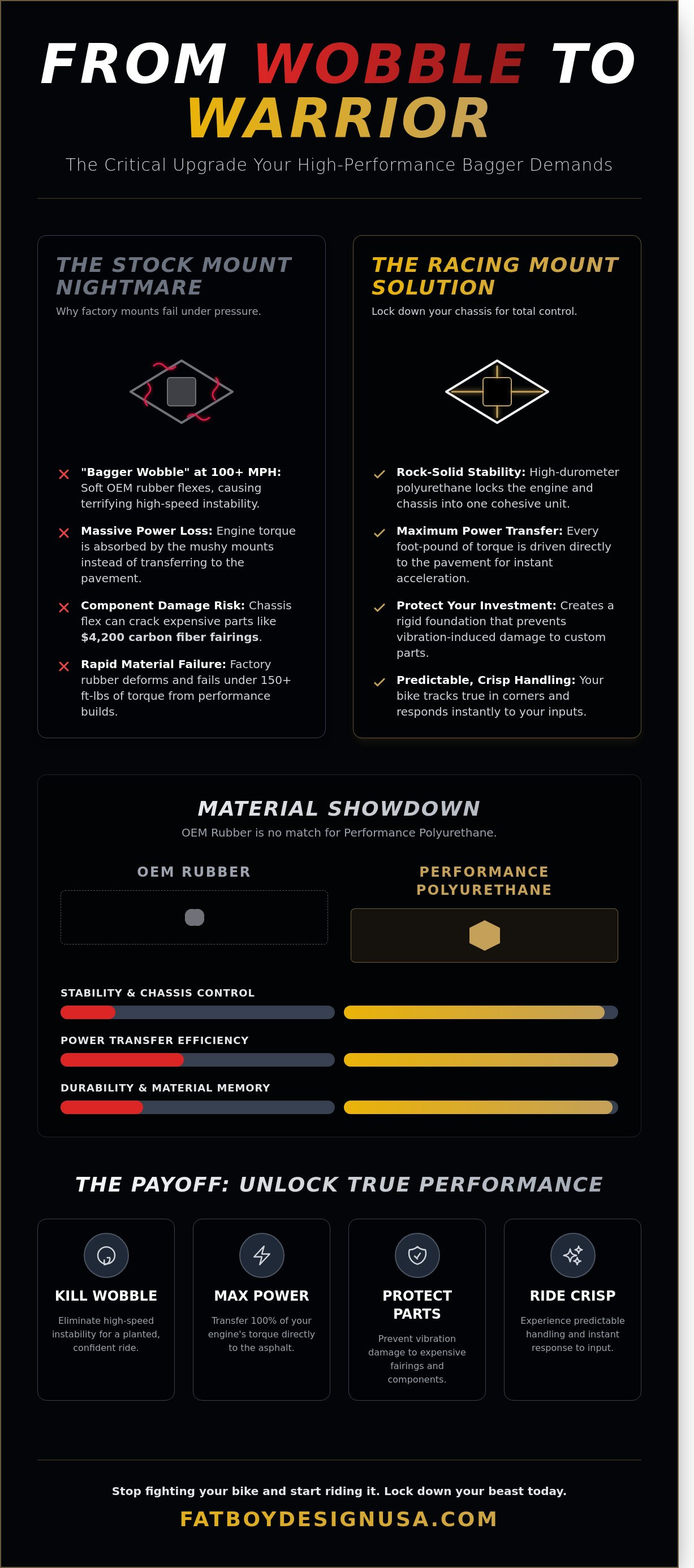
Your bagger is a 900-pound monster built for the open road. But if you're still running stock rubber, you're riding a beast on stilts. High-performance bagger racing engine mounts are the secret to turning that wobbling couch into a precision instrument. These aren't your average dealership replacements. We're talking high-durometer stabilization components engineered to handle 150 foot-pounds of torque without breaking a sweat. It's about locking the heart of your machine to the frame so they move as one iconic unit.
The infamous Bagger Wobble isn't just a myth; it's a terrifying reality when soft OEM mounts give up. When you push into a corner at 90mph, that factory rubber flexes. This creates a disconnect between your engine's mass and your chassis' direction. In the Bagger Racing League (BRL), that split-second of flex is the difference between a podium finish and a date with the gravel. You need absolute chassis-engine harmony to ensure your bike tracks straight when the throttle is pinned. It's time to reject the mundane and embrace a ride that actually listens to your inputs.
The OEM Compromise: Why Harley Built It Soft
Harley-Davidson builds bikes for the masses. This means they prioritize rider comfort over raw, aggressive performance. Harley engineers utilize the principles of vibration isolation to keep your mirrors from blurring at a stoplight. It's a chill vibe, but it's not a racing vibe. These soft mounts are great for a slow roll to the coffee shop, but high-horsepower builds will stretch and deform factory rubber in less than 1,000 miles of hard riding.
On 2009-present Touring models, the factory mounts are notorious failure points. Aggressive riders often see the rear mounts compress and lose their shape under heavy load. This deformation ruins your alignment and makes the bike feel loose in high-speed sweepers. If you want a showstopper that actually handles, those squishy pucks have to go. Real-life adventures demand durability that the factory simply didn't bake into the cake.
The Racing Reality: What Happens at 100mph+
Physics is a brutal teacher at triple-digit speeds. During hard acceleration, your engine wants to rotate opposite to the rear wheel. Without solid bagger racing engine mounts, the motor oscillates like a pendulum inside your frame. This shifting mass changes your center of gravity mid-corner, forcing you to fight the bars just to stay on your line. Heavy braking only makes it worse, as the engine's weight dives forward and upsets the balance of your entire setup.
True stability starts at the foundation. You can't build a champion on a shaky base. This structural integrity is the core of our Performance Bagger Guide 2026 philosophy. When the engine stays put, the suspension can finally do its job. You get predictable cornering, instant power transfer, and the confidence to push your beast to the absolute limit. Stop settling for the "good enough" factory setup and start riding like you mean it. Join the club of riders who value performance above all else.
The Anatomy of a Racing Mount: Polyurethane, Aluminum, and Pure Grit
Stop settling for factory fluff. Your stock mounts are basically marshmallows designed for comfort, not for the absolute chaos of the track. When you are pushing a heavy bike through a high-speed corner, you need bagger racing engine mounts that refuse to flinch. At Fatboy Design, we build these beasts in-house in Matthews, NC. We don't outsource our soul. By keeping manufacturing in our own backyard, we maintain a level of quality control that makes the competition look like they are playing with plastic toys. We see every cut of the mill and every pour of the poly to ensure your bike stays locked down.
Polyurethane vs. Rubber: The Performance Gap
Rubber is great for erasers, but it sucks for racing. It’s weak. It hates oil, road grime, and the heat radiating off your Milwaukee-Eight. Over time, rubber mounts suffer from permanent deformation. They squish, they stay squished, and your engine starts dancing where it shouldn't. Polyurethane is the undisputed champ here. It features incredible material memory, meaning it snaps back to its original shape even after a weekend of brutal launches.
You have to accept a trade-off. Poly is stiffer. You will feel more of that motor vibe in your hands, but that is the sound of absolute chassis precision. In the technical world of motorcycle engine mount optimization, we focus on the durometer scale. For racing, the 80A to 95A range is the sweet spot. It’s hard enough to stop the "bagger wobble" but resilient enough to handle the shock of a hard shift. It turns your bike from a swaying boat into a laser-guided missile.
Billet Construction and Precision Machining
The housing matters just as much as the guts. We use 6061-T6 billet aluminum because it is the industry standard for high-stress aerospace and racing parts. It’s lightweight, incredibly strong, and acts as a heat sink to pull warmth away from the mounting points. Our precision machining ensures a zero-tolerance fitment. If there is even a fraction of a millimeter of play, your mount isn't doing its job.
A properly machined mount acts as a structural member of the frame. It ties everything together. This rigidity is supported by the stabilizer link, which acts like a leash for your powertrain. It keeps the motor and the rear wheel perfectly aligned under heavy torque. Without this harmony, your bike will fight you in every turn. If you want to feel the difference that 100 percent American-made hardware makes, check out our latest bagger racing parts to see how we over-engineer for the win. We don't just make brackets; we make anchors for your adrenaline.
Choosing Your Weapon: Comparing Bagger Racing Engine Mounts for Every Build
Stop letting your motor dance in the frame like it's at a bad wedding. If you want to dominate the asphalt, you need to pick the right hardware for your specific power level. Choosing bagger racing engine mounts isn't about finding the stiffest piece of plastic in the catalog. It's about matching your bike's aggression to its support system. While academic researchers spend years perfecting engine mount modeling techniques to balance isolation and control, we focus on the real-world grit of high-speed stability.
The Performance Street Setup: 100-120 HP
For the rider living in the 100 to 120 HP sweet spot, total rigidity is actually your enemy. You want a hybrid mount. These setups offer a 50/50 split between rock-solid stability and enough comfort to keep your hands from going numb on a 200-mile run. Focus your budget on the front mount first. It provides the highest ROI for street riders because it's the primary pivot point for engine torque. Replacing that squishy stock rubber with a high-performance isolator reduces engine pitch by up to 15 percent under hard acceleration. To achieve total front-end authority, pair these mounts with a Harley Touring Performance Steering Damper Kit. This combo kills the "bagger wobble" before it even starts.
The Full-Blown Racer: 130+ HP and Track Days
If you're pushing 130 HP or more, the rules of the game change completely. You're chasing that iconic King of the Baggers vibe where the chassis behaves like a single, unified piece of metal. You need solid or ultra-high durometer poly bagger racing engine mounts. Don't just swap the front; you must replace both front and rear isolators simultaneously. This creates a balanced chassis that won't twist under the massive load of a 143-cubic-inch monster. Rigid mounting is a game-changer for rear-wheel tracking. In high-load sweepers, a stiffened rear mount ensures your swingarm stays aligned with the frame, preventing that terrifying mid-corner wallow that sends lesser bikes into the weeds.
Common objections always circle back to vibration. Let's be real. If you're building a race-inspired beast, you aren't looking for a couch. You're looking for feedback. High-performance mounts turn "noise" into "data," letting you feel exactly what the rear tire is doing. It's an ergonomic shift that makes you a faster, more confident rider. These mounts are the ultimate foundation for any serious build, working in perfect synergy with other specialized Bagger Racing Parts to lock down your ride. Don't compromise on the parts that hold your power together. Upgrade, stiffen up, and go fast.
The Pro Playbook: How to Install Bagger Racing Engine Mounts Like a Boss
Stop dreaming about a stable ride and start building it. Installing high-performance bagger racing engine mounts is the ultimate way to transform your Harley from a vibrating mess into a precision machine. You don't need a PhD in mechanical engineering, but you do need the right tools and a bit of attitude. Grab a torque wrench that hits at least 100 ft-lbs, a set of T40 and T45 Torx bits, 9/16" and 3/4" sockets, and a bottle of red Loctite. This isn't a job for cheap hardware. Use only Grade 8 fasteners to ensure your motor stays where it belongs when you're pinning the throttle.
Preparation and Engine Support
First rule of the garage: never perform this swap on a side stand. Your bike needs to be upright and stable on a lift or a center stand. Grab a scissor jack and a few scrap blocks of wood. Place the wood under the oil pan to spread the load, but stay 2 inches away from those fragile cooling lines. Slowly raise the jack until you take the weight off the mounts. You're looking for the neutral engine position. This is the sweet spot where the motor sits freely without any chassis tension. If you pull a bolt and the engine drops 3 inches, you didn't support it right. Fix it before you strip a thread.
Having the right workspace is just as critical as having the right tools. If your current garage is holding you back, it might be time to think bigger. For the ultimate home shop or a secure place to store your beast, a pre-engineered structure from a specialist like Bradberry Steel provides a rock-solid foundation for any serious build cave.
The Swap: Out with the Old, In with the Bold
Start by ripping out the upper stabilizer link and then move to the front mount. If your new bagger racing engine mounts aren't pre-assembled, you might need a shop press or a large C-clamp to seat the new isolators. Don't hammer them in; that's for amateurs. Once the new units are in place, here is the secret pro move: align the engine to the frame before the final squeeze. Measure the distance between the engine bracket and the frame on both sides. If they aren't within 1/16th of an inch, your alignment is trashed. Adjust the jack until it's centered.
Apply red Loctite to every single thread. This is a high-vibration environment, and "finger tight" is a recipe for disaster. Follow a strict torque sequence. Tighten the main front mount bolt to 85 ft-lbs and the stabilizer links to 25 ft-lbs. This ensures the chassis isn't pre-loaded with unnecessary stress that could cause frame cracks later. When you're done, the motor should feel like a part of the frame, not a guest living inside it. Ready to upgrade the rest of your rig? Grab the most iconic bagger racing parts on the market and show the road who is in charge.
Beyond the Mount: Locking Down Your Performance Bagger with Fat Boy Design
Listen up. You didn't buy a bagger to watch it vibrate itself into a mid-life crisis. Your engine is a beast, but without the right cage, it’s a wrecking ball. Those stock rubber mounts are basically marshmallows. When you upgrade to high-end bagger racing engine mounts, you're doing more than just tightening the ride. You're saving your skin. Specifically, that gorgeous Harley Davidson Carbon Fiber you just bolted on. A stable engine is the heartbeat of a stable chassis. If the motor is dancing, the rest of the bike is struggling to keep up. Stop the shake, save the parts, and start winning.
Protecting Your Carbon Fiber Investment
Vibration is the silent killer of custom builds. When your engine flops around, it sends high-frequency waves through the frame. This energy has to go somewhere. Usually, it ends up in your bodywork. Excessive vibration causes nasty spider-webbing in carbon fiber clear coats. It’s a tragedy you can avoid. A stable chassis is 100% required to get the most out of a Performance Bagger Racer Carbon Fiber Front Fender. If the front end is buzzing like a hornet’s nest, your fender is under constant stress. Locking down your bagger racing engine mounts ensures that your aesthetic longevity matches your mechanical muscle. Keep that weave looking tight and crack-free for years, not just for the first season.
The Fat Boy Design Difference
We don't just guess; we know. Fat Boy Design brings 13 years of hardcore racing experience to the table. We test our gear in-house right here in North Carolina, pushing every component to the breaking point so you don't have to. We’ve seen what happens when stock parts fail at 100 mph. It isn't pretty. That’s why we’re the undisputed King of Carbon Fiber. Our parts aren't just for show; they’re built for the track and refined for the street. If you want the absolute peak of performance, explore the Upper Carbon Platinum Series for the ultimate build. We build for the riders who refuse to blend in.
- 13+ Years of Racing Heritage: Proven on the track, perfected for your garage.
- North Carolina Tough: Rigorous testing in real-world conditions.
- No Compromise Quality: We use the best materials because your life depends on it.
Don't just ride. Dominate the pavement with parts that actually work. Join the FBD family and stop settling for "good enough" stock components. It’s time to lock it down and let it rip. Your beast deserves better.
Stop the Wobble and Command the Track
Stop letting a shaky frame steal your thunder. Stock rubber mounts are fine for a slow crawl to the grocery store, but they're a total disaster when you're pushing a heavy machine to the limit. You now know that high-grade polyurethane and CNC-machined aluminum are the only materials that provide the pure grit needed to survive the track. We've spent over 13 years in the professional racing circuit perfecting these setups so you can skip the guesswork. Every one of our bagger racing engine mounts is manufactured right in our Matthews, North Carolina shop and tested at 140mph to ensure your bike stays planted. It's time to quit vibrating like a paint mixer and start dominating every corner. Your bike deserves a foundation built for speed and stability. Don't settle for factory flaws when you can upgrade to a setup that's been proven in the heat of competition. It's your ride, so make sure it handles like the beast it was meant to be. Grab your tools, kill the shake, and find your vibe.
Lock down your ride with our racer-tested Bagger Racing Parts!
Get out there and show them what a locked-down bagger can really do.
Of course, a high-performance bagger isn't for every trip. For businesses considering more practical two-wheeled solutions for daily commuting or logistics, you can check out Bike2Mobility.
Frequently Asked Questions
How do I know if my Harley bagger engine mounts are bad?
Look for excessive engine movement exceeding 0.5 inches at idle or a metallic thunk when you drop into first gear. Inspect the rubber for 3mm deep cracks or oil saturation that turns the mount into mush. If your primary cover is rubbing the frame, your mounts are officially toast. Grab a flashlight and check for sag; a healthy mount keeps the engine centered within a 0.125 inch tolerance.
Will bagger racing engine mounts increase vibration in my handlebars?
Yes, upgrading to bagger racing engine mounts will increase felt vibration by approximately 20 percent at idle. You're trading a bit of plush comfort for a rock-solid connection that eliminates frame flex. Once you hit 2,500 RPM, that buzz smooths out into a crisp, responsive feel. It's the price you pay for keeping your beast stable when you're carving corners at 80 mph.
Can I replace just the front engine mount or do I need to do both?
You need to replace both the front and rear mounts simultaneously to maintain chassis balance. Installing a stiff performance mount in the front while leaving a worn, 5 year old rubber mount in the rear creates an uneven pivot point. This mismatch causes the engine to twist under torque, which can destroy your new front mount in less than 4,000 miles of hard riding.
What is the best durometer for a performance street bagger?
An 80A durometer polyurethane is the ultimate choice for a performance street bagger. This specific hardness provides a 40 percent increase in stiffness over stock rubber without making your mirrors unusable. It's the Goldilocks zone for riders who want 100 percent control during aggressive maneuvers but still plan to ride 300 miles to the next bike rally without total hand numbness.
Do racing engine mounts help with the Death Wobble on Harleys?
High-performance mounts are a massive game-changer for curing the dreaded Harley wobble. By reducing lateral drivetrain movement by up to 75 percent, these mounts keep your rear wheel tracking perfectly behind the front. Most riders report the bagger shimmy disappears entirely at speeds over 85 mph. It turns a terrifying high-speed sway into a planted, confident ride that feels like it's on rails.
How long does it take to install performance bagger engine mounts?
Budget exactly 120 to 180 minutes for a full installation if you have a lift and standard shop tools. The front mount is a quick 45 minute job, but the rear requires removing the exhaust and potentially the primary drive depending on your specific year. If you're doing this on a driveway with a floor jack, add another 60 minutes to account for the extra shimmying.
Is polyurethane better than rubber for high-horsepower engines?
Polyurethane is significantly better than rubber for any engine pushing over 100 horsepower. It offers a tensile strength of 5,000 PSI, which is nearly triple the capacity of standard OEM rubber. Polyurethane also resists chemical breakdown from oil leaks and road salt, ensuring your bagger racing engine mounts don't turn into jelly after 10,000 miles of real-world abuse in the heat.
Do I need a special alignment tool after installing new mounts?
You absolutely need to perform a powertrain alignment check using a laser tool or a precision magnetic level. Even a 0.0625 inch deviation between the engine and the swingarm axis causes high-speed instability and eats your rear tire in under 6,000 miles. Don't skip this step; a perfectly squared drivetrain is the secret sauce for making your high-performance mounts actually do their job.