

Bagger Racing Swingarms: Stop the Flex and Slay the Corners
Your 900 pound Harley shouldn't feel like a wet pool noodle when you're hitting triple digits on the backstretch. That terrifying high speed wobble isn't some mandatory feature of the touring life; it's a cry for help from your flimsy stock chassis. If you're serious about carving corners instead of just surviving them, a high performance bagger racing swingarm is the only way to go. It's the literal backbone of a bike that actually behaves itself. Stop letting your rear end dictate the line and start telling that asphalt who's boss.
We all love the rumble of a big V twin, but nobody likes the feeling of the frame twisting into a pretzel under heavy torque. You want sportbike precision without losing the soul of your bagger. We'll show you why swapping that stamped steel for a rigid, racer tested setup is the single most transformative move you can make for your ride. This guide breaks down how to kill the flex, gain the ground clearance you need for steep lean angles, and finally get the suspension response you deserve. Get ready to turn your heavy cruiser into a precision guided missile that shreds the track and the streets alike.
Key Takeaways
- Ditch the dreaded high speed wobble by understanding how stock stamped steel fails under the pressure of high torque engines.
- Discover why upgrading to a bagger racing swingarm is the essential foundation for rock solid stability at triple digit speeds.
- Learn to spec your build like a pro by balancing wheelbase length and shock clearance for maximum lean angles and better grip.
- Compare the lightweight agility of 6061 billet aluminum against the classic, rugged feel of chromoly steel to find your perfect track match.
- Complete the transformation by integrating your new swingarm with performance triple trees to eliminate front end slop and master every corner.
The Death of the Bagger Wobble: Why Stock Isn’t Enough
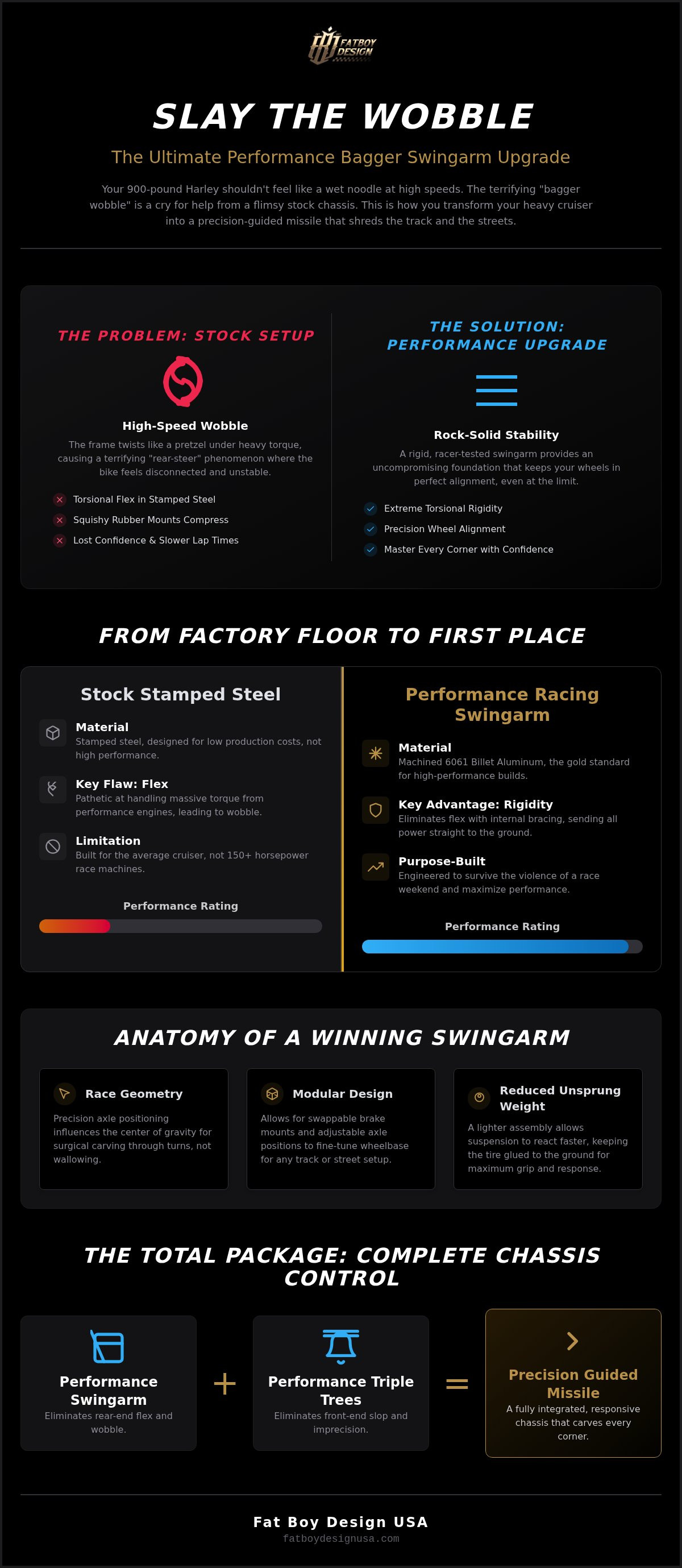
Ever felt like your bike was trying to shake you off like a wet dog at 80 mph? That's the legendary "Bagger Wobble." It's not a ghost in the machine. It's physics. When you're pushing a heavy Harley through a high speed sweeper, the factory motorcycle swingarm acts more like a piece of overcooked spaghetti than a structural component. This torsional flex is the primary reason your rear end feels disconnected from your front end when things get spicy. It's a terrifying sensation that kills your confidence and ruins your lap times.
Stock components are designed for the average cruiser mindset. That means prioritizing a soft, compliant ride over the rock solid rigidity needed for the track. While stamped steel is great for keeping production costs down, it's absolutely pathetic at handling the massive torque of a performance engine. If you've upgraded your motor but kept the stock arm, you're basically putting a rocket engine on a cardboard sled. You need a chassis that can actually keep up with your right hand.
The Physics of Flex
Torsional rigidity is just a fancy way of saying your bike shouldn't twist like a pretzel. Factory setups rely on thin steel and squishy rubber mounts that are prone to failure under pressure. Under racing loads, those mounts compress and that thin steel bends. This creates a terrifying phenomenon called "rear-steer." Instead of holding a line, the rear wheel starts making its own decisions about where the bike should go. A high quality bagger racing swingarm eliminates this nonsense. It provides a stiff, uncompromising foundation that keeps your wheels in perfect alignment, even when you're leaned over at the limit and fighting for every inch of grip.
Performance vs. Production Limits
Manufacturers build bikes for the masses. They assume you're making 70 horsepower and riding to the nearest coffee shop. They don't account for the 150 horsepower monsters we're building today. Serious riders dump the stock arm before their first track day because they know production limits are the enemy of podium finishes. At Fat Boy Design USA, we've spent over 13 years in professional racing. We know that a part built for comfort will never survive the violence of a race weekend. Upgrading to bagger racing parts isn't just about looking cool. It's about making sure your chassis can actually handle the power you've worked so hard to build. Don't let a budget factory part be the reason you're backing off the throttle when you should be pinning it.
Anatomy of a Racing Swingarm: Built to Slay
Most stock arms are just placeholders meant to keep your wheel from falling off. A real bagger racing swingarm is a masterpiece of engineering designed to handle the violence of the track. It's the difference between a bike that wallows through a turn and one that carves through it with surgical precision. We're moving away from "it fits" and moving toward "it performs." This isn't just about adding a shiny part to your Harley; it's about fundamentally changing how your bike interacts with the road.
Race geometry is the secret sauce here. It's not just about making the arm stiff; it's about where that axle sits and how it influences your center of gravity. Modern performance arms often feature modular designs. This means you aren't stuck with one setup. You can swap brake mounts or adjust axle positions to fine tune your wheelbase. Whether you're chasing a podium or just trying to outrun your buddies on a Sunday morning, that flexibility is a game changer.
Materials Matter: Billet is King
While some still swear by chromoly, 6061 billet aluminum has become the gold standard for high performance builds. It's carved from a solid block of high grade metal, which means no weak welds and no hidden air pockets. This material offers a strength-to-weight ratio that makes factory stamped steel look like a joke. Internal bracing is the real hero in this story. It prevents the arm from twisting during high torque launches. You want all that power going straight to the ground, not wasted on bending your frame. If you're serious about your build, take a look at our bagger racing parts to see how we prioritize these racer tested standards.
Unsprung Weight and Suspension Response
Let's talk about unsprung weight, the stuff that isn't supported by your springs. This includes your wheels, tires, and the swingarm itself. If this assembly is heavy, your shocks have to work twice as hard to keep the tire on the ground. It's like trying to play ping pong with a bowling ball; it just doesn't react fast enough. A lighter bagger racing swingarm reduces this mass, allowing your suspension to breathe. Your rear wheel stays glued to the asphalt instead of bouncing over every imperfection. It creates that "magic carpet" feel where the bike tracks true through the roughest sections of the track. When your shocks can actually do their job, you get better grip, better feel, and a whole lot more confidence in the corners.
Choosing Your Spec: Length, Clearance, and Control
Picking the specs for your bagger racing swingarm is where the magic happens. This isn't a one size fits all situation. You're building a weapon tailored to your specific brand of chaos. Whether you're hunting lap times or just trying to survive a canyon run without scraping your floorboards, the right measurements matter. It's the difference between a bike that feels like a precision instrument and one that feels like a shopping cart with a broken wheel. You're the pilot. Choose your flight plan.
Axle diameter is your first big decision for maximum stiffness. You've got 25mm, 1-inch, and the beefy 28mm options. Why does it matter? Stiffness. A thicker axle reduces deflection under load. When you're pinning it out of a corner, you want your wheel to stay exactly where you pointed it. Don't settle for "good enough" when you can have "rock solid." We've seen plenty of stock axles flex under pressure, and it isn't pretty. Go big or go home.
Wheelbase and Handling Dynamics
Length is everything. Drag racers go long because they want to keep the front end down during violent launches. Circuit racers? They stay tight. A shorter wheelbase makes the bike flickable. It lets you dive into corners with less effort. If you're building a street legal performance bagger, you're looking for that "Goldilocks" length. You want enough stability to handle triple digits without the shakes, but enough agility to actually make the turn. Adjusting your wheelbase also shifts your center of gravity. A slight change can transform a sluggish cruiser into a hungry corner carver. Our bagger racing parts are designed to give you that precise control over your machine's geometry.
Shock Clearance and Ground Clearance
If you aren't running at least 14 inch shocks, are you even trying? To get those steep lean angles, you need height. But taller shocks often lead to "transmission rub" or frame interference on stock setups. This is where a dedicated bagger racing swingarm shines. Unlike basic OEM modifications that just hack away at the metal, these are engineered with specific clearance for high performance suspension. You get the ride height you need without the mechanical headaches. It's about maximizing your lean angle so you can slay the corners without leaving a trail of sparks behind you. Performance isn't just about speed. It's about having the room to move when the asphalt gets twisty.
The Aluminum vs. Steel Debate: What Wins on the Track?
It's the ultimate heavyweight showdown. In one corner, we've got the old school reliability of chromoly steel. In the other, the high tech precision of billet aluminum. Choosing the right material for your bagger racing swingarm isn't just about bragging rights at the bike show. It's about how your motorcycle handles the brutal forces of a high speed corner. While steel has its place in the history books, the modern track belongs to the light and the rigid. We're not just building parts; we're building an unfair advantage.
The Aluminum Advantage
There's a reason every top team in the King of the Baggers series chooses aluminum. It's all about that strength to weight ratio. Swapping your factory setup for a billet aluminum arm can easily shed 5 to 10 pounds of unsprung weight. That's a massive performance boost that your shocks will thank you for every time you hit a ripple in the asphalt. Aluminum also acts like a giant heat sink, pulling warmth away from your bearings and keeping everything running smooth when the pace gets frantic. Plus, you can't beat the "cool factor" of a raw, CNC machined finish. It looks like it belongs on a fighter jet, not a lawnmower. It's corrosion resistant, perfectly aligned, and ready to take a beating.
Chromoly Steel: The Old School Alternative
Steel still makes sense if you're living life on the drag strip or competing in classes like the Bagger Racing League Super Street class, where aftermarket arms are strictly prohibited. It's got a unique "snap" and feedback that some veteran riders swear by. It's tough as nails and can handle the violent launches of a high horsepower drag bike without breaking a sweat. But for the open classes and pure canyon carving? Steel is heavy. It's the "comfortable" choice, but comfort doesn't win races. We lean toward the high tech precision of modern alloys because we've spent over 13 years in the professional racing world. We've seen what happens when you try to win with yesterday's tech. If you want a bike that feels like a precision instrument, you need the materials to match. Ready to ditch the dead weight? Grab a bagger racing swingarm from our collection and feel the difference for yourself.
The Total Package: Integrating Your Performance Swingarm
A bagger racing swingarm is a total game changer, but it isn’t a magic wand that fixes a bike with a front end made of wet cardboard. If your rear wheel is tracking straight but your handlebars are still hunting for a line, you’re going to have a bad time. Total stability is a team sport. You need to think about how every component talks to the next one. At Fat Boy Design USA, we don’t just build parts; we build handling systems that turn 900 pound cruisers into corner slaying monsters. It’s time to stop looking at your bike as a collection of bolts and start seeing it as a precision machine.
Our philosophy is simple: we build parts that are racer tested and ready for the street. We’ve spent over 13 years in professional racing, and we know that a single upgrade is just the beginning of the journey. Your mother might hate how fast you’re diving into that apex, but your lap times will love it. We focus on the foundation so you can focus on the throttle. Don't let a budget factory chassis hold back the engine you worked so hard to build.
Front-to-Back Harmony
Your new swingarm provides the rigidity your rear end craves. Now, you need to match that energy up front. Pairing your arm with high performance Bagger Racing Triple Trees is the only way to achieve true chassis harmony. Rigid trees eliminate the flex in your forks, ensuring that when you point the wheel, the bike actually goes there. Don’t forget about your engine mounts, either. In a performance bagger ecosystem, squishy rubber is the enemy. Check out our Performance Bagger Guide 2026 to see how we stack these upgrades for maximum impact.
Lighten the Load
Mass is the enemy of momentum. While you’ve already killed the flex, you still need to address the weight. High performance Carbon Fiber Harley Parts allow you to shed pounds where it matters most. Using Carbon Fiber Fenders further reduces that pesky unsprung weight we talked about earlier. Shedding pounds from the top of the bike lowers your center of gravity and makes your new bagger racing swingarm work even more efficiently. It’s about creating a bike that feels light on its feet despite its massive physical presence. Stop talking about your build and start finishing it. The track is calling, and it's time to answer.
Time to Own the Apex
You’ve got the power. Now it’s time to give your chassis the backbone it deserves. We’ve broken down why that factory flex is a total buzzkill and how a rigid, billet aluminum setup turns your heavy Harley into a surgical instrument. Remember, total stability is a team sport. Pairing a high performance bagger racing swingarm with rigid triple trees and lightweight carbon fiber is the only way to kill the wobble for good. Don't let a budget stock part dictate your lean angle or your confidence.
At Fat Boy Design USA, we don't just guess. Our parts are built by racers, for racers, right here in our North Carolina shop. Every item is racer tested on the track and crafted with in-house CNC machining to meet the highest performance standards. We’ve spent over 13 years figuring out what works so you don’t have to. Stop settling for a bike that handles like a wet pool noodle and start building a beast that breathes fire. Your best lap time is waiting for you.
Upgrade Your Ride with Fat Boy Design Bagger Racing Parts
Go out there, pin the throttle, and show that asphalt who’s boss. We’ll see you at the finish line.
Frequently Asked Questions
Do I really need a racing swingarm for a street-only bagger?
You absolutely need one if you're tired of that "walking on eggshells" feeling in every high speed turn. Even for street riders, a bagger racing swingarm provides the rigidity required to navigate highway sweepers without the terrifying frame twist. It isn't just for the track; it's for anyone who wants their 900 pound machine to feel planted. Ditch the flimsy stock steel and enjoy a ride that actually goes where you point it.
Will a performance swingarm fix the high-speed Harley wobble?
It is the single most effective way to kill the dreaded "death wobble" for good. Most high speed instability starts at the rear wheel because the stock arm twists under heavy load. By replacing it with a rigid, racer tested unit, you eliminate that torsional flex. For the ultimate rock solid feel, we recommend pairing your new arm with our performance triple trees to stabilize the front end as well.
Can I install a bagger racing swingarm myself or do I need a shop?
You can definitely handle the install if you have a motorcycle lift and a decent set of wrenches. It is a direct bolt on replacement for most Touring models. Just remember that precision is everything when it comes to your driveline. If the idea of pulling your pivot shaft and aligning the rear wheel makes you sweat, it might be worth a trip to your favorite local performance shop for a pro setup.
What is the best shock length to run with an aftermarket swingarm?
14 inches is the gold standard for riders who want to actually lean their bikes into a turn. A high quality bagger racing swingarm is specifically clearanced to accommodate these taller shocks without hitting the frame or rubbing the transmission. This extra height gives you the ground clearance needed to slay the corners. Some extreme track builds even push up to 16 inches for maximum leverage and suspension travel during aggressive riding sessions.
How much weight can I actually save by switching to an aluminum swingarm?
Switching to a billet aluminum arm typically sheds between 5 and 10 pounds of dead weight. This isn't just about making the bike lighter to push around the garage; it's about reducing unsprung mass. When your rear wheel and swingarm weigh less, your shocks don't have to fight as hard to keep the tire glued to the asphalt. You get a smoother ride and significantly better grip when you're pinning it.
Does a racing swingarm change the bikes seat height or geometry?
The swingarm itself is designed to maintain your factory geometry, but it opens the door for bigger changes. By using the clearanced design to run taller shocks, you will raise the seat height and increase your ground clearance. This shift improves your lean angle and makes the bike feel much more responsive. It turns a lazy cruiser into a machine that's hungry for the next apex without scraping your expensive floorboards.
Will my stock brakes work with a racing swingarm or do I need a kit?
Most performance swingarms feature modular designs that can accommodate your stock brake setup with the right brackets. However, if you're going through the trouble of stiffening the chassis, you should probably think about stopping power too. Many riders choose this moment to upgrade to radial mount calipers for better feel and consistency. Check the specs on your chosen arm to see what mounting hardware is included for your specific year and model.
What maintenance does a billet aluminum swingarm require?
Maintenance is surprisingly low compared to the massive performance gains you'll feel on the road. You mainly need to keep an eye on the torque specs for your pivot bolts and ensure your bearings stay properly lubricated. Because billet aluminum is naturally corrosion resistant, you don't have to worry about the rust or paint chipping that plagues stock steel parts. A quick wipe down during your regular wash is usually enough.