

Bagger Racing Swingarms: Stop the Flex and Slay the Corners
Your 900-pound Harley isn't a tractor, so why settle for a ride that feels like a wet noodle in the corners? You've got the torque to tear up the asphalt, but that stock setup starts screaming the second you lean it over. We're talking about the high-speed wobble that turns a fun track day into a white-knuckle nightmare. If you want to actually use all that power, a high-performance bagger racing swingarm is the single most critical upgrade you can make. It's the backbone of any serious build. Stop letting your frame dictate your speed.
We know the feeling. You love the massive presence of your bike but hate the flex and the lack of ground clearance when things get spicy. You want rock-solid stability at 100 mph and a suspension that actually reacts to the road. This guide shows you how a racing-spec swingarm kills the flex, boosts your lean angle, and transforms your heavy cruiser into a precision-guided missile. We'll look at the engineering that turns big and heavy into fast and fearless. It's time to stop taking the mundane route and start slaying corners like a pro.
Key Takeaways
- Kill the "bagger wobble" for good. Learn why your stock components are flexy noodles that can't handle real torque.
- Discover why a high-performance bagger racing swingarm is the non-negotiable foundation for any track-shredding build.
- Compare the lightweight magic of billet aluminum against the grit of steel to find your perfect track-day partner.
- Get the lowdown on race geometry. Dial in your wheelbase and shock clearance to lean deeper without the drama.
- Go for the total package. Pair your rear-end upgrades with performance triple trees to make your heavy Harley handle like a nimble sportbike.
The Death of the Bagger Wobble: Why Stock Isn’t Enough
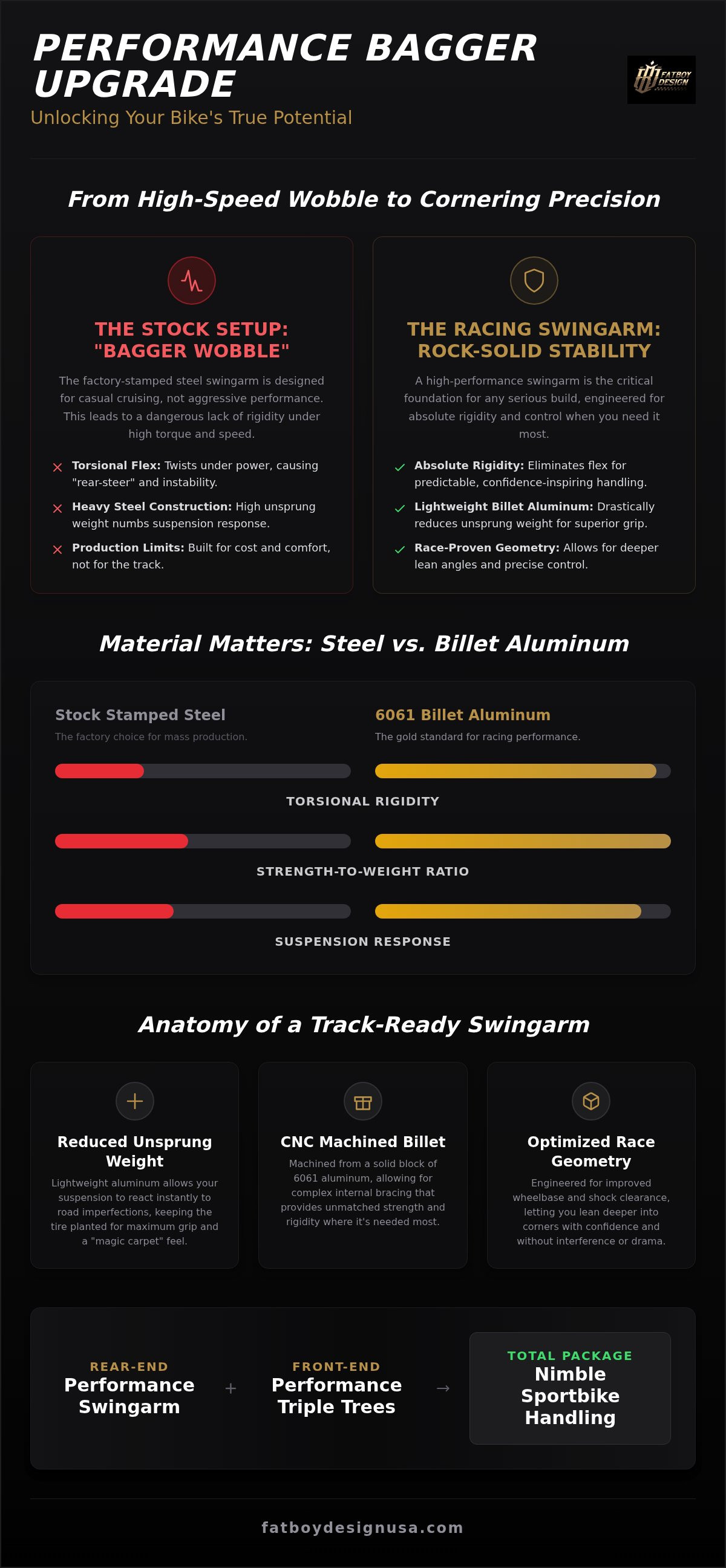
Picture this. You're hitting a sweeper at 80 mph. You lean in, feeling like a god, and then it happens. The bike starts to dance. Not a fun, "I'm at a party" dance. We're talking about the dreaded Bagger Wobble. It’s that terrifying oscillation that makes your 900-pound beast feel like it's made of Jell-O. Most riders blame the tires or the wind. They're wrong. The primary culprit is the torsional flex in your factory-stamped steel swingarm. While the cruiser mindset is all about comfort and soaking up bumps, the racing mindset demands absolute rigidity. You can't win a fight with a wet noodle.
The Physics of Flex
Let's talk about torsional rigidity without the boring lab coats. When you twist the throttle mid-corner, your engine sends a massive surge of torque to the rear wheel. On a stock motorcycle swingarm, that force causes the arm to twist. Combine that with squishy factory rubber mounts, and you've got a recipe for disaster. This flex creates "rear-steer." Your back wheel starts trying to lead the way while your front wheel is still committed to the turn. It's inconsistent, it's sloppy, and at aggressive lean angles, it’s flat-out dangerous. A bagger racing swingarm fixes this by replacing that flimsy steel with high-strength materials that refuse to budge.
Performance vs. Production Limits
OEM manufacturers have a secret. They build bikes for the masses, not the monsters. Their priority is keeping costs low and the ride "plush" for a casual Sunday cruise. That stamped steel arm was designed for a 50-horsepower world. Now, you’re throwing 150 horsepower at it and wondering why the bike feels unhinged. Serious riders dump the stock arm before their first real track day because they know production limits are meant to be broken. If you want to slay corners, you need bagger racing parts designed by people who actually spend time on the grid. Don't let a budget-focused factory part hold your performance hostage. Upgrade to a bagger racing swingarm and feel what it's like to actually own the road.
Anatomy of a Racing Swingarm: Built to Slay
Stop looking at that stock swingarm; it's a glorified boat anchor. If you want to transform your Harley into a track-eating beast, you need to understand the skeleton beneath the chrome. A bagger racing swingarm isn't just about looking cool at the local bike night, though it definitely does that too. It’s a precision-engineered piece of hardware designed to handle the brutal forces of high-speed cornering. We're moving away from budget-friendly stamped steel and entering the world of high-performance geometry and aerospace materials. It's about building a foundation that can actually handle the heat.
Materials Matter: Billet is King
When you're building for the podium, material choice is everything. Most top-tier racers choose 6061 billet aluminum for a reason. It offers a strength-to-weight ratio that makes chromoly steel look like wet cardboard. CNC-machining this stuff from a solid block allows for complex internal bracing. This bracing is the secret to preventing that nasty arm twist when you're pinned in a corner. It’s beefy where it needs to be and light where it doesn’t. This means you get a component that can handle high-torque launches without bending like a pretzel. It’s about durability for heavy trail braking and the confidence to push harder every single lap.
Unsprung Weight and Suspension Response
Let's tackle the biggest secret in racing: unsprung weight. This is the weight of everything not supported by your suspension, like your wheels, brakes, and that swingarm. Think of it this way. If you’re wearing heavy boots, you can't dance fast. If your swingarm is a heavy steel pig, your shocks spend all their energy just trying to move the arm instead of keeping your tire glued to the asphalt. By switching to a lightweight bagger racing swingarm, you're giving your suspension a massive promotion.
- Faster Reaction: Your shocks can respond to bumps in milliseconds rather than fighting inertia.
- Better Grip: A lighter rear end means the tire stays in contact with the road, even on choppy surfaces.
- Precise Control: You get a ride that feels incredibly smooth and connected to the track, often called the "magic carpet" effect.
Don't forget the modularity. A real racing arm gives you options for different brake setups and axle sizes. It’s about building a bike that fits your specific riding style and performance goals. If you're ready to stop the flex and start winning, checking out high-quality bagger racing parts is the first step toward total track dominance. Focus on the geometry, lose the dead weight, and let your suspension finally do the job it was meant to do.
Choosing Your Spec: Length, Clearance, and Control
Choosing the right specs for your bagger racing swingarm is where you stop being a passenger and start being a pilot. It's the difference between a bike that feels like a precision tool and one that handles like a shopping cart with a bad wheel. You've got to be honest about how you ride. Are you hunting for low ETs on the drag strip, or are you trying to scrape floorboards in the tight stuff? Stiffness is the name of the game. Picking between a 25mm, 1-inch, or a massive 28mm axle diameter is a major decision. It’s not just about fitting your wheel; it’s about maximizing stiffness to kill any hint of lateral movement. Stiffer axles provide a direct line of communication between the asphalt and your brain, giving you the confidence to stay pinned when others are backing off.
Wheelbase and Handling Dynamics
Wheelbase is your biggest handle for tuning stability versus agility. Drag racers love a long arm because it keeps the front wheel on the ground when the light turns green. If you’re hitting the track, you probably want to stay closer to stock or even a bit shorter. A shorter wheelbase makes a heavy bagger feel surprisingly flickable. It reduces the effort needed to tip the bike into a corner, making it feel like it's shed a few hundred pounds. However, there’s a trade-off. Go too short, and you might lose that high-speed "on rails" feeling. Most performance builds aim for a "Goldilocks" length that balances turn-in speed with straight-line stability. Remember, changing the length also shifts your center of gravity, which dictates how much weight transfers to the rear tire when you're exiting a corner under heavy throttle.
Shock Clearance and Ground Clearance
You can’t slay corners if you’re bottoming out or scraping your pipes every five seconds. To get those steep lean angles, you need height. Serious builds often run 14-inch or 15-inch performance shocks, but a stock arm will likely smack the frame or rub the transmission. This is where a clearanced bagger racing swingarm becomes mandatory. Unlike modified OEM arms that compromise structural integrity, a racing-spec arm is designed with a specific notch or arc to clear the transmission housing. This allows for massive suspension travel without the mechanical drama. This extra ride height is the secret to gaining those extra degrees of lean angle. It keeps your hard parts off the ground and lets you carry way more corner speed. Just be sure to check your chain or belt alignment; jacking up the rear changes the angles, and you don’t want to trade cornering speed for a snapped drive line. If you're looking to complete the transformation, check out our full range of bagger racing parts to ensure every component can handle the new height.
The Aluminum vs. Steel Debate: What Wins on the Track?
Let's settle the bar fight once and for all. Steel or aluminum? It’s the classic rivalry. Steel is the old guard, reliable and heavy as a sledgehammer. Aluminum is the modern track star, light and precise. When you’re hunting for a bagger racing swingarm, you’re hunting for an edge. On the track, every single ounce counts toward your lap time. Top teams in the "King of the Baggers" series aren't running steel for a reason. They choose billet aluminum because it’s the only way to get the rigidity needed to handle 150+ horsepower without the weight penalty of a tank. It’s about winning, not just participating.
The Aluminum Advantage
Billet aluminum is a weight-loss miracle for your bike's rear end. You’re typically dropping 5 to 10 pounds compared to that factory stamped-steel anchor. This isn't just dead weight; it’s unsprung weight. As we talked about earlier, shedding this weight lets your suspension react with lightning speed. Beyond the scales, there’s the "cool factor." A raw, CNC-machined finish looks like pure mechanical art. It screams performance. Aluminum also handles heat dissipation better than steel, which is critical when your brakes are glowing mid-race. Plus, it’s naturally corrosion-resistant. If you actually ride your bike instead of just polishing it in the garage, you’ll appreciate a part that won't rust after a rainy weekend trip.
Chromoly Steel: The Old School Alternative
Chromoly steel still has its fans, and for specific builds, it makes sense. It’s the go-to for extreme drag racing where the goal is straight-line tensile strength above all else. Steel has a unique "snap" and feedback characteristic. Some riders swear they can feel the road better through a steel arm. It’s also the choice for budget-conscious builds that want a step up from stock without the billet price tag. But let’s be honest. We aren't here for "budget" or "good enough." We’re here to push limits. Fat Boy Design leans toward the high-tech precision of modern materials because that’s where the performance lives. Our 13 years of professional racing experience taught us that precision beats tradition every time. If you’re ready to dump the dead weight and join the elite, grab the right bagger racing parts and start slaying the competition.
The Total Package: Integrating Your Performance Swingarm
You’ve finally ditched that flimsy stock setup. Your new bagger racing swingarm is bolted on and looking mean. But here’s the cold, hard truth: a rigid rear end is only half the battle. If you’ve got a rock-solid back and a front end that feels like it’s held together with rubber bands, you’re still going to have a bad time. Handling is a total system. It’s about balance. You can't put racing slicks on a lawnmower and expect to win at Daytona. To truly slay the corners, you need to think about the whole bike. It’s time to stop treating your Harley like a collection of random parts and start treating it like a precision-engineered weapon.
Front-to-Back Harmony
Think of your bike’s frame as a bridge. If one side is steel and the other is rope, the bridge fails. Pairing your new arm with high-performance Bagger Racing Triple Trees is the non-negotiable next step. These trees provide the front-end rigidity that matches your new swingarm's strength. They kill the fork flex that leads to vague steering. While you're at it, don't overlook your engine mounts. If the heart of your bike is bouncing around in the frame, no amount of billet aluminum will save you. For the full roadmap on creating a balanced monster, check out our Performance Bagger Guide 2026. It’s the blueprint for building a beast that actually breathes fire on the track.
Lighten the Load
Rigidity is great, but weight is the enemy of fun. Once the skeleton is stiff, it’s time to shed some skin. Reducing top-heavy weight is the secret to making your bike feel flickable. This is where Carbon Fiber Harley Parts come into play. By swapping out heavy steel components for carbon fiber, you lower the center of gravity and make the bike way easier to toss into a turn. Specifically, using Carbon Fiber Fenders helps reduce that pesky unsprung weight we talked about earlier. Less weight up high means your bagger racing swingarm and suspension don't have to fight inertia as hard. It makes every input feel more immediate. It makes the bike feel alive.
At Fat Boy Design, our philosophy is simple. We build stuff that’s racer-tested. We’ve spent over 13 years on the grid learning what works and what just looks pretty. We manufacture everything in-house in Matthews, North Carolina, because we’re obsessed with quality. We want you to have the most fun possible without worrying about your parts failing mid-corner. Your mother might hate how fast you’re going, but we think it’s just right. Stop talking about your dream build in the comments section. Grab the tools. Get the parts. Start building the bike that’s going to make everyone else look like they’re standing still.
Own the Asphalt and Leave the Wobble Behind
You've done the math. You know that stock stamped-steel arm is basically a wet noodle holding your performance hostage. We've covered how a high-performance bagger racing swingarm kills the flex, drops the dead weight, and gives your suspension the room it needs to actually breathe. It's the difference between white-knuckling a corner and carving it like a surgeon. Precision isn't just a buzzword; it's the foundation of every lap you take.
At Fat Boy Design, we don't just sell parts; we build them. Every piece is born from in-house CNC machining and fabrication right here in Matthews, North Carolina. We've spent over 13 years on the track testing these standards to make sure that dreaded bagger wobble is a thing of the past. We are racers building for racers, and we don't settle for "good enough" when "fast as hell" is an option.
Ready to stop talking and start shredding? Upgrade Your Ride with Fat Boy Design Bagger Racing Parts. Your bike is a beast. It's time you let it act like one. See you on the grid.
Frequently Asked Questions
Do I really need a racing swingarm for a street-only bagger?
Yes, you absolutely need one if you value stability and safety over "good enough" factory parts. Even if you never hit the track, a rigid arm eliminates the flex that makes highway sweepers feel sketchy. It transforms your daily commute into a precision experience. You don't have to be a pro to appreciate a bike that actually goes where you point it without the Jell-O dance. It's about confidence at every stoplight.
Will a performance swingarm fix the high-speed Harley wobble?
It is the single most effective way to kill the wobble at its source. While other parts like stabilizers help, the bagger racing swingarm addresses the actual torsional flex in the rear of the frame. By replacing the flimsy stamped steel with rigid billet aluminum, you stop the rear wheel from trying to steer the bike. It's the foundation of a rock-solid ride at 100 mph and beyond.
Can I install a bagger racing swingarm myself or do I need a shop?
You can certainly do it yourself if you're comfortable with a wrench and have a proper motorcycle lift. It's a bolt-on process, but you'll be digging deep into the rear end of your Harley. You'll need to handle the axle, brakes, and primary alignment. If the thought of pulling your pivot shaft makes you sweat, take it to a pro who knows performance baggers. Safety is the rule, speed is the prize.
What is the best shock length to run with an aftermarket swingarm?
Most performance riders aim for 14-inch or 15-inch shocks to gain maximum lean angle and better travel. Our racing-spec arms are often clearanced specifically to handle these taller setups without hitting the frame or transmission. This extra height is what lets you slay corners without scraping your expensive hard parts. Always check your chain or belt tension after jacking up the rear to ensure everything stays in perfect alignment.
How much weight can I actually save by switching to an aluminum swingarm?
You can typically shed between 5 and 10 pounds by ditching the factory steel anchor for an aluminum upgrade. It doesn't sound like much until you realize this is unsprung weight. Every ounce you remove from the swingarm makes your shocks react faster to the road. It’s like taking off heavy work boots and putting on track shoes. Your suspension will finally feel as responsive as it was always meant to be.
Does a racing swingarm change the bikes seat height or geometry?
The arm itself doesn't change the height, but it enables the geometry changes you actually want for better handling. By allowing for taller shocks and offering wheelbase adjustments, a bagger racing swingarm lets you dial in your perfect stance. You can go longer for drag strip stability or keep it tight for canyon carving. It gives you the freedom to customize your ride height without any mechanical interference.
Will my stock brakes work with a racing swingarm or do I need a kit?
Many designs allow you to use your stock caliper with a specific bracket, but serious builds often upgrade to something beefier. Racing arms are modular, meaning they often support radial brake mounts for massive stopping power. It’s the perfect time to ditch the spongy factory feel for something that actually bites. Check the specs of your specific arm to see if you need a new hanger or a full kit.
What maintenance does a billet aluminum swingarm require?
Billet aluminum is remarkably low maintenance compared to painted or powder-coated steel. You won't have to worry about rust or chips leading to corrosion over time. Just keep it clean and inspect your pivot bearings or bushings during your regular service intervals. A quick wipe down with a quality aluminum cleaner keeps that machined finish looking like a piece of jewelry. It’s built for durability on every day adventures and social gatherings.