

Bagger Racing Triple Trees: Master the Geometry of High-Speed Stability (2026)
Your stock touring rig is a nervous wreck masquerading as a motorcycle. Stop settling for a front end that handles like a wet sponge on a slip-and-slide. If you have ever felt that gut-wrenching chassis shimmy during a high-speed sweeper, you know exactly what we are talking about. It is time to stop white-knuckling your way through corners and start dominating them with bagger racing triple trees. We are talking about a total front-end revolution that replaces vague steering with razor-sharp feedback. It is the difference between surviving a turn and attacking it.
You want to push your bagger to the absolute limit, but the factory setup is holding you back with limited lean angles and a front end that feels totally disconnected. We promise to help you master the science of front-end geometry to eliminate high-speed wobble for good. This article breaks down how to achieve rock-solid stability at 100+ mph, faster turn-in response, and the confidence to trail-brake deep into every corner. Get ready to turn your heavy hauler into a precision-carving race machine that actually listens to your commands.
Key Takeaways
- Ditch the "Bagger Wobble" by upgrading to components that actually handle a 45-degree lean. Stop letting your front end dictate your fear level.
- Learn why billet 6061-T6 aluminum and 4140 chromoly steel are the only materials that survive high-speed racing stress. Flex is for gym class, not your chassis.
- Master your front-end geometry by choosing the perfect trail for your riding style, whether you crave rock-solid stability or aggressive canyon carving. Upgrading to bagger racing triple trees is the first step.
- Discover the secret to a "Neutral State" installation that keeps your neck bearings happy and your steering razor-sharp. Stop fighting the bars at triple-digit speeds.
- Build a complete racing system by pairing stiff trees with a performance swingarm and lightweight carbon fiber to kill steering inertia for good.
Why Stock Triple Trees Fail in Bagger Racing
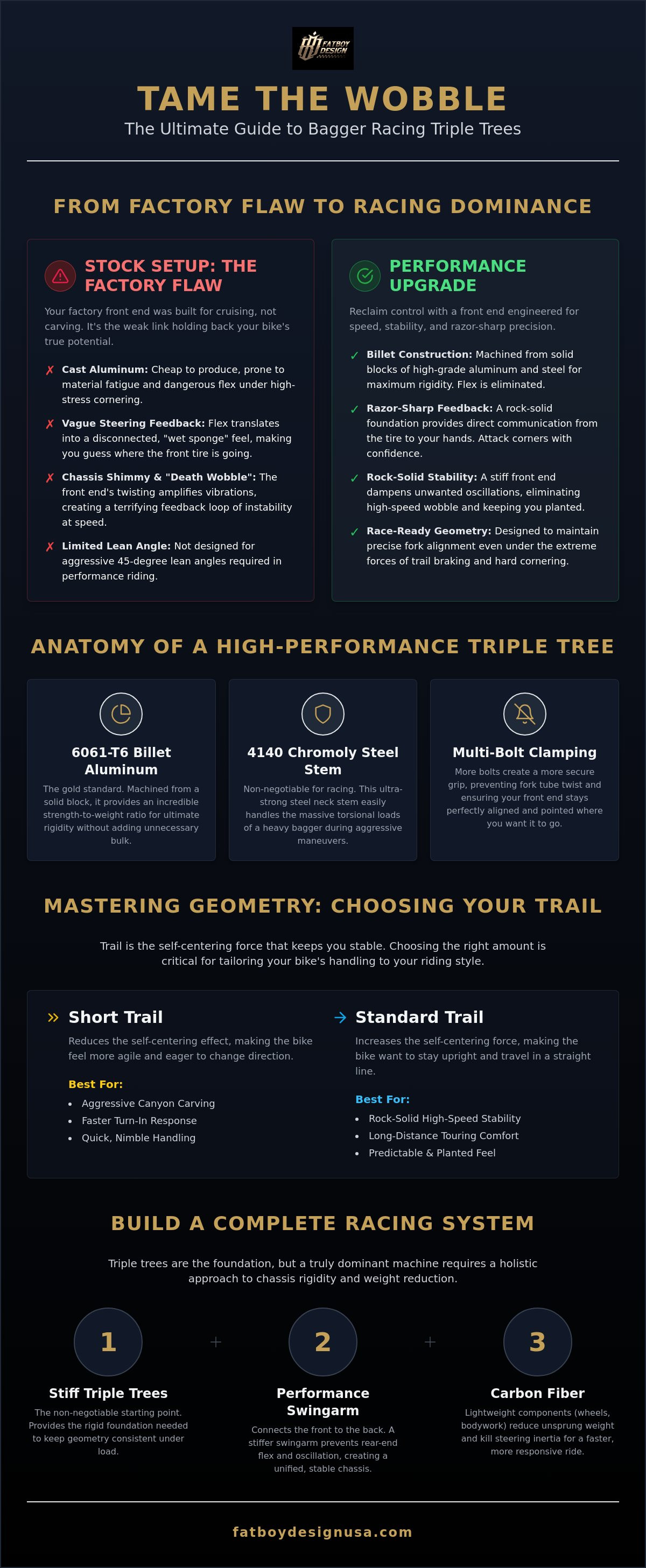
Your factory bagger was built for a leisurely Sunday cruise to the local diner, not for dragging floorboards at 100 mph. Stock trees are designed for straight-line stability and low-speed parking lot maneuvers. They aren't built for 45-degree lean angles. When you start pushing into a corner, that cast aluminum starts to flex. It is a physical limit you can't ignore. Material fatigue is real. Most OEM trees are made from cast aluminum. It's cheap to produce but lacks the structural integrity for high-performance riding. Under the stress of sticky racing tires, these components act more like a spring than a solid mount. You'll feel the front end "pushing" or washing out when you need precision most. This is where bagger racing triple trees become a necessity. When those front-end components twist, that energy doesn't just disappear. It travels through the frame, turning into a rear-end oscillation that feels like the bike is trying to shake you off. It's a feedback loop of pure terror.
The Physics of Trail and Stability
Let's talk about motorcycle steering geometry. Trail is the horizontal distance between where the steering axis hits the ground and the center of the front tire's contact patch. It's the self-centering force that keeps your bike upright. If you have too much trail, your bike feels like a heavy, unresponsive barge. It resists turning and feels sluggish when you're trying to hit an apex. You want agility without sacrificing that rock-solid feeling. Drivetrain-induced oscillation occurs when the engine's torque and rear-wheel energy overwhelm a flexible frame, sending a harmonic ripple through the chassis that the stock front end simply cannot dampen. By upgrading your setup, you reclaim control over these forces instead of letting them dictate your line.
The Death Wobble: A Chassis Crisis
The "Death Wobble" isn't just a scary name. It's a chassis crisis. Flexible stock trees amplify vibrations from your massive V-twin engine and the uneven road surface. This flex translates into vague steering feedback. You lose the "feel" for what the front tire is doing. High-performance bagger racing triple trees are the foundation of any serious "King of the Baggers" build. They provide the rigidity needed to handle the massive torque and weight of a performance bagger. Without them, you're just guessing where the bike is going. Precision starts at the neck. If your triple trees are twisting under load, your suspension can't do its job correctly. You're effectively riding a bike with a hinge in the middle. Grab some bagger racing parts that are built to handle the abuse. These trees ensure your forks stay parallel and your geometry remains consistent, even when you're trail-braking deep into a hairpin. Stop fighting your bike. Make it work for you.
Anatomy of a High-Performance Racing Triple Tree
Don't let your front end be the weak link in your build. If you're serious about speed, you need components that don't flinch when the pavement gets mean. High-performance bagger racing triple trees are built from billet 6061-T6 aluminum. This isn't just marketing fluff. It's the gold standard for a reason. Billet aluminum offers an incredible strength-to-weight ratio, giving you the rigidity you need without the bulk. You want a front end that feels like it's carved from a single block of granite. Pair that with a neck stem made from 4140 chromoly steel. This material is non-negotiable for racing. It handles the massive torsional loads of a heavy bagger without breaking a sweat. When you're diving into a corner, you need to know your steering stem isn't going to flex or fail. It's about peace of mind at triple-digit speeds.
Clamping power is another game-changer. Look for multi-bolt lower trees. More bolts mean a more secure grip on your forks. This prevents fork tube twist and keeps your front end pointed exactly where you want it. Precision machining is the secret sauce here. High-torque maneuvers can cause "bolt-hole wallowing" in inferior parts, leading to slop in your steering. Properly machined trees eliminate this entirely. While you're dialing in your setup, remember that there are legal specifications for motorcycle rake and trail that establish a baseline for safety. On the track, it's all about finding that perfect balance of geometry and grit. Check out our latest bagger racing parts to see what professional-grade hardware actually looks like.
Billet vs. Cast Construction
Cast parts are for lawnmowers. In the racing world, billet is king. Cast aluminum is porous and inconsistent. Billet has a dense, continuous grain structure that dampens vibrations instead of amplifying them. CNC precision ensures your fork holes are perfectly aligned every single time. This means zero stiction in your suspension travel. Plus, billet dissipates heat much faster than cast metal. This keeps your neck bearings at a happy temperature during long, aggressive sessions, extending their life and keeping your steering smooth as silk.
Hardware and Finish
Forget the hardware store specials. You need Grade 8 or stainless steel hardware to handle the vibration and stress of racing. We finish our trees with hard anodizing. It provides UV stability and a surface hardness that laughs at rock chips and road grime. Fat Boy Design USA uses precision-machined spacers for perfect wheel centering because a millimeter of misalignment is a mile of handling trouble on the track. Everything is designed to fit perfectly, look killer, and perform even better. It is time to upgrade your expectations.
Short Trail vs. Standard Trail: Choosing Your Weapon
Pick your poison. Your bike's personality is written in the geometry of your bagger racing triple trees. Standard Trail (5.7 inches plus) is the high-speed security blanket you want for long-haul stability. It keeps the front end tracking straight and true when the wind is howling. But let's be honest. You didn't come here to play it safe. You came here to win. Standard trail can feel sluggish when you're trying to hit an apex at speed. It is stable, sure, but it lacks the "snap" needed for competitive racing. It's the difference between a luxury sedan and a GT3 car.
Short Trail (5.1 to 5.4 inches) is the weapon of choice for the aggressive rider. It is all about maximum agility. This setup lets you dive into corners with minimal effort. But there is a trade-off. Agility demands muscle. A shorter trail means the bike is more sensitive to every input, including the ones you didn't mean to make. Even a 2-inch drop in ride height can drastically shift your geometry, sharpening the rake and shortening the trail further. It is a high-stakes game of physics where every tenth of an inch matters. You have to decide how much muscle you want to use to keep that beast on its line.
The Canyon Carver Setup
Short trail is the only way to make an 800-pound beast feel "flickable." It turns a heavy touring rig into a precision instrument that loves the twisties. Just remember that aggressive geometry can get nervous without the right support. You absolutely need to pair your trees with our Performance Steering Damper Kit to keep things civil. It is the insurance policy you need against unwanted headshake when you are pushing the limits of traction. Don't go into the canyons without it.
The Track Day Specialist
If you have graduated to inverted fork conversions like 50mm or 54mm setups, you are playing in the big leagues. Ride height isn't just about looks; it is a tuning tool that changes your effective rake on the fly. For a dedicated bagger racing setup, the ideal trail measurement usually lands between 5.2 and 5.5 inches to provide the perfect cocktail of lightning-fast turn-in and high-speed composure. This "goldilocks" zone allows you to trail-brake deep into corners without the front end feeling like it wants to tuck. This is where championships are made. Stop guessing and start tuning your bagger racing triple trees for the podium.
Installation & The Drivetrain Alignment Secret
Stop. Put the impact wrench down. Installing bagger racing triple trees isn't a "close enough is good enough" job. It is a surgical procedure for your chassis. First, support that fairing and neck properly. Don't let the weight of your front end stress the frame while you're working. You need to achieve what we call a "Neutral State" installation. This means ensuring zero pre-load on the neck bearings during the initial fitment. If you bind those bearings up before you even hit the road, you're inviting a high-speed tank slapper to the party. Precision is the only thing standing between you and a rock-solid ride. Keep your forks perfectly parallel and square. Even a fraction of a millimeter of twist will turn your high-end suspension into a glorified pogo stick. Torque sequences are your new religion. Over-tightening billet aluminum is a great way to ruin expensive parts. Under-tightening is a great way to meet a guardrail. Follow the specs. No excuses.
Laser Alignment vs. Manual Measurement
Don't guess where your wheels are pointing. You need to ensure the front wheel tracks perfectly with the rear. While manual measurements with strings and straight edges work for the old school, laser alignment is the gold standard for performance builders. Even a tiny misalignment in the drivetrain will cause your bagger to "dog-track" down the straightaway. This kills your stability and ruins your tires. Proper neck bearing preload is the secret to avoiding that terrifying oscillation at triple-digit speeds. You want the steering to be smooth but controlled. Grab a set of digital calipers and a quality torque wrench. These are the tools that separate the racers from the pretenders. Do it right the first time.
Post-Install Shake Down
The job isn't done just because the bike is off the lift. Check for cable bind and clearance at full lock. You don't want your throttle sticking or your brake lines stretching when you're maneuvering in the pits. After your first heat cycle, go back and re-torque every single bolt. Metal expands and settles. That "click" on the torque wrench after a ride is the sound of safety. Read our Performance Bagger Guide 2026 for more chassis tuning secrets that will keep your beast breathing fire. Ready to start your transformation? Head over to Fat Boy Design USA and grab the hardware that actually wins races. Your bike is waiting to be reborn.
The Racing System: Triple Trees, Swingarms, and Carbon
Your bike is a living system. It is not just a collection of random parts bolted to a frame. When you install high-performance bagger racing triple trees, you are finally giving your front end the backbone it deserves. But here is the catch. That newfound rigidity has to live somewhere. If your front end is rock-solid but your rear end is still acting like a wet noodle, you have just moved the problem down the line. You need a chassis that speaks the same language from the headlight to the taillight. This is the "System Approach" that separates the podium finishers from the parking lot posers. Don't treat your front end like an island. Give it the support it needs to shine, which is why we recommend pairing your setup with elite components from Suspension Store for total control.
Unsprung weight is the hidden enemy of front-end performance. Every ounce you shave off the components that move with the wheel allows your suspension to react faster to the road. It's about reducing steering inertia. That is why we recommend swapping your heavy plastic for Carbon Fiber Front Fenders. It makes the bars feel lighter. It makes the bike respond to your thoughts instead of your muscles. The Fat Boy Design philosophy is simple. Build it light. Build it stiff. Win races. We have spent over 13 years testing these theories on the track so you don't have to guess. We do the math. You get the glory.
The Swingarm Pivot Connection
Stiffening your front end with bagger racing triple trees puts more stress on your swingarm pivot. It's basic physics. If the front doesn't flex, the energy travels through the frame and looks for the next weakest point. You shouldn't upgrade your trees without considering the other half of the equation. A Bagger Racing Swingarm is the perfect partner for a rigid front end. It ensures the rear wheel follows the line you set without that dreaded mid-corner wallow. The synergy of billet alloys and carbon fiber creates a weight balance that feels like cheating. It turns an 800-pound beast into a surgical instrument.
Final Call to Action: Join the Club
Reject the mundane. Stop settling for a motorcycle that feels like a compromise. Embrace the art of high-speed lounging and give your bike the aesthetics to match its adrenaline. Fat Boy Design is the home for riders who refuse to take life slow. We build racer-tested parts in-house in Matthews, NC, because we care about the precision that keeps you on two wheels. You are not just buying parts. You are joining a club where the only rule is to stop taking life so seriously. Shop Bagger Racing Components at Fat Boy Design USA and start dominating the asphalt. Your bike is ready for its transformation. Are you?
Own the Asphalt with Precision Geometry
Stop wrestling your bike through every sweeper. You now know that geometry isn't just for textbooks; it's the difference between a high-speed wobble and a podium finish. By upgrading to bagger racing triple trees, you are choosing rigidity over factory flex. You are choosing a front end that actually talks to you. Remember that a true racing machine is a system. Pair those trees with a stiff swingarm and lightweight carbon fiber to keep the unsprung weight low and the adrenaline high. Don't let your chassis dictate your fear level anymore.
At Fat Boy Design USA, we don't just sell parts; we build the hardware that dominates the track. With 13+ years of professional racing expertise and in-house manufacturing in Matthews, NC, our billet components are used by top competitors who refuse to settle for second place. Every piece is racer-tested in real-world conditions to ensure you get the rock-solid stability you deserve. It is time to stop taking life so seriously and start taking your corners with total confidence. Upgrade Your Bagger with Racer-Tested Triple Trees today. Your bike is ready to stop cruising and start carving.
Frequently Asked Questions
Will racing triple trees increase vibration in my handlebars?
Actually, high-quality billet aluminum often reduces unwanted buzz compared to porous cast parts. While the front end feels stiffer and more connected to the road, the dense grain structure of the 6061-T6 alloy absorbs high-frequency harmonics better than the stock setup. You get crystal-clear feedback from the front tire without the numbing hand tingle. It is about precision, not punishment.
Can I use my stock 49mm forks with racing triple trees?
Yes, most performance setups are designed to be a direct bolt-on for your factory 49mm fork tubes. You don't always need an expensive inverted fork conversion to feel a massive difference in handling. Upgrading to bagger racing triple trees while keeping your stock forks is a smart way to fix your geometry without emptying your entire bank account in one go.
What is the "death wobble" and can triple trees fix it?
The death wobble is a terrifying chassis oscillation that usually starts at the neck and ripples through the entire bike. While it is often caused by a combination of factors, flexible stock trees are a major culprit. Stiffening the front end with a racing-grade setup provides the structural integrity needed to resist these vibrations. It is the most effective foundation for killing the wobble for good.
Is a 2-inch drop triple tree safe for daily street riding?
It is perfectly safe as long as you account for the reduced ground clearance in deep leans. Dropping the front end lowers your center of gravity and sharpens your steering response, which is a blast on twisty backroads. Just be mindful of speed bumps and steep driveways. You are trading a bit of comfort for a bike that finally handles like it is on rails.
Do I need to modify my fairing to install performance triple trees?
Most of our performance trees are designed to fit under your stock fairing without any major surgery. You might need to do some minor cable rerouting or very light trimming on certain custom setups, but we aim for a "bolt-on and go" experience. Always check for full-lock clearance during the install to ensure your bars don't smack your expensive plastic when you're maneuvering in the driveway.
What is the best trail measurement for a Road Glide racing build?
For a dedicated Road Glide racer, you want to land in the 5.2 to 5.5-inch trail range. This is the "sweet spot" that provides lightning-fast turn-in response without making the bike feel nervous at triple-digit speeds. It gives you the agility to dive into corners while maintaining enough self-centering force to keep the bike tracking true on the long straights.
How often should I inspect my neck bearings after installing racing trees?
If you are pushing your bike hard on the track or in the canyons, inspect your neck bearings every 2,500 to 5,000 miles. Racing puts significantly more stress on your steering head than a casual cruise. Check for any notchiness or play in the movement. Keeping these bearings clean and properly preloaded is the secret to maintaining that razor-sharp steering feel you just paid for.
Why are billet triple trees better than the stock cast versions?
Billet is king because it is carved from a solid block, ensuring perfect alignment and zero internal voids. Stock cast trees are made by pouring molten metal into a mold, which can leave them porous and prone to flexing under load. Our bagger racing triple trees provide the rigidity needed to keep your forks parallel, which eliminates stiction and allows your suspension to actually do its job.