

Bagger Racing Triple Trees: Precision Geometry for Your Harley Beast
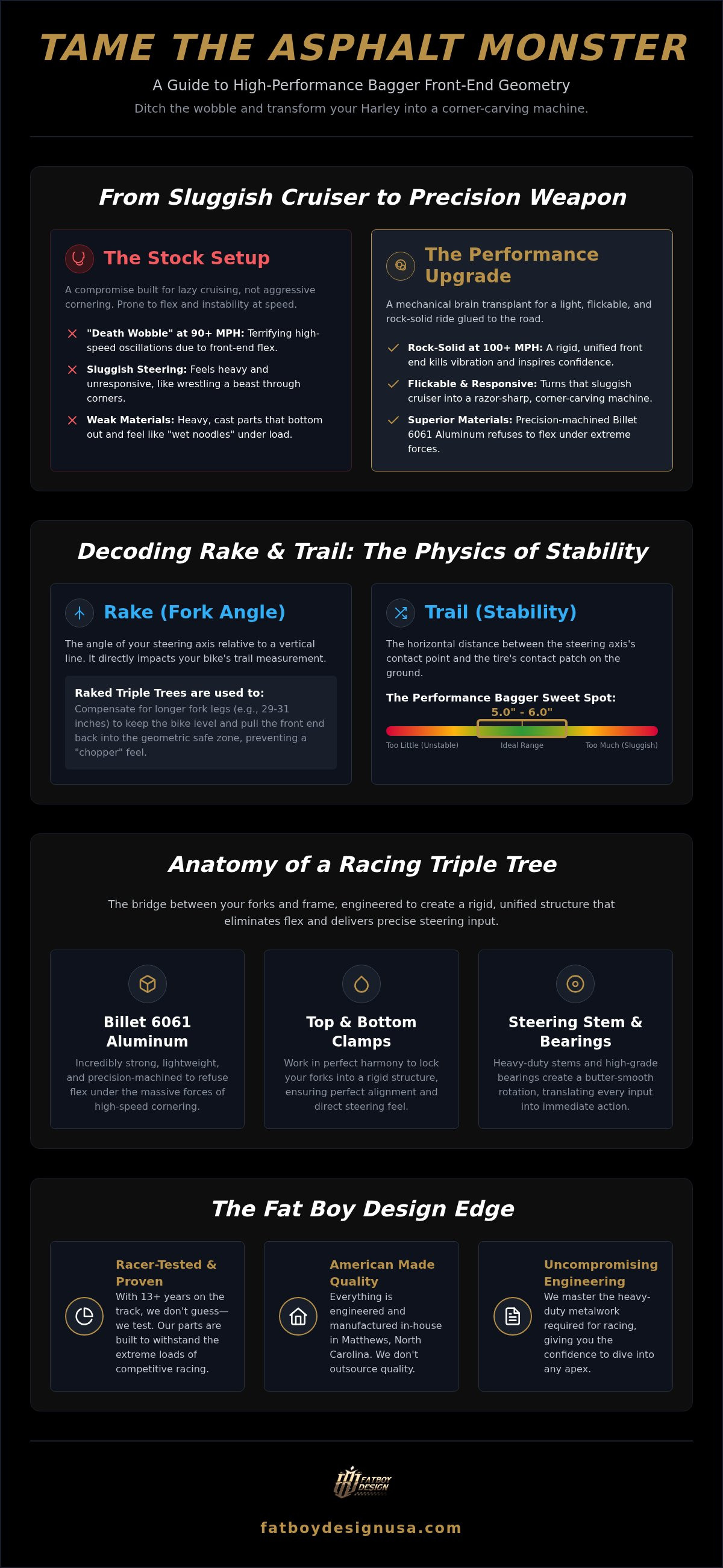
Stop treating your Harley like a parade float and start riding it like the asphalt-eating monster it was born to be. If you’ve ever hit 90 MPH only to feel the dreaded death wobble start its rhythmic dance of doom, you know the terror. Stock front ends are great for lazy Sunday cruises, but they bottom out and feel like wet noodles the second you actually try to race. Upgrading to high-performance bagger racing triple trees isn't just a shiny flex; it's the mechanical brain transplant your bike needs to handle like a precision-guided missile.
We know you’re tired of wrestling a heavy beast through every corner. You want a bike that feels light, flickable, and totally glued to the road when you’re leaning it over. This guide breaks down the physics of front-end stability and explains why the right geometry is your ticket to a rock-solid ride at 100+ MPH. We’re covering everything from trail numbers to the racer-tested engineering we build in our Matthews, North Carolina facility. Get ready to ditch the sluggish steering and turn your bagger into a corner-carving machine.
Key Takeaways
- Ditch the "death wobble" for good by understanding how your front-end geometry dictates every move your Harley makes at high speeds.
- Master the dark arts of rake and trail to turn that sluggish, heavy steering into a light and flickable racing experience.
- Learn why precision-engineered bagger racing triple trees are the secret sauce for keeping your bike stable while leaning deep into the corners.
- Compare the classic 49mm evolution with the high-performance inverted fork revolution to find the perfect setup for your personal beast.
- Get the inside track on why racer-tested hardware manufactured right in Matthews, NC beats generic, outsourced parts every single time.
The Brains of the Front End: What Are Bagger Racing Triple Trees?
Your front end is the command center of your motorcycle. If it feels sloppy, you aren't riding; you're just a passenger on a vibrating couch. Triple trees, or yokes for the enthusiasts, are the literal bridge between your forks and the frame. They set the stage for your motorcycle steering geometry. Stock trees are designed for slow-rolling through town with a passenger and two weeks of laundry in the bags. They’re heavy. They’re cast. They’re boring. High-performance bagger racing triple trees are the exact opposite. They turn that sluggish cruiser into a razor-sharp weapon designed for the track.
Anatomy of a Racing Triple Tree
We start with Billet 6061 aluminum. It’s light. It’s incredibly strong. It’s the industry standard for a reason. These aren’t just clamps; they’re precision-machined works of art that refuse to flex. You have the top clamp and the bottom clamp working in perfect harmony to keep your forks aligned. Don't get distracted by the "Wolf One" hype; focus on the engineering. We use heavy-duty steering stems and high-grade bearings to ensure every rotation is butter-smooth. It’s about creating a rigid connection that stands up to the massive forces of high-speed cornering.
Why Your Stock Harley Setup is Holding You Back
Your factory setup is a compromise. It’s built for straight-line stability at 65 MPH while carrying a cooler. When you start throwing serious power at a corner, those cast parts start to flex. That flex turns into vibration, and that vibration eventually turns into the dreaded "death wobble." It’s terrifying. It’s also avoidable. Our bagger racing parts are designed to handle the extreme loads of competitive racing without flinching. High-performance racing trees lock your front end into a rigid, unified structure that kills the 'bagger wobble' once and for all.
At Fat Boy Design USA, we’ve spent 13+ years on the track. We build everything in-house in Matthews, North Carolina. We don't outsource quality to the lowest bidder. We don't guess. We test. We’re the Kings of Carbon Fiber, but we master the heavy-duty metalwork required for racing too. We build components that give you the confidence to dive into an apex without a second thought. Stop settling for mundane stock performance and join the club where speed is the only rule. It’s time to upgrade your beast.
Decoding Trail and Rake: The Physics of Cornering
Geometry isn't just for high school nerds. It's the literal difference between a bike that carves and a bike that fights you. Let's talk trail. This is the horizontal distance between where your steering axis hits the ground and where your tire actually touches the asphalt. Think of it like a shopping cart wheel. Too much trail and your bike feels like it's stuck in wet concrete. Too little? You're one pebble away from a terrifying tank slapper. High-quality bagger racing triple trees are the precision knobs we turn to get this distance exactly right.
Rake and trail are a package deal. You can't mess with one without annoying the other. If you increase the rake angle of the forks, your trail grows. If you throw on a 21 inch wheel, everything shifts. Most racers prefer a 19 inch setup for that snappy, responsive feel. We're chasing that "Short Trail" secret. It gives you faster turn-ins. It makes the bike feel light. But we do it without sacrificing high-speed stability. It’s a dark art. We’ve mastered it.
The Sweet Spot for Performance Baggers
For a bike that actually wants to turn, the magic zone is typically between 5.0 and 6.0 inches of trail. Stock Harleys often push way past this. They prioritize lazy cruising. We prioritize the apex. If you're running inverted forks like Ohlins or a GSXR swap, your tree requirements change instantly. We design for neutral steering. This means the bike goes exactly where you look. No mid-corner corrections. No wrestling the bars. Just pure, unadulterated flow. Check out our bagger racing parts to see how we dial this in.
Rake Adjustments: To Rake or Not to Rake?
Choosing between 0-degree and raked trees depends on your fork length. If you're running longer 29 to 31 inch fork legs to get that tall bike clearance, you need to compensate. You want to keep the bike level. A raked tree can help pull the front end back into the geometric safe zone. It prevents the bike from feeling like a chopper when you're trying to race. For a deep dive into the ultimate setup, read our Performance Bagger Guide 2026. Stop guessing. Start winning. It's time to build a beast that actually handles.
Inverted Forks vs. 49mm Tubes: Choosing Your Setup
Choosing your front-end setup is like picking your fighter in a high-stakes game. Do you go for the stealthy sleeper look or the full-blown, track-shredding monster? Either way, your bagger racing triple trees are the foundation. They hold everything together when you're pushing the limits of physics. You need a setup that doesn't just look the part but actually survives the violence of a high-speed corner. We've seen riders try to mix and match cheap parts; it never ends well.
The 49mm setup is the evolution of the classic Harley look. It’s for the rider who wants to keep the silhouette familiar but the performance alien. You take those stock tubes, gut the mushy internals, and replace them with high-end racing cartridges. It’s effective. It’s clean. But because you’re still using a traditional fork design, you need trees that can handle the increased rigidity of those new internals. Without beefy clamps, those 49mm tubes will still twist like a pretzel when you're hard on the binders.
Then there’s the Inverted Revolution. This is the absolute gold standard for anyone serious about the podium. We're talking 50mm top and 55mm bottom setups using Ohlins or GSXR-style legs. Why? Stiffness. Traditional forks have the smallest part of the tube at the triple tree, which is the point of highest stress. Inverted forks flip the script. They put the massive, beefy outer tube in the clamps. This virtually eliminates fork flex. However, that extra stiffness means your bagger racing triple trees have to be engineered with even more precision to prevent the frame from feeling the strain.
The 49mm 'Sleeper' Build
This is all about maximizing what you already have. You keep the 49mm tubes but drop in high-performance racing cartridges for actual damping control. Often, a 2-inch drop is the move here. It gives you that aggressive, nose-down racing stance that looks mean and handles even better. To keep that front end from getting twitchy at triple-digit speeds, you absolutely need a Harley Touring Performance Steering Damper Kit. It’s the ultimate insurance policy for your front-end geometry.
Going Full Race: The Inverted Setup
When you step up to 50-55mm legs, clamping force is everything. You can't just squeeze them; you have to secure them with precision-machined authority. At Fat Boy Design USA, we’re the King of Carbon Fiber, so we know how to balance metal strength with lightweight performance. We build our trees to ensure your stock wheels and brakes still play nice with the new racing hardware. While a 49mm build is a massive step up from stock, an inverted setup offers a turn-in speed that makes a heavy bagger feel like a middleweight sportbike in the tight stuff.
Installation and Setup: Getting the Geometry Right
You’ve spent the cash. You’ve got the parts. Now, don’t be the guy who ruins a masterpiece with a "close enough" attitude. Installing bagger racing triple trees isn't like slapping on a new seat or a set of grips. This is mechanical surgery. If you eye-ball your front-end alignment, you aren't just being lazy; you're being dangerous. Precision geometry requires precision installation. One millimeter of misalignment can turn your dream build into a high-speed nightmare that pulls to the left and shakes like a leaf.
Setting your sag and ride height is the final step in the geometry puzzle. This is where you finalize your trail numbers. If the front sits too high, your bike will feel stable but turn like a freight train. If it’s too low, it’ll be twitchy and nervous. You want that sweet spot where the bike feels balanced and neutral. This is also where the steering damper comes into play. Think of it as your safety net. It’s there to catch any micro-oscillations before they turn into a full-blown wobble. It’s the ultimate insurance policy for your front end.
Step-by-Step Front-End Alignment
- Align the forks: Slide your tubes into the clamps and ensure they are perfectly parallel. Use a precision alignment tool or a glass plate to verify they aren't twisted.
- Torque the pinch bolts: Grab your torque wrench. Don't guess. Billet 6061 aluminum behaves differently than factory cast iron. Follow the FBD specs religiously to avoid crushing your fork tubes.
- Check fall-away: This is all about bearing preload. Your front end should move smoothly without binding or feeling "notchy," but it shouldn't be loose enough to rattle.
- The tracking test: Once everything is tight, take it to a closed course. The bike should track straight as an arrow without you fighting the bars.
Common Installation Pitfalls to Avoid
The biggest mistake is over-tightening the steering stem top nut. If you crush those bearings, your steering will bind, and you'll be wrestling the bike through every turn. Then there’s the "bagger struggle" with cable routing. With all the fairing wires and brake lines, it’s easy to create a pinch point. Ensure everything moves freely from lock to lock. Finally, re-check your torque after the first 100 miles of spirited riding. Parts settle, and metals expand. Don't skip this. If you want the ultimate rock-solid feel, upgrade to our performance steering damper kit and ride with total authority.
The Fat Boy Design Edge: Racer-Tested in Matthews, NC
We aren't just some corporate office hiding behind a polished website. We’re in Matthews, North Carolina, and we’ve got grease under our fingernails. For over 13 years, we’ve been professional racers, testing every component until it either wins or breaks. When you bolt on our bagger racing triple trees, you aren't just getting a part; you're getting a decade of track-proven dominance. We manufacture everything in-house because we’re control freaks. We don't outsource our quality to the lowest bidder. We build it here, we test it here, and we stand by it on the track.
The real magic happens through synergy. Your front end is a delicate ecosystem of weight and geometry. While our trees provide the rigid, unyielding foundation, they reach their full potential when paired with our Performance Bagger Racer Carbon Fiber Front Fender. By ditching the heavy factory steel for lightweight carbon fiber, you slash unsprung weight. This lets your new triple tree geometry react faster and feel even lighter. It’s the ultimate combination of metal authority and carbon agility that competitors simply don't talk about.
Precision Machining with a Rebel Heart
Our Matthews facility is where we put our gear through hell. We test for flex and stress under conditions that would make stock parts crumble. We use precision machining to ensure every tolerance is exact, but we do it with a rebel heart. We believe parts should look as mean as they perform. You’re building a beast, not a minivan. Our hardware features a bold, aggressive aesthetic that demands attention in the staging lanes. Dive into our Bagger Racing Parts Collection to see how we blend high-end performance with pure visual dominance.
Join the FBD Racing Family
We champion the art of the performance bagger while respecting the soul of vintage choppers. It’s about merging the best of both worlds. Our team supports riders from the professional circuit to the local canyon carvers. We provide racer-tested parts for real-world riders who refuse to compromise on quality or affordability. Stop fighting your bike. Fix your front end and join a club where leisure is a virtue and speed is a requirement. Ready to transform your ride? Shop FBD Bagger Racing Parts now and experience the difference of American-made precision.
Master the Apex and Own the Road
Stop letting your front end dictate your limits. You now know how rake and trail turn a wobbly boat into a precision-guided missile. Whether you’re sticking with the classic 49mm evolution or going full-race with an inverted setup, the goal is the same: rock-solid stability. We don't just guess at geometry; we build it with authority. Our bagger racing triple trees are born from 13+ years of pro racing experience and manufactured right in Matthews, North Carolina. We’ve done the brutal testing for flex and stress so you don’t have to. It's time to ditch the "death wobble" and start carving corners with total confidence. Your Harley was built to be a beast. Stop holding it back with lazy factory parts. Join the FBD family and feel what real stability at 100+ MPH actually looks like. Grab your gear and get ready to shred.
Unleash your beast with Fat Boy Design Bagger Racing Parts
Frequently Asked Questions
What exactly do triple trees do on a Harley Bagger?
Triple trees act as the literal backbone of your front end. They clamp your fork tubes together and pivot on the frame's neck, translating your handlebar input into actual movement. These components dictate your rake and trail, which are the secret ingredients for how your bike handles. Think of them as the command center that decides if your Harley feels like a nimble racer or a lazy cruise ship.
Will racing triple trees fix the high-speed 'bagger wobble'?
Yes, high-performance bagger racing triple trees are specifically engineered to kill that terrifying wobble. Stock trees are often cast and prone to flexing under heavy loads, which triggers those high-speed shakes. By upgrading to rigid, billet aluminum trees, you eliminate that flex. This creates a rock-solid connection between your forks and frame, keeping your front wheel tracking straight as an arrow even at triple-digit speeds.
Do I need to change my forks to use racing triple trees?
Not necessarily, but it depends on your performance goals. You can find trees designed to fit your stock 49mm tubes if you just want to improve geometry and rigidity. However, if you're chasing podium finishes, you might want to swap to beefier 50mm or 55mm inverted forks. We build trees for both setups, so you can choose the level of "beast mode" that fits your specific build style.
What is the difference between 0-degree and raked triple trees?
It’s all about the angle of the fork tubes relative to the steering stem. A 0-degree tree keeps the forks parallel to the stem, which is standard for most performance builds. Raked trees actually tilt the forks outward. While raked trees are often used for big wheels, racers use them strategically to balance trail numbers when running extra-long fork legs. It’s a precision tool for leveling out your ride.
How does changing the triple trees affect my bike's trail?
Triple trees are the primary way you manipulate trail without cutting your frame. By changing the offset or the rake in the trees, you move the tire's contact patch forward or backward. This adjustment is critical because it determines how much self-centering force your steering has. The right trees let you find that sweet spot between effortless, flickable turn-ins and high-speed stability that feels like it is on rails.
Can I install bagger racing triple trees myself, or do I need a pro?
If you are a confident wrench-turner with a proper torque wrench and an alignment tool, you can tackle this. It’s a major mechanical job that involves stripping the front end, fairing, and controls. Precision is everything here. If you aren't comfortable checking bearing preload or verifying fork parallelism, don't risk it. A professional shop can ensure your geometry is perfect, so you don't end up with a crooked ride.
Are billet aluminum triple trees stronger than the stock Harley cast trees?
Absolutely, billet 6061 aluminum is vastly superior to factory cast iron in terms of strength-to-weight ratio. Cast parts are made by pouring molten metal into a mold, which can leave tiny air pockets and weak spots. Billet is carved from a single, solid block of high-grade aluminum. This makes our bagger racing triple trees incredibly rigid and resistant to the twisting forces that make stock front ends feel mushy.
How do I know if my bagger needs a 'short trail' setup?
You need a short trail setup if your bike feels like a freight train that refuses to turn. If you are wrestling the bars through every canyon corner or track apex, your trail is likely too long. A shorter trail reduces the effort needed to lean the bike over, making it feel lighter and more responsive. It’s the secret to making a 600-pound racing machine dance through the tight stuff without breaking a sweat.