

Bagger Racing Triple Trees: Precision Geometry for Your Harley Beast
Your 800-pound Harley doesn't have to handle like a soggy mattress in a hurricane. It's a total myth that heavy bikes are destined to be sluggish, bottom-heavy boats. You've felt that terrifying "death wobble" at triple-digit speeds, and you've fought that heavy, stubborn steering in tight hairpins. We agree that wrestling a beast shouldn't be the price of admission for high-speed thrills. Upgrading to high-performance bagger racing triple trees is the single biggest move you can make to reclaim control and stop the front-end flex that kills your confidence.
You're about to master the physics of front-end stability and discover why precision geometry is the secret to turning your touring rig into a corner-carving racing machine. We're stripping away the mystery of trail numbers and billet aluminum to give you rock-solid stability and light, flickable steering. We'll dive into the racer-tested tech that eliminates bottoming out and gives you the confidence to lean deep into every canyon turn. It's time to stop taking life so seriously and start treating the track like your personal playground. Get ready to transform your ride into a precision-guided missile.
Key Takeaways
- Master the physics of rake and trail to transform your heavy touring rig into a precision-guided cornering machine.
- Stop the "death wobble" in its tracks by upgrading to high-performance bagger racing triple trees designed for rock-solid stability.
- Compare modern 49mm internals against the inverted fork revolution to choose the gold standard for your front-end geometry.
- Learn why exact torque specs and professional-grade installation are non-negotiable for keeping your forks healthy and your steering sharp.
- Get the inside scoop on racer-tested components manufactured in-house to bridge the gap between vintage style and track performance.
The Brains of the Front End: What Are Bagger Racing Triple Trees?
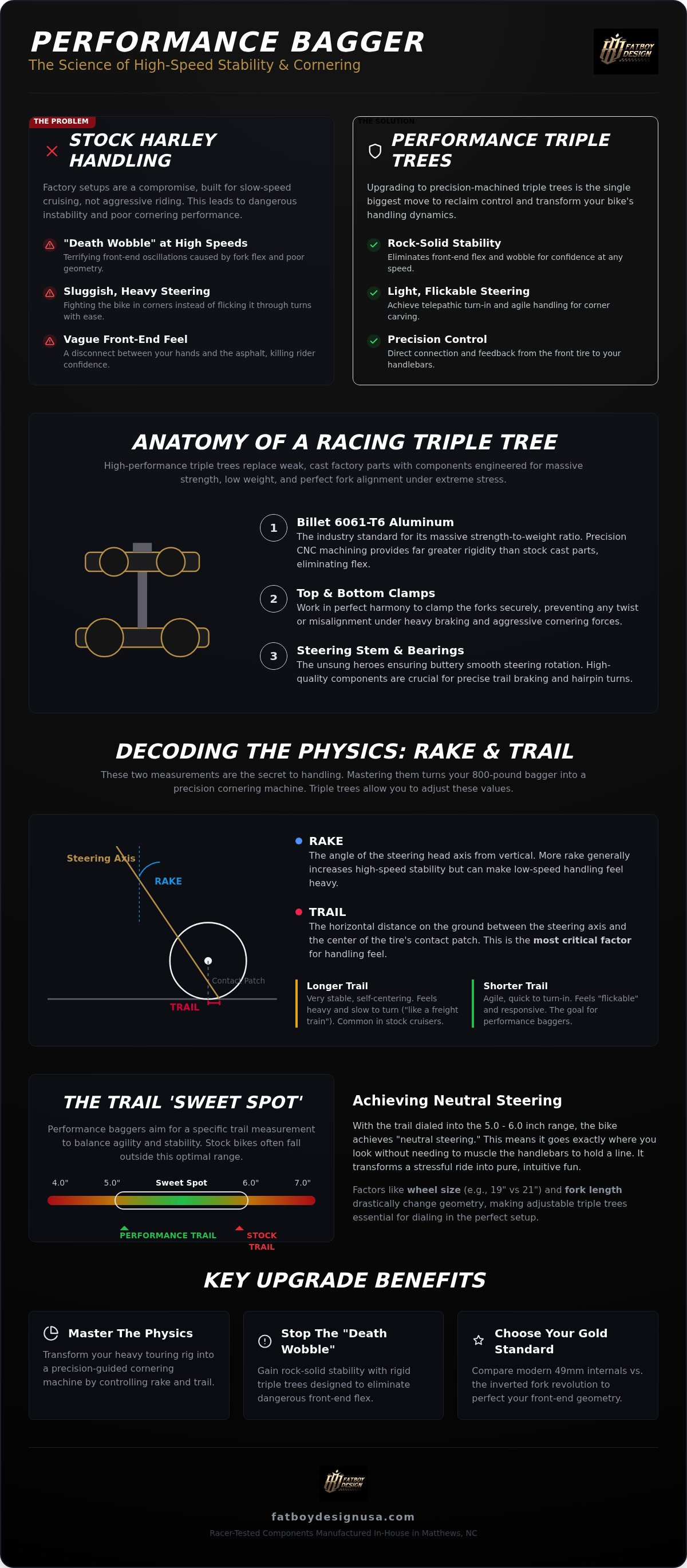
Triple trees are the yokes that hold your forks in place and tell your front wheel exactly where to go. Think of them as the neurological center of your bike's front end. If your stock trees are the "brains," they're currently set to "nap mode." Factory setups are engineered for heavy luggage and slow-speed stability. That's fine for a cross-country tour with the cruise control on; it's a total disaster for the track. High-performance bagger racing triple trees replace that cast-iron sluggishness with precision-machined billet aluminum. This shift isn't just about shedding weight. It's about changing the fundamental motorcycle geometry to favor aggressive agility over lazy straight-line cruising.
We don't just build parts at Fat Boy Design USA; we build the confidence you need to hunt down the apex. Born from 13+ years of track experience, our components bridge the gap between vintage Harley style and modern racing performance. We reject the mundane and embrace the whimsy of high-speed lean angles. When you swap out those factory clamps, you're joining a club where the only rule is to stop taking life so seriously and start riding faster.
Anatomy of a Racing Triple Tree
Billet 6061-T6 aluminum is the industry standard for a reason. It offers a massive strength-to-weight ratio that cast parts simply can't touch. While some riders obsess over specific brand styles, the real magic happens in the relationship between the top and bottom clamps. These components must work in perfect harmony to prevent fork twist under heavy braking. Don't forget the steering stems and bearings. These are the unsung heroes that ensure your rotation stays buttery smooth when you're trail braking into a hair-raising hairpin. We manufacture these bagger racing parts in-house in Matthews, NC. We don't outsource our quality to the lowest bidder because your safety at 100 MPH isn't a side hustle.
Why Your Stock Harley Setup is Holding You Back
Your stock Harley is a victim of the "Touring" compromise. It was built to haul chrome and leather in a straight line for five hundred miles. Under racing loads, those factory cast parts flex like a pool noodle. This flex leads to vibration, vague steering, and that sickening feeling of disconnect between your hands and the asphalt. High-performance racing trees eliminate the 'bagger wobble' once and for all by providing the structural rigidity needed to keep your front tire locked onto its intended path.
Decoding Trail and Rake: The Physics of Cornering
Physics doesn't have to be a snooze fest. When you're leaning an 800-pound beast into a hairpin, math is your best friend. Trail is the horizontal distance between where your steering axis hits the ground and your tire's actual contact patch. Think of it like a shopping cart wheel. Long trail makes the bike stable but makes it feel like you're steering a freight train. Short trail makes it flickable. High-quality bagger racing triple trees allow you to manipulate these numbers to find the "short trail" secret. Racers crave that immediate, telepathic turn-in without sacrificing rock-solid stability at 120 MPH.
Your wheel size and ride height are the biggest variables in this equation. Moving from a 19-inch to a 21-inch wheel changes your geometry instantly. It raises the front, kicks out the rake, and stretches your trail. If you don't compensate with the right offset in your triple trees, your bike will feel heavy and reluctant. It's about finding that perfect balance where the bike stops fighting you and starts working with you. Getting the math right is easier when you're starting with performance bagger parts designed by actual racers who live for the apex.
The 'Sweet Spot' for Performance Baggers
The magic zone for most performance builds lives between 5.0 and 6.0 inches of trail. Stock setups often wander outside this range, prioritizing "safety" over "shredding." When you level up to inverted forks like Ohlins or GSXR-style 50/54mm setups, your tree requirements shift. We design our components for "neutral steering." This means the bike goes exactly where you look. You won't have to "muscle" the bars to keep it on line. It's a total vibe shift that turns a stressful ride into pure, unadulterated fun.
Rake Adjustments: To Rake or Not to Rake?
Does your Road Glide need 0-degree or raked trees? It's all about your fork length. If you're running longer 29-inch to 31-inch fork legs to gain that sweet ground clearance, you have to keep the bike level. A nose-high bagger handles like a pig. Choosing the right bagger racing triple trees can help pull that front end back into alignment. This keeps your trail numbers in the sweet spot while you gain the travel you need for the track. For a deep dive into balancing your setup, check out our Performance Bagger Guide 2026. It's the ultimate roadmap for building a beast that actually breathes fire.
Inverted Forks vs. 49mm Tubes: Choosing Your Setup
Choosing your front-end setup is like picking your favorite flavor of high-speed chaos. You've got two main paths: the classic 49mm evolution or the full-blown inverted revolution. Both require specialized bagger racing triple trees to actually perform, but they offer very different vibes on the tarmac. The 49mm setup is the "sleeper" choice. It keeps that iconic Harley silhouette while hiding modern, track-ready internals. It's subtle. It's cool. It's for the rider who wants to surprise sportbikes without looking like they're trying too hard.
The inverted revolution is a different beast altogether. When you step up to 50/55mm legs from Ohlins or GSXR donors, you're entering the gold standard of racing. These forks are inherently stiffer because the thickest part of the tube is clamped in the trees. This massive increase in rigidity means your trees need to be beefier to handle the stress. If your trees aren't up to the task, the whole front end will twist like a wet noodle under heavy braking. You also need to ensure your stock wheels and brakes play nice with the new geometry. It's a puzzle, but the reward is a front end that feels like it's on rails.
The 49mm 'Sleeper' Build
You don't have to toss your stock tubes to get track-day performance. Upgrading your 49mm tubes with high-end cartridges is a massive win for your handling. When you pair these internals with racing trees, you gain the stiffness you've been craving. Many racers opt for a 2-inch drop to achieve that aggressive, nose-down racing stance. This lower center of gravity helps you flick the bike into corners with way less effort. To keep everything under control at high speeds, you'll definitely want to bolt on a Harley Touring Performance Steering Damper Kit. It's the ultimate insurance policy against the shakes.
Going Full Race: The Inverted Setup
If you're chasing podiums, an inverted setup is the only way to fly. These custom trees for 50-55mm legs are all about clamping force. We're the "King of Carbon Fiber," so we know that every ounce of metal strength must be matched with carbon lightness to create a balanced machine. Our bagger racing triple trees are engineered in-house to survive the extreme loads of professional racing. The turn-in speed of an inverted setup is so lightning-fast it makes traditional 49mm tubes feel like they are wading through a bucket of molasses. It's a transformative upgrade that turns your heavy bagger into a precision instrument.
Installation and Setup: Getting the Geometry Right
Precision is the only thing standing between you and a high-speed wobble. Don't turn your build into a clown show by 'eye-balling' the alignment. When you install your bagger racing triple trees, you are setting the stage for every corner you'll ever hit. This isn't just about bolting parts together. It's about creating a perfectly parallel foundation for your forks. If your tubes are even a fraction of a millimeter out of sync, your steering will feel vague and unpredictable. You've spent the money on high-performance parts; don't ruin the experience with a lazy setup.
Torque is your new religion. Pinch bolts are sensitive. Over-tightening them can actually crush your fork tubes or cause the internals to bind. We provide specific torque specs for our FBD components because they often differ from the generic OEM numbers found in your service manual. Follow them to the letter. Once the hardware is tight, you need to set your 'sag' and ride height. This is the final adjustment that dictates your actual trail numbers while the bike is under load. A bike that sits too low in the rear will kick the front out and ruin your turn-in speed.
Finalize the build with a high-quality steering stabilizer. Even with the best geometry, a heavy bagger needs an extra layer of protection against road imperfections at 100+ MPH. It acts as the final filter for your front end, soaking up the chatter so you can focus on the next apex. Dial in your front-end stability with a Harley Touring Performance Steering Damper Kit to ensure your ride stays as smooth as it is fast.
Step-by-Step Front-End Alignment
- Align the forks: Slide the tubes into the clamps and ensure they are perfectly parallel before tightening anything.
- Torque the pinch bolts: Use a calibrated torque wrench to hit the exact FBD or manufacturer specs.
- Check 'fall-away': Adjust your bearing preload until the front end swings smoothly without any notchiness or play.
- The tracking test: On a closed course, ensure the bike tracks straight and true without pulling to either side.
Common Installation Pitfalls to Avoid
Over-tightening the top nut is a classic rookie move. This binds your steering bearings and makes the bike feel like it's fighting you in every turn. Then there's the 'bagger struggle' of cable routing. Racing trees are often beefier than stock, meaning you have to be creative with your wiring harness to prevent binding at full lock. Always re-check your torque after the first 100 miles of spirited riding. Parts settle, and a quick double-check ensures your beast stays rock-solid on the road.
The Fat Boy Design Edge: Racer-Tested in Matthews, NC
We didn't just wake up one day and decide to make parts. We've been sweating on the grid for over 13 years. That's the FBD difference. Our bagger racing triple trees aren't just shiny pieces of metal; they are the result of thousands of laps and a healthy dose of rebellion. Everything we sell is manufactured in-house in Matthews, North Carolina. We don't do the whole 'lowest bidder' thing. If it's on your bike, it was cut, polished, and tested by our own hands. We prioritize leisure and speed in equal measure, ensuring your build is as fun to ride as it is to look at. It's an invitation to reject the mundane and join a club where the only rule is to go faster.
Let's talk synergy. We are the 'King of Carbon Fiber' for a reason, but we master the heavy-duty metalwork too. When you pair our rigid billet work with our Carbon Fiber Front Fenders, you're creating a front end that is both incredibly light and impossibly strong. It's about shedding every possible ounce of unsprung weight while keeping the geometry locked in. This is how you win. When you're shopping for bagger racing triple trees, you need to know they can survive extreme conditions. We offer racer-tested parts for real-world riders who refuse to settle for boring, sluggish factory standards. Turn your touring rig into a precision-guided racing missile and feel the difference in every turn.
Precision Machining with a Rebel Heart
Our facility in Matthews isn't just a warehouse. It's a laboratory of speed where we strip away the pretension and focus on pure performance. We push every design to its absolute limit to ensure it never fails you at the apex. We test for flex and stress until we're 100 percent satisfied with the results. The outcome? Parts that look as mean as they perform. The FBD aesthetic is bold, rhythmic, and unapologetically loud. It creates a physical presence that dominates the track. Check out the full Bagger Racing Parts Collection to see what happens when precision machining meets a rebel heart.
Join the FBD Racing Family
We live for performance baggers and vintage choppers. It's the best of both worlds. Our team supports racers from the track to the street because we've been there ourselves. We're not just a brand; we're your charismatic friends who value comfort and style above all else. We champion the art of lounging, but we do it at 100 MPH. Joining the FBD family means rejecting the boring and embracing the whimsy of the track. We make technical specifications feel like a conversation rather than a chore. Ready to fix your front end and join the club? Shop FBD Bagger Racing Parts and start your next high-speed adventure today.
Claim Your Apex Dominance
Your Harley is a powerhouse, but it shouldn't feel like steering a barge through a swamp. Upgrading to high-performance bagger racing triple trees is the ultimate shortcut to rock-solid stability and light, flickable handling. You've mastered the physics of trail and rake. You know why inverted forks are the gold standard for stiffness. Now, it's time to put that knowledge to work. We manufacture every part in-house in Matthews, North Carolina. Our crew brings 13+ years of professional racing experience to the table. These parts aren't just designed; they are racer-tested to survive extreme track conditions. We bridge the gap between vintage style and track-ready precision so you can lean into every turn with total confidence. It's time to reject the mundane and transform your front end into a precision-guided missile.
Unleash your beast with Fat Boy Design Bagger Racing Parts. Stop taking life so seriously and start treating every canyon road like your personal track. Your next adventure is waiting for you at the finish line.
Frequently Asked Questions
What exactly do triple trees do on a Harley Bagger?
Triple trees connect your front forks to the frame and act as the neurological center for your steering. On a heavy bagger, they dictate how the bike leans and turns. Stock trees are heavy and prone to flex. FBD's racer-tested trees are rigid, meaning your front wheel actually follows your hands instead of suggesting a general direction. They are the brains of your front end, managing the geometry that keeps your beast under control.
Will racing triple trees fix the high-speed 'bagger wobble'?
Yes, they are a massive part of the solution. The infamous "death wobble" often comes from flex in the stock cast-iron components and poor geometry. High-performance bagger racing triple trees provide the rigidity needed to stop that terrifying oscillation. When you combine them with a proper steering damper and solid bearings, you're building a front end that stays rock-solid even when you're pushing past 100 MPH on the track.
Do I need to change my forks to use racing triple trees?
Not necessarily. You can find racing trees designed specifically for stock 49mm tubes. However, many racers use this upgrade as an excuse to swap to inverted forks like Ohlins or GSXR setups. If you stick with 49mm tubes, we recommend upgrading the internals with high-performance cartridges. This ensures your forks can actually keep up with the precision of your new billet aluminum clamps and racing geometry.
What is the difference between 0-degree and raked triple trees?
It's all about the angle. A 0-degree tree keeps the forks at the same angle as the steering neck. Raked trees add extra degrees to kick the front wheel out further. In the performance world, we use rake to compensate for longer fork legs or larger wheels. The goal is to keep the bike level and ensure your trail numbers stay in the "sweet spot" for aggressive cornering and high-speed stability.
How does changing the triple trees affect my bike's trail?
Triple trees change the "offset," which is the distance between the steering stem and the fork tubes. This distance directly dictates your trail. By moving the forks forward or backward relative to the neck, you can shorten or lengthen the trail. Shortening the trail makes your bagger feel light and flickable; while a longer trail keeps it stable during high-speed straightaways. It's the secret to making a heavy bike handle like a sportbike.
Can I install bagger racing triple trees myself, or do I need a pro?
If you're handy with a wrench and own a calibrated torque wrench; you can do it. But don't get cocky. This is your steering we're talking about. You need to be meticulous with bearing preload and pinch bolt torque. One mistake can lead to binding or a crushed fork tube. If you've never pulled a front end apart, having a pro handle the alignment is a smart move for your peace of mind.
Are billet aluminum triple trees stronger than the stock Harley cast trees?
Absolutely. Stock Harley trees are usually made of cast iron or heavy duty steel; they're built for cost and durability, not performance. Our bagger racing triple trees are machined from solid 6061-T6 billet aluminum. This material is lighter and significantly more rigid. It resists the twisting forces that happen when you're braking hard or leaning deep into a turn, giving you a much more connected feel to the road.
How do I know if my bagger needs a 'short trail' setup?
If your bike feels like a stubborn mule in tight turns or requires massive physical effort to lean over, you probably have too much trail. A 'short trail' setup is for riders who want their bagger to handle with precision. It creates faster turn-ins and more agility. If you're carving canyons or hitting the track, a shorter, more aggressive trail is the secret to hunting down those apexes like a pro.