

Building a Chopper vs Buying One: Grease, Glory, or Instant Gratification?
The most expensive motorcycle you'll ever own isn't the one with the shiny price tag on the showroom floor. It's the half-finished, skeletal frame currently gathering cobwebs and shame in your garage. You want a machine that turns heads and rattles windows, but you're torn between the raw satisfaction of the build and the instant thrill of the ride. It's a classic crossroads where your desire for a unique beast meets the terrifying reality of custom chopper parts cost. We get it. You don't want to be the guy with a project that never actually sees the pavement.
Whether you're dreaming of a $5,000 budget build or a $30,000 professional masterpiece, you deserve to know exactly what you're signing up for. We've stripped away the fluff to help you decide if you're ready to get your hands greasy or if you'd rather just turn a key and vanish into the sunset. This guide dives into the real ROI of building versus buying, provides a checklist for garage readiness, and validates your chosen path to glory. Let's find out if you're a master builder or a high-speed connoisseur who demands instant gratification.
Key Takeaways
- Decide if you crave the "built not bought" street cred or if you’d rather spend your weekends tearing up the asphalt instead of scouring forums.
- Stop guessing about the total custom chopper parts cost and get the real numbers on engines, frames, and why carbon fiber is the ultimate performance cheat code.
- Learn why a professional title and a shop-backed build might actually save your wallet, and your neck, in the long run.
- Run through our brutal garage-readiness checklist to see if you have the tools, the space, and the sanity to survive a 12-month project.
- Discover the "Hybrid Path", the secret to scoring a reliable base bike and upgrading it with elite racing parts for a machine that actually works.
The Soul vs. The Speed: The Real Cost of Building or Buying a Chopper
The garage door rolls up and the smell of stale oil hits you. You're staring at a naked frame, a pile of boxes, and a dream that’s either going to be a masterpiece or a very expensive anchor. This is the ultimate biker dilemma. Do you spend your nights covered in grit to earn the "built not bought" badge, or do you drop the cash to ride a turn-key beast tomorrow? Your choice dictates your lifestyle for the next year. It also dictates your budget, because the custom chopper parts cost can spiral faster than a burnout if you aren't careful. Building is a performance quest. Buying is a shortcut to seat time. Choose your hunger for grease vs. glory.
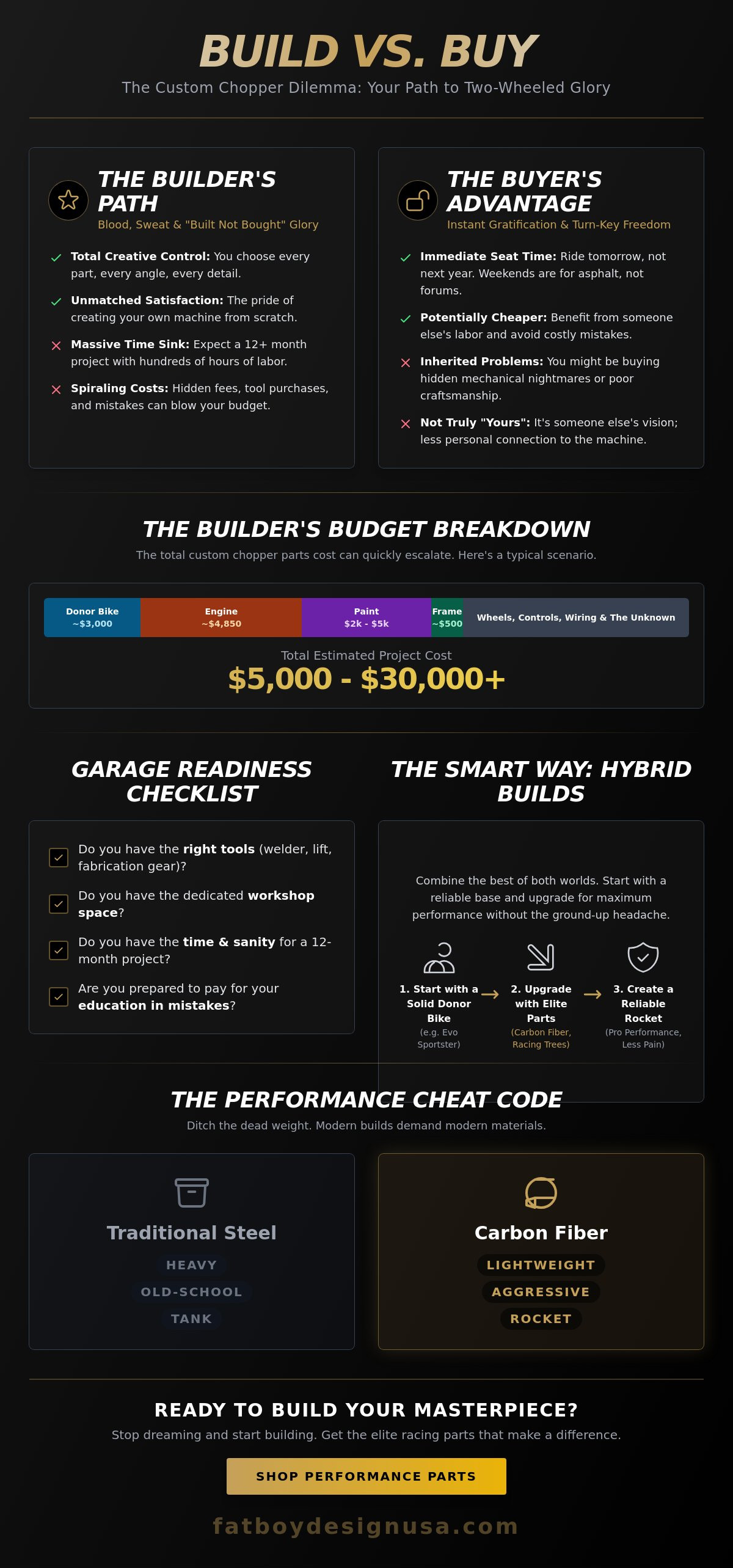
The initial investment isn't just about the bike. A solid donor motorcycle, like a clean Evo Sportster, usually runs around $3,000. But that's just the entry fee. Once you start cutting the frame and sourcing a new engine, you're looking at a range between $5,000 and $30,000. Hidden costs lurk everywhere. Professional paint alone can eat $2,000 to $5,000 of your stash. Then there's time. A ground-up build demands hundreds of hours of fabrication, wiring, and frustration. You are essentially paying for your education in blood and sweat.
The 'Built Not Bought' Philosophy
There is an undeniable respect earned when you roll up on a machine you assembled yourself. Handling your own wrenches and welding isn't just about saving money; it’s about total creative control. You decide where every bolt sits. You choose the rake, the stretch, and the stance. To understand the roots of this obsession, look at the history of chopper motorcycles and how they evolved from stripped-down stockers to rolling sculptures. The Chopper Soul is the intersection of engineering and art. When you build, you can integrate high-end harley davidson carbon fiber components to shed weight and add a modern, aggressive edge that a factory bike just can't touch.
The Instant Gratification of Buying
If you hate the idea of "project bike depression," buying a finished custom is your ticket to freedom. You skip the twelve months of staring at a bike on a lift. You get immediate seat time. Sometimes, buying a pro-built machine is actually cheaper than the total custom chopper parts cost required to build one from scratch. You benefit from someone else’s labor and their mistakes. However, buying has its own risks. You might inherit hidden mechanical nightmares or a "trailer queen" that looks pretty but handles like a shopping cart with a broken wheel. Always check the bones before you sign the check.
The Builder’s Path: Blood, Sweat, and Custom Carbon Fiber
Forget the glossy catalogs for a second. The real hunt happens in the dark corners of online marketplaces and dusty swap meets. You're looking for the perfect heart for your machine. When you start tallying up your custom chopper parts cost, the engine is usually the biggest gut-punch. A new Ultima 107 CI crate engine currently sits between $4,595 and $4,850 depending on the finish. It’s a lot of coin. But that’s the price of glory. You aren't just buying metal; you're buying the soul of your build. The satisfaction of hearing that monster roar for the first time is worth every cent and every late night in the garage.
Fabrication and Sourcing
Fabrication is where the boys are separated from the men. Pick a donor bike that doesn't fight back. Sportsters and older Softails remain the undisputed kings of the build world. You can snag a running Evo Sportster for about $3,000. It's the perfect canvas for a weld-on hardtail kit, which usually runs between $300 and $500. While you're dreaming of a 10-inch over front end, don't forget the motorcycle safety and legal requirements that keep your build street-legal. Stability is non-negotiable. Grab some Bagger Racing Triple Trees to make sure your front end stays planted when you're pinning the throttle.
Modernizing the Build with Carbon Fiber
Old-school builders love their heavy steel. We think that’s boring. Why ride a tank when you can ride a rocket? Modern builders are trashing the dead weight and upgrading to carbon fiber motorcycle parts. It’s the ultimate performance cheat code. There’s a reason people call us the King of Carbon Fiber. We’re obsessed with weight reduction. Swap those clunky stock fenders for performance bagger racer carbon fiber front fenders. You’ll feel the difference in every turn. It’s the smartest way to manage your custom chopper parts cost while actually improving how the bike handles. Plus, that carbon weave looks incredible under the sun. It elevates your build from a simple garage project to a high-tech showstopper.
Ready to shed some dead weight? Take a look at our full carbon lineup and start your performance revolution today.
The Buyer’s Advantage: Analyzing the Custom Premium
Stop listening to the garage purists for a second. There’s zero shame in skipping the grease under your fingernails to get your knees in the breeze today. While the "built not bought" crowd is busy hunting for a lost spacer in a pile of sawdust, you could be carving canyons. Buying a pro-built machine isn't just about laziness. It's about engineering certainty. You get a bike where the geometry was calculated by a professional, not guessed after a six-pack. Plus, you avoid the project bike depression that leaves too many home builds as skeletal remains on Facebook Marketplace. You want to ride, not play archeologist in your own garage.
When you analyze the custom chopper parts cost, you quickly realize that buying a finished bike often saves you a fortune in "oops" money. You aren't paying for the expensive trial and error of a first-time builder. You’re paying for a machine that actually starts every Sunday morning without a fight. You get the chance to test ride the beast, feel the vibration, and check the handling before you commit thousands of dollars. That’s a luxury no home builder ever has until the very end.
What to Look for When Buying Custom
Don't get blinded by a killer paint job. Check the bones first. Inspect the weld quality. If it looks like bird poop, walk away. Wiring is another massive red flag. Home-builders often leave a "rats nest" behind the side covers that’s just waiting to short out. Look for high-end ergonomics that prove the previous owner cared about more than just looks. If you see quality handlebar risers, it’s a clear sign they valued control and rider comfort.
Paperwork is your biggest hurdle. A "Special Construction" title can be a DMV nightmare depending on your state. Always verify the VIN and engine numbers match the title exactly. As noted by The Kneeslider on budget bike building, the actual expense of a build often exceeds the sum of its parts. This makes a turn-key purchase look like a bargain when you factor in the hundreds of hours of free labor the seller already put in.
The Cost of Convenience
The Custom Premium price tag is real, but it’s often cheaper than the alternative. Think about it. A pro-built bike from a reputable name holds its resale value far better than a "Franken-bike" assembled in a suburban driveway. You’re buying a brand and a reputation, not just a bunch of metal. This convenience allows you to focus on refining the ride. Total custom chopper parts cost becomes a secondary concern when you have a reliable, turn-key beast ready to rip. You can always add your own flair later, like swapping heavy stock parts for performance carbon fiber, without the headache of a ground-up build.
Decision Framework: Is Your Garage (and Brain) Ready for a Project?
Your garage is currently a graveyard for unfinished home improvement projects and holiday decorations. Be honest. Before you start ordering frames and engines, you need to decide if you have the mental fortitude to see a build through. It isn't just about the money. It's about the "Space Race". Your bike will live on a lift for at least 12 months. Do you have room for that, or will you be tripping over a kickstand every time you try to find the lawnmower? Building a bike is a marathon; it is not a sprint. If you’re the type of person who loses interest after the first weekend, just buy the turn-key beast and save yourself the heartbreak.
The actual custom chopper parts cost is only part of the equation. You also need to audit your tool chest. You don't necessarily need a full industrial machine shop, but a basic set of wrenches from the local hardware store won't cut it. You’ll need grinders, torque wrenches, and potentially a TIG welder if you’re doing your own fabrication. If you can’t lay a clean bead, don't fake it. Know when to DIY and when to call in a professional. Budget an extra 20% "Oops" cushion into your finances. You will drop a freshly painted tank. You will snap a bolt. You will fry a wiring harness. It’s part of the glory.
The Builder's Practical Checklist
Step 1: Define your style. Are you going for a classic long-fork Chopper, a stripped-back Bobber, or a fire-breathing Performance Bagger? Knowing your endgame prevents "part creep" where you buy stuff that doesn't fit the vision. Step 2: Inventory your gear. Ensure you have the fabrication equipment to handle the heavy lifting. Step 3: Set a realistic timeline. Think it’ll take six months? Double it. Now you’re being realistic about how long that frame will be taking up your parking spot.
The Buyer's Inspection Checklist
If you’re buying, your checklist is different. Step 1: Determine your performance specs. Do you want a bike that just looks cool at the bar, or one that actually handles? Step 2: Research the builder. Check their previous projects and reputation in the community. Step 3: Factor in personalization. Even a turn-key bike will need your touch. You'll likely want to swap out heavy stock components for elite bagger racing parts to truly make it yours and ensure it performs as good as it looks.
Ready to upgrade your current ride or start a fresh performance build? Grab our Harley Davidson carbon fiber parts and start cutting weight today.
The FBD Way: Hybrid Builds for Maximum Performance
The "built not bought" purists might call it cheating. We call it working smarter. The Hybrid path is the ultimate way to dodge the never-ending project trap while still ending up with a machine that screams individuality. You buy a solid, reliable base bike. Then, you use your hands to turn it into a performance monster. This strategy lets you control your custom chopper parts cost by focusing your cash where it actually matters: speed, handling, and aesthetics. You skip the twelve months of staring at a bare frame and get straight to the part where you actually ride the thing.
Starting with a Harley Davidson Bagger is the smartest move you can make in 2026. These bikes are built for the long haul. They have the torque. They have the frame. But they also have a lot of heavy, boring plastic. Trashing the stock saddlebags and dash for our carbon fiber replacements is an instant level-up. You’re shedding dead weight and adding a high-tech finish that stock bikes can't touch. The Fat Boy Design USA philosophy is simple. We build racer-tested parts for riders who refuse to be generic. We don't do "average". We do "transformative".
Upgrading the Essentials
Don't just make it look fast. Make it handle like it’s on rails. A Harley Touring Performance Steering Damper Kit should be the first thing you install. It’s the difference between a white-knuckle wobble and a smooth, confident line through the corners. Replacing stock fenders and lids with lightweight carbon fiber completely changes the physics of your ride. It’s about better acceleration and sharper braking. Fat Boy Design USA parts bring professional racing tech to your street build without the professional racing headache.
Join the Fat Boy Design USA Family
Our factory in Matthews, NC is the heart of this modern movement. We aren't just selling parts; we’re sharing a legacy. Every weave of our harley davidson carbon fiber is informed by 13 years of high-stakes racing experience. We’ve done the testing so you don't have to. You’re joining a club that values performance above all else. Total custom chopper parts cost is an investment in your freedom and your sanity. Stop dreaming about the perfect machine. Start shredding the pavement. Whether you build it from the ground up or upgrade a turn-key beast, just make sure it’s yours.
Stop Dreaming and Start Shredding
Whether you're ready to bleed for your build or you'd rather just turn the key and vanish, the choice is yours. You've seen how the custom chopper parts cost can fluctuate based on your hunger for performance and your tolerance for grease. You know that a Hybrid build gives you the best of both worlds, offering reliability and raw speed. It's time to stop overthinking and start acting. Your garage is waiting, and the road is calling. Don't settle for a heavy, generic machine when you can have a racer-tested beast that turns heads at every stoplight—and if you want to coordinate your look with your riding crew for those big events, you can learn more about Adorb Custom Tees for matching group apparel.
At Fat Boy Design USA, we've spent over 13 years in professional racing to make sure your street machine handles like a dream. Every racer-tested carbon fiber component we produce is proudly manufactured in our Matthews, North Carolina factory. We don't do boring, and we definitely don't do slow. It's time to Upgrade your build with the King of Carbon Fiber at Fat Boy Design USA. Let’s get that bike out of the boxes and onto the asphalt where it belongs. The world needs more fire-breathing machines and fewer garage ornaments. Go get it.
Frequently Asked Questions
Is it cheaper to build a chopper or buy one?
Buying a turn-key bike is usually cheaper because you aren't paying for the previous owner's expensive learning curve. When you build, you pay for every mistake and every specialized tool you have to buy. A used custom often sells for less than the sum of its parts. You get the ride without the twelve month garage sentence. It's the ultimate shortcut for riders who want glory without the grit.
How much does it cost to build a custom chopper in 2026?
A home-built project in 2026 typically ranges from $5,000 for a budget build to over $30,000 for a professional-grade machine. Your custom chopper parts cost will depend heavily on whether you use a crate engine or rebuild a donor motor. Remember to double your initial budget. Unexpected fabrication needs and high-end finishes like professional paint always eat more cash than you plan for.
Do I need a special license for a custom-built motorcycle?
You need a standard motorcycle endorsement to ride, but your bike needs a Specially Constructed Vehicle title. The DMV will inspect your receipts for the frame, engine, and transmission to issue a VIN. Registration laws vary by state, so check your local requirements before you start welding. Don't get caught riding a ghost bike; get the paperwork right so you can shred legally.
What are the most important tools for a first-time chopper build?
A high-quality angle grinder, a reliable torque wrench, and a sturdy bike lift are your holy trinity. You can't build a safe machine with just a screwdriver and a prayer. You'll also need a decent set of sockets and potentially a TIG welder if you're feeling brave. Invest in tools that won't snap when you're torquing down the essentials. Good tools make the difference between a masterpiece and a disaster.
Can I use carbon fiber parts on an old-school chopper?
Absolutely, and you should if you care about performance. Swapping heavy steel for carbon fiber side covers or fenders is the smartest way to modernize an old-school silhouette. It's the Hybrid approach we love. You get the classic look with modern weight reduction. It turns a sluggish vintage build into a responsive street beast that handles like a dream.
How long does it typically take to build a chopper from a donor bike?
Expect your first build to take at least twelve months from the moment you strip the donor bike. Life happens, parts get delayed, and you'll definitely spend weeks staring at a wiring diagram. If you think you'll be done in six months, you're dreaming. Take your time to get the geometry and safety right. A rushed build is a dangerous build.
Is a built bike harder to insure than a bought one?
Yes, insuring a Special Construction bike is usually more complex than a factory Harley. You'll likely need a stated-value policy and a professional appraisal to prove what the bike is actually worth. Standard insurance companies often struggle with custom builds. Look for specialized motorcycle insurers who understand the blood and sweat you put into the machine. It's worth the extra effort to protect your investment.
What is the best donor bike for a custom chopper build?
The Evo Sportster is the undisputed king of donor bikes for its reliability and massive aftermarket support. You can usually find a clean, running Sportster for around $3,000. It's a narrow, simple platform that's perfect for hardtail kits. If you want something bigger, an older Softail is a great choice. Both give you a solid foundation without the headache of modern, over-complicated electronics.