

Carbon Fiber Saddlebag Lids: The Ultimate Performance Bagger Upgrade
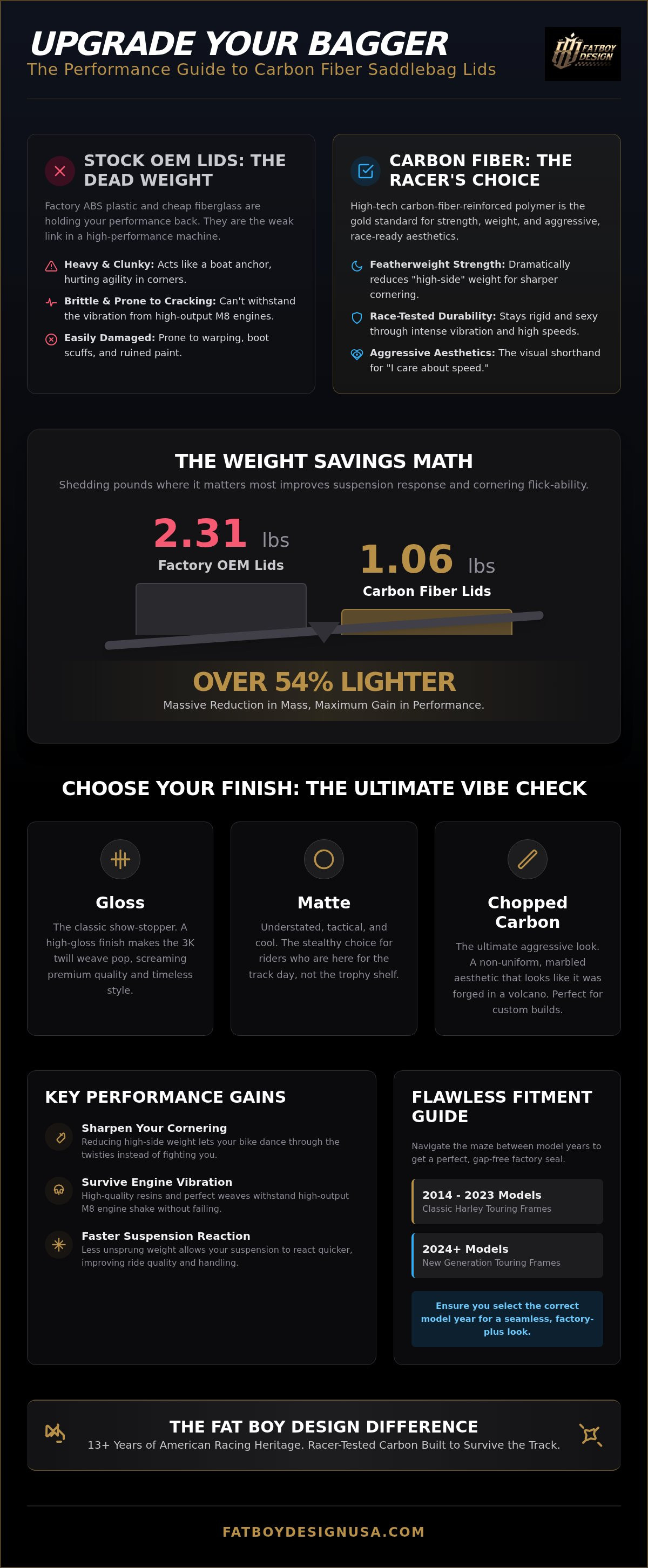
Your stock Harley lids are basically boat anchors masquerading as motorcycle parts. They're heavy, they're clunky, and they're holding your performance back. You didn't build a performance bagger to feel like you're hauling a trailer through every corner. Upgrading to high-quality carbon fiber saddlebag lids isn't just about the "wow" factor at the bike wash; it's about shedding dead weight where it counts. Real-world testing shows these lids can be over 50% lighter than OEM plastic, dropping from 2.31 lbs down to a featherweight 1.06 lbs. That's a massive win for your suspension and your sanity.
We know the pains of the open road. You've probably seen cheap fiberglass lids crack under vibration or watched boot scuffs turn your expensive paint into a scratched mess. It's time to embrace race-tested durability instead. This guide will help you select and install the best lids for your Harley so you can stop worrying and start riding. We're breaking down everything from weight savings to the final bolt-on steps. Let's turn your bike into the lean, mean, carbon-clad machine it was always meant to be.
Key Takeaways
- Master the art of the performance bagger by swapping heavy stock plastic for lightweight carbon fiber saddlebag lids that sharpen your cornering.
- Pick the right vibe for your ride by comparing the sleek look of Gloss and Matte finishes against the raw energy of Chopped Carbon.
- Navigate the fitment maze between classic 2014 models and the new 2024+ Touring frames to get that perfect, gap-free factory seal.
- Grab essential installation hacks to avoid over-torquing hardware and keep your carbon components structurally sound for the long haul.
- Discover why 13 years of American racing heritage means your parts are built to survive the track and look incredible doing it.
Why Carbon Fiber Saddlebag Lids are a Performance Necessity
Your bagger deserves better than the factory's "good enough" leftovers. Let's be real. Those stock plastic lids are sluggish, heavy, and frankly, they're killing your vibe. If you're chasing the performance bagger dream, you need to ditch the dead weight. High-quality carbon fiber saddlebag lids aren't just a fancy accessory. They are a structural necessity for anyone who actually likes to lean their bike. Reducing "high-side" weight is the secret sauce to improving cornering flick-ability. When you strip pounds off the highest point of your bags, your bike stops fighting you in the twisties and starts dancing. It's the difference between wrestling a bear and leading a tango.
The race-ready look is more than just an aesthetic choice. It's a statement. Carbon fiber has become the visual shorthand for "I care about speed." It defines the modern performance bagger by stripping away the pretension of heavy chrome and replacing it with raw, functional power. It looks aggressive because it is aggressive. Plus, it actually holds up. High-output M8 engines are masterpieces of engineering, but they shake like a paint mixer. You need parts that can survive that vibration without vibrating themselves to pieces. Our carbon is racer-tested for a reason. We've spent 13 years on the track making sure our gear stays rigid, stays light, and stays sexy through every mile of abuse you throw at it.
The Problem with Stock Plastic and Fiberglass
Stock ABS plastic is a ticking time bomb of warping and scuffs. One misplaced boot and your paint is ruined forever. Then there's fiberglass. It's heavy, it's brittle, and it's prone to cracking when you're pinning it at 100mph. You didn't buy a Harley to baby it. You bought it to rip. Cheap lids can't handle the heat, the speed, or the lifestyle. Carbon fiber is the only material that keeps up with the pace while looking like a million bucks.
The Weight Savings Math
Let's look at the numbers because they don't lie. Factory OEM lids tip the scales at about 2.31 lbs. Our carbon fiber saddlebag lids weigh in at a measly 1.06 lbs. That is a massive reduction in mass right where it affects your center of gravity. These parts are made from high-tech carbon-fiber-reinforced polymers, which offer a strength-to-weight ratio that makes standard ABS plastic look like wet cardboard. Every ounce you shave off the rear end allows your suspension to react faster to the road. Less weight means less inertia. Less inertia means you're out-accelerating and out-cornering the guy with the stock setup every single time.
Performance vs. Aesthetics: Choosing the Right Carbon Finish
Picking a finish is the ultimate vibe check for your build. Do you want to blind the competition with a high-gloss shine, or disappear into the shadows with a stealthy matte? Gloss is the classic show-stopper. It makes the weave pop and screams premium quality. Matte, on the other hand, says you're here for the track day, not the trophy shelf. It’s understated. It’s cool. It’s tactical. If you really want to get aggressive, chopped carbon is your new best friend. It’s a non-uniform, marbled look that looks like it was forged in a volcano. It’s perfect for custom builds that want to stand out from the sea of standard twill. Whatever you choose, make sure you match your carbon fiber dash for that cohesive, factory-plus look. A mismatched bike is just a cry for help.
But looks aren't everything. You're riding a high-output M8, not a golf cart. The vibration from a performance-tuned engine can shred inferior parts. That's why we use high-quality resins that laugh at UV rays and engine heat. Research into automotive applications proves that carbon fiber is the gold standard for high-stress environments. Don't let your lids turn yellow or crack after one summer in the North Carolina sun. We build these things to survive the elements and the engine. If you're ready to upgrade the look of your rear end, browse our carbon fiber collection and find your perfect match.
The Science of the Weave
We don't just slap a pretty layer on top. Being the "King of Carbon Fiber" means caring about what's under the hood. Standard 3K twill is great for that classic look, but our structural integrity goes all the way through. We ensure the weave stays straight across the entire surface of your carbon fiber saddlebag lids. No wavy lines. No amateur hour. Just pure, symmetrical perfection that holds its shape at triple-digit speeds.
Durability and Maintenance
Bagger lids take a beating. Between road debris and the occasional boot scuff from a clumsy passenger, they need to be tough. Is ceramic coating worth it? Absolutely. It adds an extra layer of defense against micro-scratches and makes cleaning a breeze. For maintenance, stick to soft microfibers. Avoid the gas station squeegee if you value your finish. These lids are designed to resist the daily grind while keeping that just-unboxed glow. They're built by racers who know that a bike should look as good in the parking lot as it does on the podium.
Fitment Guide: Ensuring a Seamless Factory-Plus Look
Stop guessing and start fitting. When we talk about "Direct Replacement," we aren't just blowing smoke. Your carbon fiber saddlebag lids should fit so perfectly that people assume Harley finally stepped up their game at the factory. We call this the "Factory-Plus" look. It’s the same footprint you know, just lighter, stronger, and infinitely cooler. Don't settle for "close enough" lids that leave gaps big enough to swallow a credit card. You want a tight, clean seal that looks like it was born on the assembly line in Milwaukee, even though it was actually perfected in North Carolina.
Know your generation before you click buy. The 2014-2023 Touring models have been the gold standard for a decade. However, the new 2024+ models have changed the game with updated lines and mounting points. We've spent the time in the shop making sure our molds are dead-on for both. A lid that doesn't seat right isn't just an eyesore; it's a performance liability. If it catches the wind at 90mph, you're going to feel it. Precision fitment is the only way to ensure your bike stays stable when you're pinning the throttle.
Hardware and Latch Transfers
Keep your factory guts. Your OEM latch kit is a solid piece of engineering, so why waste it? Moving your hardware over to your new lids is a straightforward process. Grab your tools, clear off a bench, and take your time. This is also the perfect moment to inspect your rubber seals. If they look like a dried-out raisin, throw them in the trash. Never skimp on new weather stripping during an upgrade. You're looking for that crisp, mechanical "click" when you close the bag. That sound is the only way to know you've got a perfect seal against the elements.
Compatibility with One-Touch Latches
We love the Harley One-Touch system as much as you do. It’s convenient, fast, and iconic. That’s why we design our lids specifically to play nice with the One-Touch mechanism. You won't have to fight the handle or pray it catches. We've eliminated the common "lid rattle" found in those cheap, thin aftermarket parts. Our lids stay quiet and secure, even when your M8 is screaming. If you're looking to round out the rest of your build, check out our full range of Bagger Racing Parts. We make sure every component works together to create a bike that’s as tight as a drum and twice as loud.
Installation and Performance Tuning
Clear off your workbench and put down a soft towel. You're about to handle the crown jewels of your bike's rear end. Installing carbon fiber saddlebag lids isn't rocket science, but it does require a bit more finesse than swapping out a battery. You need a clean workspace and a calm mind. Don't try to do this on a gravel driveway in the dark. Grab your Torx set, some Blue Loctite, and a cold drink. We're going to make sure these lids sit so flush they look like they were carved out of a single block of speed.
Handling carbon fiber requires a specific touch. It is incredibly strong, but it doesn't like being crushed. Avoid over-torquing your hardware like you're trying to win a strongman competition. If you hear a crunch, you've gone too far. Snug is the name of the game. Use a light hand and let the hardware do its job without stressing the material. Once everything is mounted, take a second to check your gaps. A perfect, even line between the bag and the lid is the hallmark of a pro-level build. If it’s wonky, adjust the hinges until it’s straight. Don't be the guy with the crooked carbon.
The 5-Step Installation Process
- Strip the Old Gear: Pop your factory lids off and carefully remove all the hinges, latches, and tethers. Keep your screws organized.
- Prep the Carbon: Give your new lids a quick wipe down. Ensure the mounting points are clear of any packaging dust or debris.
- Transfer the Hardware: Bolt your OEM hinges and One-Touch latch mechanisms onto the carbon lids. Remember, snug but not crushed.
- Seal the Deal: Apply your new weather stripping. This is your only defense against a rainstorm turning your saddlebags into small bathtubs.
- Final Mount: Attach the lids to the bags. Open and close them a few times to ensure the movement is smooth and the "click" is satisfying.
Pro-Tips for Racing Applications
If you're running a high-output M8, vibration is your constant companion. Use Blue Loctite on every single hinge bolt to prevent high-RPM shakes from backing them out. Check your tether length too. If the tether is too long, your expensive new lids will flop over and smack your side covers, ruining that perfect paint. Before you twist the throttle, verify that your latch engagement is rock-solid so your gear doesn't end up scattered across the interstate. Ready to shed that dead weight? Shop our carbon fiber saddlebag lids and start your transformation today.
The Fat Boy Design Difference: Racer-Tested Carbon
We aren’t some faceless corporate ghost hiding behind a glossy catalog. Fat Boy Design USA lives, breathes, and builds right in Matthews, North Carolina. When you choose our carbon fiber saddlebag lids, you are supporting American manufacturing that actually understands the soul of a Harley. It matters. Your bike is an American icon, and it deserves parts built by people who ride the same highways you do. We have earned the title "King of Carbon Fiber" through years of sweat, grease, and high-speed laps. We don't just sell components. We sell the hard-earned results of thirteen years of professional racing heritage. Every single fiber is baked with the knowledge of what it takes to survive the track and dominate the street.
Our promise is simple. We offer rigorous testing for real-world abuse. We know you’re going to ride hard. We know you’re going to push that M8 engine to its limits. That is why we don't settle for "good enough" materials. We use the same high-spec resins and layup techniques that we trust with our own lives on the race course. It is about more than just shedding weight. It is about the confidence that comes from knowing your gear was built by racers, for racers. Stop settling for parts designed by people who have never hit a corner at triple digits.
From the Track to the Street
Our design process starts at the finish line. We have spent over 13 years pushing performance baggers to their absolute breaking points in professional racing environments. If a design can't handle the brutal vibrations and aerodynamic forces of a race, it never makes it to our shop floor. We test our parts on the exact same bikes we race. This means your street build gets the direct benefit of podium-winning technology. Our philosophy is straightforward. High performance doesn’t have to be pretentious. It should be fun, bold, and ready for any adventure you can dream up.
The Complete Carbon Ecosystem
Most riders start with the lids. It is an easy win for both style and weight. But once you see that carbon weave catching the sun, you are going to want the full transformation. This is the complete carbon ecosystem. Don't leave the job half-finished. Pair your new lids with our full Carbon Fiber Saddlebags to create a seamless, aggressive rear profile. To truly balance the machine, tie the whole look together with our Performance Bagger Racer Carbon Fiber Front Fender. Join the FBD club today. Reject the mundane, embrace the bold, and finally ride the bike you were always meant to have.
Take the High-Side Weight to the Trash
Your Harley deserves more than heavy, sluggish plastic. You’ve seen how shedding weight transforms your cornering and why a race-tested finish beats a cheap fiberglass knockoff every single time. It’s about more than just looking fast at the stoplight. It’s about the 13+ years of performance manufacturing we’ve baked into every single weave. We design and produce everything 100% in-house in Matthews, NC, because we don't trust anyone else with your ride's potential. High-quality carbon fiber saddlebag lids are the easiest way to start your full performance transformation.
Don’t let another season pass with a rear end that fights your every move. It is time to join the club of riders who prioritize speed, style, and pure enjoyment. Grab your tools, clear your bench, and get ready for the mechanical "click" of a perfect seal. Upgrade Your Bagger with FBD Carbon Fiber Lids and feel the difference on your very first corner. The road is waiting. Your bike is finally ready to dominate it.
Frequently Asked Questions
Will carbon fiber saddlebag lids fit my 2024 Road Glide?
Yes, they fit perfectly. We have specifically engineered our molds for the 2024 and newer Harley models to ensure a gap-free, factory-plus fit. You don't have to worry about universal parts that look like a hack job. Our 2024+ lids follow the updated body lines of the new Road Glide and Street Glide with absolute precision.
Do I need to buy new latches for these carbon fiber lids?
You don't need to buy a single new latch. These lids are designed to accept your factory One-Touch hardware without any drama. Just strip the guts from your stock lids and bolt them onto the carbon. It is a clean, straightforward swap that keeps your bags locking and opening exactly like they did the day you rolled off the showroom floor.
How much weight do carbon fiber saddlebag lids actually save?
You will save over 50% of the weight compared to your stock setup. A factory lid weighs about 2.31 lbs while our carbon fiber saddlebag lids weigh a measly 1.06 lbs. Shedding that dead weight from the highest point of your bags makes your bike feel more responsive and way easier to flick through the corners.
Are carbon fiber lids more durable than the stock Harley lids?
Yes, they are significantly more durable than stock plastic or brittle fiberglass. We have spent 13+ years racing these parts to ensure they can handle high-output engine vibrations without cracking. Our carbon won't warp in the summer heat or flex under pressure. It is built for riders who actually push their bikes to the limit.
Can I paint my carbon fiber saddlebag lids to match my bike?
You can definitely paint them, though we think the raw weave is the ultimate flex. If you are going for a specific color-matched look, these lids take paint just like any other high-end composite. Just scuff, prime, and spray. It is a great way to get the weight savings while keeping your bike's original paint scheme intact.
Do these lids come with weather stripping and seals?
We recommend transferring your factory seals or grabbing a fresh set of weather stripping for the best results. A perfect seal is non-negotiable for high-speed runs and rainy days. Reusing your OEM rubber ensures that satisfying mechanical "click" every time you shut your bags, keeping your gear bone-dry and secure.
What is the difference between chopped carbon and twill weave lids?
Twill is the classic diagonal weave you see on race cars. Chopped carbon has a marbled, non-uniform look for a more aggressive custom vibe. Both options use the same high-spec resins and offer the same structural integrity. It just depends on which look matches your bike's personality and your existing carbon accessories.
Is installation difficult for a DIY rider?
Installation is a total breeze for any DIY rider with a basic tool kit. If you can handle a Torx bit and a screwdriver, you can finish this job in a single afternoon. Just follow our simple 5-step process and avoid over-torquing the hardware like a gorilla. It is a high-impact upgrade that doesn't require a professional mechanic.