

Carbon Fiber vs Fiberglass Harley Parts: The Brutal Truth for 2026
Your Milwaukee-Eight is essentially a high-performance jackhammer on wheels, and that cheap fiberglass fender you just bolted on is currently one pothole away from becoming a very expensive jigsaw puzzle. When it comes to the great debate of carbon fiber vs fiberglass harley parts, most riders settle for "good enough" until the first spider-web crack appears across their paint. We get it. You want a bike that looks like a million bucks and handles like a pro-racer without the soul-crushing weight of traditional materials holding back your 0-60 times.
In this guide, we're stripping away the marketing fluff to reveal why choosing the right weave determines whether your Bagger shreds the track or falls apart under the pressure of the Harley shake. You'll discover the brutal truth about weight savings, long-term durability, and why our Upper Carbon Platinum Series is the only choice for riders who refuse to compromise. From front fenders to racing swingarms, we're breaking down the science of speed and the cost of settling for second best in 2026. It's time to stop taking life so seriously and start taking your build's performance to the next level.
Key Takeaways
- Stop settling for "good enough" and learn why high-tech carbon filaments leave heavy, flexible fiberglass in the dust.
- Master the performance math of carbon fiber vs fiberglass harley parts to shave pounds off your front end for pro-racer handling.
- End the nightmare of spider-web cracks by choosing vibration-resistant materials that won't crumble under the brutal shake of your V-Twin.
- Ditch the dusty sanding blocks and discover how precision-molded parts deliver a perfect fit and aggressive 3K aesthetics without the bodywork headache.
- Get the inside scoop on why 13 years of track-tested racing experience makes the Upper Carbon Platinum Series a mandatory upgrade for serious riders.
Carbon Fiber vs Fiberglass Harley Parts: The Material Showdown
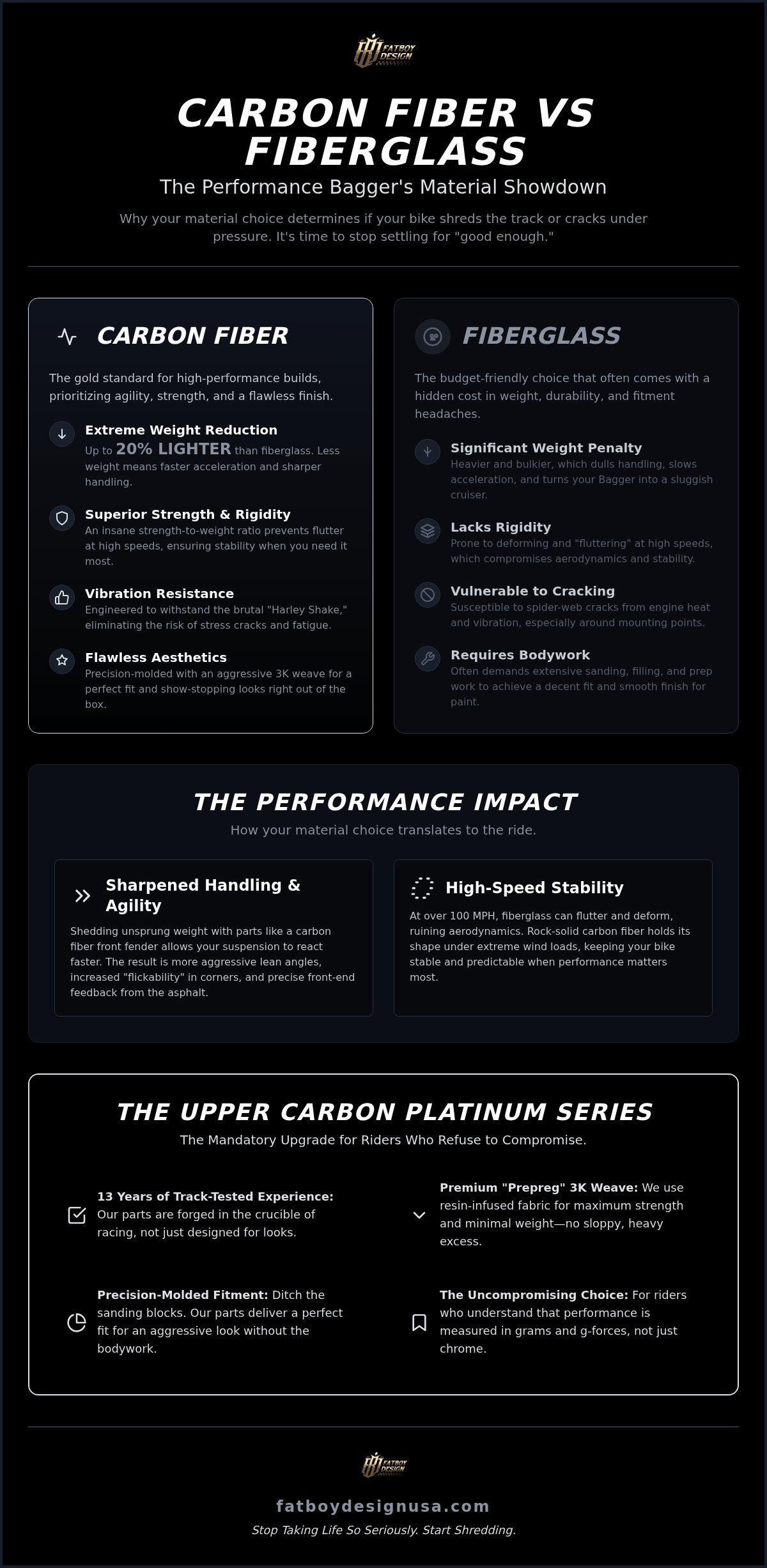
Stop bolting heavy, outdated materials to your high-performance machine. Your Bagger deserves a skin that’s as tough as its engine. Carbon fiber is a high-tech polymer reinforced by thin, incredibly strong filaments of carbon. It is the gold standard for anyone who actually wants to ride hard. Fiberglass uses glass fibers embedded in resin. It is heavier, less rigid, and generally lacks the "cool factor" of its carbon cousin. Choosing between these two isn't just about looks. It’s about deciding if your bike is a trailer queen or a track-shredding monster.
What Makes Carbon Fiber the King?
Carbon fiber owns the throne because of its insane strength-to-weight ratio. This material is the secret sauce for harley davidson carbon fiber builds that prioritize agility. At Fat Boy Design USA, we don't just use any carbon. We focus on the 3K weave. This isn't just for the aggressive aesthetics. It provides the structural rigidity required to handle 100mph wind blasts without flinching. We utilize "Prepreg" construction in our Upper Carbon Platinum Series. This means the resin is already baked into the fabric. It eliminates the sloppy, heavy excess found in cheaper parts. You get a component that is lean, mean, and ready for the most demanding environments.
The Fiberglass Reality Check
Look, fiberglass is the budget-friendly choice for mass-produced fairings. It’s fine if you’re just cruising to the local coffee shop, but there is a massive weight penalty. When comparing carbon fiber vs fiberglass harley parts, you're looking at carbon being up to 20% lighter. That is a huge difference when you are trying to toss a heavy Bagger into a tight corner. Plus, Fiberglass properties and characteristics show it lacks the natural stiffness of carbon. Common failure points are everywhere. Think about those nasty cracks around mounting holes or the gel coat spider-webbing after a summer of engine heat. It simply isn't built for the long-term abuse of a high-horsepower V-Twin. It’s a temporary fix for a permanent performance goal.
It really comes down to the "Show vs. Go" mentality. Fiberglass is for the rider who wants a cheap surface to paint over. Carbon fiber is for the enthusiast who wants a Carbon Fiber Front Fender that actually improves front-end feedback. If you're ready to stop taking life so seriously and start shredding the pavement, the choice is obvious. Don't let your parts be the weakest link in your build.
Weight, Strength, and Speed: The Performance Comparison
Speed is a game of math, and your Harley is currently failing the equation if it's draped in heavy fiberglass. When we dive into the performance side of carbon fiber vs fiberglass harley parts, the winner is decided before you even hit second gear. It's about more than just looking fast. It is about shedding the dead weight that turns your Bagger into a sluggish cruiser. Racing teams don't use fiberglass for a reason. They need parts that can survive the track without adding bulk.
Shaving Pounds for Better Handling
Fiberglass saddlebags are essentially bricks bolted to your frame. They are thick, heavy, and offer zero performance benefits beyond holding your gear. Swap those out for carbon fiber versions and you'll feel the difference in the first corner. The reduction in mass increases your flickability and allows for more aggressive lean angles. This is especially critical for your unsprung weight. Lighter components allow your suspension to react faster to bumps and dips. Every ounce saved on the front end improves steering precision and transforms how your bike communicates with the asphalt. If you want that pro-racer feel, starting with a carbon fiber front fender is the easiest way to sharpen your front-end feedback.
Structural Integrity at 100+ MPH
High speeds reveal the ugly truth about cheap materials. Fiberglass fairings and fenders have a nasty habit of "fluttering" or deforming once you cross into triple digits. This isn't just annoying; it ruins your aerodynamics and creates instability. Carbon fiber is rock solid. Its incredible tensile strength means it holds its shape under extreme wind loads, keeping your bike stable and your internal components protected. Unlike fiberglass, which can suffer from hidden structural failures, research into the fatigue and durability of composite materials proves that carbon fiber maintains its integrity through thousands of high-stress cycles. It won't flex, it won't bow, and it certainly won't let you down when you're pinned at full throttle.
Stop letting weight hold you back from the ride you deserve. You can keep hauling around that extra fiberglass bulk, or you can upgrade your setup with pro-grade gear that actually works. Your Bagger was built to shred. Make sure the parts you're bolting on are up to the task.
The Harley Shake: Vibration Resistance and Longevity
Your Harley is a beautiful, thumping beast, but that V-Twin vibration is a straight-up assassin for cheap bodywork. When you look at carbon fiber vs fiberglass harley parts, you have to consider the "Harley Shake." It is the relentless, high-frequency buzzing that turns your bike into a 900-pound vibratory finisher. Fiberglass parts are usually thick and resin-heavy. This makes them incredibly brittle. Over a few thousand miles, that vibration finds every weak point in the material. You start seeing those tiny, ugly spider-web cracks in the gel coat. It usually starts near the mounting holes before spreading across the entire fairing or fender like a bad map.
Why Fiberglass Cracks Under V-Twin Stress
Fixing cracked fiberglass is a nightmare that never ends. Most riders resort to the "sand and pray" method. You grind down the crack, slap on more resin, and hope it doesn't pop back up before the next rally. It always does. This happens because fiberglass doesn't handle energy well. For a solid introduction to composite materials, you will learn that different fibers handle stress in different ways. Fiberglass just isn't designed for the constant harmonic abuse of a Milwaukee-Eight engine. The engine harmonics create tiny stress fractures that eventually turn your expensive paint job into a mess of flakes and frustration.
Carbon Fiber’s Superior Fatigue Life
Carbon fiber is built differently. It is an energy-absorbing powerhouse. The carbon filaments are flexible enough to dissipate vibrations without developing fatigue. This is called harmonic dampening. It is a fancy way of saying your parts won't shake themselves to pieces. While fiberglass mounts wallow out and get sloppy, carbon fiber stays tight. Our Upper Carbon Platinum Series parts from Fat Boy Design USA are racer-tested specifically to survive high-RPM harmonics. We manufacture everything in-house in Matthews, North Carolina. This allows us to see exactly how these parts handle the stress before they ever reach your doorstep. We have spent 13 years on the track making sure these pieces don't flinch when the rev limiter starts screaming.
Think about the long-term ROI. You can buy one high-quality harley davidson carbon fiber part today, or you can buy three fiberglass replacements over the next five years. The math is simple. Carbon fiber outlasts the competition because it is engineered for the hostile environment of a real-world ride. It is the difference between a part that looks good in the showroom and a part that still looks flawless after a cross-country trip. Don't let a budget choice turn into a recurring expense. Your Bagger deserves components that can handle the heat and the hustle without cracking under the pressure.
Aesthetics and Fitment: Showstopper Looks Without the Headache
Fiberglass is like a bad date. It looks okay from a distance, but the closer you get, the more work it requires. When you are comparing carbon fiber vs fiberglass harley parts for your 2026 build, aesthetics are only half the battle. You want that deep, aggressive 3K weave that screams performance, not a wavy fiberglass surface that needs three coats of primer just to look decent. Our carbon parts come with a high-gloss finish and built-in UV protection. This keeps that "just-out-of-the-mold" shine for years. Cheap fiberglass gel coats often yellow or go dull after a single season under the sun. It’s a visual disaster you don't need.
The Iconic Carbon Weave Look
The raw 3K weave is the ultimate badge of honor. It tells everyone you value speed and precision. Don't fall for the hydro-dipping trap. Real carbon fiber has a depth and texture that fake "carbon look" film can never replicate. It perfectly complements the Performance Bagger aesthetic. It gives your bike a high-end, pro-racer finish that painted fiberglass simply cannot touch. It is about visual dominance that matches your bike’s physical presence. You aren't just building a bike. You are creating a masterpiece that demands attention at every stoplight.
Precision Fitment vs. Fiberglass Frustration
Here is the dirty secret the budget brands won't tell you: fiberglass parts almost never fit right out of the box. You'll spend hours "massaging" them, sanding edges, and drilling holes just to get them to line up with your frame. That is a massive hidden cost in labor and frustration. The debate of carbon fiber vs fiberglass harley parts often ends the moment you try to install them. High-quality Harley carbon fiber parts from Fat Boy Design are precision-molded in-house in North Carolina. They offer bolt-on simplicity that gets you out of the garage and back on the road. We value your time as much as your bike’s performance. Stop wasting weekends on bodywork and start riding.
Your bike should be a showstopper, not a headache. Ditch the dusty sanding blocks and embrace the future of composite design. Shop the Upper Carbon Platinum Series today and give your Bagger the high-end finish it deserves. It’s time to stop settling for "good enough" and start demanding the best for your ride.
Why Fat Boy Design USA Wins the Carbon War
Why settle for a global supplier that doesn't know a shovelhead from a panhead? When you're weighing carbon fiber vs fiberglass harley parts, you need a brand that lives in the fast lane. Being the "King of Carbon Fiber" isn’t just a title we slapped on a banner. It is a standard we live by every single day in our shop. While other brands are busy mass-producing brittle fiberglass in overseas factories, we're right here in Matthews, North Carolina. We're cutting, laying, and curing the most aggressive parts on the market. We don't just make furniture for your bike. We make weapons for the street.
Racer-Tested in Matthews, NC
We don't guess. We test. With 13+ years of professional racing experience, we know exactly what happens to a fairing when you're pinned at 140mph. Every component we sell is born on the track and refined for your Bagger. We focus on "Performance Bagger" components because we know you actually plan on riding your bike. Supporting Fat Boy Design USA means supporting a rider-owned business that speaks your language. We understand the "Harley Shake" because we feel it too. We build parts that don't just survive that vibration; they thrive in it. When you choose the Upper Carbon Platinum Series, you're joining an elite club of riders who refuse to compromise on quality or soul.
The FBD Guarantee of Quality
Our manufacturing process is a closed loop of excellence. From the initial concept to the final track test, everything happens under one roof in North Carolina. This allows us to maintain rigorous testing standards for every fender, dash, and side cover we ship. We've already discussed the nightmare of fiberglass fitment and the inevitable spider-web cracks. You don't have time for that. You have roads to conquer. Our in-house design team ensures that every bolt hole lines up and every weave is flawless. We take the guesswork out of your build so you can spend your time where it belongs—on the asphalt.
The choice in the carbon fiber vs fiberglass harley parts debate is clear. You can haul around heavy, brittle glass, or you can ride with the strength of a racer. Stop settling for "good enough" and start demanding the best. It's time to upgrade to Fat Boy Design Carbon Fiber and experience the difference that 13 years of racing heritage makes. Your Bagger is waiting. Give it the armor it deserves.
Stop Settling and Start Shredding
Your Bagger is a high-performance machine, not a science project for cheap resins. We've laid out the cold, hard facts: the choice in the carbon fiber vs fiberglass harley parts debate defines whether you're carving corners or patching cracks. It's time to stop lugging around the dead weight of fiberglass and start reaping the rewards of 3K structural rigidity. You've seen how harmonic dampening saves your sanity and how precision fitment saves your weekend. There is no middle ground when the throttle is wide open.
Don't let your build be defined by "good enough." You deserve the same racer-tested durability that wins on the track. We build every piece in Matthews, North Carolina, with the soul of a rider and the precision of a pro. It's time to choose the armor that outlasts the competition and looks like a million bucks while doing it. Shred the weight and upgrade to Fat Boy Design USA Carbon Fiber now!
Your Milwaukee-Eight is ready to breathe fire. Go out there and own the asphalt.
Frequently Asked Questions
Is carbon fiber stronger than fiberglass for Harley parts?
Carbon fiber is the undisputed champion of strength. It offers a superior strength-to-weight ratio that makes fiberglass look like wet cardboard. While fiberglass is flexible and absorbs light impacts, it lacks the structural rigidity needed for high-speed stability. Carbon fiber stays stiff under pressure, ensuring your parts don't deform when you're pinning the throttle. It is the professional choice for any rider who actually plans on pushing their bike to the limit.
Why do fiberglass Harley fenders crack so easily?
Fiberglass fenders crack because they are brittle and resin-heavy. Your V-Twin engine is basically a high-powered jackhammer that creates relentless harmonic stress. This "Harley Shake" finds every weak point in the fiberglass gel coat, leading to those ugly spider-web fractures. Most fiberglass parts are mass-produced with inconsistent thickness, making them prone to snapping around mounting holes. Carbon fiber absorbs this energy without developing the same fatigue-induced failures over years of hard riding.
Does carbon fiber actually reduce Bagger weight significantly?
Yes, switching to carbon fiber can shave off a massive amount of dead weight. In the debate of carbon fiber vs fiberglass harley parts, carbon is up to 20% lighter than its glass-based counterparts. This isn't just about total weight; it's about reducing unsprung mass on your front end. A lighter front fender improves steering precision and suspension response. It turns your sluggish Bagger into a machine that actually wants to lean into tight corners.
Can you paint over carbon fiber Harley parts?
You absolutely can paint over carbon fiber, but you're basically hiding a masterpiece under a rug. Many builders choose to paint only portions of the part, leaving "windows" of the 3K weave exposed to show off the performance pedigree. If you decide to go full color, the carbon provides a perfectly stable, smooth surface that won't shrink or warp like fiberglass. Just make sure your painter knows they're working with high-end, racer-tested composites.
Is carbon fiber worth the investment for a street-only Harley?
It depends on how much you value your sanity and your bike's look. Even for street-only riders, carbon fiber is a smart play because it outlasts fiberglass three to one. You won't be dealing with sagging bags or cracked fairings after a few seasons of riding. Plus, the high-end aesthetic of our Upper Carbon Platinum Series adds immediate resale value and curb appeal that painted fiberglass just can't match at the local bike night.
How do I maintain the gloss on my carbon fiber motorcycle parts?
Maintaining that deep, mirror-like gloss is easier than you think. Our parts come with built-in UV protection to prevent yellowing, but you should still treat them like your high-end paint job. Use a quality ceramic coating or a non-abrasive wax to keep the surface slick. Avoid harsh chemicals or gritty cleaning rags that could scratch the clear coat. A quick wipe-down after a ride keeps the 3K weave popping and looking brand new.
Do Fat Boy Design USA parts require professional installation?
Not necessarily, but it depends on your wrenching skills. Fat Boy Design USA parts are engineered for bolt-on simplicity, precision-molded in-house in North Carolina to avoid the fitment nightmares common with fiberglass. Unlike budget parts that require hours of sanding and "massaging" to fit the frame, our components are built for a clean installation. If you can handle basic hand tools, you can likely handle the install, though a pro shop is always a safe bet for complex builds.
What is the difference between wet carbon and prepreg dry carbon?
Wet carbon involves brushing resin onto the fabric, which often leads to heavy, resin-rich, and uneven parts. Prepreg, or "dry" carbon, is the gold standard we use. The resin is already impregnated into the fibers, and the part is cured under heat and pressure in an autoclave. This process eliminates excess weight and creates a much stronger part. When comparing carbon fiber vs fiberglass harley parts, prepreg carbon is the undisputed king of performance and aggressive racing aesthetics.