

Carbon Fiber vs Fiberglass Motorcycle Fenders: The High-Performance Showdown
Your stock fender is basically a boat anchor dragging your front end into the gutter. It’s heavy. It’s boring. It’s killing your handling. When you’re weighing the carbon fiber vs fiberglass motorcycle fenders debate, you’re really deciding if you want a high-speed beast or a fragile show pony. We get it. You’re over fiberglass parts that spiderweb the second your V-twin starts vibrating. You want a bike that responds instantly, not one that feels like it’s fighting you in every corner.
Stop guessing and start building. You’re about to discover why carbon fiber is the undisputed king of the road for performance baggers and custom choppers. We’ll dive into how 500 MPa of tensile strength and a weight reduction of up to 60% over stock ABS transforms your ride. From meeting the 2025 California rear fender laws to surviving high-speed stability tests, we’re covering the tech that makes you faster. Ditch the bulk. Embrace the aesthetics that actually demand attention. Your bike deserves better than "good enough." Let’s get to work.
Key Takeaways
- Ditch the boat anchor. Learn how trimming unsprung weight transforms your front-end suspension from sluggish to razor-sharp.
- Settle the carbon fiber vs fiberglass motorcycle fenders showdown by seeing which material actually survives the "Harley Shake" without spiderwebbing.
- Stop building for the trailer and start building for the track with a clear look at the cost-to-performance ratio of elite composites.
- Find out why 13 years of racing heritage makes Fat Boy Design USA the King of Carbon Fiber and the only choice for parts that demand attention.
The Heavy Truth: Why Your Stock Fender is Holding You Back
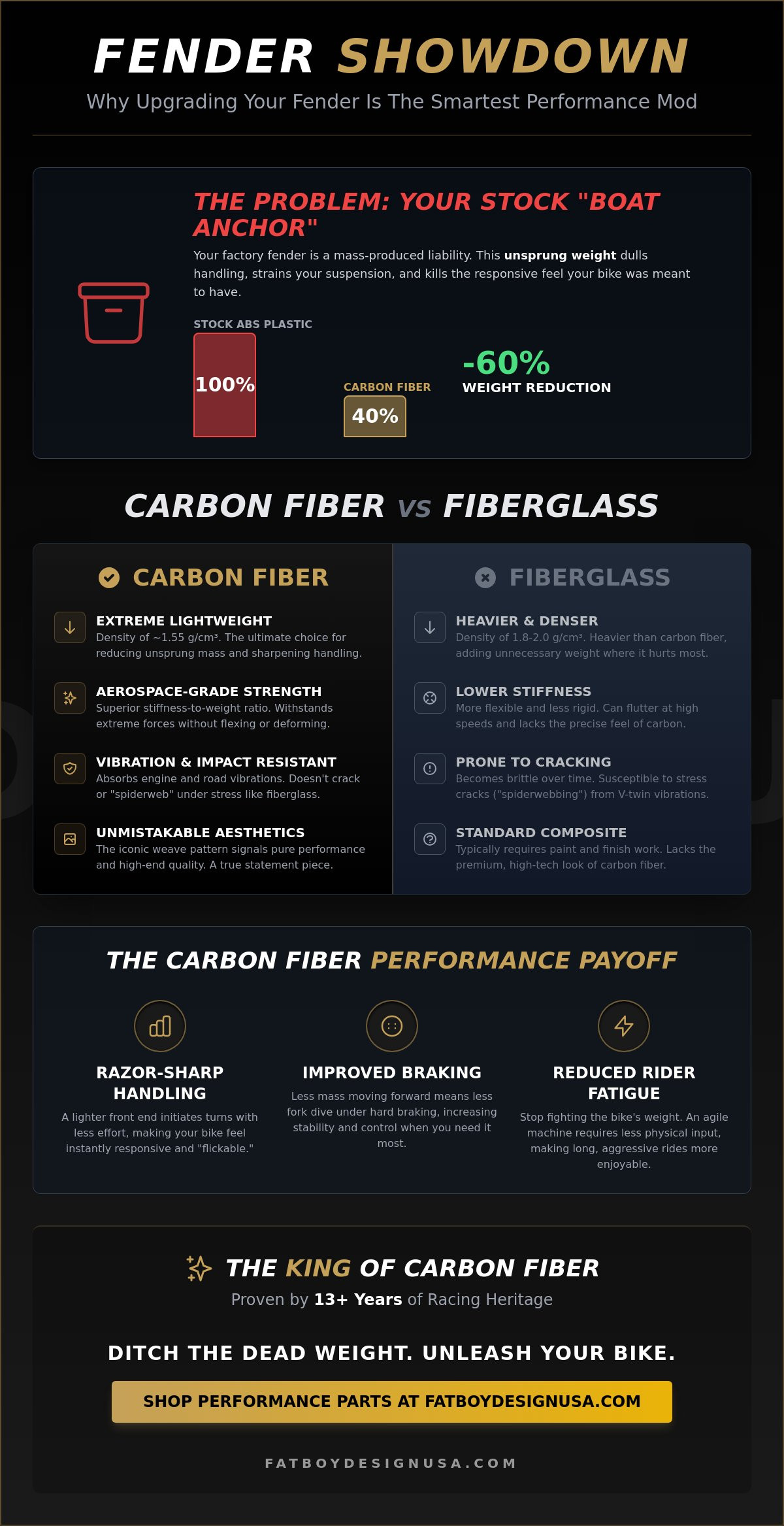
Stop pretending that massive piece of plastic or sheet metal on your front wheel is doing you any favors. It isn't. It is a weight tax you're paying every time you lean into a corner. When you start comparing carbon fiber vs fiberglass motorcycle fenders, you have to realize that weight isn't just a number on a spec sheet. It is a physical barrier between you and the perfect line. Your stock fender is a boat anchor. It’s dulling your bike’s senses and making your suspension work twice as hard for half the results.
Unsprung Weight and Your Suspension
Think of your suspension like a prize fighter. If his gloves are filled with lead, he’s slow. He can't react to a jab. Unsprung weight is exactly that lead. It is the mass that sits "below" the springs: your wheels, tires, brakes, and that chunky fender. For Bagger forks, unsprung weight is the specific mass that forces your suspension to fight physics just to keep your tire in contact with the ground. Every ounce you strip off that fender feels like pounds coming off the frame because of how it affects the leverage on your forks.
When you hit a pothole or a seam in the road, a heavy stock fender wants to keep moving up. Then it wants to stay down. Your springs and dampers have to wrestle that momentum to keep you stable. By switching to a material like Carbon-fiber reinforced polymer, you are cutting mass where it matters most. A carbon fiber front fender can weigh up to 60% less than the stock ABS version found on most Harleys. That isn't just a "nice to have" statistic. It means your front tire stays glued to the asphalt instead of bouncing like a basketball.
The 'Bagger Drag' Factor
Ever feel like your bike is "diving" too hard when you grab a handful of brake? That is the weight of the front end trying to bury itself. A heavy fender creates a pendulum effect that makes a 900lb machine feel like a 2,000lb tank. Racers who live for bagger racing parts know the secret: the front fender is the easiest way to fix your bike’s "flickability."
- Better Braking: Less mass moving forward means less fork dive and more stability.
- Snappier Handling: A lighter front end initiates turns with significantly less effort.
- Reduced Fatigue: You stop fighting the bike’s natural urge to stay upright, making long rides through the twisties a breeze.
Stock parts are designed by accountants to meet a budget. They are the enemy of pure performance. If you want a bike that snaps to attention the moment you look at a corner, you need to shed the dead weight. A performance bagger racer carbon fiber front fender isn't just a vanity project. It is about reclaiming the handling your bike was supposed to have before the factory choked it with "good enough" components. Ditch the drag and feel what your suspension is actually capable of doing.
Carbon Fiber vs. Fiberglass: The Nerd Stuff That Actually Matters
Let’s get under the clear coat. When you weigh the pros and cons of carbon fiber vs fiberglass motorcycle fenders, you’re looking at a battle between space-age tech and 1950s leftovers. Fiberglass is the old-school composite of the masses. It’s cheap, it’s easy to mold, and it’s been the "good enough" standard for decades. But "good enough" doesn't win races. Carbon fiber is the aerospace-grade weave of champions. It isn't just about looking cool; it’s about a molecular structure that eats vibration for breakfast.
Material Science 101 for Riders
Tensile strength is the name of the game. While we’ve talked about the raw power of carbon, the real magic is in the stiffness. Carbon fiber doesn't flex or flutter when you're hitting triple digits on the interstate because its atoms are locked into a rigid crystalline lattice. Compare that to glass fibers, which are essentially amorphous strands of melted sand that lack internal discipline. This rigidity ensures your aerodynamics stay consistent even under heavy wind load.
The use of Composite Materials in Automotive Industry applications has proven that density is the silent performance killer. Carbon fiber composites have a density of around 1.55 g/cm³, making them significantly leaner than fiberglass at 1.8 to 2.0 g/cm³. We use high-end epoxy resins to bind these fibers together, creating a part that is practically indestructible under normal riding conditions. If you want a bike that feels tight and responsive, you need materials that don't bend under pressure.
The Manufacturing Process Gap
Most fiberglass parts are hand-laid in a messy, wet process that leads to air bubbles and uneven thickness. It’s inconsistent. We do things differently in Matthews, NC. Our vacuum-infused and pre-preg processes ensure the resin is pulled through the weave perfectly. This eliminates the "dead weight" of excess glue. It’s how Fat Boy Design USA maintains the "King of Carbon Fiber" standard for every part that leaves our shop. There are no shortcuts here.
Every harley davidson carbon fiber component we make is designed to fit like a glove and shine like a mirror. Cheap imports use "wet" lay-ups that result in wavy finishes and poor fitment. Our parts are cured to perfection, ensuring they stand up to the heat and road grime of real-world riding. Why settle for a generic composite when you can have a racing-grade component built right here in the USA? Take a look at our Upper Carbon Platinum Series to see what happens when science meets style. It’s time to stop compromising on your build.
Performance Baggers vs. Show Bikes: Choosing Your Weapon
Pick a side. Are you building a machine that eats miles and carves corners, or are you building a trophy hunter that lives on a trailer? The choice between carbon fiber vs fiberglass motorcycle fenders usually comes down to your mission statement. If you're chasing the "Cholo Softail" look with floor-scraping fenders and a candy-paint job that costs more than a sedan, fiberglass makes sense. It’s a budget-friendly canvas for heavy flake and airbrushing. But if you're building for speed, fiberglass is just dead weight dressed in pretty colors. Performance baggers require a different level of discipline.
Let’s talk about the "Performance Bagger Tax." Yes, carbon fiber costs two to three times more than fiberglass. It’s an investment. But you aren't just paying for a look; you're paying for a structural upgrade that redefines how your bike moves. High-quality performance bagger parts are about efficiency. While a full fiberglass body kit can weigh up to 25 kg, a carbon fiber equivalent keeps things between 8 and 12 kg. That is a massive difference when you're trying to outrun physics on a heavy touring frame.
The Performance Bagger Checklist
Competitive racing demands parts that don't just sit there. They have to perform. Carbon fiber wins the heat game every single time. Near your high-performance calipers and rotors, heat soak can turn cheap resins into mush. Carbon fiber handles the thermal stress without warping. We use the Bagger Racing Carbon Fender as our benchmark for a reason. It’s designed to stay rigid under the extreme wind pressure and heat of the track. If your weight targets are aggressive, you can't afford the 18-25 kg bulk of a fiberglass setup. You need the lean, mean profile of a racing-grade weave.
The Aesthetics of the Weave
Paint hides sins. Raw carbon fiber exposes them. There is a specific kind of "flex" that happens at a bike show when you roll up with a perfect 2x2 twill weave under a deep, glass-like clear coat. You can’t fake that depth. While fiberglass is almost always destined for a paint booth to cover up its dull, fibrous texture, carbon fiber is the main event. It screams "high-end" without saying a word. It’s the ultimate aesthetic upgrade for riders who want their bike to look like it just rolled out of a Skunkworks hangar. Whether you're at a stoplight or a show, the visual dominance of carbon is undisputed. It doesn't just demand attention; it commands respect.
Beyond the Weave: Durability, Vibration, and the 'Crack' Factor
Your V-twin isn't just an engine. It’s a vibrating chaos machine. That legendary "Harley Shake" is great for the soul, but it’s absolute murder on cheap bodywork. When you look at carbon fiber vs fiberglass motorcycle fenders, you have to talk about harmonics. Fiberglass is rigid in all the wrong ways. Over time, those constant pulses from your engine turn into tiny fractures in the resin. We call it "spiderwebbing." One day your custom paint looks perfect; the next, it looks like a shattered mirror. Carbon fiber handles the stress differently. It’s built to endure the rhythmic violence of a high-performance bagger without breaking a sweat.
Vibration Dampening and Longevity
Carbon fiber is a master of high-frequency absorption. It doesn't just sit there; it dampens the buzz that usually rattles your bolts loose and numbs your hands. This material has incredible "memory." It can flex under the stress of high-speed wind resistance and snap right back to its original shape without structural fatigue. We don't just guess at this. Fat Boy Design USA components are racer-tested over thousands of miles of real-world abuse. While fiberglass gets brittle and tired after a few seasons of heat cycles, carbon fiber stays as crisp as the day you bolted it on. It’s the difference between a part that lasts and a part that’s just passing through your garage on its way to the scrap heap.
Road Debris and Impact Reality
Let’s kill a myth right now. Some riders think carbon fiber is fragile like a wine glass. That is total nonsense. If a rock hits your fender at 80mph, you want the material with the highest impact resistance possible. Fiberglass often cracks or chunks on impact, requiring messy resin repairs that never quite look right under a clear coat. Carbon fiber is engineered to take the hit. Contrary to what the internet experts say, high-quality carbon fiber is incredibly tough and does not shatter into a million pieces from a stray pebble.
If you do manage to gouge it, the structural integrity usually remains intact because the weave distributes the force. You aren't just buying a fender. You’re buying peace of mind for every highway mile, especially with the 2025 California rear fender laws requiring parts that actually stop debris spray. Ready to upgrade to something that actually survives the road? Grab a performance bagger racer carbon fiber front fender and see the difference for yourself. Ditch the cracks and embrace the weave. It is time to treat your bike to parts that can actually keep up with your lifestyle.
Joining the Carbon Club: Why Fat Boy Design Rules the Road
You’re not just buying a part. You’re joining a legacy. For 13 years, we’ve been the ones pushing the limits of what a Bagger can do. When you look at the carbon fiber vs fiberglass motorcycle fenders landscape, you see a lot of noise. We provide the signal. Being the King of Carbon Fiber isn't a self-proclaimed title; it’s a standard we’ve earned on the track. We don't hide behind corporate jargon. We speak the language of speed, aesthetics, and pure, unadulterated fun.
Our 'Platinum Series' represents the pinnacle of harley davidson carbon fiber engineering. These aren't generic components. They are exclusive, precision-fit elements designed to make your bike look like a million bucks while shaving off the dead weight that kills your handling. Start your journey with the Performance Bagger Racer Fender. It’s the easiest way to feel the difference immediately. Ditch the bulk. Feel the snap. Ride like you mean it.
American Made, Racer Tested
We do it all in Matthews, North Carolina. No overseas mystery meat. No global supply chain excuses. Every part is designed, molded, and cured in-house. We test our gear on the track before it ever touches your street bike. If it can’t handle a 140mph sweeper, it doesn't get the Fat Boy Design seal of approval. We’ve spent over a decade refining our processes so that 'affordable' never means 'cheap.' You’re getting racing-grade tech that’s built to survive the real world. We are riders. We are racers. We know exactly what your bike needs to outperform the pack.
The Ultimate Performance Bagger Build
A fender is just the gateway drug. To truly dominate the road, you need a cohesive setup. Pair your carbon with our Bagger Racing Triple Trees to lock in your front-end geometry. Create a visual masterpiece by adding carbon side covers, a dash, and saddlebag lids. This isn't just about weight anymore; it's about creating a machine that demands attention at every show and every stoplight. You’ve spent enough time guessing. You’ve spent enough time settling for heavy, sluggish components. Stop compromising. Start riding light. Join the club and see why Fat Boy Design rules the road.
Own the Road with Racing-Grade Tech
You’ve seen the science. You know why weight is the enemy of every great ride. Choosing between carbon fiber vs fiberglass motorcycle fenders isn't just about aesthetics; it’s about how your bike responds when you’re pushing the limits. Fiberglass is fine for the trailer. Carbon fiber is for the rider who demands zero compromise and instant response. We’ve spent over 13 years in professional racing proving that our parts don't just look fast; they are built to survive the rhythmic violence of your V-twin.
Every single component is manufactured in-house in Matthews, NC. We don't outsource your performance. Our parts are racer-tested for maximum durability so you can ride with total confidence. It’s time to stop dragging that heavy stock anchor around and start feeling what your bike can actually do. Enhance your ride. Embrace the weave. Join the club where the only rule is to stop taking life so seriously and start enjoying the curves. Your bike is waiting for its upgrade.
Upgrade to the King of Carbon Fiber: Shop FBD Fenders Now
Common Questions About High-Performance Fenders
Is carbon fiber really lighter than fiberglass for motorcycle fenders?
Yes, carbon fiber is significantly lighter, often weighing 40% to 60% less than fiberglass equivalents. A typical carbon fiber body kit stays between 8 and 12 kg, while fiberglass versions can balloon up to 25 kg. This massive weight drop is exactly what you need to kill that sluggish front-end feel and make your bike react instantly to every input.
Can you paint a carbon fiber motorcycle fender to match your Harley?
Absolutely, you can paint carbon fiber just like any other composite material. While many riders love showing off the raw 2x2 twill weave, you can scuff, prime, and spray it to match your factory Harley paint perfectly. It takes paint beautifully and won't require the heavy body filler often needed to smooth out wavy, hand-laid fiberglass parts.
Which is more durable for a daily rider: carbon fiber or fiberglass?
Carbon fiber is the clear winner for durability due to its superior tensile strength and fatigue resistance. It boasts a tensile strength of over 500 MPa, making it much tougher against the constant engine harmonics that cause fiberglass to spiderweb. For a daily rider, carbon handles the road grime and vibration without losing its structural integrity over time.
Why are carbon fiber motorcycle parts so much more expensive?
The higher cost comes from the expensive raw materials and the complex manufacturing process required to get it right. Carbon fiber parts typically cost two to three times more than fiberglass because they require vacuum infusion or autoclave curing to ensure maximum strength. You aren't just buying a fender; you're buying aerospace-grade tech that is built to outperform everything else on the road.
Do carbon fiber fenders crack easier than fiberglass fenders?
No, carbon fiber is actually less prone to cracking under normal riding conditions compared to fiberglass. Because it is stiffer and has a higher impact resistance, it doesn't flex and fatigue the same way. When comparing carbon fiber vs fiberglass motorcycle fenders, fiberglass is the material that usually ends up with stress fractures from those heavy V-twin vibrations.
How do I know if a carbon fiber fender will fit my specific Harley model?
Check the product specifications for your specific year and model, like the Touring or Softail lines. We design our fenders to be direct bolt-on replacements for OEM parts. Our precision molding ensures that the mounting holes line up perfectly every time. If you’re running an oversized front tire or a custom rake, just verify the clearance before you pull the trigger.
Does carbon fiber fade in the sun over time?
Only if it lacks a high-quality UV-inhibiting clear coat. Raw resin can yellow under the sun, but our parts are finished with premium UV protection to keep them looking glass-smooth for years. This protection prevents the material from becoming brittle or losing its deep, dimensional luster. Keep it clean, and it’ll stay the center of attention at every show.
Is fiberglass or carbon fiber better for Bagger racing?
Carbon fiber is the undisputed champion for Bagger racing. In a sport where every gram counts, the weight savings and heat dissipation of carbon fiber are essential for high-speed stability and braking performance. It’s the material of choice for anyone looking to shed 15 kg or more during a full widebody conversion for the track. Don't settle for second place with heavy fiberglass.