

Carbon Fiber vs Fiberglass Motorcycle Parts: The 2026 Performance Showdown
Is your heavy-ass Harley basically a boat anchor with wheels? If you're tired of your bike feeling sluggish in every corner while weighing the pros of carbon fiber vs fiberglass motorcycle parts, you aren't alone. We know you want a machine that's light, fast, and looks like a million bucks without the "oops, it cracked" fiberglass regret. It's time to join the club where the only rule is to stop taking the mundane seriously and start embracing pure, unadulterated speed.
Deciding on the right material is the difference between a sluggish cruiser and a track-ready performance beast. You deserve parts that don't fail under racing stress or spider-web after one bumpy ride. We promise to show you exactly why the right composite material is your ticket to that high-end weave aesthetic and physics-defying agility. No more settling for cheap materials that crumble when things get fast.
This 2026 performance showdown breaks down everything from weight to durability. We're diving into why carbon fiber is up to 20 percent lighter than fiberglass and how our racer-tested Platinum Series components are built to survive the track. Get ready to upgrade your environment and turn your ride into a visual masterpiece that moves as good as it looks.
Key Takeaways
- Drop the dead weight and learn how shedding pounds from your front end turns a sluggish cruiser into a corner-carving monster.
- Settle the carbon fiber vs fiberglass motorcycle parts debate once and for all by comparing raw strength, weight savings, and long-term durability.
- Protect your investment by discovering why cheap resins turn yellow and how to spot high-quality UV-resistant finishes that stay crystal clear.
- Get the inside scoop on our racer-tested Platinum Series, built right in North Carolina to handle the absolute chaos of professional Bagger racing.
- Master the art of the high-end weave aesthetic to give your Harley a visual dominance that screams performance even when it's parked.
Why Your Bagger is Heavy (And Why Materials Matter)
Let’s talk about the elephant in the garage. Your Harley is built like a tank. That is great for looking tough at a stoplight, but it is a nightmare when you actually want to lean into a corner. Weight is the silent killer of every epic ride. It turns a potential track-ready performance beast into a sluggish cruiser faster than you can say "factory stock." Manufacturers love cheap materials like ABS plastic and standard fiberglass because they are easy on the production budget. Unfortunately, they are incredibly heavy on your bike's soul. Shedding just 20 pounds of dead weight can feel like you just bolted on an extra 5 horsepower. It is pure physics. When you drop the pounds, you gain the freedom to actually ride. Trim the fat.
The Weight Penalty on Performance
Your suspension is constantly fighting a losing battle against bulky body parts. When we talk about harley davidson carbon fiber, we are targeting unsprung weight. This is the weight that hangs off your forks and swingarm without the help of your springs. A heavy front fender or a chunky rear fender forces your suspension to work harder to keep the rubber on the road. This creates that sluggish feeling in tight corners that makes you feel like you are steering a cruise ship. Racers obsess over every single ounce of savings because they know that agility is earned, not given. If you want your bike to react to your inputs instantly, you have to stop carrying around the extra baggage. Performance isn't just about the engine; it is about how much mass that engine has to move.
Fiberglass: The Old School Standard
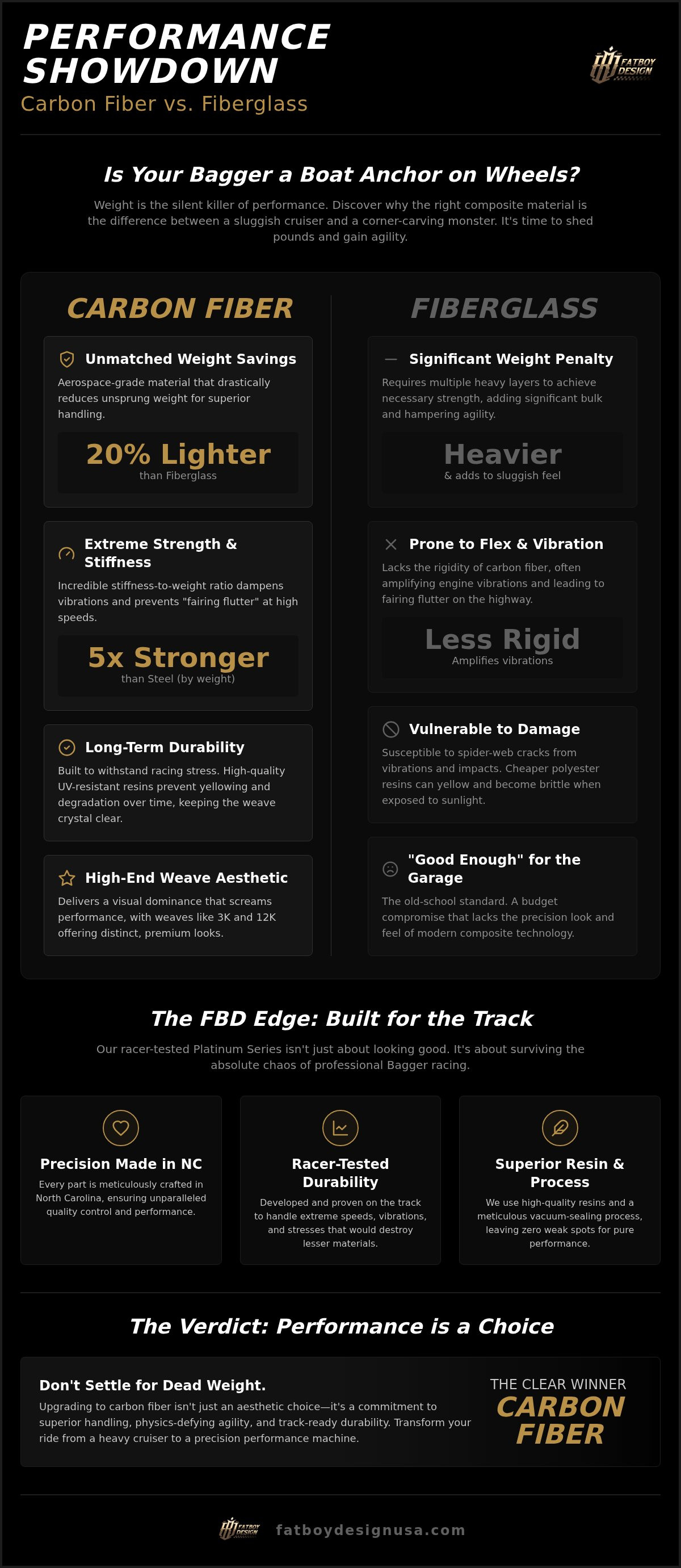
Fiberglass has been the go-to for custom builders for decades. It is a simple recipe of glass fibers mixed with polyester resin. It is definitely an upgrade over old-school steel, but it has its limits. To make fiberglass strong enough to survive the brutal vibrations of a big V-twin, you have to layer it up. All those layers add up to a serious weight penalty. When you compare carbon fiber vs fiberglass motorcycle parts, fiberglass is the "good enough" option for the garage. However, it cannot touch the high-tech efficiency found in the science of carbon fiber. While fiberglass is roughly 20 to 30 percent lighter than standard plastic, it still feels like a lead weight compared to aerospace-grade materials. It is time to stop settling for the old-school standard and start demanding real performance. Your bike deserves better than a budget compromise.
The Science of Speed: Carbon Fiber’s Unfair Advantage
Carbon fiber is the undisputed heavyweight champion of the lightweight world. It is not just about looking cool at the local bike night. It is about atomic bonds. Carbon atoms are locked in a crystal alignment that creates extreme tensile strength. Imagine a material five times stronger than steel but light enough to float. That is the magic ratio. When you compare carbon fiber vs fiberglass motorcycle parts, the stiffness-to-weight ratio is the deciding factor. High-quality resin and a meticulous vacuum-sealing process ensure there is zero wasted space. No air. No weak spots. Just pure, unadulterated performance that makes your bike feel like it is on rails.
Woven for War: Structural Integrity
You see those numbers like 3K, 6K, or 12K? They are not just random codes. They tell you how many thousands of carbon filaments are in each bundle of the weave. A 3K weave is tight and light. A 12K weave is chunky and bold. Directional strength is the secret weapon here. We can layer the fibers to handle specific stresses, making parts thinner and tougher than anything else on the market. Tensile strength is the maximum amount of pulling force a composite can endure before it snaps under the brutal pressure of high-speed racing. It is the backbone of structural integrity. Check out the Upper Carbon Platinum Series to see what real precision looks like.
Stiffness and Vibration Dampening
Your V-twin is basically a mobile earthquake. It shakes everything. Fiberglass struggles with that constant buzzing. It eventually leads to "fairing flutter" at highway speeds, which is as annoying as it sounds. Carbon fiber is inherently stiffer. It dampens engine vibration instead of amplifying it. When weighing carbon fiber vs fiberglass motorcycle parts for your cockpit, the difference is clear in your hands. Think about the contrast between a shaky plastic dash and a rock-solid carbon one. It feels crisp. It feels high-end. It feels like you actually care about your ride. You get a smoother experience without the extra bulk. It is a win-win for your hands and your lap times.
The Ultimate Showdown: Carbon Fiber vs. Fiberglass
It is the heavyweight title fight of the century. In one corner, we have the elite athlete. In the other, the weekend warrior. When we talk about carbon fiber vs fiberglass motorcycle parts, we are really talking about the difference between a podium finish and a participation trophy. Carbon fiber is the undisputed king of the track. It is roughly 20 percent lighter than fiberglass, which might not sound like much until you are trying to flick an 800-pound bagger through a chicane. Fiberglass is the budget-friendly cousin. It gets the job done for basic bodywork, but it lacks the soul and the science that makes carbon fiber a game-changer.
Let’s talk about the vibe. Visual aesthetics matter. That raw, shimmering carbon weave is the ultimate flex. It tells the world you don't compromise. Fiberglass? You have to paint it to hide its messy secrets. Then there is the heat. Your V-twin is basically a mobile furnace. Carbon fiber possesses incredible thermal stability, meaning it won't warp or go soft when the sun is beating down and your engine is screaming. It stays rigid. It stays true. It stays badass.
Weight and Aerodynamics
Every ounce you shave is a victory. Swapping your stock unit for a Carbon Fiber Front Fender is the easiest way to feel an immediate difference in your steering. Because carbon is so much stronger, we can make the profiles thinner. This leads to better airflow and improved cooling for your brakes and engine. Think about the cumulative effect. Combine that fender with carbon saddlebags, a dash, and side covers. Suddenly, you aren't just riding a bike; you are piloting a precision instrument. You'll feel the agility in your wrists and the speed in your chest.
Impact Resistance and Failure Points
What happens when a stray rock hits your bike at 80mph? If you're running cheap fiberglass, you'll likely see "spider-webbing." Those tiny, ugly cracks spread through the resin like a virus. There is a common myth that carbon fiber just shatters like glass. That might have been true in the 90s, but modern aerospace-grade composites are built for war. Our Bagger Racing Parts are designed to take a beating and keep their structural integrity. We have seen these parts survive track slides that would turn fiberglass into a pile of white dust. It is about resilience. It is about knowing your bike won't fall apart when the road gets rough. Stop settling for fragile. Start riding with confidence.
Real-World Durability: Which One Survives the Road?
Let’s get real about the elements. The sun is not just for beach days; it is a giant UV laser aimed directly at your bike's finish. When you are weighing carbon fiber vs fiberglass motorcycle parts, durability isn't just about surviving a crash. It is about surviving a Tuesday in July. Cheap carbon fiber is notorious for turning a nasty shade of yellow or looking cloudy after just one season. It is embarrassing. You didn't buy a premium part to have it look like a piece of old Scotch tape. If you want that weave to pop for years, you need to understand what is happening under the surface. High-end parts stay crisp. Cheap ones fade into the mundane.
UV Resistance and Clear Coats
The secret to longevity is a high-quality, automotive-grade UV-resistant clear coat. Without it, epoxy resin degrades and yellows under sunlight. We use premium resins that prevent structural softening over time. You can spot a low-quality 'carbon-look' part from a mile away. They usually have a wavy finish or a weird, plastic-wrap sheen. Real carbon fiber from our shop is built to stay crystal clear through years of abuse. It is the difference between a high-end masterpiece and a cheap knockoff. Don't let your bike suffer from a bad tan. Grab the good stuff from our Upper Carbon Platinum Series and keep that finish flawless.
The 'Daily Rider' Test
When comparing carbon fiber vs fiberglass motorcycle parts for a daily rider, think about the long-term abuse. Road salt, grime, and engine heat are part of the game. Fiberglass is a champ at absorbing impacts, but it is also prone to soaking up chemicals if the gel coat is compromised. Carbon fiber is chemically inert. It doesn't care about road salt. It handles the brutal torque of a Harley frame without flinching. Dry carbon is the gold standard for durability because it uses a pre-impregnated resin system cured under high pressure, resulting in a part with zero excess weight and maximum strength. Can you repair a cracked fender? Fiberglass is easier to patch with a DIY kit. Carbon fiber requires a pro. But here is the kicker: you are way less likely to crack the carbon in the first place. It is built for the long haul. It is built for speed. It is built for you.
The FBD Edge: Why Our Carbon Fiber Rules the Track
We don't just build parts; we build legends. Right here in Matthews, North Carolina, we've spent the last 13 years perfecting the art of the performance bagger. This isn't some corporate boardroom project. It's a racer-tested obsession born on the world's fastest tracks. Every mold in our shop carries the DNA of professional racing. When you're stuck in the middle of the carbon fiber vs fiberglass motorcycle parts debate, remember that only one of these materials is actually trusted by the guys pushing high horsepower through a corner. We are the kings of carbon fiber for a reason.
Our Upper Carbon Platinum Series is the absolute industry benchmark. We don't do compromises. We don't do "good enough." We provide the zero-compromise solution for riders who want visual dominance and physics-defying speed. When you compare carbon fiber vs fiberglass motorcycle parts at the highest level, the FBD edge is undeniable. These are affordable, racer-tested parts that bring elite technology to your local bike night. Join the club. Reject the mundane. It's time to see what happens when 13 years of racing expertise hits the pavement.
Racer-Tested, Rider-Approved
We put our Bagger Racing Carbon Fender through absolute hell before it ever touches your bike. We test these components under extreme loads that would turn mass-produced fiberglass into a pile of dust. Because we handle all our manufacturing in-house, we maintain total quality control. No cheap resins. No weak spots. Professional racers choose FBD because they need parts that survive the chaos of the track. If it's good enough for the podium, it's more than good enough for your daily commute. Trust the process. Trust the win.
Complete Your Build
Don't stop at a single fender. To truly kill the weight, you need a cohesive, lightweight look. We offer everything from saddlebags to side covers to help you shed every possible pound. For the ultimate control, pair your carbon kit with our Performance Steering Damper Kit. It's the secret to keeping your front end stable while you're flicking that lightweight machine through the twisties. The steering damper provides the precision your new, agile bike demands. Dive into our full harley davidson carbon fiber collection and start building the performance beast of your dreams. Your bike is waiting for its upgrade.
Take the Lead: Kill the Weight Today
Your bike is more than just a machine. It is a statement of intent. We have settled the carbon fiber vs fiberglass motorcycle parts debate for good. You know that shedding pounds translates directly to faster cornering and better suspension response. While fiberglass is fine for a basic build, it cannot touch the structural integrity or the high-end weave of elite carbon. Don't let a heavy front end or a yellowing fairing hold you back from the ride you deserve. It is time to embrace the speed you have been missing.
At Fat Boy Design USA, we have 13+ years of professional racing pedigree baked into every mold we create. We build everything right here in Matthews, NC, using racer-tested durability standards that the mass-produced guys simply cannot match. It is time to join the club and stop taking the mundane so seriously. Transform your environment and your riding experience with parts that are actually built to win. Your Harley is waiting for its evolution. Make it happen.
Upgrade to the King of Carbon Fiber - Shop FBD Now
Frequently Asked Questions
Is carbon fiber really stronger than fiberglass for motorcycle bodywork?
Yes, it is a total beast. When choosing carbon fiber vs fiberglass motorcycle parts, remember that carbon handles the brutal vibrations of a big V-twin without flinching. It leaves fiberglass in the dust regarding tensile strength and pure rigidity. Because it is so much stronger, we can make parts thinner and tougher. You get a rock-solid component that doesn't weigh your bike down like a lead sled.
Will carbon fiber motorcycle parts turn yellow in the sun?
Only the cheap junk does that. High-quality parts use automotive-grade UV-resistant clear coats to block those nasty rays. We use premium resins in our shop to ensure your weave stays crystal clear for years. If you buy a bargain part from a random site, expect it to look like a yellowed newspaper by next season. Buy once, cry once. You don't want your ride looking like a relic.
Can you paint over carbon fiber parts if you don't like the weave?
Go for it. You can totally paint over the weave if you want that sleeper look. You don't have to show off the carbon to benefit from it. Plenty of pro racers paint their carbon to match team colors while still reaping the massive weight-saving benefits. Just have a pro handle the prep work so the finish sticks. You get stealthy vibes and aerospace tech in one package.
How much weight can I actually save by switching to carbon fiber?
You can drop a serious amount of bulk. Carbon fiber is up to 20 percent lighter than fiberglass and significantly lighter than stock ABS plastic. When you're looking at carbon fiber vs fiberglass motorcycle parts, remember that every ounce counts. Shedding weight from your front fender or saddlebags makes your Harley feel like it finally went on a diet. It's the easiest way to gain instant agility.
Is fiberglass easier to repair than carbon fiber after a crash?
Fiberglass is definitely easier for a quick DIY patch. You can grab a repair kit at the local shop and go to town. Carbon fiber usually needs a specialist to fix cracks properly without losing its strength. But remember, carbon is way more resilient. It often survives impacts that would turn fiberglass into a pile of sad, white spider-webs. It's built for the long haul and high speeds.
Are carbon fiber parts worth the extra cost for a street-only Harley?
Do you like having a bike that actually handles? If the answer is yes, then it's worth every penny. Even if you never hit a track, the improved agility and crisp feel of carbon make every corner more fun. Plus, the visual dominance of a carbon dash or side covers is the ultimate flex at any bike night. Stop settling for mundane parts and start enjoying your ride.
What is the difference between 'wet' and 'dry' carbon fiber?
Dry carbon is the high-performance gold standard. It uses pre-impregnated resin and high-pressure curing to eliminate every gram of unnecessary weight. It's stronger and more consistent than wet carbon, which is made by hand-brushing resin onto the fabric. Wet carbon is cheaper, but it's heavier and lacks the structural perfection of the dry stuff. We don't do compromises. We only do the absolute best.
Do carbon fiber parts require special cleaning products?
Treat it like your favorite paint job. Stick to pH-neutral soaps and soft microfiber towels to keep things scratch-free. A quick hit of spray wax or a ceramic coating will keep that UV protection strong and the shine popping. Stay away from abrasive cleaners or stiff brushes. You don't want to bury that beautiful weave under a layer of nasty swirl marks. Keep it clean and simple.