

Carbon Fiber vs. Fiberglass Motorcycle Parts: Which Reigns Supreme?
Your Harley shouldn't feel like you're trying to steer a freight train through a bathtub. If your "performance" upgrade is just cheap fiberglass that's destined to spiderweb before your next oil change, you're doing it wrong. Let's be real; nobody wants a bike that handles like a tank. When it comes to the showdown of carbon fiber vs fiberglass motorcycle parts, the difference isn't just about looking cool at the local bike night. It's about shedding that dead weight and finally feeling what your engine can actually do.
We know you're tired of the marketing jargon and confusing talk about "weaves" that sounds more like a trip to the hair salon than a garage. You want a bike that's snappy, responsive, and built to last a lifetime without structural failure. Today, we're stripping away the fluff to give you the brutal truth about weight, strength, and track-ready performance. You'll discover how switching to high-end composites can make your components up to 40% lighter than fiberglass alternatives. We're showing you exactly how to turn that heavy bagger into a high-end, race-tested machine that commands respect on every corner.
Key Takeaways
- Stop guessing. Learn why the choice of carbon fiber vs fiberglass motorcycle parts is the literal foundation of a performance build that doesn't handle like a wet sponge.
- Discover the "hand-laid" secret. It's the difference between a fender that lasts a lifetime and a cheap part that cracks under the slightest pressure.
- Kill the "Bagger Wobble" for good. We'll show you how material rigidity stops your fairings from fluttering like a nervous bird at high speeds.
- Forget the price tag and focus on value. High-end carbon holds its resale worth while cheap fiberglass usually ends up in the dumpster.
- Get the track-ready truth. Find out why racer-tested parts from North Carolina are the ultimate performance flex for riders who actually ride hard.
The Material Showdown: Why Your Choice Defines Your Ride
Stop settling for stock. Your Harley deserves better than heavy plastic or brittle "budget" glass. Picking sides in the battle of carbon fiber vs fiberglass motorcycle parts is the first real decision you make when building a performance bagger. It's the foundation of your entire build. Get this wrong, and you're just putting lipstick on a pig that still handles like a tractor. The right material doesn't just change the look; it changes the way the bike talks to you on every corner.
Most of the internet is currently stuck in a "helmet trap." They'll tell you all about how materials absorb impacts for your skull, but body parts are a different beast entirely. Your fenders, lids, and side covers don't need to crush; they need to stay rigid under extreme wind pressure and engine vibration. We aren't looking for a one-time safety buffer here. We're looking for structural integrity that survives the track and the street without flinching. This distinction is why comparing carbon fiber vs fiberglass motorcycle parts for your bodywork is so critical.
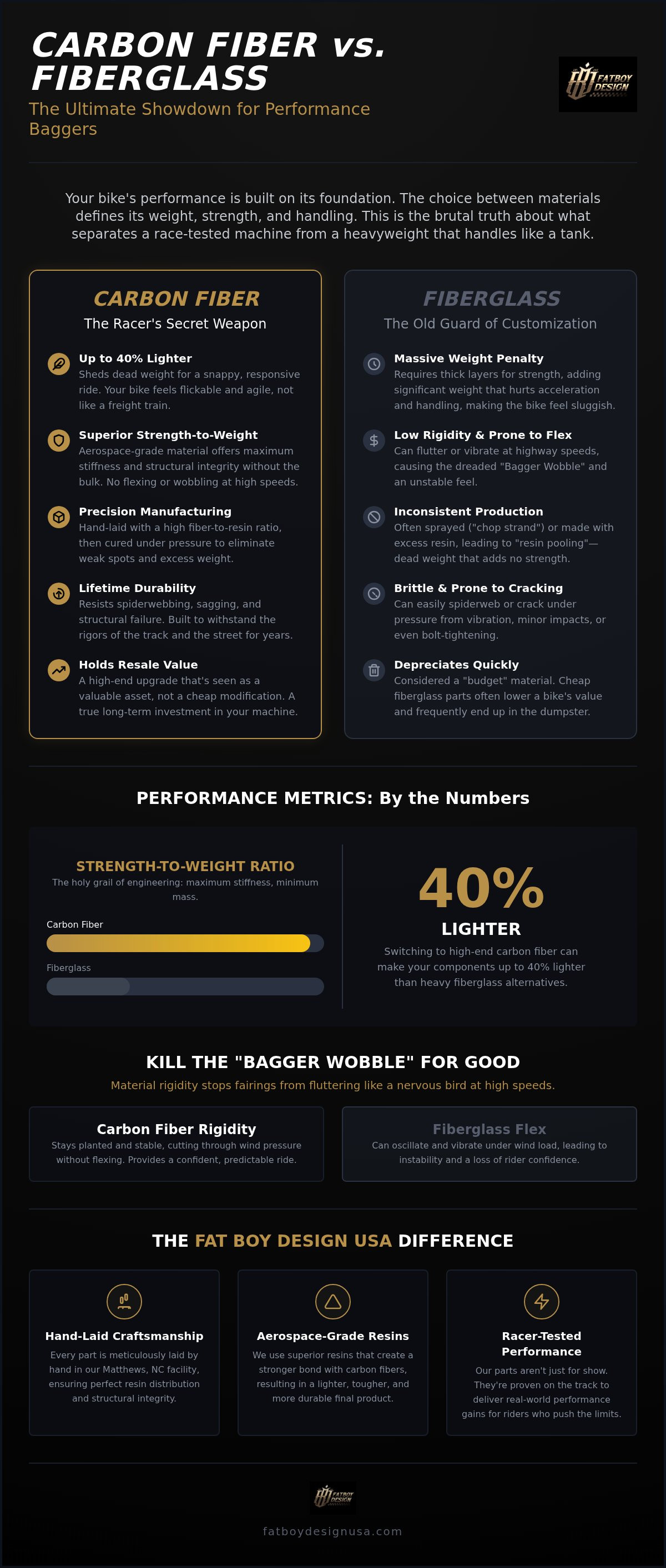
Think of the strength-to-weight ratio as your bike’s "punch per pound." It is the holy grail of modern engineering. You want maximum stiffness with minimum gravity-sucking mass. You want a bike that feels light between your knees but stays planted when you're pinning the throttle.
Fiberglass: The Old Guard of Customization
Fiberglass is the grizzled veteran of the custom world. It’s a cocktail of woven glass fibers and resin that has been the go-to since your grandpa’s first Panhead. It dominated the scene for decades because it’s incredibly cheap to produce and easy to mold into wild, flowing shapes. If you want a crazy one-off show bike that never leaves the trailer, fiberglass is your friend. However, it carries a massive weight penalty. To make fiberglass strong enough to handle 80mph highway gusts without fluttering like a leaf, you have to pile on the layers. Before you know it, your "custom" part weighs as much as the stock steel it replaced. It’s the dad bod of materials: functional, but definitely not fast.
Carbon Fiber: The Racer’s Secret Weapon
This is where things get serious. Carbon fiber isn't just a fancy sticker; it’s a high-tech composite made of atomic-level carbon chains bonded with aerospace-grade resins. This material, technically known as Carbon Fiber Reinforced Polymer, migrated from Formula 1 cockpits and fighter jets straight to the bagger racing parts community. It offers a level of longevity that fiberglass simply can't touch. When you aim for "King of Carbon Fiber" status, you're investing in harley davidson carbon fiber components that won't spiderweb, won't sag, and will keep your bike feeling flickable for a lifetime. It’s the ultimate performance flex for riders who actually ride.
The Science of the Weave: How These Parts are Actually Made
Forget the assembly lines and mindless robots. Real performance is born from human hands. When you look at the debate of carbon fiber vs fiberglass motorcycle parts, you're really looking at the difference between mass-produced bulk and artisan precision. At Fat Boy Design USA, we keep the magic in-house at our Matthews, NC facility. This isn't just about pride; it's about control. We know exactly how much resin goes into every layer because we're the ones laying it down by hand. This human touch ensures that every curve of your bike is backed by structural integrity, not just luck.
Resins act as the unsung hero, the literal glue that holds your performance together. In the fiberglass world, manufacturers often drown the fibers in resin to hide imperfections or speed up the process. This leads to "resin pooling," which adds dead weight without adding a single ounce of strength. Carbon fiber, however, thrives on a much higher fiber-to-resin ratio. By using high-pressure curing, we squeeze out the excess junk. The result is a part that is incredibly dense, structurally sound, and light enough to make your bike feel like it just shed a hundred pounds of useless fat.
Fiberglass Production: Layers and Bulk
Fiberglass usually comes in two flavors: "Chop Strand" and "Woven Mat." Chop strand is basically liquid glass and glue sprayed into a mold. It's cheap, it's fast, and it's heavy as a bag of wet sand. Woven mat is a step up, but it still requires massive thickness to stay rigid under pressure. Because fiberglass isn't as naturally stiff, builders have to pile on the layers to prevent the part from flopping. This creates a bulky profile that easily traps air bubbles. Those tiny pockets of air are ticking time bombs that eventually lead to the dreaded spiderweb cracks that ruin your expensive custom paint job.
Carbon Fiber Engineering: Precision over Piles
Carbon fiber is a different animal entirely. You'll often hear about "3k" or "12k" weaves. These numbers represent the thousands of carbon filaments in each bundle, or "tow." A 3k weave gives you that tight, iconic race look, while 12k offers a broader, bolder pattern. We use vacuum bagging to pull a literal ton of pressure onto the part while it cures. This eliminates air and creates a uniform bond that fiberglass can't touch. Tensile strength is simply the measure of how much your parts can resist being pulled apart while your 100mph bagger tries to shed its skin on the open road. If you want that level of security, it's time to check out our harley davidson carbon fiber collection for parts that actually perform.
Performance Metrics: Weight, Rigidity, and the "Bagger Wobble"
Handling isn't just about how much horsepower you're packing. It's about how your bike fights gravity. Shedding weight at the wheels is the fastest way to turn a heavy tank into a precision scalpel. This is the magic of reducing unsprung weight. When your suspension doesn't have to fight a heavy, oscillating fender, it reacts faster. You feel the road, not just the bumps. In the showdown of carbon fiber vs fiberglass motorcycle parts, carbon wins the handling war every single time. It keeps your tires glued to the pavement instead of bouncing over it like a beach ball.
High-speed runs are where the truth really comes out. Have you ever looked at a fiberglass fairing while doing 90mph? It flutters. That flex creates drag and, worse, contributes to the dreaded "bagger wobble." Carbon fiber stays rock-solid. It maintains its aerodynamic shape even under extreme wind pressure. This rigidity means your bike stays stable while everyone else is white-knuckling their handlebars. It’s the difference between a smooth glide and a shaky ride.
Shedding Lbs: The Carbon Fiber Diet
Let’s talk real numbers. Swapping a clunky stock or fiberglass part for a Carbon Fiber Front Fender is the ultimate weight-loss program for your Harley. Industry data shows that carbon fiber components for motorcycles are typically up to 20% lighter than their fiberglass cousins. That might not sound like much on paper, but you’ll feel it the moment you dive into a corner. Less weight means your brakes don’t have to work as hard to stop the rotation. Your acceleration gets a natural shot of adrenaline. Suddenly, your bike feels flickable. It’s a psychological boost that makes you want to lean just a little bit further every time.
Structural Integrity: No More Cracks
Fiberglass is famous for "spidering." Over time, the constant vibration of a big V-twin engine causes tiny fractures in the brittle resin. These cracks spread like a bad rumor until your custom paint job looks like a shattered mirror. Carbon fiber has superior fatigue resistance. It is built for the long haul. People love to claim carbon fiber is brittle, but that’s a total myth for high-quality, hand-laid parts. It survives rock chips at 80mph far better than fiberglass, which tends to chip and flake off in chunks. Our bagger racing parts are racer-tested for a reason. If they can survive a season of track abuse, they’ll survive your weekend adventures without flinching.
The Financial Reality: Is the Upgrade Worth the Investment?
Let’s have a heart-to-heart with your wallet. We know; building a dream bagger feels like a constant battle between your bank account and your desire to be the fastest guy on the block. When you weigh the costs of carbon fiber vs fiberglass motorcycle parts, it’s easy to get blinded by the initial price tag. But here is the brutal truth: cheap parts are a luxury you can’t afford. If you’re constantly replacing cracked fairings or repainting "budget" glass, you aren't saving money. You’re just paying a subscription fee to stay slow. At Fat Boy Design USA, we’ve seen plenty of riders spend twice as much in the long run just trying to avoid the premium choice upfront.
The "Buy Once, Cry Once" philosophy is the only way to live. High-end carbon fiber components aren't just an expense; they’re an investment in your bike’s future. Because these parts don't degrade under the stress of a V-twin’s vibration, they hold their resale value like a gold bar. Try selling a used, spider-webbed fiberglass fender on a forum. You’ll get pennies. Sell a pristine carbon piece? You’ll have a line of riders at your door. You can’t put a price on the "Cool Factor" of looking like a pro while your buddies are still struggling with heavy, outdated materials.
Fiberglass: The Budget-Friendly Trap?
Fiberglass looks cheap on the invoice, but the hidden costs will haunt you. Most fiberglass parts arrive with pits, pinholes, and uneven surfaces that require hours of professional sanding and prep before paint can even touch them. You’ll spend a fortune on labor just to make a "cheap" part look decent. Then there is the repairability myth. Sure, you can patch fiberglass with a kit from the hardware store, but it will never look the same. You’ll always see the ghost of that repair under your paint. Most riders eventually get tired of the "replacement cycle" and buy carbon anyway. Save yourself the headache and skip the middleman.
Carbon Fiber: The Premium Path
Choosing carbon fiber means choosing a material that stays show-ready for a lifetime. With a high-quality UV-protected clear coat, your parts will resist yellowing and fading under the sun. Maintenance is a breeze. Just wash, wax, and go. At Fat Boy Design USA, we focus on providing affordable carbon fiber that doesn't cut corners on racing specs. We’ve stripped away the middleman markups so you can get track-ready durability without the "superbike" price tag. It is the smartest way to upgrade your environment and your ride simultaneously.
Stop treating your bike like a science project and start treating it like the investment it is. If you want that pro-level look without the pro-level debt, shop our harley davidson carbon fiber collection and join the club of riders who refuse to settle for second best.
Why Fat Boy Design USA Carbon Fiber Crushes the Competition
Look, anyone can buy a mold and some resin. But not everyone can build a part that survives a 120mph corner at Daytona. We aren't just some faceless corporation hiding behind a glossy catalog. We are Fat Boy Design USA. We build every single component in-house right here in Matthews, NC. No middlemen. No offshore shortcuts. When you choose between carbon fiber vs fiberglass motorcycle parts, you aren't just picking a material; you're picking a team. Our team is obsessed with making your Harley the absolute best version of itself. The debate ends the moment you pull your first FBD component out of the box and feel how light it really is.
If you want the absolute peak of aesthetics and performance, our FBD Exclusive parts in the Platinum Series are the answer. These aren't just accessories; they're members of your inner circle. We treat them with the respect they deserve because we know they're going on a machine that defines your lifestyle. Stop compromising with heavy, brittle alternatives. Start dominating the road with parts that were born for the spotlight. It is time to reject the mundane and embrace a ride that actually responds when you talk to it.
The Fat Boy Design USA Racing Pedigree
Thirteen years. That is how much professional racing insight is baked into every fender and side cover we ship. We don't just "hope" our gear works. We test our Bagger Racing Parts in the most brutal real-world conditions imaginable. If a component can survive a full season of track abuse, your daily commute or cross-country tour is a walk in the park. This is our "Lovable Extrovert" promise to you: we stand by our gear because we ride it ourselves. Every. Single. Day. We’ve seen what happens when carbon fiber vs fiberglass motorcycle parts go head-to-head on the track, and we know which one brings home the trophy.
Your Next Step to Performance
Ready to join the club? Choosing your first component is the only hard part. If you want an immediate handling boost, go for a front fender to kill that unsprung weight we talked about earlier. If you want to transform your cockpit and stare at perfection all day, a carbon dash is a total game-changer. We designed our parts for a perfect fit, so you won't be spending your entire weekend fighting with a drill and a prayer. It is time to upgrade your beast and leave that "tank-like" handling in the rearview mirror. Shop Fat Boy Design USA Carbon Fiber Now and feel the difference for yourself.
Stop Dragging and Start Flying: Your High-Performance Future
The choice between carbon fiber vs fiberglass motorcycle parts isn't just about weight; it's about how you want your bike to behave when the road gets demanding. We've seen the truth. Fiberglass is a heavy, brittle relic of the past that eventually cracks under the pressure of real riding. Carbon fiber is the future. It’s the secret to shedding that "bagger wobble" and finally feeling the responsiveness your Harley was built for. By choosing hand-laid components, you're investing in parts that last a lifetime and look like a million bucks at every stoplight.
Don't settle for mass-produced junk. At Fat Boy Design, we bring over 13 years of professional racing expertise to every piece we create in our North Carolina facility. We focus on affordable, racer-tested performance that bridges the gap between the track and the street. You deserve a bike that’s as bold and energetic as you are. It’s time to stop overthinking and start upgrading.
Upgrade Your Ride with Racer-Tested Carbon Fiber and join the club of riders who prioritize pure enjoyment. See you on the road!
Frequently Asked Questions
Is carbon fiber really stronger than fiberglass for motorcycle parts?
Yes, carbon fiber beats fiberglass in strength every single day. While fiberglass is flexible, carbon fiber offers superior rigidity and structural integrity. This means your parts won't sag or flutter when you're pinning the throttle. It’s the difference between a material that survives the track and one that just survives the driveway. When comparing carbon fiber vs fiberglass motorcycle parts, carbon is the undisputed champion of durability for high-speed runs.
How much weight can I actually save by switching to carbon fiber fenders?
You can expect to shed some serious pounds. Industry data shows carbon fiber motorcycle parts are typically 20% lighter than their fiberglass equivalents. On a heavy Harley bagger, losing that unsprung weight at the front wheel transforms your handling. It makes your bike feel flickable and responsive instead of feeling like you're steering a lead sled. It’s the fastest way to improve your braking distance and acceleration without touching the engine.
Does carbon fiber crack more easily than fiberglass if I hit a pothole?
Not if it’s built right. While cheap, mass-produced carbon can be brittle, our hand-laid components are designed for racing abuse. Fiberglass actually tends to "spiderweb" and crack more easily over time due to engine vibrations and road impacts. Carbon fiber has incredible fatigue resistance; it handles the constant thumping of a V-twin without losing its cool. It’s built to survive the real world, including those nasty potholes that ruin lesser parts.
Can I paint over carbon fiber parts if I want a specific color?
Absolutely, you can paint them just like any other body part. While most riders love showing off that iconic carbon weave, these parts take paint beautifully. You get the massive weight savings of carbon fiber while keeping your custom color scheme perfectly intact. Just make sure your painter knows they're working with high-end composites. You get the best of both worlds: the "King of Carbon Fiber" performance with your signature show-bike aesthetic.
Why is carbon fiber so much more expensive than fiberglass?
It comes down to the science and the sweat. Carbon fiber requires high-tech resins, vacuum bagging, and intense pressure to achieve its legendary strength. It’s a labor-intensive process that can't be rushed. Fiberglass is cheap because it's mass-produced with basic materials. When evaluating carbon fiber vs fiberglass motorcycle parts, you’re paying for aerospace-grade technology that lasts a lifetime. It’s a "buy once, cry once" investment that pays off in performance and resale value.
Is carbon fiber UV resistant or will it turn yellow over time?
High-quality carbon fiber stays crystal clear if it has the right protection. We use premium, UV-resistant clear coats on all our parts to prevent yellowing or fading from sun exposure. Cheap carbon parts from "mystery" factories often skip this step, leading to a nasty yellow tint after a few months. Our gear is designed to look show-ready for the long haul, whether you're parked at a bike night or crossing the desert.
What is the best carbon fiber part to start with for a Harley Bagger?
Start with the front fender if you want an immediate handling boost. Reducing unsprung weight at the front wheel makes the biggest difference in how your bike dives into corners. If you’re more about the "cockpit view," go for a carbon fiber dash. It’s the part you’ll see every time you look down, and it instantly levels up the prestige of your ride. Both are easy installs that provide a massive performance win.
Are Fat Boy Design carbon fiber parts made in the USA?
You bet they are. Every single Fat Boy Design component is manufactured in-house at our facility in Matthews, North Carolina. We don't believe in offshore shortcuts or faceless factories. By keeping production local, we maintain total control over the hand-laid process and ensure every part meets our racer-tested standards. When you buy from us, you're supporting American craftsmanship and getting gear that we’re proud to run on our own bikes.