

Choosing the Right Triple Tree for a Chopper: The Ultimate 2026 Geometry Guide
Your front end is either a masterpiece of engineering or a high-speed disaster waiting to happen. There is no middle ground when you are chasing that iconic long and low stance. Most builders get paralyzed by the math, fearing the dreaded speed wobble or buying parts that simply won't fit their fork diameter. You are right to be picky. Choosing the right triple tree for a chopper is the difference between a bike that tracks like a dream and one that fights you at every turn. With the 2026 Harley Fat Boy now starting at a hefty $23,999, you cannot afford to mess up the geometry on your pride and joy.
We are here to turn those dark arts of rake and trail into your new favorite vibe. Forget the dry, corporate jargon. We are talking about billet aluminum strength and precision that makes your front end feel like a tank but handle like a scalpel. This guide breaks down the essential geometry you need to master your bike's soul. You will gain the confidence to pick a showstopper setup that looks legendary and stays rock-solid at any speed. Let's build something iconic.
Key Takeaways
- Master the geometry gods of rake and trail to kill the speed wobble and keep your ride tracking straight.
- Nail your bike's personality by deciding between the lane-splitting Narrow Glide or the chunky, oversized Wide Glide stance.
- Upgrade your handling with billet aluminum that sheds weight and adds serious structural integrity to your front end.
- Follow our 2026 guide for choosing the right triple tree for a chopper to ensure your iconic build rides as good as it looks.
- Leverage track-tested racing tech to transform your street bagger into a high-performance machine that rejects the mundane.
More Than Just a Pretty Face: Why Triple Trees Are Your Chopper's Geometry Gods
Stop staring at your bars for a second and look down. That chunky slab of metal holding everything together is the triple tree. It is the literal bridge between your hands and the asphalt. Without it, you are just a person holding a pipe on a runaway frame. We call it a 'tree' because of the three critical contact points that hold your bike's ego together: the central steering stem and the two fork tubes. The triple tree is the primary component for steering axis and stability. Choosing the right triple tree for a chopper isn't just about the chrome; it's about ensuring your front end doesn't turn into a liability at high speeds.
Your upper and lower clamps work in a tight tandem to keep your forks from twisting like a wet pretzel. When you dive into a corner or hit a surprise pothole, these two pieces of hardware ensure your fork tubes stay parallel. If they flex, your steering becomes vague and terrifying. This is why performance builders in 2026 are moving away from cast steel and embracing the rigid, high-energy vibe of billet aluminum.
The Anatomy of the Front End
The connection between your motorcycle fork and triple tree is the foundation of your steering geometry. The steering stem is your pivot point. It determines how your bike 'flops' at low speeds or 'tracks' when you are pinning it on the highway. Precision machining in the fork tube bores is a total game-changer. If those bores are off by even a fraction of a millimeter, you get fork slip, which ruins your alignment and your day. Then you have the pinch bolts. These are the unsung heroes of the garage. They provide the clamping force that keeps your front end from falling apart while you are doing 80mph on the interstate. Don't cheap out on these bolts.
Style vs. Physics: The Chopper Dilemma
Choosing the right triple tree for a chopper means balancing that oversized, showstopper look with the cold, hard reality of physics. We all love to reject the mundane. Stock trees look like they belong on a tractor, not a custom beast. You want that chunky, wide-set look that gives your bike a massive physical presence. However, you should never sacrifice structural integrity for a 'long and low' aesthetic. Our bagger racing parts are designed to bridge that gap. They offer track-level strength and weight reduction so your bike handles like a scalpel while looking like an absolute icon. A 'showstopper' bike that can't handle a corner is just a very expensive paperweight. Stay safe, stay stylish, and keep your geometry in check.
Cracking the Code: Rake, Trail, and Avoiding the Dreaded Speed Wobble
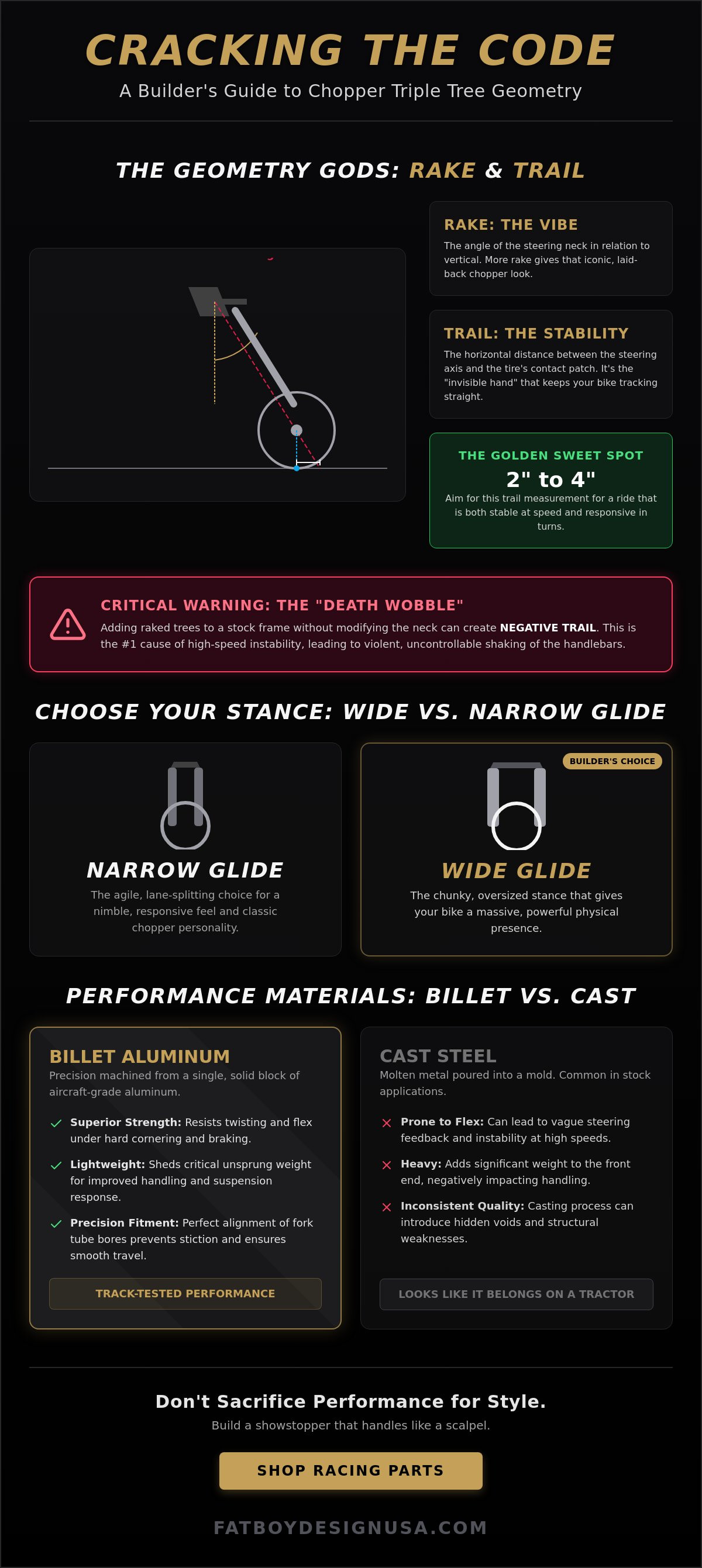
Rake is the vibe. It is that lazy, laid-back lean that makes a chopper an icon. But rake without trail is a death sentence. Trail is the horizontal distance between where your tire touches the dirt and where your steering axis hits the ground. It is the invisible hand that keeps your bike going straight. When you are obsessing over motorcycle handling and stability, trail is your absolute best friend. Choosing the right triple tree for a chopper means finding the perfect balance between these two geometry gods. Get it right, and you glide. Get it wrong, and you fight.
The Golden Rule is simple: if you rake the neck of your frame to 40 degrees, you often need raked trees to kick the forks out and bring that trail back into the safe zone. This sounds counterintuitive, but raking the trees actually reduces trail. It is a game of millimeters. If your trail gets too short, you meet the 'Death Wobble'. This is when your bars start to scream and shake with a mind of their own. It is violent, it is terrifying, and it usually ends in a very expensive slide. This happens because your front wheel is hunting for a center point that your geometry has deleted.
Raked Trees on Stock Frames: A Warning
Don't be the guy who buys raked trees just to 'stretch' a stock frame without cutting the neck. It is the number one mistake in the garage. Adding 5 degrees of rake in the trees on a stock 30-degree neck actually pulls your front axle closer to the frame. This creates negative trail. Now your bike wants to turn itself into a unicycle from hell at 70mph. If your bike feels 'twitchy' or falls into turns too fast, your current setup is a ticking time bomb. Check your measurements before you ride.
Calculating the Perfect Stance
Aim for the golden sweet spot: a trail measurement between 2 inches and 4 inches. This range gives you high-speed stability without making the bike feel like a literal boat at low speeds. Fork length changes the final math too. Longer forks increase your rake angle but can also mess with your trail if you aren't careful. Grab a simple $15 angle finder and a string line. Do the math before you buy the parts. If you are pushing the limits of your geometry, a performance steering damper kit can help tame the beast while you dial in your stance. Stay safe and stay iconic.
Wide Glide vs. Narrow Glide: Choosing Your Chopper’s Stance
Stance is the soul of your build. It is the first thing people notice when you roll up to the spot. Choosing the right triple tree for a chopper dictates whether you are building a nimble lane-splitter or a massive highway bruiser. You have three main paths: the skinny Narrow Glide, the beefy Wide Glide, or the balanced Mid-Glide. Each one changes the physical presence of your bike and how it interacts with the pavement. Don't just pick one because it looks cool; pick one that fits your riding vibe and your hardware.
Tree width isn't just about aesthetics. It is a technical boundary. Your choice here determines your front wheel hub width, axle length, and brake rotor spacing. If you buy a Narrow Glide tree but already have a Wide Glide hub sitting on your bench, you are going to have a very frustrating afternoon. Match your parts before you start turning wrenches. This is about building an iconic machine that actually functions, not a collection of mismatched parts gathering dust in the garage.
The Narrow Glide Aesthetic
If you are chasing that classic Frisco-style look, Narrow Glide is your go-to. It is the king of 'skinny' builds. Usually paired with a tall 21-inch front wheel, this setup is all about agility and a lean profile. By keeping the fork tubes close together, you shed unnecessary weight and gain incredible low-speed flickability. It makes the bike feel light and responsive. Most of these setups use 35mm or 39mm fork tubes, keeping everything tight and tucked. It is the ultimate choice for the rider who treats city traffic like a personal obstacle course.
Going Big with Wide Glide
Then there is the Wide Glide. This is the 'oversized' showstopper that screams classic Harley-Davidson power. It pushes the forks out, creating a chunky, planted stance that feels rock-solid on the open road. It is the perfect home for fat tires and beefy fork tubes that demand attention. Because the stance is wider, the bike feels more stable at high speeds. It doesn't get bullied by crosswinds or grooved pavement. To make this setup even more bulletproof, a Performance Steering Damper Kit adds a layer of precision that keeps your bars steady when you are pinning it.
Mid-Glide is the 'Goldilocks' choice for modern performance builds. It offers a bit more breathing room than a Narrow Glide without the massive footprint of a Wide Glide. It is a game-changer for riders who want to run dual-disc brakes or slightly wider tires while keeping the front end relatively light. When you are choosing the right triple tree for a chopper, consider the Mid-Glide as the high-performance middle ground that rejects the mundane limits of traditional categories.
Performance Materials: Why Billet Aluminum Beats Cast Steel Every Time
Choosing the right triple tree for a chopper is where you decide if your bike feels like a precision instrument or a shopping cart with a bad wheel. Most stock bikes come with cast steel or cast aluminum trees. They are cheap. They are mass-produced. They are mundane. If you want a front end that actually talks to you, move to billet. Billet aluminum is carved from a solid block of high-grade metal, ensuring there are no air bubbles or weak spots hiding inside. It is the difference between a showstopper build and a budget compromise.
Weight is the enemy of fun. Shedding even a few pounds from your triple tree significantly improves your steering response. It makes the bars feel lighter and the bike more eager to tip into a corner. Then there is the flex factor. You want just enough flex to feel the road texture without the front end wandering. Cast parts tend to be either too stiff and brittle or too soft and vague. High-quality billet provides that perfect "Goldilocks" feedback that keeps you in total control.
The Billet Advantage
Machining a triple tree from a solid block of 6061-T6 aluminum provides maximum strength for high-horsepower builds. When you are pushing a heavy bagger or a long-fork chopper, you need precision tolerances that cast parts just can't match. "Close enough" is a recipe for a steering stem that binds or fork tubes that slip. Check out our Bagger Racing Parts to see what happens when you stop settling for factory leftovers and start using race-grade engineering.
Durability for Real Life Adventures
We build for real life, not just for the trailer. Our racer-tested parts are a total game-changer for street riders who actually put miles on their machines. While chrome looks great in the showroom, it eventually flakes and peels after a few seasons of rain and road salt. Anodized finishes are chemically bonded to the metal, meaning they won't chip or fade when the going gets tough. 6061-T6 aluminum is the industry standard for custom trees because it offers the perfect ratio of weight to structural integrity. Upgrade your gear and grab some carbon fiber parts to match that high-performance billet vibe. Stop taking life so seriously and start riding a bike that handles as good as it looks.
The Fat Boy Design Edge: Why Our Racing Heritage Wins the Street
We've spent over 13 years breaking the rules and building absolute beasts in Matthews, North Carolina. Since 2013, Fat Boy Design USA has been the home of the "lovable extrovert" builder who refuses to settle for factory-standard boredom. We don't just sketch parts on a napkin and hope for the best. Every component we create is born on the track and refined in the garage. Choosing the right triple tree for a chopper is about more than just matching a 2026 Harley-Davidson Fat Boy spec; it is about injecting your ride with authentic racing DNA. We are "The Original" for a reason. Our parts are designed, cut, and tested in-house to ensure they live up to the hype.
Reject the mundane. Blending in is for people who take life too seriously. Our parts are for the riders who want an iconic, showstopper front end that handles with the precision of a professional racer. When you choose FBD, you are joining a club that values performance just as much as a killer aesthetic. We take a larger-than-life perspective on every build, framing even a single triple tree as a transformative element that changes your bike's entire soul. It is time to stop overthinking and start riding something legendary.
Racer-Tested Engineering
Our background in high-stakes Bagger racing makes our chopper parts better than anything you will find in a generic catalog. Racing is the ultimate stress test. We don't just sell a product; we ride it until it breaks, then we go back to the bench and make it stronger. This commitment to durability means our street parts can handle real life adventures without breaking a sweat. Pair your new front end with the King of Carbon Fiber collection for the ultimate performance pairing. You get the weight savings of a racer and the iconic look of a custom show bike.
Your Next Move: Building Your Masterpiece
Don't settle for off-the-shelf boredom. Your bike deserves the chunky, oversized FBD vibe that screams power and precision. Choosing the right triple tree for a chopper is the first step toward a front end that tracks straight and looks legendary. If you are chasing a specific, one-of-a-kind vision, contact us for custom fabrication fees on bespoke projects. We love a challenge. It is time to embrace the art of the ride and build your masterpiece. Shop Fat Boy Design USA for the ultimate Harley upgrades and transform your machine today.
Own the Road with Your Masterpiece
You now have the keys to the kingdom. You understand that rake and trail aren't just boring math problems; they are the difference between a shaky mess and a smooth, iconic glide. Choosing the right triple tree for a chopper is the ultimate game-changer for your custom build. You know why billet aluminum crushes cast steel and why your stance defines your entire bike's soul. It is time to stop overthinking and start making moves. Your front end is the face of your machine. Make sure it tells a story worth hearing.
We have been breaking rules and winning races for over 13 years. Every part we ship is designed and manufactured right here in Matthews, North Carolina. You get track-ready performance mixed with showstopper aesthetics that look like they belong in a gallery. We are "The Original" for a reason. Don't settle for the mundane factory leftovers that everyone else is running. Upgrade your ride with racer-tested Fat Boy Design parts and turn your chopper into a legend. Let's get to work and build something that makes people stop and stare. Ride hard and stay iconic.
Frequently Asked Questions
Can I put raked triple trees on my stock Harley frame?
You can physically bolt them on, but it is usually a bad idea for your safety. Adding raked trees to a stock 30-degree frame neck reduces your trail and makes the bike dangerously unstable at high speeds. Most professional builders in 2026 avoid this setup because it turns your front end into a twitchy nightmare. Stick to a balanced geometry unless you are ready to cut and rake the neck properly.
What is the difference between rake and trail on a chopper?
Rake is the angle of your steering head, while trail is the distance between the tire contact patch and the steering axis. Think of rake as the style and trail as the stability glue. Choosing the right triple tree for a chopper requires balancing these two numbers so your bike doesn't hunt for a center point at 70mph. One is about the look; the other is about staying upright.
How do raked triple trees affect motorcycle handling?
Raked trees decrease your trail, which makes the steering feel lighter and much more responsive at low speeds. However, this comes at a cost on the highway. If you go too far, the bike loses its self-centering ability and becomes difficult to keep in a straight line. You will be fighting the bars constantly, which is a total vibe-killer for long-distance cruising or high-speed runs.
Do I need longer forks if I use raked triple trees?
You almost always need longer fork tubes to keep your frame level when adding rake. If you stick with stock lengths, the front of the bike drops, which ruins your ground clearance and makes the bike look "nose-heavy." A common 2026 setup involves adding 2 to 4 inches of fork length to compensate for a 3-degree rake. Keep the bike level to maintain that iconic showstopper stance.
What is the 'sweet spot' for trail on a custom chopper?
The golden sweet spot for trail on a custom build is between 2 inches and 4 inches. If your measurement drops below 2 inches, you are inviting the speed wobble to your next ride. If you go over 4 inches, the bike feels like a heavy boat that refuses to lean into corners. Aim for 3 inches of trail if you want the ultimate mix of stability and flickability.
Are aluminum triple trees strong enough for a heavy Harley?
High-grade 6061-T6 billet aluminum is more than strong enough for a 900-pound Harley-Davidson. It is significantly more rigid than the cast steel alternatives found on budget factory setups. Our racing-grade billet trees handle the massive torque of high-horsepower baggers without breaking a sweat. They provide the structural integrity you need for real-life adventures while shedding unnecessary pounds from your front end.
How do I measure my fork tube diameter for new trees?
Grab a set of digital calipers and measure the diameter of your fork tube at the exact clamping point. Standard Harley sizes are typically 39mm, 41mm, or 49mm, though some performance builds use 55mm inverted tubes. Do not guess this measurement. Even a 1mm difference will prevent the trees from clamping correctly, which is a massive safety hazard that rejects the art of a clean build.
Will raked trees fix my bike's high-speed wobble?
Raked trees will not fix a wobble; they usually make the problem much worse. A high-speed wobble is often caused by insufficient trail or worn steering head bearings. Since raked trees reduce trail even further, they can turn a minor vibration into a violent death wobble. Choosing the right triple tree for a chopper means calculating your geometry correctly from the start rather than trying to mask a mechanical issue.