

Chopper Frame Geometry Explained: Rake, Trail, and the Art of the Showstopper
Building a bike that looks like an absolute showstopper is easy; building one that doesn't try to kill you at 75 mph is the real trick. You want that iconic, stretched-out silhouette that stops traffic and wins trophies. We totally get it. However, nobody wants a machine that handles like a wobbly grocery cart or develops a terrifying death wobble the second you hit the open highway. That's why getting your chopper frame geometry explained is the most vital step before you ever touch a torch or spend a single dime on custom parts.
It's time to stop guessing and start building with total confidence. We're stripping away the dry, academic jargon to give you the ultimate masterclass in rake and trail. You will learn exactly how to balance a wild aesthetic with rock-solid stability so your custom creation feels as good as it looks. We're breaking down the physics of the 4 inch trail sweet spot and showing you how to avoid the common math mistakes that ruin 60% of amateur garage builds. Let's dive into the secrets of creating a ride that is chunky, stable, and undeniably legendary.
Every legendary build starts with a solid foundation, and if you’re looking to create the ultimate workspace for your project, Bradberry Steel offers pre-engineered steel building systems designed for residential and commercial shops.
Key Takeaways
- Master the "Holy Trinity" of rake, trail, and stretch to ensure your custom build is a total showstopper rather than a high-speed death trap.
- Get the essential physics of your ride dialed in with chopper frame geometry explained to make even the most aggressive silhouette feel light and flickable.
- Learn the secret to measuring trail like a pro to eliminate the dreaded death wobble and achieve smooth, effortless steering.
- Discover how modern Harley Carbon Fiber components let you cheat physics by cutting weight for a game-changing performance boost.
- Find out why racer-tested fabrication from Matthews, NC is the ultimate way to build a bike that looks iconic and survives real-world speeds.
The Chopper Geometry Manifesto: Why Rake and Trail Rule Your Ride
Stop thinking about math as a boring classroom chore. In the garage, geometry is the soul of your machine. It's the difference between a smooth, iconic cruise and a terrifying tank slapper at 70 mph. Get it right, and you're floating on a cloud. Get it wrong, and you've built a 700-pound death trap. We call it the Holy Trinity of custom builds: Rake, Trail, and Stretch. This is chopper frame geometry explained for those who reject the mundane and crave a bike with a pulse.
Most stock Harley-Davidson models, like a 2024 Softail, come with a rake around 30 degrees. It's safe, predictable, and frankly, a bit too "standard" for the lovable extrovert. We deviate from these factory baselines to capture that showstopper silhouette. We want the bike to look like it's doing 100 mph while it's parked in your driveway. However, moving away from stock means you need to understand the physics of your vibe. We focus on three main pillars:
- Rake: The angle that sets the entire attitude of the front end.
- Trail: The invisible force that keeps your wheels pointed forward.
- Stretch: The literal length that gives your bike that chunky, oversized presence.
Rake vs. Trail: The Dynamic Duo
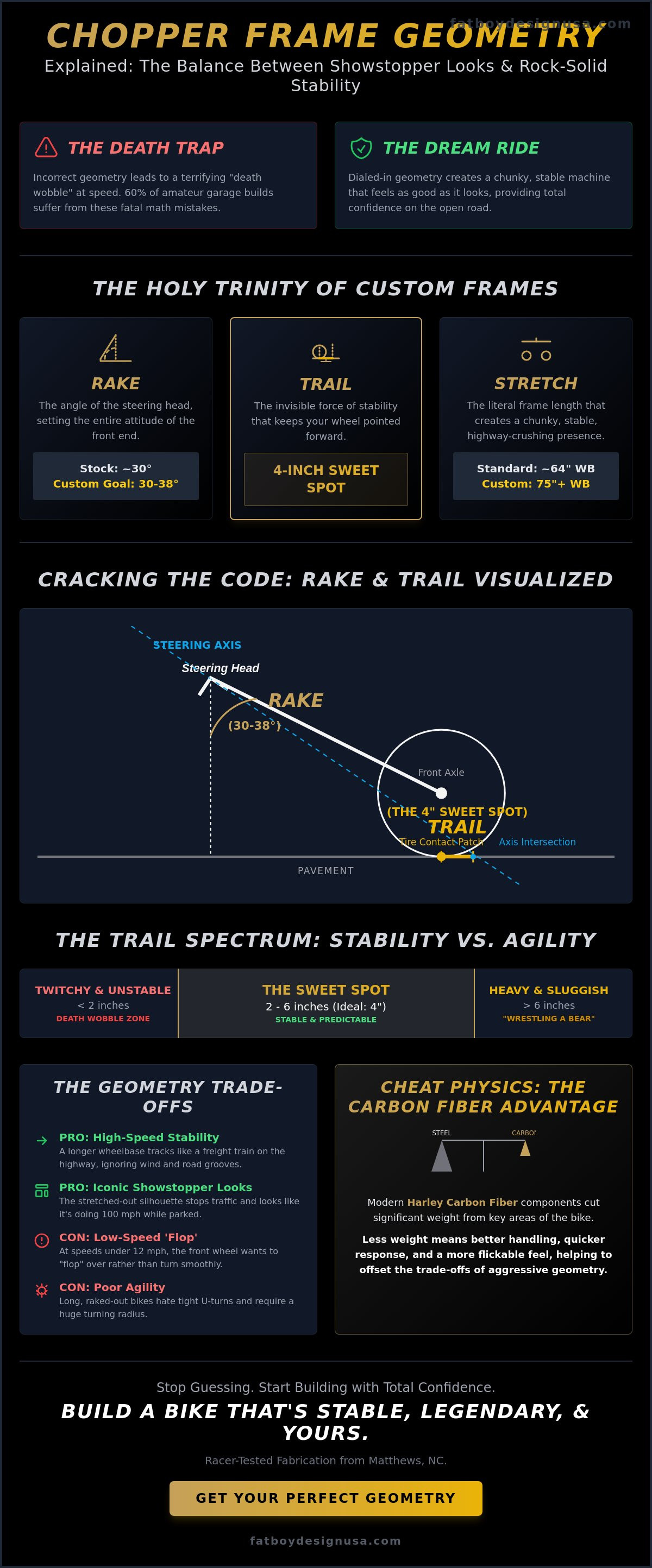
Rake is the angle of the steering head measured from a vertical line. Trail is the horizontal distance between the tire's contact patch and the point where the steering axis hits the pavement. These two measurements are the DNA of your motorcycle's stability. You can explore the foundational physics of Bicycle and motorcycle geometry to see how these forces balance out. If your trail is too short, the bike becomes twitchy and nervous at high speeds. If it's too long, you'll be wrestling a bear just to change lanes. It's a delicate dance between looking cool and staying alive.
Wheelbase and Stance: Beyond the Aesthetics
A longer wheelbase creates that ultimate chill-out stability for straight-line highway runs. Imagine a custom 75-inch wheelbase compared to a standard 64-inch setup. That extra length makes the bike track like a freight train, refusing to be bullied by wind or road grooves. There's a trade-off for this game-changer look; long-and-low bikes absolutely hate tight U-turns. You won't be flicking this machine through a narrow alleyway, but that isn't the point.
Stance isn't just for the cameras. It dictates your center of gravity and your cornering vibe. A low-slung, chunky frame keeps the weight close to the asphalt. This creates a grounded, confident feeling that allows you to relax and enjoy the scenery. This chopper frame geometry explained isn't just about numbers; it's about building a machine that matches your personality. Whether you're hitting a local bike night or a cross-country run, your geometry determines if you're the master of the road or just a passenger on a wild ride.
Cracking the Code: Rake, Stretch, and the 'Holy Trinity' of Frames
Rake isn’t just some boring math problem for guys in lab coats. It’s a statement of intent. It’s the difference between a bike that looks like a commuter and a bike that looks like it belongs on a 1970s movie poster. Most builders aim for that 30 to 38 degree window. It’s the magic zone where you still get that stretched-out vibe without needing a 40-acre field to make a U-turn. Chopper frame geometry explained simply: more rake equals more stability at high speeds but more 'flop' when you’re pulling into the parking lot. You’re trading low-speed agility for that high-speed, rail-like feel. It’s a bold choice for a bold rider.
The physics of the long fork look are undeniable. When you kick that front wheel out, you shift your weight bias toward the rear tire. This gives the bike a planted feel during acceleration, but it makes the front end light. About 65 percent of your weight might sit over the rear axle in extreme builds. This shift is what creates that iconic "chopper squat" when you hammer the throttle. It’s all about the showstopper aesthetic, but you have to respect the balance. If you go too far without planning, you’ll end up with a bike that’s more sculpture than street machine.
The Neck Angle (Rake) Deep Dive
Increasing your rake creates a floppy sensation at speeds under 12 miles per hour. It’s pure physics. Your front wheel wants to fall over rather than turn. You can't just slap on 12-over forks and call it a day. Fork length and rake are a package deal. If you mess up the math, your trail goes to zero and the bike becomes a death trap. Raked triple trees are a total game-changer here. They push the forks out further without changing the frame angle, fixing your trail issues instantly and keeping the ride smooth.
Frame Stretch: Going Up and Going Out
Stretch is where the real drama happens. Up-stretch adds height to the downtubes. It creates breathing room for a massive 120-cubic-inch V-twin engine, making the whole profile look chunky and powerful. Out-stretch pushes the neck forward. This gives the bike an aggressive, reaching profile that looks like it’s doing 100 mph while parked. Be careful though. Every inch of stretch changes your reach to the Chopper Handlebars. A 4-inch out-stretch can turn a comfortable cruise into a literal stretch-fest for your back. If you want to keep that long front end stable at 80 mph, consider adding a steering damper kit to your setup.
The Death Wobble vs. The Dream Ride: Trail Measurement Explained
Trail is the most important number you’ve never heard of. It’s the invisible force that keeps your bike tracking straight while you’re looking cool. Get it wrong, and you’re fighting for your life at 75 mph. Get it right, and you’ve got a showstopper that handles like a dream. Chopper frame geometry explained simply: trail is the physical distance between where your steering axis hits the ground and where the front tire actually touches the pavement.
Signs of bad trail are impossible to ignore. If your trail is too short, you’ll meet the "Death Wobble." This high-speed vibration can turn a sunny cruise into a disaster in 2 seconds flat. If you’re feeling those pre-wobble jitters, look into a Harley Touring Performance Steering Damper Kit to keep your front end in check. On the flip side, too much trail makes the bike feel like a heavy, sluggish tank. You’ll be wrestling with the bars just to make a simple turn at the gas station.
The "Goldilocks" zone for most custom builds is between 4 and 6 inches of trail. This has been the industry standard since the custom chopper boom of 1969. To measure it in your garage, grab a level, a string, and a cold beer. Follow these steps for a quick check:
- Level your bike perfectly straight.
- Drop a vertical line from the center of your front axle to the floor.
- Run a string through the center of your steering neck at its exact angle until it hits the ground.
- Measure the distance between those two points on the floor.
If that measurement hits 5 inches, finish your beer; you’ve nailed the ultimate setup.
Positive, Negative, and Neutral Trail
Positive trail creates the "shopping cart wheel" effect. The tire follows the steering axis, pulling the bike straight automatically. It’s the ultimate safety net for high-speed runs. Negative trail is a suicide setup. The tire wants to lead the steering, making the bike physically unrideable. Neutral trail, or zero trail, feels like you’re riding on a sheet of ice. There’s no feedback. One sneeze at 60 mph and you’re in the ditch.
Calculating Trail Like a Pro
Math doesn’t have to be a buzzkill. The basic formula involves your rake angle, triple tree offset, and tire radius. Don’t forget the "chunky" rubber factor. Swapping a skinny 21-inch wheel for a massive 16-inch tire can shift your trail by 0.5 inches or more instantly. For 100 percent accuracy, a professional frame jig is worth its weight in gold. It eliminates the 3 percent margin of error that comes with a shaky hand and a tape measure. Accuracy is the difference between a vibey ride and a total showstopper.
To achieve this level of precision, many builders opt for a dedicated workshop from Bradberry Steel, ensuring their frame jig sits on a perfectly level, high-quality steel floor.
Performance Meets Old School: How Modern Parts Fix Geometry Gaps
Old-school choppers were heavy. They looked like dreams but often handled like total nightmares. We are talking about 700-pound beasts with 45-degree rakes that required a gym membership just to pull a U-turn. Modern builders are tired of the struggle. They use Harley Carbon Fiber to cheat physics and reclaim their ride. This is how chopper frame geometry explained becomes a lesson in high-speed performance rather than just a vintage aesthetic. It is about stripping away the dead weight to let the soul of the bike shine through.
Carbon Fiber’s Role in Unsprung Weight
Unsprung weight is the ultimate enemy of a smooth, responsive ride. This includes everything not supported by your springs; things like wheels, brakes, and fenders. A Performance Bagger Racer Carbon Fiber Front Fender isn't just for the track. It is a total game-changer for custom choppers. Reducing mass at the front end allows your steering assembly to react 40% faster to every input you give it. This makes even the most aggressive, stretched-out geometry feel light and flickable. You get that iconic, oversized vibe without the sluggish, heavy response of traditional steel parts. It is pure sensory satisfaction for the modern rebel.
Triple Trees and Steering Dampers: The Geometry 'Cheat Codes'
Sometimes the vision for a build goes a little too far. You want that massive rake, but you accidentally ruined your trail measurement in the process. Do not panic. Raked triple trees are the ultimate secret weapon for the custom builder. They allow you to bring your trail back into the safety zone by changing the fork angle relative to the steering neck. It is a clever math trick that saves your skin and your bike.
Every high-performance build that actually hits the pavement needs a Harley Touring Performance Steering Damper Kit. This is racer-tested tech designed for bikes that see the highway at 80 mph, not just the back of a trailer. A damper stabilizes the front end and kills the dreaded speed wobble before it even starts. Understanding chopper frame geometry explained through the lens of modern materials is the only way to build a showstopper that survives the real world.
- Reduced Mass: Carbon fiber parts cut weight by up to 60% compared to steel.
- Precision Handling: Steering dampers provide a consistent, chunky feel at high speeds.
- Trail Correction: Triple trees fix the "flop" associated with extreme rakes.
Stop settling for a bike that is hard to handle. Upgrade to iconic carbon fiber parts and transform your chopper into a performance masterpiece.
Building Your Showstopper: From Blueprint to Matthews, NC Fabrication
At Fat Boy Design USA, we don't just push paper. We push limits. We live the racing life every single day in our Matthews, NC shop. Building a bike isn't just about following a guide; it's about creating a machine that screams. When you're doing 80 on the I-77, you need to know your bike won't fall apart. That's where racer-tested durability comes into play. We've spent 13 years in the dirt and on the asphalt to make sure our parts handle real-world chaos.
Stop taking life so seriously. Build the bike. Ride the vibe. Make it iconic. Your chopper should be a reflection of your refusal to be boring. Use the best components, trust the engineering, and then get out there and cause a scene. It's time to join the club where the only rule is to enjoy the ride. We provide the hardware; you provide the soul. If you want to carry that custom flair into your holiday celebrations, Adorb Custom Tees offers matching sets that let you and your partner show off your unique style at the next family gathering.
Why Racer-Tested Parts Matter for Custom Geometry
FBD parts are born on the track and bred for the street. There's a massive difference between mass-produced catalog parts and our in-house fabricated components. While a catalog part might look okay in a photo, it hasn't survived 500 laps of high-intensity vibration. Our 13 years of racing experience informs every single carbon fiber weave we produce. We understand exactly how stress distributes across a frame when you're leaning into a hard corner at speed.
When the chopper frame geometry explained in your blueprints meets our high-performance Bagger Racing Parts, the result is a total game-changer. We don't guess. We test. This ensures your front end stays stable and your trail remains consistent, even when the road gets rough. Our carbon fiber isn't just for show; it's a structural masterpiece designed for the ultimate performance and sensory satisfaction.
Your Next Steps: FBD Components for the Ultimate Build
Ready to start? Begin with the front end. Your choice of fenders and trees will define the entire silhouette of your build. Choose wisely. A chunky, aggressive front end sets the tone for a showstopper. Don't forget the "King of Carbon Fiber" touch. Adding our carbon fiber dash and side covers provides that oversized, premium feel that sets FBD apart from the imitators. It's about creating a cohesive look that looks fast even when it's parked.
Every piece we make is designed to be a transformative element for your motorcycle. Whether it's a small accessory or a major structural component, it should feel like part of the family. Having the chopper frame geometry explained is the first step, but executing that vision requires parts that can handle the pressure. Take the leap and upgrade your ride with components that actually mean something. Your build deserves the best, and we've got the track record to prove it.
Every professional build also deserves a professional environment; Bradberry Steel provides the pre-engineered steel buildings that give you the space and security needed for high-end motorcycle fabrication.
Own the Road with Precision Geometry
Don't let a bad rake or a sketchy trail turn your dream build into a nightmare. You've seen chopper frame geometry explained; now it's time to put that math into motion. Remember that the "Holy Trinity" of rake, trail, and stretch determines if your bike is a high-speed showstopper or a shaky mess. We've spent 13+ years in professional racing to ensure every angle we cut is perfect. Our in-house fabrication team in Matthews, NC, builds parts that don't just look like Red Dot-level art; they perform under pressure.
Stop settling for boring, cookie-cutter setups that feel sluggish. Grab some racer-tested gear that brings that iconic, chunky aesthetic to your garage. Whether you're dodging a death wobble or just want to vibe on the highway, we've got the hardware to make it happen. It's your ride, so make it loud, make it bold, and make it handle like a pro. Upgrade your build with racer-tested parts at Fat Boy Design USA!
Keep the rubber down and the attitude up. Your next masterpiece is waiting for you to pick up the torch and get to work.
Frequently Asked Questions
What is the best rake angle for a chopper?
The ideal rake angle for a balanced showstopper usually sits between 38 and 42 degrees. This specific range gives you that iconic stretched look without turning your bike into a literal boat. If you push past 45 degrees, you're looking at a turning radius that requires a 40 foot wide road. Keep it tight and stylish to master your chopper frame geometry explained for the ultimate street vibe.
Can I change my rake without cutting the frame?
You can absolutely change your rake without a torch by swapping in raked triple trees. These kits offer 3 to 7 degrees of extra kick without a single permanent frame modification. It's a total game-changer for riders who want the look but don't want to butcher their stock frame. Just watch your trail numbers so your ride stays smooth and stable at 70 mph.
How does fork length affect my trail?
Adding length to your forks typically increases your trail by pushing the front axle further away from the steering axis. A 6 inch over fork setup can significantly change how the bike handles the pavement. You'll feel more stability in a straight line, but low-speed turns might feel like you're steering a chunky ocean liner. Balance is everything when you're chasing that perfect geometry.
What happens if my trail is too low?
A trail measurement below 2 inches makes your bike twitchy and prone to dangerous high-speed oscillations. You want your front wheel to follow the steering axis, not fight it. If your trail hits that 0 inch mark, your chopper will feel like a shopping cart with a bad wheel at 50 mph. Stick to the 4 to 6 inch gold standard for a ride that's both safe and cool.
Are raked triple trees safe for high-speed riding?
Raked triple trees are safe only when they are used to bring the trail back into the 3 to 5 inch safety zone on a raked frame. Using them on a stock 30 degree frame can actually reduce trail to dangerous levels. Professional builders have used these for 20 years to fix handling on custom builds. Always do the math before you bolt them on to keep your ride iconic.
How do I calculate trail if I'm using a Springer front end?
To calculate trail on a Springer, you must include the rocker offset in your measurements. Measure the horizontal distance from the pivot bolt to the center of the axle, which is usually 2 or 3 inches. Subtract this offset from the calculated rake trail to find your true number. It's a bit more math, but getting it right ensures your Springer stays a functional part of your family.
Does tire size change my motorcycle's geometry?
Swapping a 19 inch wheel for a 21 inch front tire raises the front end and increases your trail by roughly 0.5 inches. Every inch of tire height alters the angle where the rubber meets the road. It's a small change that creates a massive shift in how the bike feels. This is why chopper frame geometry explained focuses so much on the total package, not just the metal.
Why is my chopper wobbling at high speeds?
High-speed wobbles usually happen because your trail is less than 2 inches or your neck bearings are loose. If your geometry is too aggressive, the front wheel loses its self-centering ability at 65 mph. Check your tire pressure first, then measure your trail to ensure it sits between 4 and 6 inches. Nobody wants a tank-slapper when they're trying to look this good on the highway.