

Custom Paint on Carbon Fiber Motorcycle Parts: The Ultimate Flex for 2026
Slapping a solid coat of paint over high-performance carbon fiber is like wearing a parka over a tuxedo. It is a total crime against aesthetics. You spent the cash on that legendary weave because it looks fast even when it is standing still. We get it. You want a custom look that screams personality, but you are terrified of hiding that beautiful texture or watching your expensive finish peel off like a bad sunburn. You might even be searching for how to wrap carbon fiber motorcycle parts just to play it safe. Forget safe. We are here to play bold.
We agree that your bike deserves to be a one of one masterpiece. This guide will show you how to transform your high-end parts into a show-quality hybrid that reveals the weave while adding a layer of depth plastic could never touch. We are diving into the world of translucent fades, racing-standard durability, and the exact prep steps needed for the elite components from Fat Boy Design USA. Get ready to ditch the boring factory look and embrace a finish that is as loud as your exhaust. It is time to turn your fenders and side covers into the ultimate 2026 flex.
Key Takeaways
- Unlock the magic of tinted clear coats to add wild color without suffocating that legendary carbon fiber weave you paid for.
- Learn the technical secrets behind UV protection and adhesion so your masterpiece stays fresh and never turns that nasty yellow.
- Master the art of the "Fade-to-Carbon" look to blend raw racing vibes with high-end custom paint on your saddlebags and lids.
- Skip the struggle of how to wrap carbon fiber motorcycle parts and go for a deep, permanent finish that makes cheap vinyl look like a sticker book.
- Discover why Fat Boy Design USA’s Platinum Series is the ultimate canvas for painters who want to skip the prep and get straight to the glory.
Table of Contents
Why Paint Over Perfection? The Art of Custom Carbon
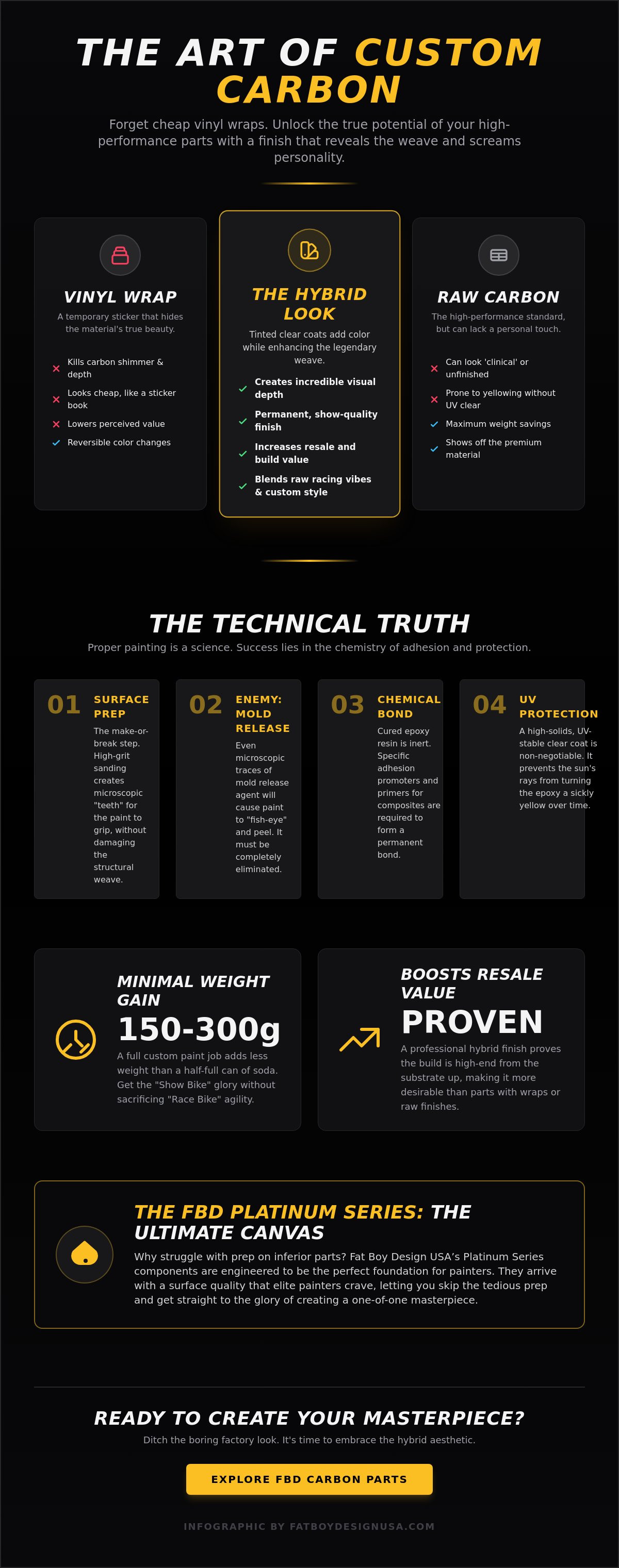
Carbon fiber is the undisputed gold standard of the performance bagger world. It is light. It is strong. It is expensive. But let's be honest: raw carbon can look a little clinical if everyone else at the bike show has the same setup. Custom paint is the soul of your build. In 2026, the elite riders are moving toward the "Hybrid Look." This style uses transparent custom paint, which involves laying down tinted clear coats over the raw weave. You get the color you want without losing the high-tech texture you paid for. It is the ultimate flex. It tells the world you have the budget for the best parts and the vision to make them a one of one masterpiece.
The Aesthetic Advantage of Carbon Substrates
When you paint over plastic, the result is flat. It is just color on a surface. Carbon-fiber reinforced polymer is different. It has a three dimensional structure that interacts with light. When you apply a candy coat, the sunlight travels through the pigment, hits the weave, and bounces back. This creates a visual depth that feels like you are looking into a pool of liquid color. While some riders search for how to wrap carbon fiber motorcycle parts to change their look, a wrap is just a sticker. It sits on top and kills the shimmer. Real custom paint on harley davidson carbon fiber from Fat Boy Design USA increases resale value because it proves the build is high-end from the substrate up. It is the difference between a custom suit and a t-shirt.
Performance Meets Personality
You don't have to choose between track speed and show style anymore. By using transparent techniques on bagger racing parts, you keep the weight savings of the material while ditching the "track-only" utility vibe. It is a psychological shift. Your bike stops looking like a tool and starts looking like an extension of your personality. If you are worried about the finish, don't be. High-quality parts, like those found in the Platinum Series from Fat Boy Design USA, are engineered to be the perfect canvas. They arrive with a surface quality that elite painters crave. You might wonder how to wrap carbon fiber motorcycle parts for protection, but a UV-stable clear coat over custom paint offers superior durability against the elements. It is time to embrace the hybrid aesthetic. Stop blending in and start leading the pack with a look that is as fast as it is flashy.
The Technical Truth: How Painting Carbon Fiber Actually Works
Carbon fiber is a high-tech diva. It's not like a steel tank or a plastic fender. It's a complex chemical cocktail of resin and woven fabric. If you treat it like metal, your expensive paint job will flake off faster than a cheap sticker. Success starts with understanding that you aren't just painting a surface; you're bonding with epoxy resin. While many riders spend time researching how to wrap carbon fiber motorcycle parts to avoid the "scary" chemistry of paint, the truth is that a professional finish is all about the science of adhesion. It's about creating a permanent chemical handshake between the part and the pigment.
Weight is the biggest question in the pits. You bought carbon to save ounces, so why add them back? A high-end custom paint job usually adds between 150 to 300 grams to a full set of harley davidson carbon fiber components. That's less than the weight of a half-empty soda. You get the "Show Bike" glory without sacrificing the "Race Bike" agility. Just make sure your painter uses a high-solids, UV-stable clear coat. Without it, the sun's rays will turn your beautiful weave a nasty, sickly yellow over time. Nobody wants a bike that looks like an old newspaper.
Surface Prep: The Make-or-Break Step
Forget the "scuff and buff" nonsense you heard on a forum. Carbon fiber requires a delicate touch. You need high-grit sanding to create "teeth" for the paint without chewing into the structural weave. The real enemy is mold release agent. This is the slippery stuff used to get the part out of its mold during manufacturing. If even a microscopic trace remains, your paint will "fish-eye" and peel. Because epoxy resin is chemically inert once cured, it requires specific adhesion promoters and primers designed for composites to ensure a long-term bond that won't crack under vibration.
Heat and Outgassing Challenges
Outgassing is the silent killer of custom carbon. Tiny pockets of air can hide inside the weave or resin. When a painter puts the part in a heated bake cycle to dry the paint, that air expands. It pushes out and creates tiny bubbles in your fresh finish. It's a nightmare. This is why the pros prefer "air-dry" cycles for high-end bagger racing parts. Using top-tier parts makes this easier. The Platinum Series from Fat Boy Design USA is engineered with superior resin density, which significantly reduces the risk of outgassing during the painting process. If you're still debating how to wrap carbon fiber motorcycle parts versus painting them, remember that paint is a lifetime commitment to style, while a wrap is just a temporary fling.
Ready to start your masterpiece? Check out our full collection of carbon fiber parts and find your perfect canvas today.
Killer Techniques: Candy Fades, Ghosting, and Exposed Weaves
You've already leveled up with the best carbon on the market. Now, it's time to make it personal. Don't settle for the same raw look every other performance bagger is rocking at the local bike night. While the internet is full of riders looking for how to wrap carbon fiber motorcycle parts, we know you want something more permanent. Vinyl is fine for a weekend experiment or a quick color change. Paint is for building a legacy. We are talking about techniques that turn your bike into a moving art gallery that happens to go 120 mph.
The "Candy" Deep Dive
Candy paint is basically a high-end filter for your bike. It doesn't just sit on top of the weave; it dances with it. In 2026, the streets are seeing a massive surge in Blood Red and Electric Blue candies. But the real show-stopper is Burnt Orange. It makes the carbon look like it is glowing from the inside out. To get that legendary "miles deep" finish, your painter needs to stack multiple layers of high-solids clear coat. It should look like you could reach your hand right into the color and touch the fabric underneath. This is the ultimate way to add personality without suffocating the high-tech texture of your harley davidson carbon fiber.
Masking for Exposed Weave
This is the surgical side of the custom shop. A Fade-to-Carbon design is a total power move. You paint the outer edges of the part and let the raw weave emerge toward the center. It is a visual reminder of the racing tech under the hood. Use your Carbon Fiber Front Fender to set the pace for the whole build. It's the first thing people see when you're rolling up. Masking these transitions takes a steady hand and zero distractions. Pro painters use a "pinstripe break" to hide the physical edge where the paint layers meet the clear. It creates a seamless transition that feels factory-made but looks totally custom.
Let's talk vibes. Gloss is the classic choice for a reason. It pops. It shines. It demands a crowd. But matte finishes are having a major moment in 2026. A matte candy over raw carbon looks stealthy, mean, and incredibly expensive. Then there is ghosting. Imagine a subtle logo or a racing stripe that is invisible in the shade but screams for attention under the gas station lights. If you are still googling how to wrap carbon fiber motorcycle parts, stop. You can't wrap your way into this kind of soul. Real custom paint is how you win the show and the street.
From Track to Show: Designing Your Carbon Masterpiece
You have the parts. Now you need the plan. Designing a custom carbon masterpiece isn't about hiding the material under a gallon of primer. It's about balance. The biggest mistake rookies make is covering up the very thing they spent their hard-earned cash on. While beginners might look up how to wrap carbon fiber motorcycle parts to get a quick fix, you are building a show-stopper. The goal is a cohesive look that ties your harley davidson carbon fiber into your frame, your powder coat, and your chrome. It should look intentional. Not like a collection of random expensive bits.
Follow the 70/30 Rule. This is the secret sauce for a show-winning finish. Aim for 70% paint and 30% exposed carbon weave. This ratio provides enough color to make the bike pop from a distance while rewarding anyone who walks closer with that high-tech texture. When you talk to your painter, be specific. Don't just say "make it cool." Show them your powder coat swatches. Explain where you want the "peek-a-boo" carbon to live. A well-placed window of weave on your saddlebag lids or dash can do more for your aesthetic than a full-coverage job ever could.
The Bagger Racing Aesthetic
Go fast. Look faster. The performance bagger scene is all about that track-ready energy. Use "Speed Lines" and bold racing numbers to break up the surface. Ghosting sponsor logos into the paint layers adds a professional, sponsored-rider vibe without the clutter of actual stickers. It’s about subtle dominance. If you need a spark of creativity, check out our Bagger Racing Parts to see how the pros use contrast to highlight speed. It’s not just about weight savings. It’s about looking like you just rolled off the podium at Laguna Seca.
The Chopper and Vintage Vibe
Who says carbon fiber is only for modern racers? You can make high-tech composites feel right at home on a vintage-style build. The trick is mixing eras. Try laying down some old-school metal flake or genuine gold leaf pinstriping over a carbon substrate. It’s a wild, counter-intuitive mix that stops people in their tracks. It bridges the gap between the heritage of the past and the technology of 2026. If you're still wondering how to wrap carbon fiber motorcycle parts for a vintage look, stop. A wrap will never capture the shimmer of real metal flake over a deep weave. It’s time to commit to the craft.
Ready to build your legend? Shop the full Fat Boy Design collection and get the canvas your vision deserves.
Fat Boy Design: The King of Carbon Meets Custom Paint
You have the vision. You have the color palette. Now, don't blow the whole build by buying bargain-bin parts. The world's top custom painters have a secret: they hate working on low-quality carbon. Cheap resin and uneven weaves are a nightmare to prep. If you want a finish that looks like liquid glass, you need a foundation that is already perfect. That is where we come in. Fat Boy Design is the undisputed King of Carbon Fiber. We don't just make parts; we create the canvases that elite painters use to win trophies. Our in-house manufacturing process ensures that every piece leaving our floor is ready for the spray booth.
If you are still debating how to wrap carbon fiber motorcycle parts because you're worried about paint adhesion, you're looking at the wrong parts. Wraps are for people trying to hide surface flaws. Our customers show their parts off. When you start with a high-density, racer-tested substrate, the chemical bond is permanent. You get the durability of a track bike with the jaw-dropping aesthetics of a high-end show build. It is time to join the club where the only rule is to stop taking life so seriously and start riding something legendary.
The Platinum Series Advantage
What makes the Platinum Series the gold standard for custom art? It's all in the surface. Most carbon parts are riddled with tiny pinholes that swallow paint and ruin candy coats. Our Platinum Series is engineered to be pinhole-free. This saves your painter hours of frustration and saves you money on labor. We've spent years perfecting the resin-to-carbon ratio so your finish stays flat and deep for a lifetime. You can read more about our obsession with quality in The Fat Boy Design USA Story. We aren't just a brand. We're the pioneers of the performance bagger movement.
Get Started on Your Build
Stop settling for boring factory plastic. It's time to build a beast that breathes fire and looks better than anything else on the road. Whether you're aiming for a full-color candy fade or a stealthy matte weave, we have the hardware to get you there. Dive into our Carbon Fiber Harley Parts guide to see what's possible for your specific model. Don't wait for the next season to pass you by. Order your Bagger Racing Carbon Fender today and give your bike the flex it deserves. While the other guys are still googling how to wrap carbon fiber motorcycle parts, you'll be out there leading the pack. Let's get to work.
Build a Legacy That Screams Speed
Your bike is more than just a machine. It is a loud, fast statement of who you are. We have covered the technical science of resin adhesion and the visual magic of the 70/30 rule. You now know that candy coats and transparent fades are the secret to that liquid depth plastic can never touch. While the rest of the pack is still stuck googling how to wrap carbon fiber motorcycle parts to hide their boring factory trim, you are ready for a permanent power move. Real carbon fiber deserves real art. It's that simple.
Choose the foundation that the world's top custom painters trust. Our parts carry 13 plus years of racing pedigree and are built right here with in-house American manufacturing. Every piece is racer-tested to ensure a show-quality finish that stays flawless even at triple-digit speeds. Stop blending in with the generic, sticker-covered crowd. It is time to ride a masterpiece that breathes fire and turns every gas station stop into a photo op.
Upgrade to the King of Carbon Fiber: Shop the Platinum Series Now
Go out there and make them stare. Your next level of performance and style is just one click away. It is time to embrace the hybrid look and lead the pack.
Frequently Asked Questions
Can you paint directly onto carbon fiber?
Yes, but don't just blast it with a rattle can. Carbon fiber isn't metal; you're actually painting the epoxy resin that holds the fabric together. You have to scuff it gently and clean it like your life depends on it. If you skip the prep, your paint will flake off like a bad decision. A little extra love in the beginning prevents a total disaster at the finish line.
Does painting carbon fiber make it weaker or heavier?
Painting won't make your parts weaker, and the weight gain is almost zero. A high-end custom job adds about 150 to 300 grams to your build. That is roughly the weight of a small sandwich. In exchange, a UV-stable clear coat actually protects the resin from sun damage. It is a total win-win for anyone who values both performance and show-stopping style.
What is the best type of paint for carbon fiber motorcycle parts?
High-solids urethane with UV stabilizers is the undisputed champion. You need a finish that can handle the heat, vibration, and road debris of a high-performance bagger. Don't go cheap here. Use the same grade of materials you would find on a fighter jet or a factory race team bike. Your carbon deserves a finish that is as tough as the weave underneath.
How do you keep the carbon fiber weave visible through the paint?
Tinted clear coats and candy paints are your best friends. These act like a colored lens for your bike. You get the punchy pop of color you want while the carbon texture shimmers underneath. It is the ultimate way to customize your look without suffocating the high-tech soul of the material. It makes a standard solid wrap look like a boring sticker book.
Will the paint peel off my carbon fiber fenders over time?
Not if the surface is prepped to perfection. Peeling usually happens because of leftover mold release agents from the manufacturing process. If you are only looking at how to wrap carbon fiber motorcycle parts because you fear the paint won't stick, take a breath. A professional painter knows how to strip those chemicals and create a permanent bond that handles racing speeds without flinching.
Do I need a special primer for carbon fiber?
Absolutely. You need an epoxy-based primer or an adhesion promoter specifically designed for composites. Carbon fiber is chemically "lazy" and doesn't like to stick to standard automotive primers. A specialized primer acts as the ultimate wingman, forcing the paint and the resin to become best friends forever. It ensures your custom art stays exactly where you put it for years.
How much does it cost to custom paint carbon fiber parts?
Industry data shows custom paint jobs usually land between $800 and $2,500. Specialized prep work for carbon fiber typically starts around $250 because it has to be done by hand. It's an investment in your bike's legacy. While basic single-color jobs are cheaper, you didn't buy carbon fiber just to hide it under a boring, budget-friendly coat of black. Go big or go home.
Can I DIY paint my carbon fiber parts or should I hire a pro?
DIY is fine for small bits, but hire a pro for the big stuff. If you're researching how to wrap carbon fiber motorcycle parts because you're worried about the difficulty of paint, a pro painter is the answer. They have the gear to stop outgassing and ensure a show-quality finish. Don't put a "backyard special" on a high-performance Fat Boy Design part. It deserves better.