

Dial in Your Cockpit: The Ultimate Guide to Pullback Risers for Your Harley
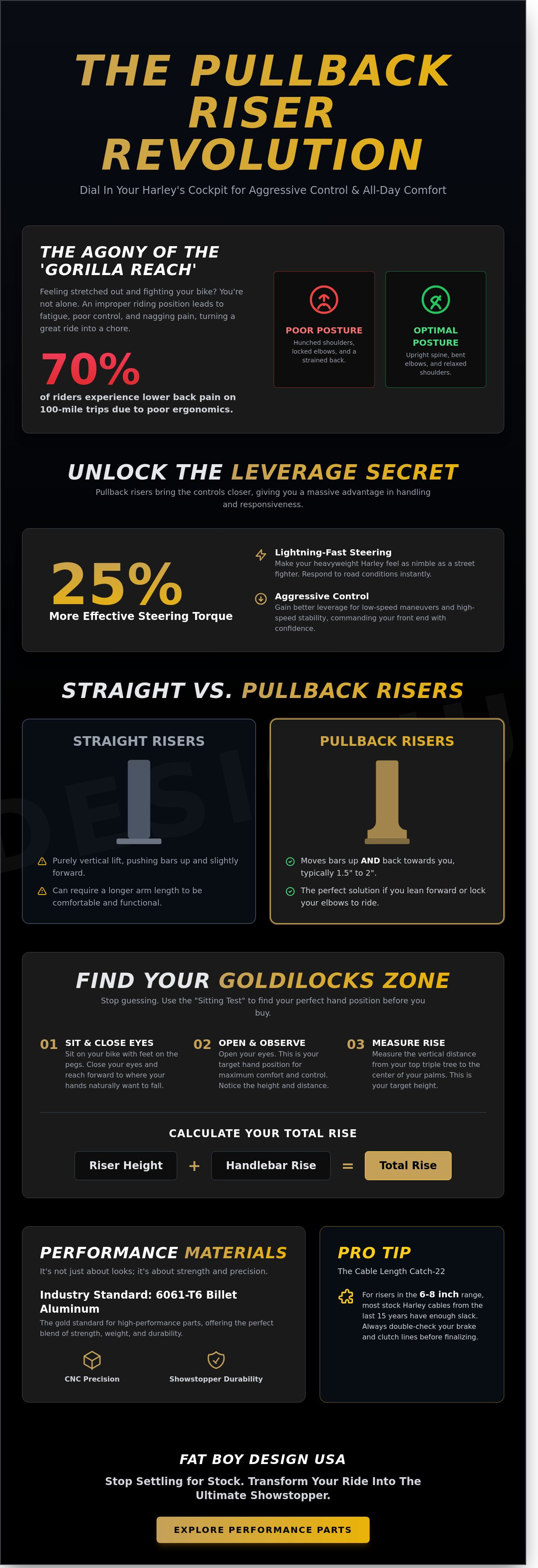
Your Harley-Davidson shouldn't feel like a medieval rack designed to stretch your spine into a pretzel. If you're white-knuckling the grips just to stay upright, you're doing it wrong. Roughly 70% of riders experience nagging lower back pain on 100-mile trips because their bars are just an inch too far away. It's time to stop the stretch and start the party. Installing a set of chunky pullback risers is the fastest way to bring the controls to you, creating an iconic, aggressive stance that doesn't kill your vibe.
We know the struggle of feeling disconnected from the front end when you're leaning into a sharp corner. You want that locked-in feeling and better leverage for low-speed maneuvers without the headache of guessing cable lengths. This guide breaks down exactly how to dial in your cockpit for maximum comfort and high-performance style. We'll cover everything from height selection to the technical bits that ensure your 2024 Low Rider S feels like a custom-fit glove. Get ready to transform your ride into the ultimate showstopper.
Key Takeaways
- Discover how pullback risers unlock the "Leverage Secret" for lightning-fast steering and total aggressive control.
- Learn the "Sitting Test" to nail your perfect hand position and calculate total rise before you buy.
- Find out why 6061-T6 aluminum is the industry-standard showstopper for high-performance CNC precision and durability.
- Master the "No-Bleed" installation method to swap your setup without the mess of disconnecting brake lines.
- See why racer-tested DNA and complete cockpit integration are the ultimate game-changers for any performance bagger.
What Are Pullback Risers and Why Does Your Harley Crave Them?
Stop fighting your bike. If you feel like you are reaching across a dinner table just to grab your grips, your geometry is trashed. Pullback risers are the ultimate fix. These aren't just shiny blocks of metal; they are precision-engineered spacers that move your bars up and, more importantly, back toward your chest. By bringing the controls closer, you eliminate the dreaded "gorilla reach" that turns a Sunday cruise into a chiropractor's dream. Understanding Motorcycle handlebar basics is the first step to realizing that your stock setup was likely designed for a mannequin, not a human who actually likes to ride.
The "Leverage Secret" is where the magic happens. When your hands move closer to your body, your elbows naturally bend. This position grants you 25% more effective steering torque compared to being stretched thin. You aren't just steering anymore; you are commanding the front end. This setup results in a faster steering response that makes a heavy touring rig feel like a nimble street fighter. It's about total control. It's about making your Harley move exactly when you think it should.
Ergonomics are the silent hero here. We see it all the time: riders with hunched shoulders and locked elbows. That is a recipe for a 45-minute ride limit. Pullback risers drop the tension in your traps and lower back by allowing a neutral, upright spine. It is the difference between feeling every pothole in your vertebrae and gliding through the twisties with ease. Plus, the look is pure "Performance Bagger" or "Club Style" gold. It screams that you care about how your bike handles, not just how it sits in the parking lot.
Straight vs. Pullback: The Great Debate
Straight risers look tall and mean, but they demand a specific arm length to be functional. Choose pullback risers if you find yourself leaning forward or locking your joints just to maintain a steady throttle. A 1.5-inch or 2-inch kickback preserves the aggressive vertical lines of your front end while giving you that much-needed relief. It keeps the visual profile chunky and iconic without sacrificing your ability to actually turn the bike.
The Performance Bagger Connection
In the high-stakes world of the "King of the Baggers" racing series, cockpit geometry is everything. These racers aren't just looking for comfort; they are hunting for high-speed stability and the confidence to lean a 600-pound machine into a 50-degree angle. Dialing in your reach is a game-changer for aggressive riding. If you want to build a machine that handles as good as it looks, check out our Performance Bagger Guide to see how risers fit into the total performance puzzle. It is time to stop settling for "stock" and start riding a bike that fits you like a glove.
How to Choose the Perfect Height and Pullback for Your Build
Stop guessing. Your Harley isn't a generic rental. It's a statement. Picking the right pullback risers is the difference between an iconic ride and a literal pain in the neck. You want that "king of the road" feeling. You want comfort that lets you ride until the tank is dry. It starts with your hands and ends with your attitude. Don't settle for "good enough" when you can have perfection.
Finding Your Goldilocks Zone
Forget the tape measure for a second. Sit on your bike. Keep your feet on the pegs or floorboards. Close your eyes. Now, reach out to where your hands naturally want to go. Open your eyes. That's your target. This isn't just about "vibes" either. A 2022 University of Waterloo ergonomic research study used digital human models to prove that even small shifts in hand position drastically change spinal load. Measure the vertical distance from your top triple tree to your palms. That's your magic number for height.
Calculating "Total Rise" is where most riders trip up. You have to combine the riser height with your handlebar bend. If you have 2-inch rise bars and you bolt on 8-inch risers, you're rocking a 10-inch total rise. Simple math. Don't forget the pullback angle. A 1.5-inch kickback moves the bars closer to your chest. It's a game-changer for shorter arms or long-haul touring. Whether you're stripping down a 2005 Dyna, rebuilding a classic FXR, or styling a 2024 M8 Softail, your riser choice defines the cockpit's geometry and your overall control.
The Cable Length Catch-22
Let's talk about the dreaded cable stretch. Nobody wants to finish a build only to realize their brake line is tighter than a guitar string. It's a mood killer. Follow these rules to stay safe and keep the project moving:
- 6-8 inch risers: Most stock Harley cables from the last 15 years have enough slack to survive this range without a total swap.
- 10+ inch risers: Welcome to "cable kit" territory. Budget for new lines now to avoid a mid-install headache.
- The Pro-Tip: Route your cables behind the triple trees. This sneaky move often nets you an extra 25mm of slack. It's a free win for your wallet.
Don't settle for a boring, cramped setup that leaves you sore after twenty miles. Make your bike a showstopper that actually feels good to ride. If you're ready to upgrade the rest of your machine for a high-performance look, check out the Harley carbon fiber collection for parts that match your new aggressive cockpit. Chill out, get comfortable, and let the miles melt away.
Performance Materials: Carbon Fiber vs. Steel vs. Aluminum Risers
Your cockpit isn't just a place to hang your mirrors; it's the nerve center of your entire ride. Choosing the right material for your pullback risers determines whether you're fighting the bike or flowing with it. On a performance build, weight is the enemy. Shaving off 500 grams from your triple trees might not sound like much, but it changes your flickability instantly. High-end builds demand materials that balance extreme durability with a lightweight profile. You want parts that can handle the torque without adding unnecessary bulk to the front end.
- Aluminum (6061-T6): This is the gold standard for CNC-machined parts. It offers an incredible strength-to-weight ratio and doesn't rust. Most riders choose this for its precision and clean, industrial lines.
- Chromoly Steel: If you're into the stunt scene or high-impact riding, steel is your best friend. It's heavier than aluminum, but it won't snap when you're slamming the front end down after a massive wheelie.
- Carbon Fiber: The undisputed heavyweight champion of the lightweight world. Using composites in your cockpit setup is the ultimate flex for performance junkies who want zero compromise. It's about getting that "factory racer" look while cutting every possible ounce.
Vibration Dampening and Stiffness
Nobody likes "bar buzz" at 4,000 RPMs. It turns a fun ride into a hand-numbing chore. Material choice plays a huge role in how those vibrations reach your grip. Aluminum is incredibly stiff, which is great for feedback but can be harsh on long hauls. To fix this, you have to choose your bushings wisely. Solid bushings give you a direct, connected feel to the front tire. Rubber bushings act like a pillow for your palms. If you're chasing the ultimate feel, check out our guide on Carbon Fiber Harley Parts to see how high-tech materials change the game. This material naturally absorbs high-frequency chatter better than any metal ever could.
Aesthetics and Finishes
Let's be real: looks matter. Your pullback risers are the first thing people see when they peer over your tank. Whether you want a Black Electroplate finish for that stealth look or a Raw Machine finish to show off the tool paths, your choice sets the tone. For a truly cohesive vibe, match your setup to a Carbon Fiber Dash. A show-stopper bike starts at the triple trees and moves back. Don't let a boring finish ruin a 20,000 dollar build. Make it iconic. High-quality finishes like chrome or hard anodizing ensure your parts look as good in five years as they do on day one. Stop settling for mundane parts and start building a cockpit that reflects your style.
Step-by-Step: How to Install Pullback Risers Without Losing Your Mind
Let’s get your hands dirty. Installing pullback risers isn't rocket science, but it requires a bit of finesse and a lot of protection for your chrome. You want that perfect reach without a massive headache or a trip to the paint shop. Grab your kit and let’s move. You’ll need a reliable torque wrench, a set of Allen sockets, and the thickest, softest towel in your garage. That towel is the only thing standing between a dropped wrench and a $1,500 dent in your fuel tank.
The "No-Bleed" Method is the ultimate game-changer for this job. Most riders think they need to disconnect brake lines and clutch cables to swap risers. That’s a mess you don't want. By carefully unbolting the controls and using a bungee cord to support the bars, you can swap the hardware without ever opening the hydraulic system. This saves you at least 45 minutes of bleeding brakes and prevents DOT 4 fluid from eating your paint. It’s fast, it’s clean, and it works 95 percent of the time on modern Harley setups.
Pre-Flight Check and Teardown
Protecting your tank is the absolute first priority. Drape that heavy towel over the entire top of the bike. Once you loosen the top clamp bolts, those bars are going to want to dive for the floor. Don't let them dangle by the wires. Use a soft tie or a bungee to hang the bars from your rafters or a sturdy stand. While the old risers are off, inspect your bushings. If they feel like 10-year-old chewing gum, replace them. About 85 percent of high-speed handlebar wobble starts with degraded rubber bushings. Switch to polyurethane for a stiffer, more responsive feel.
The Installation and Alignment
Drop your new pullback risers into the triple tree and hand-tighten the bottom bolts. Don't go full Hulk yet. You need to find the "sweet spot" for the sweep. Sit on the bike, close your eyes, and reach out. Your hands should naturally land on the grips without straining your shoulders. Once the angle is set, it is time for the "Full Lock" test. Turn the front wheel all the way to the left, then all the way to the right. If your cables pull tight or your throttle sticks, you need to reroute your lines. Safety is the only rule here.
Finally, use Blue Loctite on every single bolt. Harleys are famous for vibration, and a loose riser at 70 mph is a nightmare you don't want to live. Torque the bottom bolts to 30-40 ft-lbs according to your specific model manual. Double-check your gaps on the top clamp to ensure even pressure. Now you're ready to ride in total comfort.
Ready to upgrade your entire front end for maximum control? Check out our high-performance bagger racing parts to finish the look.
Why Fat Boy Design is the Secret Sauce for Your Performance Bagger
Stop settling for "good enough" parts from a dusty catalog. Fat Boy Design is the original rebel of the performance bagger scene. We don't just design parts; we rip on them. Our pullback risers aren't just pieces of metal. They are the result of thousands of miles of aggressive testing on the pavement and the track. We build what we want to ride. If a component doesn't survive a weekend of high-speed cornering and brutal vibrations, it doesn't get the Fat Boy Design stamp. It's that simple.
Every part we ship comes straight from our North Carolina facility. We keep everything in-house to ensure 100 percent quality control. This isn't mass-produced junk from overseas. It's American craftsmanship with a heavy dose of attitude. We don't do boring. We do iconic. Your bike should be a showstopper at the local bike night and a weapon on the track. When you choose FBD, you're investing in a legacy of speed and style that stands out in a sea of stock bikes.
Beyond the Risers: Total Control
A killer cockpit requires more than just height and reach. You need a balanced machine that listens to your every input. Pair your new pullback risers with a Performance Steering Damper Kit to kill that front-end wobble for good. Speed is about weight management too. Swapping your heavy stock front end for a Bagger Racing Carbon Fender can slash front-end weight by up to 70 percent compared to OEM steel. A balanced bike reacts faster. It feels lighter. It makes you look like a pro because you're riding a bike that's actually dialed in.
Join the FBD Crew
We aren't here to play nice with the status quo. Our approach is unapologetically bold because your Harley deserves better than a cookie-cutter setup. We treat every build like it's our own. We're the charismatic, slightly rebellious friends who want you to have the best ride of your life. Need expert advice on your specific build? We've got you. We live for the details that turn a standard Harley into a performance masterpiece.
Stop taking life so seriously. It's time to reject the mundane and embrace a lifestyle of high-speed fun. Your bike is an extension of your personality. Make it loud. Make it fast. Make it yours. Check out our most exclusive gear and get your cockpit ready for the big leagues. Shop the Upper Carbon Platinum Series and join the crew today.
Take Command of Your Ride Today
Stop wrestling your bike and start actually riding it. You now know that the secret to a legendary performance bagger is all in the ergonomics. From dialing in the perfect height to choosing between carbon fiber and aluminum, your setup should be as bold as your personality. Our pullback risers aren't just parts; they're your ticket to a more relaxed, high-performance lifestyle. We've spent 13+ years in the professional racing world making sure our gear doesn't just look iconic, it survives the wildest rides. We manufacture every single piece in-house in Matthews, NC, so you know it's built to last through every highway sprint and city cruise. It's time to reject the mundane and embrace the ultimate cockpit upgrade that turns your Harley into a total showstopper. Don't settle for imitators when you can have the racer-tested original. Grab your gear and get back to the fun stuff. Your bike is waiting for its new vibe.
Upgrade Your Cockpit with Fat Boy Design USA
Frequently Asked Questions
Do I need new cables for 2 inch pullback risers?
You usually won't need new cables because Harley-Davidson engineers leave 2 to 3 inches of slack in the factory wiring loom. Check your brake line tension at full lock to be sure. If the lines feel tight, snip a few zip ties around the frame to gain an extra 0.5 inch of wiggle room. It is a quick swap that keeps your wallet happy while getting those bars closer to your reach.
What is the difference between pullback risers and straight risers?
Straight risers launch your bars directly toward the sky, while pullback risers kick them back toward your chest at a 25 or 30 degree angle. Straight setups demand an aggressive, forward-leaning posture that can strain your lower back. These risers are the ultimate game changer for riders who want to kick back and relax without reaching like they are trying to touch the horizon.
Will pullback risers fit on my Harley Street Glide?
Standard risers won't fit a stock Street Glide because the batwing fairing blocks the mounting path. You have exactly zero inches of clearance behind that plastic shell for traditional riser clamps to function. If you want that pullback feel on a bagger, you need to swap to specialized bars. These bars incorporate a 2 inch or 3 inch kickback directly into the tube design to clear the inner fairing dash.
How do I measure the pullback on my current risers?
Measure from the center of the mounting bolt at the base to the center of the handlebar clamp. Use a straight edge or a ruler to find the horizontal distance between these two points. Most standard setups offer a 1 to 1.5 inch offset from the factory. Knowing this number helps you decide if you need a 4 inch or 6 inch jump to reach your personal comfort zone.
Can I use pullback risers with my stock Harley handlebars?
You can absolutely use your stock bars as long as the riser clamp matches your bar diameter. Most older Harleys use a 1 inch diameter, while newer Fat Bob models often feature 1.25 inch bars. Just ensure your stock bars don't have a built-in riser or a cast base. This setup is a budget-friendly way to fix your posture without buying a whole new front end.
Do pullback risers make a bike harder to handle at high speeds?
Pullback risers don't ruin your handling, but they do change your leverage. By bringing the bars closer, you might feel 10 percent more input sensitivity when you are hauling at 80 miles per hour. It makes the bike feel flickable and responsive rather than heavy. Most riders find the increased comfort actually improves their control because their arms aren't locked out straight like a mannequin.
Are solid riser bushings better than rubber ones for pullback setups?
Solid bushings are 100 percent better for tall setups because they eliminate the wet noodle feeling in your hands. When you add 8 or 10 inches of height, rubber bushings flex too much under steering pressure. Swapping to polyurethane or solid aluminum bushings stops the bars from twisting. You'll feel a bit more vibration, but the precision in your steering is worth the trade for a stable ride.
What is the most popular height for pullback risers on a Dyna?
The 8 inch and 10 inch heights are the undisputed kings for Dyna riders across the country. This height perfectly aligns the bars with your shoulders for most riders between 5 foot 9 and 6 foot 1. It creates that iconic club style look while keeping your back straight. Pair them with a mid-bend bar to achieve the ultimate cockpit setup for lane splitting or long hauls down the coast.