

Forged vs Billet Triple Trees for Harley: The Ultimate Performance Bagger Breakdown
That high-speed front-end wobble isn't a rite of passage. It's a sign your bike is waving the white flag. You've felt it. That sickening shimmy when you're pushing the limit or diving into a sharp curve with loaded bags. It's vague, it's sketchy, and it's a total buzzkill for anyone trying to actually ride their machine. Stop settling for a front end that feels like a suggestion rather than a command.
We know you want a bike that carves corners like a pro and stays rock-solid at triple digits. This guide to forged vs billet triple trees for harley delivers the gritty truth about steering precision. You'll discover how to kill the "death wobble" once and for all while giving your bike an aggressive, performance-first look. We're breaking down the manufacturing secrets that separate basic replicas from track-ready Bagger Racing Triple Trees so you can start riding with absolute confidence. It's time to stop the sway and start the shred.
Key Takeaways
- Understand exactly why your stock front end feels like a wet noodle when you're pushing through a high-speed corner.
- Uncover the technical grit behind forged vs billet triple trees for harley to see why carving from a solid block beats mass-production every time.
- Discover the "Goldilocks" level of flex that provides laser-sharp racing feedback without the bone-jarring rigidity of cheap setups.
- Identify the perfect hardware for your specific hustle, whether you're hauling heavy bags or chasing the ultimate lean angle.
- Learn why racer-tested Bagger Racing Triple Trees are the final boss in the fight against the dreaded front-end death wobble.
Triple Trees 101: The Backbone of Your Harley's Front End
Think of your Harley as a heavyweight athlete. Now imagine that athlete trying to sprint in oversized, floppy sandals. That is exactly what your stock triple tree setup feels like when you start pushing the limits. These massive clamps are the literal backbone of your front end. They secure your fork tubes and pin them to the frame's steering head, creating the vital connection for your motorcycle's front wheel and axle to function. Without them, you're just sitting on a very expensive, stationary vibrator. But here is the catch. Most factory trees are designed for the "average" cruiser, not the high-performance beast you are building. When you add heavy bags and high speeds, that stock setup starts to feel vague, mushy, and downright disrespectful to your skill level.
Upgrading this single component is the ultimate cheat code. It transforms your bike from a lazy boulevard cruiser into a precision-guided corner carver. You aren't just swapping parts. You are reclaiming control. You are telling your bike exactly where to go without having to file a formal request through a flexy, uncooperative front end. Stop settling for a "good enough" ride and start demanding a front end that actually listens to your hands.
Steering Geometry and Your Sanity
Your triple trees are the architects of your ride. They dictate rake and trail, the two holy grails of steering geometry that decide if your bike feels like a scalpel or a shopping cart. Even a tiny deviation in fork alignment during hard braking can ruin your day. High-quality bagger racing parts ensure your forks stay perfectly parallel. This keeps your geometry true even when you're trail braking into a tight hair-pin. It is the difference between a bike that wanders and one that tracks like a laser beam.
The 'Death Wobble' Connection
Let's talk about the "death wobble" because it's the nightmare every rider wants to avoid. When comparing forged vs billet triple trees for harley, rigidity is the only thing that matters. Stock forged trees are often the weak link. They flex under the immense stress of a heavy performance bagger, leading to that terrifying high-speed oscillation. Choosing forged vs billet triple trees for harley isn't just about the finish; it is about structural integrity. A rigid front end keeps your tire planted and your heart rate in the green zone. Triple trees are the critical bridge between your every move and how the road actually answers.
Forged vs Billet: The Brutal Truth About How They’re Made
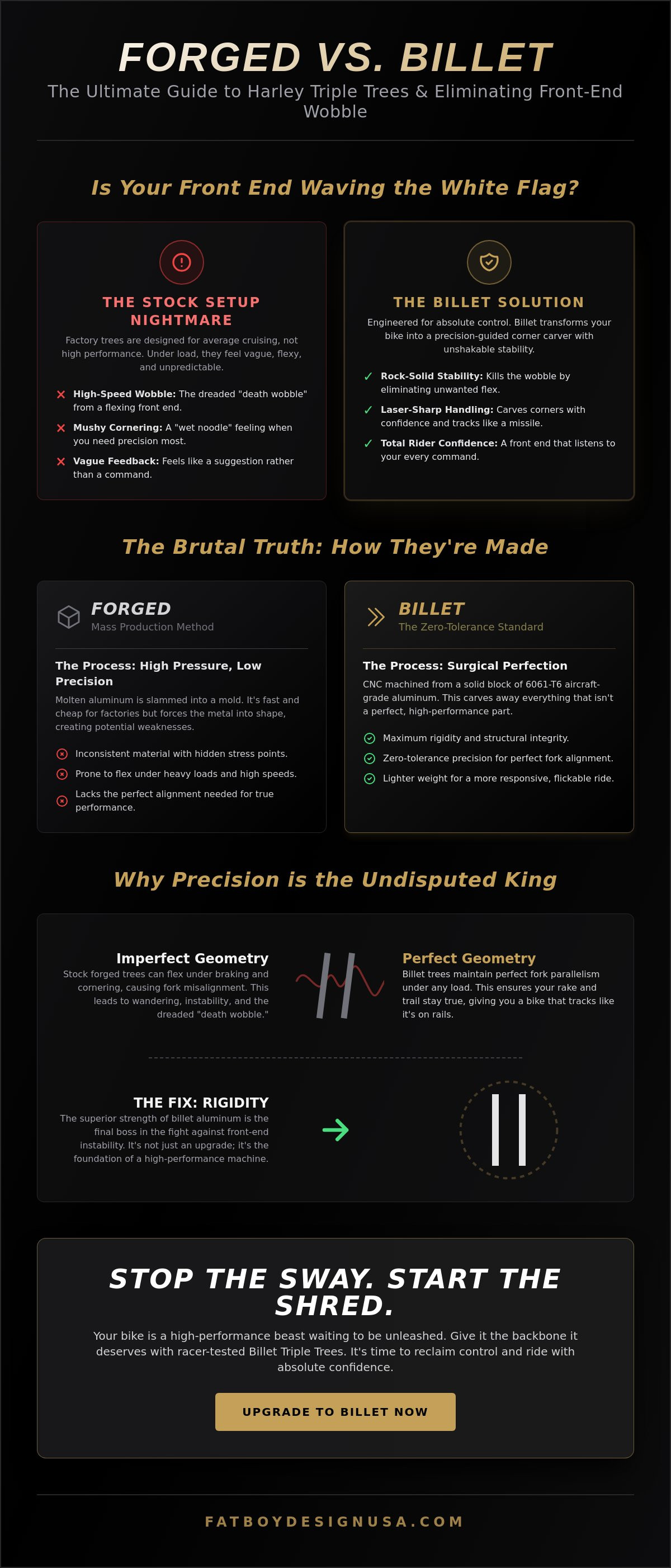
Let’s get into the heavy metal. Not the kind on your playlist; the kind holding your front end together. The debate over forged vs billet triple trees for harley usually turns into a metallurgical ego contest. Forging is the old-school hammer-and-heat method. It is efficient for the factory but lacks the soul and precision required for a true custom build. Billet is the high-tech alternative. It involves carving a masterpiece from a solid block of 6061-T6 aluminum. One is about mass production; the other is about surgical perfection.
People love to scream about "grain structure" in forged parts. Yes, smashing metal into a mold creates a dense internal structure. But here is the gritty truth: who cares if it is strong if it isn't straight? Precision is the undisputed king on a performance bagger. If your trees are off by even a hair, your handling is toast. Billet machining allows for zero-tolerance accuracy that forging simply cannot touch. Plus, there is the weight factor. Every ounce you strip off the front end makes your Harley feel lighter and more flickable. You want a bike that dances, not a lead sled.
The Forging Process: High Pressure, Low Precision
Forging is basically a high-speed smash job. Molten aluminum gets slammed into a mold to create a rough shape. It is fantastic for the factory’s bottom line because they can pump out thousands of units an hour. However, it is bad for your custom build. Because the metal is forced into a shape, it can develop hidden internal stress points. These "rough" parts often require extra machining just to fit, and they rarely offer the clean, aggressive lines of high-end bagger racing parts designed for the track.
Billet Machining: The Zero-Tolerance Standard
Billet starts with a solid, aircraft-grade block of aluminum. We use CNC machines to carve away everything that isn't a high-performance part. This process ensures maximum material consistency from the inside out. There are no hidden air pockets or stress fractures here. CNC power allows for complex geometries and integrated features, like built-in steering damper mounts, that forging just can't handle. It is the gold standard for riders who refuse to compromise on aesthetics or performance. You get a part that looks as mean as it performs, with the exact offsets needed to keep your front end stable at 100 mph.
The Handling War: Precision Machining vs. Mass-Market Forging
Stiffness is a trap. Most riders assume that a front end should be as rigid as a steel beam. That is a one-way ticket to a vibrating nightmare. When you are deep in the debate of forged vs billet triple trees for harley, you have to talk about feedback. If your front end is too stiff, it won't absorb any road energy. Instead, it sends every pebble, crack, and pothole straight into your wrists. You want a bike that talks to you, not one that yells in your face. Billet aluminum provides that "Goldilocks" level of flex. It is strong enough to kill the wobble but compliant enough to let you feel the road.
This is the secret to "racer feel." At 100mph, you need to know exactly what your front tire is doing. Is it gripping? Is it about to push? Mass-market forged parts are often too dead to tell you anything. They are thick, heavy, and lack the sophisticated resonance of a high-end machined part. Billet trees offer a superior strength-to-weight ratio that keeps you connected to the pavement without the bone-jarring harshness of low-grade steel. It is about finesse, not just brute force.
Rigidity vs. Feedback: Finding the Balance
You want stiffness where it counts: in the corners. You want your forks to stay parallel so your geometry doesn't get wonky. But you also need enough lateral flex to soak up high-frequency vibrations. Billet aluminum’s natural properties outperform cast or forged steel every single day. It offers a crisp response that makes your bagger feel like a much smaller, nimbler machine. You stop fighting the bike and start dancing with it. That is the power of choosing the right side in the forged vs billet triple trees for harley war.
Fork Alignment and Seal Longevity
Precision clamping is the unsung hero of a smooth ride. If your triple trees are even slightly warped, your forks are being pinched. This creates "stiction," which is just a fancy way of saying your suspension is getting stuck. It ruins your ride quality and blows your fork seals. Perfectly parallel bores in a billet triple tree mean your forks can finally do their job. To really lock in that front-end dominance, check out our Performance Steering Damper Kit. It is the perfect partner for a set of high-precision trees, ensuring your ride stays smooth while you are carving up the canyons. Stop letting bad alignment kill your seals and your vibe.
Street, Track, or Show? Choosing the Right Set for Your Build
Stop guessing. Start deciding. Choosing between forged vs billet triple trees for harley isn't just about what looks cool in the garage. It is about how you actually move. You have to be honest about your riding style before you drop the cash. If you are just putting to the local coffee shop once a month, the stock forged stuff might survive. But if you are chasing apexes, pinning the throttle on the highway, or hauling a bike loaded with gear, you need the surgical precision of billet. Don't be the rider who finds out their front end is inadequate while mid-corner at 80 mph.
- Step 1: Identify your riding style. Are you a Sunday cruiser or an aggressive corner carver? If you demand instant response, billet is your only option.
- Step 2: Check your weight. Heavy saddlebags and massive fairings put incredible stress on your forks. Billet trees handle that leverage without breaking a sweat.
- Step 3: Evaluate your aesthetic goals. Do you want a "factory clean" look or an industrial, race-spec vibe? Billet offers those sharp, machined lines that scream performance.
- Step 4: Consider future upgrades. Billet trees often come with integrated mounts for steering dampers or digital gauges. Plan ahead so you don't have to buy twice.
- Step 5: Budget for the long haul. Buy once, cry once. Investing in high-quality billet now saves you from replacing bent or flexy forged junk later.
The Performance Bagger Build
In 2026, racing standards have reached a final boss level. High-horsepower Harleys demand a front end that can keep up with the engine. Billet trees are the standard because they significantly reduce unsprung weight. This makes your bike feel "flick-able" instead of sluggish. You want to throw that bagger into a turn like it's a sportbike. To get that track-ready feel, you need to browse our full collection of Bagger Racing Parts. It is the quickest way to turn your couch into a rocket ship.
Custom Choppers and Show Bikes
Sometimes, the look is just as important as the lean angle. For show-stoppers, the clean, sharp lines of billet are non-negotiable. Forged parts often look dull and "bubbly" because of the mold process. Billet is different. You get those crisp, anodized finishes that catch the light. Plus, if you are running a long-fork chopper, custom offsets in billet trees can fix your ruined geometry. It makes a "un-rideable" bike actually handle. Ready to overhaul your front end? Grab the parts that define the circuit and leave the stock junk in the rearview.
Why Fat Boy Design USA Billet Trees Are the King of the Bagger Circuit
Stop trusting your life to parts made by people who have never felt a peg scrape. At Fat Boy Design USA, we don't just sell components. We sell the hard-earned results of 13 years of absolute chaos and track-side engineering. We manufacture our gear in-house right here in North Carolina. No outsourcing your safety to the lowest bidder. No middlemen. No excuses. We've spent over a decade breaking things on the track so you don't have to break them on the street. It's a legacy built on speed and a total refusal to play it safe.
When you look at the gritty reality of forged vs billet triple trees for harley, remember that we're the ones actually pushing these limits at the circuit. Our Bagger Racing Triple Trees are born from dirt, grease, and high-speed data. They're engineered to integrate seamlessly with our Performance Bagger Racer Carbon Fiber Front Fender. This combination creates a front end that's so light and responsive it feels like you're cheating. It's the ultimate lightweight setup for riders who want to dominate the twisties and look mean doing it.
Designed by Racers, for Racers
Our professional racing background isn't just a marketing slogan. It influences every single CNC cut we make. We know where a tree needs to be beefy and where it needs to lose weight. Fat Boy Design USA focuses on "affordable" performance because we believe high-end quality shouldn't require a second mortgage or a massive ego. You get track-grade hardware that actually fits your budget and your bike. Our billet trees are the first choice for Bagger racing enthusiasts because they deliver uncompromising structural integrity and laser-accurate steering feedback that stock parts can't even imagine.
The Final Verdict: Billet Wins Every Time
The war is over. Billet is the undisputed champion for any serious Harley build. Forged parts are fine for the masses, but you aren't the masses. You're someone who demands more from their machine. You want the precision, the weight savings, and the aggressive aesthetics that only a machined block of 6061-T6 can provide. Stop settling for "good enough" factory parts that flex when the pressure's on. It's time to reclaim your ride and feel what real control looks like. Upgrade your Harley's front end with Fat Boy Design USA today! Join the club where we take our riding seriously and our life not at all. Your bike is waiting for the upgrade it deserves.
Kill the Shiver and Command Your Ride
The choice between forged vs billet triple trees for harley isn't just about metallurgical specs or shop talk. It's about the soul of your ride. You've seen how mass-produced factory parts leave your front end feeling vague and uncooperative. By choosing billet, you're investing in a front end that actually communicates with the road. You're swapping the terrifying "death wobble" for a level of stability that lets you focus on the next apex rather than fighting your handlebars. It's the ultimate upgrade for any rider who demands a bike that looks as aggressive as it handles.
Fat Boy Design USA builds every component with the grit of 13+ years of professional racing expertise. Our in-house North Carolina manufacturing ensures that every cut is precise and every part is racer-tested for maximum durability. Stop letting "good enough" be the standard for your machine. It's time to experience the surgical precision and lightweight dominance that only track-bred engineering can offer. Shop Bagger Racing Triple Trees at Fat Boy Design USA and start carving corners like a pro. Your Harley is ready for its final form.
Frequently Asked Questions
Is a billet triple tree actually stronger than a forged one?
Billet is the undisputed champ when it comes to material consistency and precision. While forging smashes metal into a rough shape, billet is carved from a solid block of aircraft-grade aluminum. This means you get zero internal stress points and a part that is actually straight. In the battle of forged vs billet triple trees for harley, billet wins on structural integrity every single time.
Will upgrading my triple trees stop my Harley's high-speed wobble?
Upgrading your trees is the most effective way to kill that terrifying front-end shimmy. Most wobbles start because your stock setup is flexing like a pool noodle under the weight of a heavy bagger. A rigid billet setup locks everything in place. It keeps your forks parallel and your tire planted so you can finally stop sweating when you hit triple digits.
Do I need to change my forks if I buy billet triple trees?
Not necessarily. Most performance billet trees are designed to work perfectly with your factory fork tubes. However, if you are looking for a total transformation, some specialized kits allow you to swap in inverted sportbike forks for ultimate control. If you want to keep it simple, just grab a set designed for your stock diameter and start carving.
How much weight can I save by switching from forged to billet?
You can expect to strip off several pounds of dead weight from your front end. Forged steel trees are notoriously heavy and make your steering feel sluggish. Switching to billet aluminum lightens the load significantly. This makes your bike feel much more flickable and responsive. It is the quickest way to make your heavy tourer feel like a nimble street machine.
Are billet triple trees worth the extra cost for a daily rider?
Absolutely. You don't need to be a professional racer to appreciate a bike that actually goes where you point it. Billet trees improve daily handling and reduce the fatigue caused by fighting a vague, mushy front end. Plus, they look incredible sitting in the parking lot. It is an investment in your safety and your sanity every time you leave the driveway.
Can I install billet triple trees myself or do I need a pro?
If you have a lift, a solid set of tools, and a torque wrench, you can handle the job. But remember that this is your steering. One loose bolt can turn a fun ride into a disaster very quickly. If you aren't 100% confident in your mechanical skills, take it to a professional. It is better to pay for a few hours of labor than to second-guess your front end at highway speeds.
Do billet triple trees require special maintenance compared to forged?
Nope. Billet trees are just as durable as their forged cousins and often look better for longer. Just keep them clean and check your torque specs during your regular service intervals. Most high-end billet options come with anodized finishes that resist corrosion far better than the cheap paint found on factory parts. They are built for everyday adventures and long-term abuse.
What is the difference between 6061 and 7075 aluminum for triple trees?
6061-T6 is the gold standard for most forged vs billet triple trees for harley comparisons. It offers the perfect mix of strength, weight, and corrosion resistance for the street. 7075 is technically stronger but is also more brittle and much more expensive. For almost every rider, a well-engineered 6061 billet tree provides all the rigidity you could ever need without the unnecessary price hike.