

Gloss vs. Matte Carbon Fiber Harley Parts: The Performance Bagger’s Guide (2026)
Why settle for a bike that looks like every other stock hog on the block? You’re here because you want that stop and stare energy, but choosing between gloss vs matte carbon fiber harley parts feels like a high-stakes gamble. You’re likely worried that one wrong wash will turn your mirror-finish gloss into a map of swirl marks, or that a single greasy thumbprint will ruin your stealthy matte vibe forever. We get it. You want a machine that dominates the track and still cleans up for the weekend show without the mid-ride anxiety.
Forget the forum rumors and the old-school myths. This is your racer-tested guide to picking the King of Carbon. We’re going to help you decide between the high-voltage pop of a gloss finish and the gritty, understated power of matte. You’ll learn how to fight the 7 out of 10 owners who suffer from UV and heat damage. We’ll also show you how the latest 2026 tech, like graphene-infused coatings and the official Harley-Davidson matte detailer, keeps your ride looking lethal. Let’s get your bagger dialed in.
Key Takeaways
- Choose your vibe. Decide between the mirror-like 3D depth of gloss and the unapologetic, stealth grit of a matte finish.
- Stop the swirl marks. Master the "least aggressive" polishing techniques that keep your gloss weave popping without trashing the clear coat.
- Kill the shine. Learn the secrets of maintaining gloss vs matte carbon fiber harley parts so you can wipe away oil and fingerprints without ruining that flat, matte look.
- Armor up. Discover how graphene-infused coatings and UV blockers prevent your high-end carbon from turning yellow under the sun or engine heat.
- Go pro. Understand why racer-tested, American-made parts handle the brutal reality of the track better than mass-produced alternatives.
Gloss vs. Matte Carbon Fiber Harley Parts: The 2026 Visual War
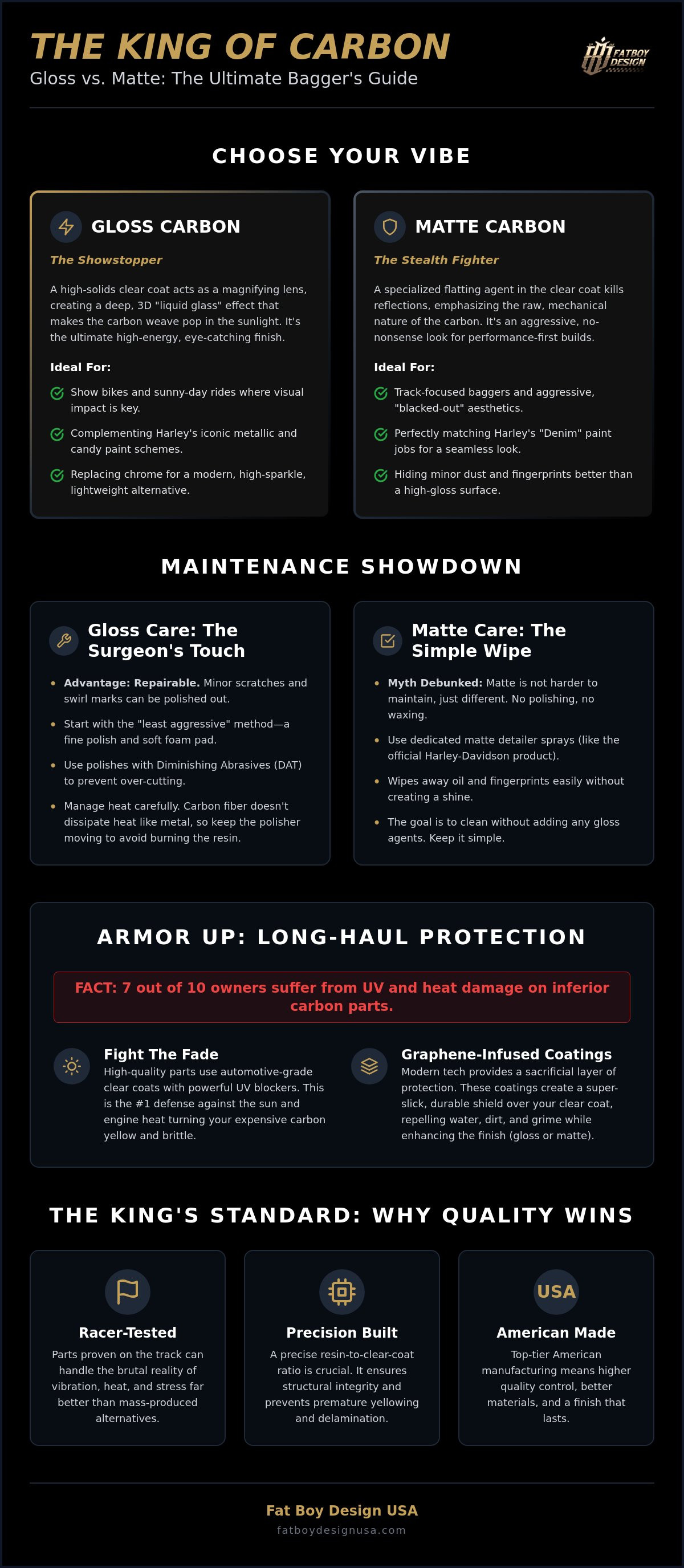
Stop staring at your stock plastics. It’s 2026, and if your bike doesn’t have that weave, do you even ride? The debate over gloss vs matte carbon fiber harley parts isn't just about what looks cooler in a parking lot. It’s about the soul of your machine. Gloss is the high-energy, "look at me" choice. It uses a high-solids clear coat to act like a magnifying glass for the eyes. This creates a deep, 3D "pop" that makes the weave look like it's floating in a pool of liquid glass. It’s pure eye candy. It’s loud. It’s proud. It’s exactly what you want when the sun hits your tank at a bike night.
Matte is the opposite. It’s for the riders who want to stay under the radar until they’re passing you on the inside of a turn. It’s the "stealth" standard for performance-first builds. While gloss adds a certain "bling" factor that rivals old-school chrome, matte emphasizes the raw, mechanical nature of the bike. It looks like it just came off a skunkworks assembly line. It feels industrial. It feels fast. It tells the world you care more about the apex than the trophy, even if you end up winning both.
Choosing between them also comes down to your Harley’s paint. Gloss carbon fiber is a chameleon. It plays incredibly well with Harley’s iconic metallic and candy paint schemes. It adds visual weight and "pop" to the build. Matte, however, is the undisputed king of the "blacked-out" Bagger aesthetic. If you’re running a Denim paint job, matte carbon is the only way to go. It keeps the lines of the bike clean without any distracting glints of light.
The Anatomy of the Finish
Premium Harley carbon fiber parts aren't just slapped together in a basement. They rely on a precise resin-to-clear-coat ratio to ensure they don't turn into yellow junk after one summer. Most people call matte "dry" carbon, but that’s a bit of a lie. It’s not actually dry. It’s just treated with a specialized flatting agent in the clear coat that kills the reflection. Think of gloss carbon as an "engineered aesthetic lens" for the underlying weave. It pulls your eye into the Carbon-fiber reinforced polymers, showing off every single thread of that beautiful 2x2 twill.
The V-Twin Context: Chrome vs. Carbon
Harleys have a long, shiny history with chrome, but the modern performance bagger is trading the shine for weight savings. Gloss carbon is the perfect replacement for chrome. It keeps that high-end sparkle but sheds the pounds that make your bike feel like a boat. If you’re building a bike to dominate the track, matte carbon is your best friend. It fits that aggressive, no-nonsense look perfectly. It makes your Bagger Racing Parts look like they mean business. No distractions. Just pure, unadulterated speed.
Gloss Carbon Fiber: The Best Polishes and Compounds for That Deep Weave Pop
Your gloss carbon is a total diva. Treat it like one. When you’re weighing the pros and cons of gloss vs matte carbon fiber harley parts, the gloss crowd has one massive advantage: you can actually fix it when life happens. But don't go grabbing that heavy-cut compound meant for a farm truck. Carbon fiber clear coats are often softer and thinner than automotive paint. You need a "least aggressive" approach. Start with a finishing polish and a soft foam pad. If that doesn't kill the swirl marks, only then do you move up one notch. It’s about surgery, not demolition.
Diminishing Abrasives (DAT) are your absolute best friend in 2026. These smart little particles start out aggressive enough to level a scratch and then literally break down into tiny polishing jewels as you work them. They stop cutting before you do something stupid. It’s like a friend who tells you to stop drinking before you start dancing on the bar. This technology ensures you get that mirror weave without leaving behind holograms that look like oily rainbows in the sun.
Heat management is where most garage heroes fail. Unlike your steel gas tank, carbon fiber is a fantastic insulator. It doesn't soak up and dissipate heat; it keeps it right on the surface where your polishing pad is screaming at 4,000 OPMs. If you linger too long on one spot, you’ll cook the resin. Keep the machine moving. Touch the surface often. If it feels hot to the hand, walk away and grab a beer while it cools. Your goal is a "Mirror Weave" finish that looks three miles deep, not a burnt fender that looks like toasted marshmallows.
Finishing Polishes for Mirror Clarity
Meguiar’s M205 is the reliable old friend that still dominates the scene for clearing light haze. However, 2026 has brought us ceramic-infused polishes that level the surface and lay down a layer of SiO2 protection in one go. It’s a massive time-saver. Just watch out for "strike-through." Aftermarket clear coats can be thin, especially on the edges. If you see the weave texture changing or getting "fuzzy," stop immediately. You’ve hit the resin, and no amount of polish can save you now. If you want to avoid the stress, start with a high-quality carbon fiber dash that’s built with enough clear coat to actually handle a detailer's touch.
Machine Polishing Curves and Radii
Forget those giant 6-inch wood-floor polishers. A 3-inch Dual Action (DA) polisher is the undisputed King for motorcycles. It fits into the tight gaps around your engine mounts and handles the complex curves of a Bagger Racing Carbon Fender without catching an edge. For the really tight spots around the triple trees, go old school. Use your fingers and a microfiber cloth. It’s slower, but your carbon will thank you for the personal touch. Ready to upgrade the look? Check out the full line at Fat Boy Design USA and get that shine dialed in.
Matte Carbon Fiber: The Stealth King and the Maintenance Myth
Matte is the boss of the shadows. It’s the move for riders who want to look fast without looking like they’re trying too hard. When you're settling the gloss vs matte carbon fiber harley parts debate for your own build, remember that matte is the ultimate low-maintenance flex. While your buddies are obsessively wiping dust off their gloss lids every ten minutes, you’re already three zip codes away. Matte carbon is surprisingly better at hiding that fine layer of road dust. It doesn't act like a spotlight for every speck of dirt. It just absorbs the light and keeps your bike looking rugged and ready for the track.
But there is a catch. You have to follow the "No-Polish" Rule. Mechanical abrasives are the sworn enemy of a matte finish. If you take a buffer or a traditional wax to your matte side covers, you’ll ruin them instantly. You’ll end up with a blotchy, semi-shiny mess that looks like a cheap DIY job. You can’t "buff out" a mistake on matte. You have to treat it with respect from day one. Keeping that "dry" look consistent across your Harley carbon fiber parts requires a different set of tools and a much lighter touch.
Chemical Cleaning vs. Mechanical Friction
Forget the friction. 2026 is all about chemistry. To deal with the real enemies-fingerprints and road oil-you need matte-specific detailers. Look for products that are pH-neutral and free of gloss-enhancing silicones or waxes. High-lubricity soaps are mandatory. They allow dirt to slide off the surface without "burnishing" the finish into a permanent shine. Use the "Two-Cloth" method in the pits. One microfiber to apply the cleaner and break down the grime; a second, dry cloth to buff away the residue. It’s fast. It’s effective. It keeps your stealth game strong.
The Permanence of Scratches
Here is the hard truth. Deep scratches in matte usually require a total re-spray. There is no middle ground. Because you can't level the clear coat with a polisher, every rock chip is a permanent battle scar. This is why using matte-specific sealants is a genius move. They create a "sacrificial layer" that protects against boot scuffs and light abrasions. These sealants bond to the surface without adding a drop of shine. Matte carbon is for the rider who values stealth over vanity. It’s built for the grit of the road. If you’re ready to commit to the dark side, check out our latest Bagger Racing Parts and give your bike that raw, mechanical edge.
Beyond the Polish: Protecting Your Bagger’s Carbon for the Long Haul
Your Harley is a rolling blast furnace. Between the screaming exhaust and the sun beating down on the asphalt, your parts are fighting for their lives. When you're picking gloss vs matte carbon fiber harley parts, you aren't just picking a look. You're picking a defense strategy. In 2026, the big question is Graphene vs. Ceramic. While traditional ceramic coatings are fantastic, graphene-infused formulas are the new kings of the V-Twin world. They offer better thermal stability. That means they don't break down when your engine starts throwing heat like a dragon with a fever. They also have anti-static properties, which means your bike actually attracts less dust while it's sitting in the garage.
Protection isn't just about shine; it's about survival. UV rays are the #1 enemy of carbon fiber. They cause that dreaded yellowing that makes high-end parts look like old newspaper. This happens when the resin under the clear coat starts to cook from sun exposure. A solid "sacrificial layer", even a simple spray sealant, acts as a sunscreen for your bike. If you're hitting the track, these coatings are a godsend. They help shed track rubber and suicidal bugs with a simple rinse. No scrubbing required. Just spray, wipe, and get back to the staging lanes.
Ceramic Coatings for High-Impact Parts
Think about your carbon fiber saddlebags. They take a beating from road debris and boot scuffs. Applying a 9H hardness ceramic coating creates a glass-like shield that’s incredibly difficult to scratch. It also gives you that "self-cleaning" magic. We’re talking about a 50% reduction in wash time. Dirt just can't find a place to hang on. You can go the professional route for a multi-year bond, or grab a DIY kit if you have a steady hand and a clean garage. Either way, it’s a massive win for your leisure time.
Combating the UV Enemy
Oxidation is the silent killer. It creates a cloudy, milky look that hides that beautiful weave you paid for. Remember, a factory clear coat is usually only 1.5 to 2 mils thick. That’s a paper-thin barrier between your investment and environmental disaster. If it’s caught early, a light polish can usually fix it, but prevention is way cheaper. This is why we use high-solids, UV-resistant clears in our premium manufacturing process. It’s built-in protection. One major tip: stop using those cheap "wash-and-wax" soaps. They leave behind a greasy film that actually attracts dust and traps heat. Stick to pure, pH-neutral shampoos that let your carbon breathe. Ready to build a bike that survives the real world? Grab your racer-tested gear here and keep that carbon looking lethal.
The King’s Standard: Why Fat Boy Design Carbon Fiber Stays Glossier (or Mattier) Longer
You’ve seen the science. You’ve mastered the wash. Now, let’s talk about the gear. When you’re choosing between gloss vs matte carbon fiber harley parts, the origin story of your parts matters more than the finish itself. Most carbon fiber on the market is mass-produced in factories that prioritize volume over vibe. Not us. We do things differently in our shop in Matthews, North Carolina. We control every single drop of clear coat from day one. This isn't just about looking good in a driveway; it's about holding that depth after thousands of miles of road grit and engine heat.
Our Platinum Series is the gold standard for riders who demand more. These aren't your average off-the-shelf components. They’re exclusive finishes designed to keep their soul long after the warranty on your bike expires. Whether you want that mirror-like pop or the grit of a stealth build, Fat Boy Design USA is the undisputed King of Carbon Fiber. We build gear for people who refuse to be slow and refuse to look basic. It’s about customization that actually lasts.
The FBD Quality Difference
We’re obsessed with the details. Our multi-stage finishing process is designed to eliminate those annoying "pinholes" and surface defects that plague cheaper brands. You won't find any "good enough" parts here. We test our gear in the brutal reality of professional bagger racing. If it can’t handle the track, it doesn't get onto your bike. Our parts are built by racers, for people who refuse to be second place. We ensure the resin-to-cloth ratio is perfect so your fenders and side covers stay structurally sound while looking lethal. It’s the difference between a part that survives a season and a part that defines a build.
Upgrade Your Ride Today
Ready to stop talking and start building? You can transform your Harley into a performance beast with everything from lightweight fenders to full dash setups. Don't just stop at the aesthetics. Match your new carbon look with our Harley Touring Performance Steering Damper Kit to ensure your bike handles as sharp as it looks. Whether you’ve landed on the side of high-voltage gloss or deep-shadow matte, we have the hardware to back up your choice. Stop settling for stock. Shop the full FBD Carbon Fiber Collection and join the club where the only rule is to never take life too seriously, but take your ride very seriously.
Claim Your Carbon and Rule the Road
You’ve got the intel. Now it’s time to pull the trigger. Deciding on gloss vs matte carbon fiber harley parts isn't a life sentence; it’s a lifestyle choice. If you crave that deep, 3D pop and don't mind a little polishing therapy, gloss is your winner. If you’re a "ride hard, wipe later" soul who wants stealthy, mechanical grit, matte has your back. Both finishes need a solid defense strategy against UV rays and engine heat to keep looking lethal for the long haul.
Your bike deserves parts that don't just look pretty but actually perform at the limit. We’ve got over 13 years of professional racing experience baked into every design. We manufacture everything in-house in Matthews, NC, to ensure the quality never slips. It’s the reason top Bagger Racing teams trust us to lead the pack. Stop settling for stock and give your machine the upgrade it’s been begging for. Upgrade to Racer-Tested Carbon Fiber at Fat Boy Design USA and get back to what matters: riding fast and looking even better.
Frequently Asked Questions
Can I use regular car wax on my gloss carbon fiber parts?
Yes, you can use regular car wax on gloss carbon fiber to add a protective sacrificial layer. It’s a great way to keep that 3D weave popping between deep cleans. Just make sure it’s a pure wax without heavy abrasives. You don't want to sand down your clear coat every time you want a little shine. Stick to high-quality carnauba or synthetic sealants for the best results.
Is matte carbon fiber more expensive than gloss?
Generally, matte and gloss parts are priced similarly because the carbon manufacturing process is identical. The difference lies in the clear coat. Matte requires a specific flatting agent to kill the reflection. While some brands might charge a small premium for the extra step, the gloss vs matte carbon fiber harley parts choice is usually about your personal style, not your bank account.
How do I remove deep scratches from my carbon fiber fender?
You can polish out light scratches if they are only in the clear coat. Use a fine-cut compound and a 3-inch DA polisher for the best control. If the scratch has reached the actual carbon weave, you’re looking at a professional re-clear or a replacement. Don't try to sand the weave itself. You’ll just end up with a fuzzy, ruined mess on your front fender.
Will polishing my carbon fiber parts remove the UV protection?
Every time you polish, you remove a microscopic layer of the clear coat that contains UV inhibitors. It won't ruin the part instantly, but you can't polish it forever. Factory clears are only about 1.5 to 2 mils thick. Once you’re through that, the sun will start cooking the resin. Polish only when necessary and always follow up with a UV-stable sealant to keep things protected.
What is the best way to clean matte carbon fiber without making it shiny?
Use a pH-neutral, matte-specific detailer and a clean microfiber cloth. Avoid any "wash and wax" soaps or products with silicones. These fill in the microscopic texture that makes matte look flat, turning your stealthy parts into a blotchy, semi-gloss disaster. Stick to the "Two-Cloth" method to ensure you aren't just moving grease around your saddlebags. It keeps the look dry and mean.
Why is my carbon fiber turning yellow, and can I polish it out?
Yellowing is usually caused by UV damage to the resin under the clear coat. If the yellowing is deep, polishing won't fix it. It’s a permanent change in the material’s chemistry. However, if the surface just looks cloudy or milky, that’s likely oxidation in the clear coat. You can polish that out to restore the clarity, but you need to add a UV-resistant coating immediately after to stop the rot.
Can I ceramic coat matte carbon fiber?
You can absolutely ceramic coat matte carbon fiber. Just make sure you use a coating specifically formulated for matte finishes. These bond to the surface and provide incredible protection without adding any artificial shine or gloss. It makes cleaning your side covers way easier. It also protects against the 7 out of 10 owners who experience heat or UV damage over time.
How often should I polish my gloss carbon fiber motorcycle parts?
Polish your gloss parts as little as possible. If you’re washing and protecting them correctly, you should only need a light polish once a year or even less. Over-polishing is the fastest way to strike through the clear coat. Focus on maintenance and protection. Let the polisher stay in the cabinet until you actually see visible swirl marks or haze on your dash or lids.