
How Are Carbon Fiber Motorcycle Parts Made? Behind the Scenes at FBD
Most "carbon fiber" parts are a lie. That glossy weave pattern you've seen slapped on budget fairings? It's often little more than carbon-look plastic waiting to crack under the first real load. If you've ever wondered how are carbon fiber motorcycle parts made — the real ones, the kind that survive race conditions and still look insane on your Bagger — that question deserves a real answer.
You already know something feels off when a $50 "carbon" panel sits next to a $500 one. Your gut's right. The gap isn't markup. It's material science, hand-laid precision, and the kind of process that doesn't cut corners because corners get you killed at speed.
Fat Boy Design USA has been building true carbon fiber parts in-house in Matthews, NC for over 13 years, with a racing pedigree that means every fender, saddlebag, and dash gets tested against real performance demands before it ever hits your bike. In this article, we're pulling back the curtain on the entire manufacturing process, from raw carbon strands to the finished part bolted to your Harley, so you can finally see exactly what you're paying for and why it matters.
Key Takeaways
- Understanding how are carbon fiber motorcycle parts made reveals why the price gap between real carbon and cheap imitations isn't markup — it's the difference between a part that performs and one that fails.
- The weave pattern on your carbon fiber isn't just cosmetic — the choice between 2x2 twill and plain weave directly impacts both the structural integrity and the visual character of every part on your Bagger.
- True carbon fiber parts go through a high-pressure autoclave curing process and vacuum bagging that eliminates air voids — a step budget manufacturers skip entirely, and the reason real parts survive race conditions.
- Every Fat Boy Design USA carbon fiber part is racer-tested before it hits the market, meaning your fender, saddlebag, or dash has already proven itself under real performance demands.
- Buying direct from the manufacturer in Matthews, NC means you're getting 13+ years of in-house racing expertise without paying middleman markups — and you'll see exactly how to spot that difference by the end of this article.
The Raw Ingredients: What Actually Goes Into Your Carbon Fiber Parts?
Strip away the glossy finish and the weave pattern you're obsessing over, and you're looking at something genuinely remarkable at the molecular level. Carbon fiber is built from atoms bonded together in crystal structures aligned parallel to the fiber's long axis. That alignment isn't an accident. It's the entire reason the material performs the way it does, channeling stress along the fiber rather than fighting it. Understanding how are carbon fiber motorcycle parts made starts right here, at the strand level, before a single layer touches a mold.
The fiber itself is only half the story. Two other decisions define every part before it ever sees a mold: the weave pattern and the resin system. Get either one wrong, and you've got an expensive-looking problem.
Weave Patterns: More Than Just Looks
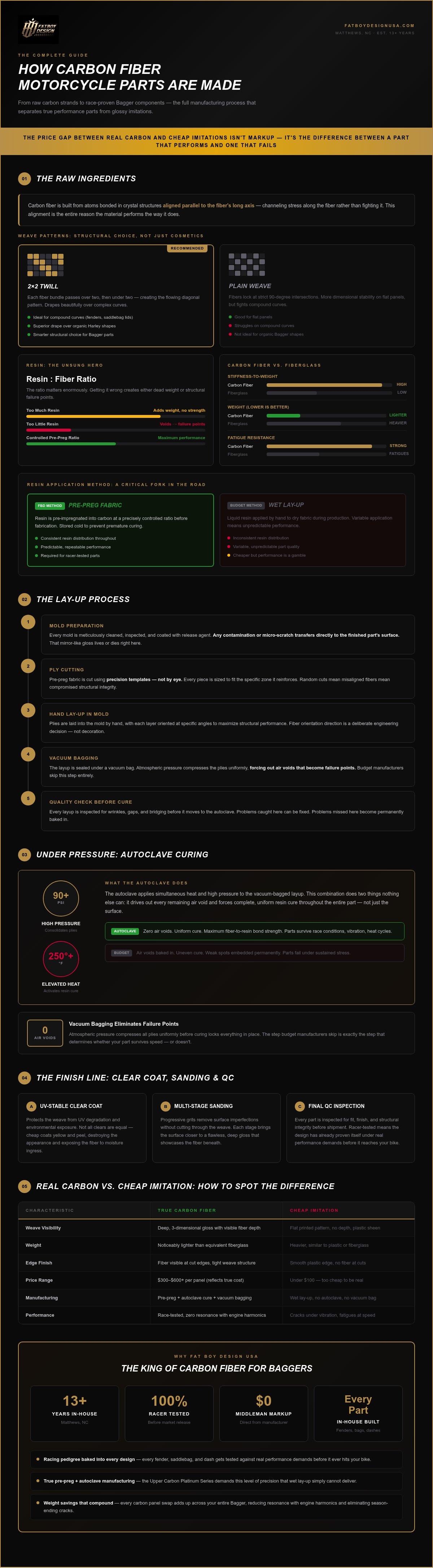
The two patterns you'll encounter most on Bagger parts are 2x2 twill and plain weave. Twill is what gives carbon fiber that flowing, diagonal visual character. Each fiber bundle passes over two, then under two, creating the offset pattern that drapes beautifully over complex curves. Plain weave locks fibers at strict 90-degree intersections, which delivers more dimensional stability in flat panels but fights you on compound curves. For Harley fenders and saddlebag lids with organic shapes, twill isn't just the prettier choice. It's the smarter structural one.
Resin: The Unsung Hero
Fiber alone is brittle. Resin is what transforms a stack of woven strands into a structural composite. It fills the gaps between fibers, transfers load between them, and protects the whole assembly from moisture and UV degradation. The resin-to-fiber ratio matters enormously. Too much resin and you're adding weight without adding strength. Too little and you're leaving voids that become failure points under vibration and heat.
The Difference Between Carbon Fiber and Fiberglass
Fiberglass is heavier, absorbs more vibration energy through flex rather than managing it, and fatigues faster under the kind of sustained stress a performance Bagger generates. Carbon fiber's stiffness-to-weight ratio isn't just a spec sheet number. It translates directly into parts that don't resonate with your engine's harmonics and don't crack after a season of hard riding. The weight savings compound across every panel you swap.
Pre-Preg vs. Wet Lay-up: The FBD Choice
Wet lay-up is exactly what it sounds like: workers apply liquid resin to dry fabric by hand during the layup process. It's cheaper. It's also inconsistent, because human application means variable resin distribution, which means unpredictable performance. Pre-preg fabric arrives with resin already impregnated into the carbon at a precisely controlled ratio, stored in cold conditions to keep it from curing prematurely. The Upper Carbon Platinum Series demands that level of precision. Wet lay-up simply can't deliver the consistency that racer-tested parts require, and that's why understanding how are carbon fiber motorcycle parts made at this level separates real performance components from shelf decorations.
The Art of the Lay-up: Hand-Crafting Performance Shapes
Watching someone describe carbon fiber fabrication as "just sticking fabric in a tray" is like watching someone describe surgery as "just cutting people open." Technically not wrong. Catastrophically incomplete. The lay-up process is where raw materials either become a precision performance component or a glossy disappointment, and every step demands decisions that no machine can make on autopilot.
Here's what actually happens inside the Matthews, NC shop before a single part ever sees heat or pressure.
Step 1: Mold preparation. The mold surface dictates the finished part's surface. Full stop. Every mold gets meticulously cleaned, inspected, and coated with release agent before a single fiber touches it. Any contamination, any micro-scratch, any inconsistency in the release coat transfers directly to your part's finish. That mirror-like gloss you're after? It lives or dies right here.
Step 2: Ply cutting. Pre-preg fabric gets cut using precision templates, not by eye. Every piece is sized to fit the specific zone it's reinforcing. Sloppy cuts mean overlaps where you don't want them and gaps where you need coverage. Templates eliminate that variable entirely.
Step 3: Laying the fibers. This is where "drape" becomes a real engineering challenge. Carbon fabric doesn't behave like cloth. On compound curves, like the organic sweep of a Harley fender, the weave wants to pucker, shift, and distort. Managing drape means coaxing each ply into position without disturbing the fiber alignment underneath it. A wrinkle in the weave isn't just ugly. It's a stress concentration point waiting to crack.
Step 4: Compaction. Between plies, air is the enemy. Each layer gets compacted using rollers and squeegees to chase out trapped air before the next ply goes down. Skip this step and you're building voids into the laminate, invisible weak points that vibration and heat will eventually find.
Ply Orientation: The Secret to Strength
Understanding how are carbon fiber motorcycle parts made at a structural level means understanding ply angles. Carbon fiber is strongest along the fiber direction. Stack all your plies in one direction and you've got a part that's incredibly strong in that axis and brittle in every other. The solution is deliberate orientation sequencing:
- 0-degree plies carry longitudinal loads, resisting bending along the part's length.
- 90-degree plies resist lateral loads and prevent splitting across the width.
- 45-degree plies handle torsional stress, the twisting forces that hit hardest on a front fender at speed or under braking.
On the Performance Bagger Front Fender, high-impact zones like the leading edge and mounting points get additional 45-degree reinforcement plies. That's not guesswork. It's a deliberate response to where real-world stress concentrates on a performance Bagger under hard riding conditions. The same orientation logic prevents warping over time, because a balanced, symmetric ply stack resists the thermal cycling that would cause an unbalanced laminate to curl or twist after repeated heat exposure.
The Human Element in a Tech-Heavy Process
No robot has the fingertip sensitivity to feel a ply starting to shift before it fully misaligns. No automated system catches a subtle resin-starved zone by touch before compaction locks it in. Master fabricators at FBD run quality checks at every single layer, not just at the finished part stage. That's what "King of Carbon Fiber" actually means in practice: a standard that doesn't defer quality control to the end of the line, because by then, it's too late to fix anything without scrapping the whole part.
If you want to see what that standard produces, browse the full Harley Davidson carbon fiber catalog and compare the finish consistency across every part. That's not luck. That's what layer-by-layer discipline looks like at scale.
Under Pressure: The Autoclave and Curing Process
You've got perfectly laid plies, precise fiber orientation, zero visible defects. And you can still ruin everything in the next step. Curing isn't a formality. It's the moment where a carefully built laminate either becomes a structural component or an expensive fiberglass impersonator. Understanding how are carbon fiber motorcycle parts made at this stage means understanding one thing clearly: heat alone isn't enough. You need pressure.
The autoclave is essentially a high-pressure industrial oven. Parts go in sealed inside vacuum bags, the chamber pressurizes, temperature ramps up on a controlled schedule, and the resin undergoes a permanent chemical transformation. That's the short version. The details are where the performance lives.
Before the autoclave door even closes, vacuum bagging does the first round of heavy lifting. A flexible membrane seals over the layup and a vacuum pump pulls the air out from between every ply. This isn't just about removing visible bubbles. It's about collapsing microscopic voids that would never show up in a visual inspection but would absolutely show up as delamination after six months of vibration and thermal cycling on your Harley.
The Science of the Cure Cycle
Temperature doesn't just spike and hold. A proper cure cycle has three distinct phases: ramp-up, soak, and cool-down. Ramp-up brings the part to cure temperature gradually, allowing resin viscosity to drop just enough to flow and wet out any remaining dry fiber zones before it starts to gel. The soak phase holds temperature steady while the resin crosslinks at the molecular level, building the rigid matrix that gives carbon its legendary stiffness. Cool-down is controlled for the same reason, because thermal shock can introduce residual stress into a laminate that's just spent an hour becoming perfectly consolidated.
Pressure during this entire cycle serves a second critical function beyond void elimination. It physically prevents delamination by holding every ply in intimate contact while the resin transitions from liquid to solid. Delamination is the number one failure mode in carbon fiber motorcycle parts, and it doesn't announce itself. A part can look perfect on the surface while its internal layers are already separating. Autoclave pressure is what closes that failure path before it opens.
Autoclave vs. Oven-Curing
Standard ovens deliver heat. That's it. No pressure differential, no vacuum consolidation, no mechanism for driving out residual porosity. Parts cured in a standard oven can look identical to autoclave-cured parts right out of the mold. They won't look identical after a hard season of riding. The surface finish difference is visible too. The Bagger Racing Carbon Fender gets that deep, consistent gloss from autoclave pressure forcing the outer ply flat against the mold surface with a uniformity that atmospheric pressure simply can't match.
Garage-built carbon parts skip autoclave curing because the equipment costs are significant and the process demands expertise. That's a legitimate business decision. It's just not one that produces parts you'd trust at speed. Every component FBD builds goes through industrial-grade curing, not because it's the easy path, but because it's the only path that produces parts worth putting on a performance Bagger.
The Finish Line: Clear Coats, Sanding, and Final QC
The autoclave door opens. The vacuum bag comes off. And there it is, your part, pulled from the mold for the first time. That moment is genuinely satisfying, but it's also where a lot of shops declare victory too early. The part isn't done. Not even close.
De-molding reveals the raw laminate, and raw means exactly that. Edges are rough. Flash lines need trimming. Mounting holes don't exist yet. Every part goes straight to precision trimming and machining, where CNC tooling cuts the final geometry: bolt holes, clearance notches, and edge profiles that need to fit your specific Harley without stress-inducing gaps or interference. Sloppy trimming creates micro-cracks at mounting points before you've even installed the part. That's not a finish problem. That's a structural failure waiting for the right pothole to introduce itself.
Sanding follows a strict multi-stage progression. Starting coarse and working progressively finer, each pass removes the scratches from the last. Skip a grit and you're trapping surface defects under your clear coat, where they'll show up as haze or orange peel the moment sunlight hits at the right angle. The goal is a surface so uniform that the clear coat sits on it like glass, not like a bandage over an uneven substrate.
Why UV Protection is Non-Negotiable
Here's the chemistry problem budget parts never solve: epoxy resins yellow under UV exposure. Not eventually. Aggressively. One summer of direct sunlight and that deep, dark weave pattern turns amber. The carbon fiber itself is fine. The resin matrix holding it together is degrading visually in real time. Cheap clear coats offer minimal UV filtering because proper automotive-grade UV-resistant clears cost more and require correct application conditions to perform. FBD uses automotive-grade clear coats specifically formulated to block UV degradation, preserving that three-dimensional weave depth that makes real carbon fiber look the way it does. Maintenance is straightforward: wash with pH-neutral soap, avoid abrasive compounds, and apply a quality paint sealant twice a year. That's it. The clear coat handles the rest.
Final Quality Control Inspection
Every finished part gets a tap test before it ships. Tapping across the surface with a coin or knuckle produces a consistent tone on a fully consolidated laminate. A dull thud in a localized spot means delamination underneath, invisible to the eye, fatal to long-term performance. Visual inspection checks weave alignment, surface consistency, and clear coat uniformity under controlled lighting. Then comes fitment verification: the part physically mounts to the correct Harley application and checks out under load. Only parts that pass every stage leave Matthews, NC. That's how are carbon fiber motorcycle parts made when the standard isn't "good enough" but "racer-tested."
Ready to see what that standard looks like on your Bagger? Browse the full Harley Davidson carbon fiber catalog and find parts that have earned the finish they're wearing.
Why Fat Boy Design USA is the King of Carbon Fiber
Titles get thrown around cheap in the motorcycle parts world. "Premium." "Race-grade." "Professional." Walk into any distributor's warehouse and you'll see those words on boxes that came off a container ship and never saw a track in their lives. The "King of Carbon Fiber" isn't a marketing slogan FBD invented on a Tuesday. It's a conclusion 13+ years of in-house manufacturing and professional racing forces you to reach when you compare the work side by side.
The math on direct-from-manufacturer pricing is straightforward. Every middleman between the shop floor and your garage adds margin. Distributors take their cut. Retailers take theirs. By the time a part reaches you through a traditional supply chain, you're paying for two or three businesses' overhead on top of the actual product. FBD builds in Matthews, NC and ships directly to you. That's it. No warehouse markups. No distributor fees. The price reflects the part, not the logistics chain wrapped around it.
In-house production isn't just a cost advantage. It's a control advantage. Every mold, every layup, every cure cycle, every QC tap test happens under one roof. If a process needs refinement, it gets refined immediately, not after a six-week communication loop with an overseas supplier. That kind of total control over how are carbon fiber motorcycle parts made is exactly what keeps consistency high and failure rates low across every fender, saddlebag, and dash that ships out the door.
From the Track to Your Garage
Professional racing doesn't forgive parts that are built for show. A fender that looks incredible in a showroom and fails under sustained vibration, heat cycling, and real aerodynamic load is useless on a performance Bagger. FBD's racing background isn't a backstory. It's the actual engineering filter every part passes through before it ever reaches a product page. If it doesn't survive track conditions, it doesn't get sold. Full stop. That's the "no-fluff" standard that separates parts designed for speed from parts designed for photography. Check out the full Harley-Davidson Carbon Fiber collection and you'll see that standard reflected across every category.
Ready to Lighten the Load?
If you're trying to figure out where one upgrade delivers the most performance-per-dollar on your Bagger, carbon fiber is the answer. Weight reduction compounds across every panel you swap. Stiffness improvements reduce vibration fatigue on long rides. And the visual upgrade is immediate and permanent. Understanding how are carbon fiber motorcycle parts made at this level makes the investment obvious, not just aspirational.
Ride with parts that have already proven themselves. Shop the latest Carbon Fiber Bagger Parts now and join the riders who stopped settling for shelf decorations.
Your Bagger Deserves the Real Thing
Now you know exactly how are carbon fiber motorcycle parts made, from crystal-aligned strands and precision pre-preg layups to autoclave pressure and racer-tested QC. The price gap between real carbon and cheap imitations isn't a mystery anymore. It's material science, process discipline, and a standard that doesn't negotiate with failure.
Three things set FBD apart from everything else on the market: 13+ years of professional racing expertise that filters every part before it reaches you, in-house manufacturing in Matthews, NC that keeps quality under one roof, and racer-tested components that have already proven themselves where it counts.
You don't have to settle for shelf decorations dressed up in carbon-look plastic. Real parts exist. They're built right here in the USA, and they're ready for your Harley right now.
Upgrade Your Harley with FBD Carbon Fiber Today! and ride with parts that have already earned their reputation the hard way.
Frequently Asked Questions About How Carbon Fiber Motorcycle Parts Are Made
Is carbon fiber really stronger than steel for motorcycle parts?
Carbon fiber isn't stronger than steel in every direction, but that's the wrong comparison. What matters for motorcycle parts is the strength-to-weight ratio, and there carbon fiber wins decisively. Steel is dense and isotropic, meaning it performs similarly in all directions. Carbon fiber is engineered to be incredibly strong along the fiber axis, so a well-designed carbon part delivers steel-level structural performance at a fraction of the mass.
For Bagger applications specifically, that directional strength is an asset, not a limitation. Ply orientation sequences are designed to put fiber strength exactly where stress concentrates, whether that's the leading edge of a front fender under aerodynamic load or mounting points absorbing road vibration. It's not about raw tensile numbers. It's about putting the right strength exactly where the part needs it.
Why is carbon fiber more expensive than fiberglass or plastic?
Three things drive the cost: raw materials, process complexity, and labor intensity. Carbon fiber precursor material and pre-preg fabric cost significantly more than fiberglass cloth or injection-molded plastic blanks before a single hand touches them. Then you add autoclave curing equipment, precision mold fabrication, and the skilled labor required to lay every ply correctly without introducing voids or misalignment. None of those inputs are cheap, and none can be skipped without compromising the final part.
Buying direct from the manufacturer, as FBD structures it, removes distributor and retailer markups from the equation. The price you pay reflects the actual material and process cost, not a supply chain layered with middlemen taking margin at every handoff. That's why in-house production in Matthews, NC matters beyond just quality control.
Can carbon fiber motorcycle parts be repaired if they get scratched?
Surface scratches in the clear coat are absolutely repairable using standard automotive wet-sanding and polishing techniques. A competent detailer can handle light scratches without touching the carbon laminate underneath. Deeper damage that cuts through the clear coat into the resin surface requires more careful work, typically spot-filling and re-clearing, but it's still manageable for someone with paint repair experience.
Structural damage is a different conversation entirely. Cracks, delamination, or impact damage that compromises the laminate itself generally means replacement rather than repair. Unlike metal that bends and telegraphs damage visibly, carbon fiber can look intact on the surface while internal layers have separated. If a part takes a hard impact, get it inspected properly before trusting it at speed.
Do carbon fiber parts turn yellow over time in the sun?
The carbon fiber itself doesn't yellow. The epoxy resin matrix and clear coat do if they lack UV protection. Cheap clear coats offer minimal UV filtering, and one hard summer of direct sunlight can turn a deep, dark weave amber in a hurry. That's a chemistry problem, not a carbon problem, and it's entirely preventable with the right finishing process. Automotive-grade UV-resistant clear coats block the wavelengths that degrade epoxy resin, preserving the weave depth and color long-term.
Maintenance makes a real difference too. Washing with pH-neutral soap, avoiding abrasive compounds that strip clear coat, and applying a quality paint sealant twice a year keeps the UV protection layer performing as designed. The part does its job. You do yours with basic upkeep.
How much weight can I actually save by switching to carbon fiber fenders?
The honest answer is that it depends on the specific part, its size, and what it's replacing. A carbon fiber front fender on a Bagger typically weighs significantly less than its steel or fiberglass equivalent, and the savings compound when you swap multiple panels. The performance benefit isn't just the number on a scale. Less unsprung weight at the front end changes how the bike responds to suspension inputs and reduces the rotational mass the engine has to manage.
Weight savings also affect handling feel in ways that are genuinely noticeable on a long ride. Less mass vibrating at the fender means less fatigue transferred to mounting points over hours of riding. If you're building a performance Bagger rather than a show bike, those cumulative gains across multiple carbon swaps add up to a meaningfully different riding experience.
Are all carbon fiber weaves the same, or is one better for racing?
Weaves are not the same, and the difference matters structurally as well as visually. The two most common patterns are 2x2 twill and plain weave. Plain weave locks fibers at strict 90-degree intersections, which delivers excellent dimensional stability on flat panels but fights you on compound curves. Twill, where each fiber bundle passes over two and under two, drapes far better over organic shapes and handles complex geometry without distorting fiber alignment.
For racing applications on parts with curved profiles, like fenders and saddlebag lids, twill is the smarter choice because maintaining fiber alignment through a curve is critical to structural performance. A wrinkle in the weave on a compound surface isn't a cosmetic issue. It's a stress concentration point. Understanding how are carbon fiber motorcycle parts made at this level explains why weave selection is an engineering decision, not just an aesthetic one.
Is it hard to install carbon fiber parts on a stock Harley-Davidson?
For most bolt-on carbon fiber parts, installation is straightforward for anyone comfortable doing basic motorcycle maintenance. Fenders, saddlebag lids, side covers, and dash panels are designed to replace OEM components using existing mounting points. If you can remove the stock part and reverse the process with a new one, you can install carbon fiber. The fitment precision on properly manufactured parts means no drilling, grinding, or creative problem-solving required.
The key word there is "properly manufactured." Parts that come from molds built specifically for Harley-Davidson applications, with mounting geometry verified against the actual bike, install cleanly. Parts that were designed loosely and trimmed by hand introduce fitment headaches that require shimming, grinding, or forcing hardware that shouldn't need force. Precision CNC trimming after de-molding is what separates a clean install from a frustrating afternoon in the garage.
What is 'Pre-Preg' carbon fiber and why does it matter for my bike?
Pre-preg is carbon fiber fabric that arrives from the manufacturer with resin already impregnated into it at a precisely controlled ratio, stored cold to prevent premature curing. The alternative is wet lay-up, where workers apply liquid resin to dry fabric by hand during the build process. Wet lay-up is cheaper and more accessible, but human application means variable resin distribution across the part, which translates directly to inconsistent performance.
Pre-preg eliminates that variable. Every square inch of fabric has the same resin content, which means predictable fiber-to-resin ratios, consistent void content after curing, and repeatable mechanical performance from part to part. For a racer-tested standard, that consistency isn't optional. A part that performs differently from the last one built isn't a quality product. Pre-preg is how you ensure the fender on your bike performs exactly like the one that proved itself under race conditions.