

How Are Carbon Fiber Motorcycle Parts Made? The FBD Deep Dive
Most of the "carbon fiber" you see on the street is just a glorified sticker, a fancy wrap that has no business being near a high-performance V-twin. If you have ever wondered how are carbon fiber motorcycle parts made for real, you are in the right place. We are talking about structural soul, not just a pretty face. You know the drill. Harleys shake, they rattle, and they will chew up inferior parts before you even hit third gear. It is totally normal to be skeptical about whether a lightweight material can handle that kind of abuse without cracking under the pressure.
Stick around because we are taking you behind the curtain at our Matthews, NC facility to show you exactly how we turn raw carbon thread into racer-tested, weight-shaving Harley parts. We promise to strip away the mystery and show you the professional manufacturing steps that separate the toys from the tools. We are diving into every high-heat, high-pressure step that makes our Upper Carbon Platinum Series the undisputed king of the road. You will learn how to spot quality markers and why our 13 years of racing expertise makes this the ultimate performance investment for your bagger.
Key Takeaways
- Learn the difference between 3k and 12k weaves and why the right "thread" is the secret to a part that survives the legendary Harley shake.
- Get the full breakdown on how are carbon fiber motorcycle parts made using our elite 5-step fabrication process at our Matthews, NC facility.
- Find out why "post-curing" is the non-negotiable science that keeps your carbon dash from melting or warping next to a hot M8 engine.
- Stop falling for "skinning" traps and discover why real structural carbon is the only way to actually shave weight off your bagger.
- See how 13+ years of professional racing expertise translates into the "Upper Carbon Platinum Series" standards you can trust at triple-digit speeds.
The Ingredients of Speed: What Goes Into a Carbon Fiber Part?
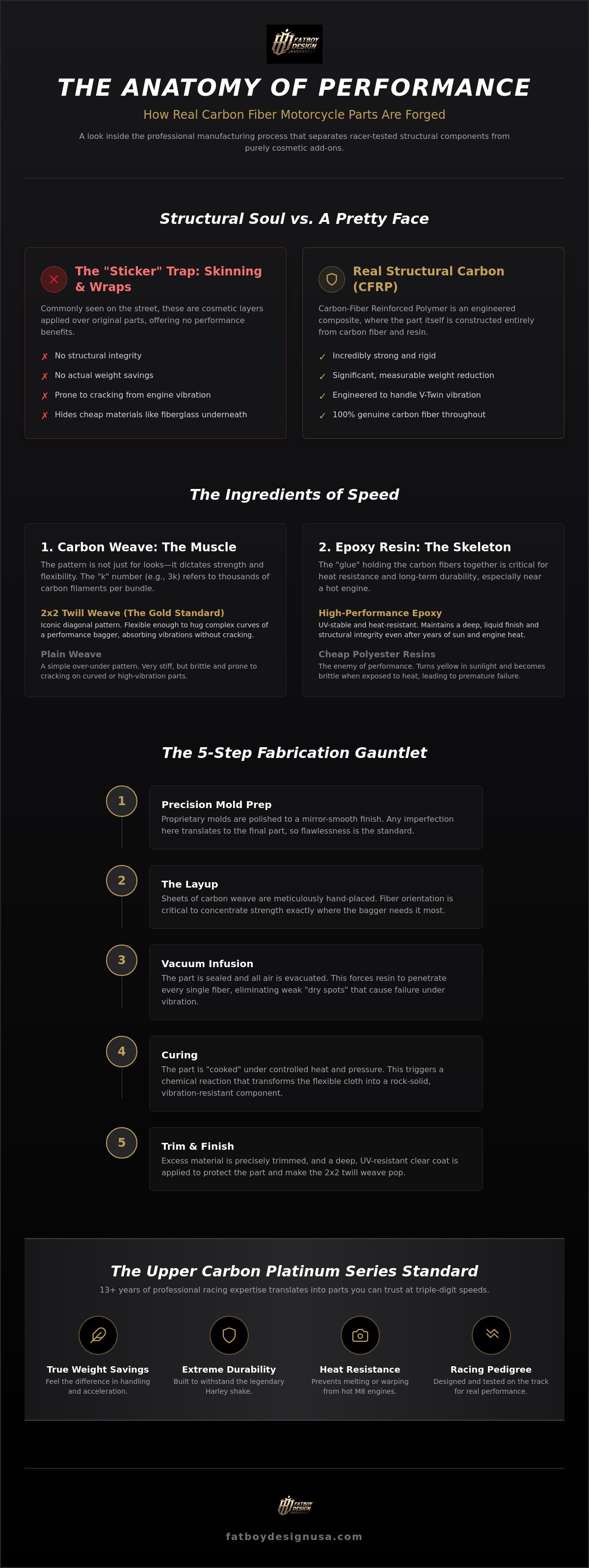
Think of carbon fiber as the ultimate power couple. It is not just one lonely material; it is a high-stakes team effort. Officially, we call these Carbon-fiber reinforced polymers (CFRP), but you can just call it the reason your bike finally feels light. If you want to know how are carbon fiber motorcycle parts made to survive a brutal racing season, you have to start with the ingredients. We use raw carbon "tow," which is just a fancy word for a bundle of carbon filaments. These bundles come in sizes like 3k, 6k, or 12k. The "k" stands for a thousand. A 3k weave has 3,000 tiny carbon hairs per bundle. We choose the specific weave that gives your Harley the most muscle without adding an ounce of unnecessary fat.
At Fat Boy Design USA, we have a strict "no filler" policy. Some shops hide cheap fiberglass under a thin layer of carbon to cut costs. We don't play those games. Our Upper Carbon Platinum Series is 100% real deal carbon from front to back. No fluff. No shortcuts. Just pure, unadulterated speed. This is the foundation of the "King of Carbon Fiber" reputation we have built over 13 years on the track.
Understanding the Weave Patterns
The pattern is not just for looks. A plain weave is a tight over-under pattern that is incredibly stiff. It is great for flat panels, but it hates curves. That is why the 2x2 twill is our gold standard. It has that iconic diagonal look you crave, but more importantly, it is flexible enough to hug the complex lines of a performance bagger. This flexibility is key. It allows the part to soak up the relentless vibration of a V-Twin engine instead of cracking under the stress. We orient the weave specifically to handle the unique loads of a heavy touring bike. It is engineering you can actually see.
The Role of High-Performance Resins
Understanding how are carbon fiber motorcycle parts made starts with the "glue" that holds everything together. If the carbon is the muscle, the resin is the skeleton. Cheap polyester resins are the enemy. They turn yellow in the sun and get brittle when things get hot. We use high-performance epoxy resins that are UV-stable and heat-resistant. This is why a Fat Boy Design USA Carbon Fiber Dash keeps its deep, liquid-like finish even after hours in the baking sun. These resins are the "secret sauce" that lets our parts survive the massive heat soak coming off a high-output M8 engine. It is the difference between a part that looks good in the driveway and one that looks good after five years on the road.
From Weave to Wing: The 5-Step Fabrication Process
Forget those grainy garage videos you saw on YouTube. Real engineering doesn't involve a paintbrush and a bucket of hope. If you want to know how are carbon fiber motorcycle parts made to survive a 120mph wobble, you have to see our five-step gauntlet. We don't just make parts; we build armor that happens to be incredibly light. It is a meticulous dance between high-tech science and old-school grit.
- Step 1: Precision Mold Prep. We start by polishing our proprietary molds until they are mirror-smooth. If there is a single speck of dust, it shows. This is where the "King of Carbon Fiber" sets the stage for a flawless finish.
- Step 2: The Layup. Our crew hand-places every sheet of carbon weave. We align the fibers so the strength is concentrated exactly where your Bagger needs it most, ensuring optimal strength-to-weight ratios.
- Step 3: Vacuum Infusion. We seal the part in a vacuum bag and pull out every molecule of air. This ensures the resin penetrates every single fiber for a "no-fail" racing bond.
- Step 4: Curing. We "cook" the part under intense heat and pressure. This chemical transformation turns floppy cloth into a rock-solid, vibration-resistant beast.
- Step 5: Trim and Finish. We cut away the excess material and apply a deep, UV-resistant clear coat. It is the final polish that makes that iconic 2x2 twill pop.
The Magic of Vacuum Infusion
This is the step that separates the pros from the hobbyists. If you want to understand how are carbon fiber motorcycle parts made at a professional level, you have to look at the pressure. While budget brands just brush resin on, we use vacuum pressure to pull the epoxy through the fibers. This eliminates "dry spots." On a vibrating Harley, a dry spot is a death sentence; it is where the part will eventually shatter. Our infusion process creates a perfect, uniform bond that is significantly stronger than anything you can do in a garage. If you want to see this science in action, check out our bagger racing parts to see how we build for the track.
Hand-Crafted Precision in Matthews, NC
Robots are great for making toasters, but they suck at handling the complex, sexy curves of Carbon Fiber Saddlebags. Human hands have the "feel" required to match the weave across multiple panels so your bike looks seamless from front to back. Every part that leaves our Matthews, NC facility carries the soul of a team that has spent 13 years breaking things on the track so you don't have to. You aren't just buying a part; you are buying a piece of racing heritage that was touched by experts at every stage.
Curing and Finishing: Why 'Cooking' the Parts Matters
You can't just leave carbon fiber out to dry like a wet dog. It needs heat. It needs pressure. It needs a serious session in the oven to reach its full potential. When you look at how are carbon fiber motorcycle parts made at a professional level, the "cook" is where the chemical magic happens. This stage is called curing, and it is the difference between a part that holds its shape and one that turns into a wet noodle the moment the sun hits it. We don't just let the resin harden at room temperature; we take it through a rigorous thermal cycle to ensure every bond is locked in tight.
The real secret is "post-curing." This is a secondary heating phase that raises what engineers call the glass transition temperature. In plain English? It makes the part stay rock-solid even when it gets incredibly hot. If a manufacturer skips this, your expensive carbon fiber might start to warp or go soft. We "cook" our parts to a specific standard developed over 13 years of professional racing. This ensures that the structural integrity is baked in, literally. It is why our gear doesn't just look fast; it stays fast regardless of the weather or the workload.
Heat Resistance for Performance Baggers
Harleys are heat-soak monsters. Between the massive M8 engine and the baking asphalt, your bike is a rolling furnace. Our curing process is designed specifically for this abuse. It ensures your side covers or fenders won't melt or distort during a heavy track day or a long haul through the desert. We test these limits daily at our Matthews, NC facility. We build bagger racing parts that are born in the heat, so they can survive the heat. It is racer-tested durability that you can feel in every corner.
The Final Polish: More Than Just Bling
Once the part is "cooked" and trimmed, it is time for the FBD shine. We don't use cheap gel coats that crack and yellow over time. We use automotive-grade UV protection that acts like a suit of armor for the fibers. This clear coat battle is won through hours of sanding, buffing, and obsessive attention to detail. This mirror finish is not just for the "wow" factor at the bike show. It seals the part against road salt, grime, and moisture. It creates that deep, 3D look where the weave seems to pop right off the surface. If you want to know more about our standards, check out the story of the King of Carbon Fiber and see how we have redefined the industry.
Professional Grade vs. DIY 'Skinning': The Safety Gap
Don't let a pretty weave fool you. There is a massive difference between a part engineered for speed and a part that is just wearing a costume. In the world of custom Harleys, you will often hear about "skinning." This is basically the automotive equivalent of putting a tuxedo on a pig. Skinning involves taking a heavy, stock plastic part and wrapping it in a single, thin layer of carbon fiber cloth. It looks the part from ten feet away, but it is a total disaster for performance. If you want to know how are carbon fiber motorcycle parts made at a professional level, you have to look past the surface and into the structural soul of the build.
The biggest lie in the skinning world is that you are saving weight. You aren't. Because you are adding a layer of carbon and heavy resin on top of an already heavy plastic part, you are actually making your bike fatter. A real Carbon Fiber Front Fender from FBD is a completely different species. It replaces the stock unit entirely. We don't do "makeup" for heavy bikes; we do structural replacements that actually change how the machine handles. When you choose real carbon, you are choosing a part that was born in a mold, not one that was glued onto a piece of trash.
Weight Savings Comparison
Let's talk numbers because the scale does not lie. Real structural carbon fiber offers a massive 50% to 70% weight reduction over stock components. On the flip side, DIY skinning usually results in a 10% weight increase. That might not sound like much until you realize that extra weight is "unsprung." That is weight the suspension has to manage every time you hit a bump. Reducing unsprung weight allows your forks and shocks to react faster, keeping your tires glued to the pavement. Stop adding dead weight to your ride and start shaving it off with the real deal.
Impact and Vibration Resistance
How are carbon fiber motorcycle parts made for the podium? They are built to flex. Real structural carbon can soak up the relentless thumping of a high-compression V-Twin without breaking a sweat. Skinned parts are notorious for delamination, which is a fancy way of saying the carbon peels off the plastic like a bad sunburn. This usually happens at 80mph, which is the last time you want a sheet of carbon fiber flying into your face. No pro racer would ever trust a skinned part because they shatter on impact. For a deeper look at building a machine that can actually handle the heat, check out our Performance Bagger Guide 2026. Build for the track, even if you only ride on the street.
Ready to ditch the plastic and get serious? Upgrade your ride with our performance bagger parts and feel the difference that real engineering makes. Whether you are installing these parts yourself or upgrading your home shop, check out Fourman Industries for personalized extension cords in unique colors that bring reliable power to your workspace.
Why FBD’s In-House Process Rules the Bagger World
We don't just build parts; we build a reputation. For over 13 years, we have been the ones at the track breaking things so you don't have to. That is the "King of Carbon Fiber" difference. While big-box brands are busy outsourcing their production to the lowest bidder overseas, we are right here in Matthews, NC. We handle every single step of the process in-house. No middlemen. No corporate excuses. Just pure, unadulterated performance delivered straight from our garage to yours. When you ask how are carbon fiber motorcycle parts made at FBD, the answer is simple: they are made with an obsession for detail that a factory robot could never replicate.
Our in-house control allows us to do things the "big guys" can't touch. We can experiment with complex weaves and reinforced mounting points that handle the massive torque of a built Harley. We aren't just following a blueprint; we are evolving the craft every single day. Joining the FBD club means you are running gear designed by racers, for racers. It is a lifestyle of rejecting the mundane and embracing the absolute pinnacle of American engineering. If it isn't good enough for the podium, it isn't good enough for your bike.
The Upper Carbon Platinum Series
If our standard line is the gold standard, the Platinum Series is the crown jewel. This is where our manufacturing process reaches its peak. We use exclusive weaves and specialized reinforcement in high-stress areas to ensure these parts survive triple-digit speeds and relentless vibration. It is the kind of jewelry that actually makes you faster. We have spent over a decade refining the science of how are carbon fiber motorcycle parts made to ensure the Platinum Series offers the best strength-to-weight ratio in the industry. It is visual dominance backed by racer-tested durability.
Ready to Put Your Bike on a Diet?
The best way to start your carbon transformation is from the ground up. Swapping out a heavy stock unit for a performance bagger racer carbon fiber front fender is the quickest way to feel the difference in your handling. It is an instant upgrade to your suspension's responsiveness and your bike's overall attitude. We stand behind every part that leaves our shop with the FBD guarantee: if it isn't racer-grade, it doesn't ship. Stop settling for heavy plastic and "skinning" scams. It is time to treat your machine to the best carbon in the game. Upgrade your ride today and see what 13 years of racing expertise feels like under your grip.
Stop Settling for Second Place
Real performance isn't about stickers or fake wraps. It is about the science of speed. You have seen the raw ingredients and the high-pressure gauntlet we use at our Matthews, NC facility. You know the secret of the "cook" and why our parts handle the heat better than a desert road. Most importantly, you understand why 13 years of racing expertise beats a DIY garage project every single time. How are carbon fiber motorcycle parts made at FBD? They are built with a total refusal to compromise on strength or style.
Your Bagger deserves better than heavy stock plastic. It deserves parts that were born on the track and refined by experts who live for the ride. We have spent over a decade breaking things so you can ride with total confidence. It is time to join the club and feel what real engineering can do for your handling. Stop riding a heavy bike, shop FBD Carbon Fiber now! Let's get your machine ready for the podium. You have the knowledge. Now get the gear.
Frequently Asked Questions
Is real carbon fiber actually made of cloth?
Yes, it starts its life as a literal fabric woven from thousands of carbon filaments. It is as floppy as your favorite t-shirt until we hit it with high-tech resin and heat. This cloth is what gives the part its iconic look and directional strength. Without the weave, it is just a puddle of plastic. We use specific patterns to make sure your Bagger stays stiff where it counts and light everywhere else.
What is the difference between dry carbon and wet carbon?
Dry carbon uses pre-impregnated fibers and high-pressure ovens, while wet carbon is made by brushing resin onto the cloth by hand. Dry is lighter and stronger, but professional vacuum infusion gets you that same racing strength without the insane aerospace price tag. Both beat a cheap plastic part any day of the week. It is all about how you manage the resin to fiber ratio during the build.
How do I tell if a motorcycle part is real carbon or just a wrap?
Flip the part over and look at the backside. Real carbon will have a visible, textured weave on the inside, not smooth black plastic or a sticker edge. If you want to know how are carbon fiber motorcycle parts made to last, look for that 3D depth in the finish. A wrap is just a flat image printed on vinyl. It looks like a photo of carbon fiber, not the actual structural beast itself.
Why are carbon fiber parts so much more expensive than plastic?
You are paying for aerospace-grade materials and hours of expert hand-labor. In 2026, high-end carbon sheets can cost over 320 USD per square meter; that is before we even start the 5-step fabrication process. Plastic parts are popped out of a machine in seconds. Carbon parts are hand-laid, vacuum-sealed, and baked like a fine steak. You are investing in engineering, not just a molded bucket.
Can carbon fiber motorcycle parts be repaired if they crack?
Cosmetic scratches can be buffed out, but a deep structural crack usually means it is time for a new part. Carbon fiber is incredibly strong, but it doesn't bend like steel; it shatters when it hits its limit. If you have a minor chip in the clear coat, a pro can fix it. If the fibers are snapped, don't risk your life on a patched fender at highway speeds.
Do I need to clear coat my carbon fiber parts every year?
Not if you buy from us. Our parts come with an automotive-grade, UV-stable clear coat that is designed to live outside. You treat it just like the paint on your tank. Give it a wash, maybe a little wax, and keep rolling. You don't need to re-coat it every year unless you are trying to hide the fact that you bought a cheap, non-UV protected part from a budget brand.
Is carbon fiber stronger than the stock steel on my Harley?
Absolutely. Pound for pound, carbon fiber has significantly higher tensile strength than steel. This means it can handle more pulling force before it snaps. While your Harley's stock steel is tough, it is also incredibly heavy. Carbon gives you that same racer-tested durability without the massive weight penalty. It is the ultimate upgrade for anyone who wants a bike that handles as good as it looks.
How much weight can I really save by switching to carbon fiber?
You can expect to shave off 50% to 70% of the weight of the stock part you are replacing. When you consider how are carbon fiber motorcycle parts made to replace heavy steel fenders and plastic lids, the savings add up fast. Dropping twenty pounds off a Bagger changes everything. Your suspension works better, your brakes bite harder, and your bike finally stops feeling like a lead sled in the corners.