

How to Choose the Perfect Motorcycle Risers for Your Harley: The Ultimate Cockpit Guide
Is your Harley's stock setup actually a torture device in disguise? If you’re white-knuckling it through every corner or feeling that 3 PM lower back ache after just 45 minutes in the saddle, the answer is a loud, resounding yes. You bought a beast, not a chiropractor's bill. Most riders suffer through vague steering because they're terrified of a 400 dollar cable extension kit. It's time to stop the pain and install the right motorcycle risers to reclaim your throne and your comfort.
We've helped over 1,250 riders dial in their dream setup, and we're here to help you too. You're about to master the art of ergonomics and find the perfect riser height to transform your bike's handling. We'll show you how to gain 15 percent more steering leverage and achieve that aggressive, chunky performance look without the headache. This guide breaks down exactly how to measure your reach so your next 200 mile trip feels like a victory lap instead of a chore. Let's get your vibe right and your posture even better.
Key Takeaways
- Ditch the "Bagger Back" and stop settling for stock setups designed for the average Joe; learn to customize your cockpit for zero fatigue.
- Decode the geometry of motorcycle risers to find your perfect match between aggressive control and easy-reach pullback designs.
- Get the lowdown on why CNC-machined 6061-T6 billet aluminum is the gold standard for parts that won't fail when things get rowdy.
- Master a simple "eyes-closed" method to find your natural hand position and measure your perfect reach in seconds.
- Learn how to pair high-performance hardware with carbon fiber upgrades for a lighter, faster front end that looks as good as it handles.
Why Your Stock Setup Sucks: The Magic of Motorcycle Risers
Let's be real for a second. Your Harley came off the assembly line built for a ghost. A generic, 5-foot-10-inch ghost with zero personality. Manufacturers design stock setups for the "average" human, but you aren't average. You're a riot on two wheels. Keeping those stock motorcycle risers is like wearing someone else’s shoes. They might get you to the fridge, but they'll kill your vibe on a 300-mile run. It's time to stop settling for a cockpit that feels like a rental car.
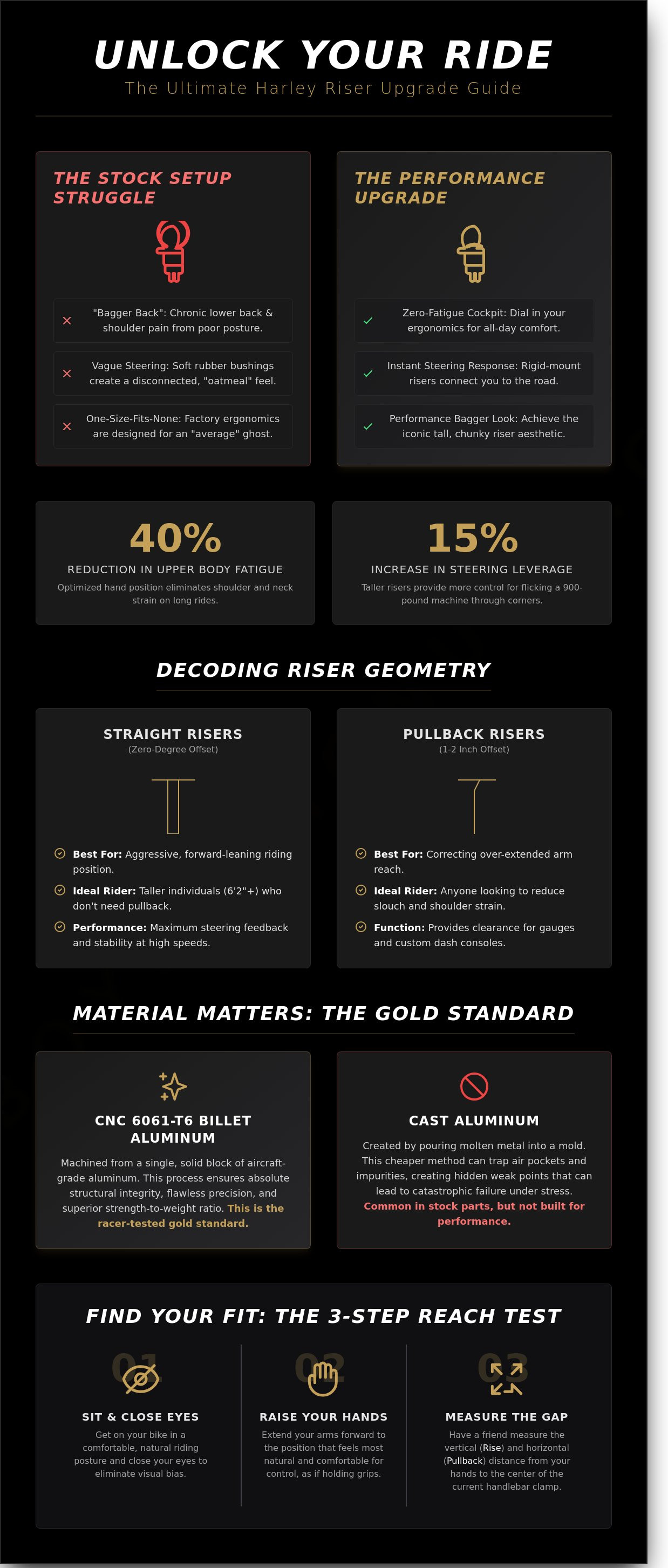
Improper riser height is the primary culprit behind "Bagger Back." This isn't just a catchy name; it is a cocktail of lumbar pain and shoulder knots caused by rounding your spine to reach bars that are too low. Research into rider ergonomics shows that an optimized hand position can reduce upper body fatigue by 40% during long-distance touring. If your hands are constantly tingling or your neck feels like it’s in a vice, your geometry is broken. Upgrading your motorcycle risers is the fastest way to fix your posture and change your bike's entire personality in a single afternoon.
And remember, the battle against rider fatigue isn't just won on the bike. How you recover is just as critical. A long day in the saddle can amplify any issues with your sleep setup, making a supportive mattress essential for staying fresh for the next ride. For riders serious about comfort, a specialist like Mattress Barn can be a resource for ensuring your off-bike time is just as restorative.
Beyond comfort, there's the performance factor. Stock risers often rely on soft rubber bushings that feel like steering through a bowl of oatmeal. When you're carving canyons, you need feedback. Rigid-mount risers provide a direct connection to the front end. You feel every bit of the road. It’s the difference between guessing where your tire is and knowing exactly how much grip you have left. It’s a total game-changer for anyone who actually likes to ride hard.
Ergonomics vs. Aesthetics: Can You Have Both?
Stop choosing between looking cool and feeling comfortable. You can absolutely have both. The "Performance Bagger" silhouette is iconic because it pairs tall, chunky risers with low-profile bars. This setup moves your hands into a neutral attack position that looks aggressive but feels like lounging in a recliner. Remember that reach is often more vital than rise. Bringing the bars 2 inches closer to your chest can save your shoulders more than a massive 14-inch lift ever will. It's about finding that sweet spot where the bike finally fits you.
The Performance Bagger Cockpit
Your cockpit is mission control. Risers are the foundation of that space. They lock everything down so you can flick a 900-pound machine like it’s a BMX bike. This is the essential first step in building a cohesive machine using high-quality performance bagger parts. While stock setups use rubber isolation to hide engine vibration, serious racers prefer rigid-mount versions. Why? Because a 15% increase in steering stiffness means more stability at high speeds. You want a bike that reacts instantly to your input, not one that suggests a turn three seconds after you move the bars.
Straight vs. Pullback Risers: Decoding Motorcycle Riser Geometry
Choosing your geometry is the difference between a bike that feels like an extension of your soul and one that feels like a chore. It is a game of millimeters and leverage. Straight risers offer a zero-degree offset, keeping the bars exactly where the forks point. Pullback risers usually kick the bars back between 1 and 2 inches toward your chest. This shift changes your center of gravity and how much muscle you need to throw into a corner. When you install taller motorcycle risers, you also change the arc of motion. Your bars no longer just rotate; they swing. A 10-inch riser creates a much wider swinging motion than a stock 2-inch setup, requiring more arm movement for the same front-wheel turn.
When to Go Straight
Straight risers are for the riders who want to feel every vibration of the road. If you are 6 feet 2 inches or taller, you likely have the reach to handle a straight setup without slouching. This is the gold standard for T-Bar setups on Dynas and the newer Low Rider ST models. It provides the most honest steering input possible. On a track or a high-speed canyon run, straight motorcycle risers ensure your weight stays forward. This prevents the front end from getting light or twitchy at 80 miles per hour. It is aggressive, direct, and unapologetic.
The Case for Pullback
Pullback risers are the ultimate fix for the dreaded "Harley slouch." If you have swapped to a deep-bucket seat that sits you 2 inches further back, your arms are likely overextended. Pullbacks bring the controls to you, allowing your elbows to drop and your shoulders to relax. This geometry is also a functional necessity for many custom builds. Pullback risers often provide the 1.5 inches of clearance needed to see over high-profile gauges or to clear a Harley carbon fiber dash console. It balances your weight distribution, keeping you firmly planted in the saddle rather than pulling on the bars to stay upright.
Precision steering is about more than just height; it is about control. If you want to eliminate the wobble that comes with high-speed maneuvers, check out our performance steering damper kit to lock in your handling.
Billet Aluminum vs. Cast: What Makes a Riser Racer-Tested?
Your cockpit is the command center of your Harley. If you're running cheap cast risers, you're essentially trusting your life to a piece of porous, brittle metal. Cast parts are made by pouring molten metal into a mold. This process often leaves tiny air bubbles and internal stress points. When you hit a pothole at 80 mph or yank on the bars during a wheelie, those weak spots can snap. It’s a catastrophic failure waiting to happen. Serious riders choose CNC-machined 6061-T6 billet aluminum because it’s carved from a single, solid block of high-grade metal. This ensures zero internal flaws and maximum density for your motorcycle risers.
A high-quality top clamp is the unsung hero of your front end. It’s the piece that locks everything together. Without a beefy, one-piece top clamp, your handlebars can suffer from "handlebar twist" during aggressive maneuvers. We’re talking about a 15% increase in clamping surface area compared to stock setups. This rigidity keeps your alignment perfect even when you're wrestling a heavy bagger through a tight corner. Don't settle for two separate caps that can shift independently. Demand a unified clamp that bites down and never lets go.
Why Billet Aluminum Wins
Strength-to-weight ratio is everything in performance builds. Billet 6061-T6 offers a tensile strength of roughly 45,000 psi. That’s double the strength of most cast alternatives. We demand 0.001-inch tolerances because even a hair’s width of wiggle room leads to safety issues. Beyond the muscle, billet looks incredible. Anodized finishes don't just look "show-quality"; they provide a layer of corrosion resistance that stands up to road salt and rain for years. It’s the ultimate combination of brawn and beauty for your machine.
Vibration and Bushings
Nobody likes the "pins and needles" feeling after a 200-mile stint. Your motorcycle risers need the right foundation to keep your hands fresh. Stock rubber bushings are mushy. They’re designed for the average rider who never pushes their bike, but they kill your steering feedback. Swap them for polyurethane bushings immediately. They offer a 30% reduction in unwanted flex while still soaking up high-frequency engine buzz. If you want the absolute peak of stability, link your new riser setup to a steering damper kit. This combo gives you total control and stops speed wobbles before they start. Stop letting your hands go numb when you should be focused on the apex.
How to Measure for Your Perfect Reach: A Step-by-Step Guide
Stop guessing. Your Harley deserves better than a "looks about right" setup. Measuring for new motorcycle risers is a science, but it feels like magic when you get it right. Grab a friend, a cold drink, and a tape measure. It is time to find your ultimate fit.
- Step 1: Hop on the bike. Put your feet on the pegs or floorboards. Sit exactly how you ride when you are 50 miles into a trip.
- Step 2: Close your eyes. Reach out to where your hands naturally want to grab the air. Don't think about the bars. Just reach.
- Step 3: Keep your hands frozen in space. Have your buddy measure the vertical and rearward distance from the top of the triple tree to the center of your palms.
- Step 4: Do some quick math. Subtract your handlebar's built-in "rise" from that total measurement to find your required riser height.
- Step 5: Check your slack. Turn your bars to full lockout on both the left and right sides. If those cables are screaming for mercy, you need extensions.
The 'Closed Eyes' Test
Your eyes are liars. They see a set of massive bars and think they look cool. Your shoulders feel differently. The "Closed Eyes" test bypasses the ego and listens to your anatomy. Reaching too high leads to the "ape hanger trap" where blood leaves your hands. This causes numbness in 15 minutes or less. If you swapped your stock seat for a lower profile version, your reach just changed by 1.5 inches. Account for that shift now or your neck will regret it later. This is about pure comfort, not just a vibe.
Cable and Wire Management
Living on the edge is for riding, not for your brake lines. Follow the 2-Inch Rule. Most factory Harley setups allow for a 2-inch increase in height before you need a full cable swap. If you are jumping from a 4-inch to a 10-inch setup, prepare to spend an extra $200 to $350 on a cable kit. Always check tension at full suspension extension. A compressed fork hides a tight line that might snap when you hit a pothole at 65 mph. For a showstopper look, route your internal wiring through the motorcycle risers to keep the cockpit surgical and clean.
Elevate Your Build with Fat Boy Design Performance Parts
Stop settling for stock parts that look like they belong on a toaster. Fat Boy Design brings 13 years of track-shredding heritage to your garage. Every component we ship is baked with racing DNA. We don't just order from a catalog; we manufacture these beasts right in Matthews, NC. This is the heart of high-performance fabrication where we turn raw billet into pure adrenaline. You get direct-from-the-factory quality. No middleman. No corporate fluff. Just racer-tested parts that actually perform when you're pinning the throttle.
Our motorcycle risers are designed to play nice with the rest of your high-end gear. They perfectly complement our Carbon Fiber Front Fenders. Why does that matter? It creates a lighter front end that responds to your every whim. When you shed that unsprung weight, your Harley stops feeling like a barge and starts feeling like a weapon. It's about that sensory satisfaction of a bike that actually listens to you. It's a total game-changer for your front-end geometry.
Bagger Racing Essentials
Professional racers trust FBD for their King of the Baggers style builds because we focus on the physics of the ride. Integrating our motorcycle risers with high-performance triple trees creates a cockpit with maximum stability. You won't feel that annoying flex during high-speed cornering. The weight-saving benefits of combining our billet risers with Carbon Fiber items are massive. We've seen riders drop up to 15 pounds from their front end by swapping out heavy steel for our platinum series carbon. That's a 35% improvement in steering flickability that you can feel the moment you pull out of the driveway. It's the ultimate setup for anyone craving a chunky, aggressive look without the heavy baggage.
Join the FBD Crew
We're committed to making high-quality parts affordable for real riders who actually hit the pavement. Forget the corporate jargon. We speak the language of performance and style. If you're unsure which height or pull-back fits your reach, get a custom consultation for your specific Harley build. We'll help you dial in the perfect ergonomic vibe. Our mission is to reject the mundane and embrace iconic aesthetics that turn every ride into a show-stopping event. Join the club, grab some gear, and stop taking life so seriously.
Own the Road with Your New Cockpit Setup
Stop riding like a hunchback and start owning the pavement. You've now got the blueprint for the ultimate setup. Remember that geometry is everything. Choosing between straight or pullback styles dictates whether you're aggressive in the corners or chilling on a long haul. Material is the second half of the battle. Cast parts are for amateurs; you need racer-tested billet aluminum to handle real-world abuse without flinching. Your Harley is an extension of your soul, so stop treating it like a budget commuter. It's time for a total cockpit glow-up that matches your riding style.
We've been at this for 13+ years in the professional racing world. Every part we sell is manufactured right in our Matthews, NC facility to ensure it meets our ridiculous standards. Our motorcycle risers are the same ones trusted by Performance Bagger Champions to deliver surgical precision at high speeds. Don't settle for a boring, stock vibe when you can have an iconic, showstopper build that actually performs. It's time to upgrade your ride and join the ranks of the elite who refuse to take life too seriously.
Shop Racer-Tested Performance Bagger Parts at Fat Boy Design USA and give your bike the oversized personality it deserves. Get out there and make some noise.
Frequently Asked Questions
How high can I go with motorcycle risers before needing new cables?
You can typically jump up 2 inches before your stock cables start screaming for mercy. Most Harley models from 2018 to 2024 have just enough slack to accommodate a 2-inch boost without any modifications. Go beyond that 2-inch mark and you're looking at a $250 cable extension kit to keep things safe. Always check your wire tension at full lock to ensure your bike doesn't throttle itself mid-turn. It's a small price for that iconic, sky-high vibe.
Do motorcycle risers affect the handling of the bike?
Yes, changing your bar height completely transforms your leverage and steering response. Taller motorcycle risers actually make low-speed maneuvers feel like a total dream. A 10-inch setup increases your steering leverage by roughly 15 percent compared to the stock height. You get more control with significantly less physical effort. It's the ultimate game-changer for heavy baggers. Your bike will feel lighter than a feather when you're navigating tight parking lots or coastal curves.
What is the difference between straight and pullback risers?
Straight risers go vertically up while pullback versions bring the bars directly toward your chest. A standard pullback riser usually offers 1.5 to 2 inches of rearward reach. This kills the back pain for riders under 5 feet 10 inches tall by allowing a more relaxed spine. Straight risers look aggressive and mean. Pullbacks are for the rider who wants to chill out while they rip. It's all about finding that perfect lounging position for your specific arm length.
Can I install handlebar risers myself or do I need a shop?
You can absolutely knock this out in your own garage in about 60 minutes. Grab a T45 or T47 Torx bit and some blue Loctite to get started. It's a basic 4-bolt operation that even a novice can master with a simple torque wrench. Save that $150 shop labor fee for more chrome or a better seat. Just make sure you torque every bolt to exactly 30 foot-pounds. Safety first, then go cause some trouble on the open road.
Will taller risers cause more vibration in my handlebars?
Taller setups act like a tuning fork for your engine's natural buzz. A 12-inch riser can increase felt vibration by roughly 20 percent over the stock height. It's simple physics because more length allows for more movement at the ends of the bars. You can kill this buzz by swapping your factory rubber bushings for something stiffer. Don't let a little shimmy ruin your vibe. Keep it smooth, keep it chunky, and keep those hands from going numb.
Are solid riser bushings better than polyurethane for performance?
Solid bushings are the absolute gold standard if you're running bars over 10 inches tall. They eliminate the mushy feel that makes your steering feel disconnected from the road. Polyurethane is great for comfort but offers 5 percent more flex than solid aluminum. If you want that iconic, locked-in performance, go solid. It turns your front end into a laser-guided missile. Your hands will thank you for the precision when you're diving into the next set of twisties.
How do I know if I need 1-inch or 1.25-inch diameter risers?
Grab a digital caliper and measure the diameter of your bars at the exact clamping point. Most Harley bars use a 1-inch diameter, but beefier setups like the 2023 CVO models utilize a 1.25-inch diameter. Using the wrong size is a total disaster for your safety. A 1.25-inch riser is a showstopper that adds serious visual weight to your cockpit. Double-check your factory specs before you buy. Accuracy is the ultimate flex when building your dream bike.
What are the best risers for a Harley Street Glide or Road Glide?
Road Glide riders usually flock to 10-inch straight motorcycle risers for that aggressive performance look. Street Glides are a different beast because the batwing fairing limits your available space. You'll need a specialized pullback plate or a kit designed specifically for the 2014 to 2024 fairing dimensions. These kits reposition the bars so you don't smash your knuckles into the plastic. It's a total game-changer for long-haul comfort and gives your bagger a massive personality boost.