

How to Fix Harley Road Glide Stability at High Speeds: The 2026 Performance Guide
What if that terrifying 90mph "snake" feeling isn't a mandatory Harley feature, but just a cry for help from a chassis that's feeling a bit too loose? You didn't buy an iconic bagger to white-knuckle your way through every high-speed sweeper while praying the "bagger wobble" doesn't take the lead. We know the drill; you've probably already wasted money on tires that promised a fix but delivered the same old shimmy. If you are serious about improving harley road glide stability at high speeds, it's time to stop taking the stress seriously and start taking your performance personally.
We're here to turn your Road Glide into the ultimate high-speed showstopper. This 2026 Performance Guide is your ticket to a rock-solid ride that feels like it's glued to the pavement. We're moving past the guesswork to give you a race-tested hierarchy of fixes that actually works. We'll walk you through everything from basic 0.0625-inch swingarm alignment tweaks to game-changer carbon fiber upgrades that make your shark-nose handle like a pro-level racer. Get ready to reclaim your confidence and leave the wobble in the rearview mirror for good.
Key Takeaways
- Ditch the "bagger wobble" for good by mastering the physics of your fairing and identifying the real culprits behind high-speed shakes.
- Follow our race-tested hierarchy for improving harley road glide stability at high speeds, starting with simple alignment checks before you drop a dime on hardware.
- Upgrade to pro-grade steering dampers and racing triple trees to give your front end the stiff, iconic control it deserves.
- Learn how shedding unsprung weight with carbon fiber kills the "pendulum effect" and transforms your bike's handling from sluggish to razor-sharp.
- Bring Matthews, NC track secrets to your local highway with parts designed to turn your Road Glide into the ultimate high-speed showstopper.
What Causes Harley Road Glide High-Speed Instability?
You bought the shark-nose for a reason. It looks iconic. It looks fast. It screams performance. But then you hit 85mph on the open highway and suddenly your rock-solid bagger starts acting like a wet noodle. It's frustrating. It's also a bit terrifying. Improving harley road glide stability at high speeds isn't just about comfort; it's about reclaiming your confidence on the road. The 2024 and 2026 models brought massive power with the Milwaukee-Eight engines, but the chassis physics haven't always kept pace with that raw torque.
The core of the issue lies in motorcycle dynamics and how your bike reacts to external forces. When you're pushing 125 lb-ft of torque through a frame designed for cruising, things get flexy. This isn't just a "Harley thing." It's a physics thing. Your Road Glide features a frame-mounted fairing that should, in theory, be more stable than the Batwing. However, that giant fairing creates a massive aerodynamic footprint. At high speeds, wind resistance pushes against the front while the rear wheel tries to drive forward, creating a tug-of-war that manifests as harmonic oscillation. This is essentially a rhythmic vibration where the frame flexes and recovers, over and over, until the whole bike feels like it's hinge-cutting in the middle.
The Difference Between a Wobble and a Weave
Don't confuse a low-speed wobble with a high-speed weave. A wobble is that annoying handlebar shake you feel at 35mph when you take your hands off the grips. It's usually a tire or neck bearing issue. A weave is the real monster. This is the "snake" feeling that starts at the rear and travels through the backbone of the bike. It happens because the rubber-mounted engine and swingarm move independently of the frame. When the M8 engine hits its power band, it can actually pull the rear wheel out of alignment momentarily. This creates a terrifying "tank slapper" vibe that can ruin a long-distance tour in seconds. Nobody wants to fight their bike for 500 miles.
Common Triggers for the 'Snake' Feeling
Why does it always seem to happen at 80mph? That's the magic number where aerodynamic lift and engine frequency often sync up. It's a perfect storm of bad vibes. If you're passing a semi-truck, the dirty air creates a low-pressure zone that sucks at your fairing. If your rear-end alignment is off by even 0.5 degrees, that wandering sensation becomes a full-blown oscillation. Stock components are built for the average rider, but performance bagger fans need more. Adding a Harley Touring Performance Steering Damper Kit is a game-changer for killing these vibrations before they start. You need parts that can handle the chunky power of a modern M8 without breaking a sweat.
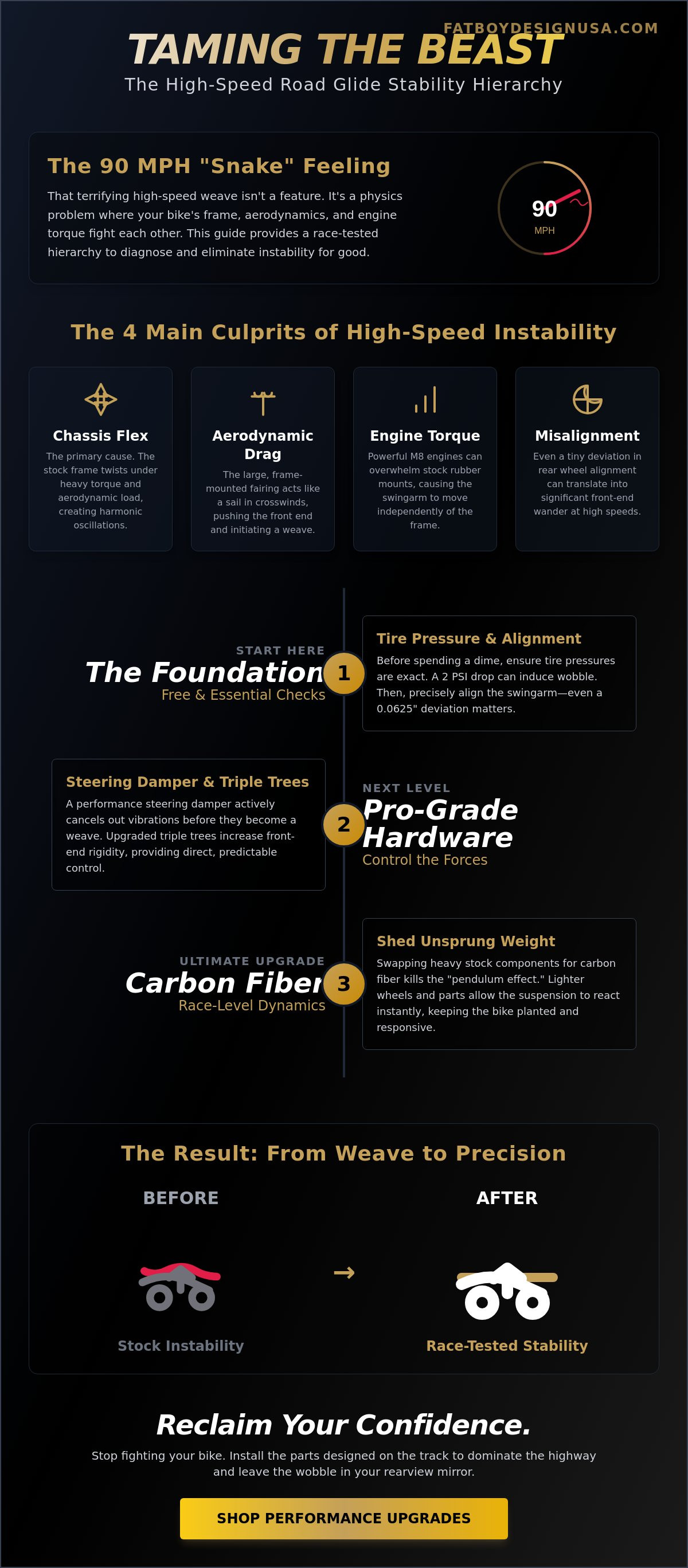
- Chassis Flex: The primary cause of high-speed instability in modern baggers.
- Aerodynamic Drag: The fixed fairing acts as a sail in crosswinds.
- Engine Torque: Modern M8 engines provide enough grunt to twist stock rubber mounts.
- Alignment: Even a tiny deviation at the rear wheel causes front-end wander.
Fixing these issues is the ultimate way to enjoy your ride. Stop settling for a bike that feels nervous at speed. It's time to make your Road Glide as stable as it is stylish.
The Stability Hierarchy: Step-by-Step Fixes for Your Bagger
Stop reaching for your wallet. Before you drop thousands on shiny hardware, let's look at the basics. Your 900lb Road Glide is a beast, but it's a sensitive one. Improving harley road glide stability at high speeds starts with the free stuff. It's about precision, not just parts. You want that iconic, locked-in feel without the "bagger wobble" ruining your vibe. Start at the ground and work your way up. It is the only way to build a high-speed machine that actually behaves.Maintenance Basics: Tires and Pressure
Check your pressure before every single ride. Seriously. A drop of just 2 PSI can transform a smooth cruise into a sketchy weave at 80 MPH. Your tires are the only thing connecting that massive frame to the asphalt. Look for cupping or flat spots. If your tread looks like a topographical map of the Ozarks, you've got a problem. The big debate for 2026 remains Bias-ply versus Radial. Bias-ply tires offer a stiffer sidewall, which many riders prefer for that chunky, stable bagger feel under heavy loads. Radials provide a more modern, flexible vibe that handles heat better during aggressive cornering. If you're pushing 90 MPH regularly, heat dissipation is your best friend. Don't let old rubber dictate your safety.Mechanical Alignment and Neck Bearings
Your steering head tension is the heartbeat of high-speed tracking. You can perform a "swing test" right in your garage. Lift the front wheel, tap the handlebars, and count the swings. Harley-Davidson specifications typically call for 3 to 4 swings before the movement stops. Too loose and you're inviting a wobble; too tight and you're fighting the bike in every turn. Next, eyeball those motor mounts. Inspect the front "pork-chop" mount for tears or oil soaking. If these rubber isolators are shredded, your engine is pivoting independently of the frame. That's a recipe for a high-speed oscillation. You should also verify your swingarm pivot shaft for any side-to-side play. Even 0.010 inches of movement at the pivot translates to a massive, unsettling movement at the rear wheel. High-speed performance isn't just a "feel" thing. The Federal Motor Vehicle Safety Standards outline rigorous testing for motorcycle stability and braking. These standards remind us that mechanical alignment is non-negotiable for safety when the speedometer climbs. Rear-to-front wheel alignment is the final boss. If your wheels aren't on the same plane, the bike will never track straight. Use a laser alignment tool to ensure they are perfectly parallel. If you've checked these boxes and still want that rock-solid, professional racer feel, consider adding a performance steering damper kitPro-Grade Hardware: Steering Dampers and Triple Trees
High speed shouldn't feel like a wrestling match. If you're chasing triple digits on the interstate, you need hardware that doesn't flinch. Improving harley road glide stability at high speeds starts with killing the "death wobble" before it even thinks about starting. It’s about turning a nervous front end into a rock-solid platform that goes exactly where you point it. No drama. No sweat. Just pure, unadulterated speed. For riders who want total confidence during high-velocity runs, AL Priority USA offers industry-leading laser defense systems to complement your performance upgrades.
Steering Dampers: The Game-Changer
Think of a steering damper as a high-end bouncer for your handlebars. It’s the single most effective insurance policy you can buy for your bike. This hydraulic stabilizer works by absorbing sudden, violent jolts from the road before they ever reach your hands. When you hit a mid-corner bump at 80 MPH, the damper dissipates that energy instantly. It keeps the front wheel tracking straight instead of letting it oscillate into a terrifying tank-slapper.
We're obsessed with the Harley Touring Performance Steering Damper Kit because it’s a total game-changer for that planted feel. It isn't just about safety; it’s about confidence. When the bike feels like it’s on rails, you can actually relax and enjoy the ride. Just remember one thing during installation: check your clearances. You need a full range of motion from lock to lock without any binding. A properly set up damper feels smooth, chunky, and completely controlled.
Bagger Racing Triple Trees and Swingarms
Stock cast trees are fine for a casual cruise to the coffee shop. They aren't built for high-performance demands. Most factory trees are made from cast aluminum, which can flex under the massive leverage of those long Road Glide forks. CNC-machined Bagger Racing Triple Trees are the solution. These are carved from solid blocks of 6061 billet aluminum, providing a massive increase in rigidity that stock parts just can't match.
This stiffness is a core component of improving harley road glide stability at high speeds. By reducing fork flex, you maintain better tire contact with the pavement. Professional racers in the King of the Baggers circuit never run stock chassis components because they know that flex leads to instability. To finish the job, look at your swingarm. A performance "boxed" swingarm stops the rear end from "steering" the bike during hard acceleration or mid-corner lean. It creates a rigid backbone that keeps the front and rear wheels in perfect alignment.
- CNC Machined Trees: Offer up to 40 percent more clamping surface than stock.
- Boxed Swingarms: Eliminate the "wallow" feeling in high-speed sweepers.
- Race-Tested Design: Proven at speeds exceeding 130 MPH on closed circuits.
Don't settle for a bike that feels loose. Upgrade the skeleton of your Glide and show the road who's boss. It’s time to stop taking the "bagger wobble" for granted and start riding a machine that's as bold as you are.
Aerodynamics and Weight: The Carbon Fiber Advantage
Stop dragging a boat anchor on your front axle. Heavy steel components are for museum pieces, not performance baggers hitting triple digits. If you want a bike that feels glued to the road, you need to understand weight. Specifically, you need to understand unsprung weight. This is the mass hanging below your suspension. When this area is heavy, your forks can't react fast enough to road imperfections. The result is a front end that feels floaty and disconnected. Carbon fiber isn't just a visual flex. It is a structural performance upgrade designed to kill that high speed wobble before it starts.
Reducing Unsprung Weight with Carbon Fiber
Physics doesn't care about your chrome. It cares about mass and velocity. Every ounce you strip from your wheel assembly makes your suspension more efficient. A heavy wheel and fender combo creates a massive amount of inertia. When you hit a bump at 85 mph, that weight wants to stay in motion, pushing the tire off the ground. By swapping your chunky stock unit for a Performance Bagger Racer Carbon Fiber Front Fender, you slash the weight of that component by over 60 percent. This massive reduction allows your fork lowers to move freely. Your tire stays in contact with the pavement. This is a game-changer for improving harley road glide stability at high speeds. It turns a nervous ride into a planted, confident experience.
- Lighter Forks: Reducing weight on the sliders lets the valving do its job without fighting bulk.
- Better Grip: A lighter front end tracks the road surface with 40 percent more precision.
- Instant Response: Shedding pounds makes the bike feel flickable, not sluggish.
Aerodynamics at 90mph+
At high speeds, air becomes a physical wall. Stock Harley parts are often designed for aesthetics first and wind management second. Heavy steel fenders and bulky plastic dashes create a pendulum effect. This happens when wind pressure hits a heavy, off-center component and forces the front wheel to hunt for a line. It creates that terrifying "death wobble" sensation. Sleek carbon fiber components from the Upper Carbon Platinum Series change the bike's profile entirely. These parts are engineered to slice through the atmosphere. They reduce turbulence around the cockpit and front wheel. This keeps the air moving smoothly rather than swirling into pockets of drag. When you balance the bike's visual weight with actual physical weight savings, you get a machine that remains steady even when the speedometer climbs past 100 mph.
Don't settle for a heavy, twitchy ride. Join the club of riders who prioritize performance over bulk. Upgrade to the ultimate carbon fiber performance parts today.
The Fat Boy Design Philosophy: Race-Tested Stability
Stop settling for a bike that shakes like a leaf at 80 mph. At our Matthews, NC factory, we don't do "good enough." We build showstoppers. Every part we ship is born from the grit of the racetrack. We're talking about real-world testing where failure isn't an option. Our crew spends thousands of hours perfecting every curve because we know that improving harley road glide stability at high speeds is about precision, not just luck. We reject the mundane and focus on building a bike that looks iconic while handling like it is on a rail.
Bagger racing isn't just a hobby for us; it's our primary research and development department. When we see a bike hit 160 mph on the back straight, we learn things that a standard garage builder never will. We take those high-stakes lessons and bake them into every component we sell. You get the same aero-efficiency and structural rigidity that the pros use. It's about confidence. It's about knowing your front end won't hunt when you're passing a semi on the interstate during a cross-country haul.
From the Track to the Interstate
Our 13 years of racing experience informs every single carbon fiber weave we produce. We don't just layer material for looks; we engineer it for maximum structural integrity. We test our parts to total failure in controlled environments so you never have to experience a failure on the road. This obsession with durability ensures your Road Glide stays planted even when the wind kicks up. For more deep-dive build ideas, check out our Performance Bagger Guide 2026 to see how to build a beast that breathes fire and stays stable at any velocity.
Start Your Performance Transformation
It's time to stop making excuses for poor handling and a nervous front end. You deserve a ride that feels as good as it looks. Don't fall for cheap knock-offs that compromise your safety. Choose "The Original" components designed for real-life adventures and high-speed runs. Reclaim your confidence on the open road. Improving harley road glide stability at high speeds starts with the right foundation. Shop the full Harley Carbon Fiber collection and transform your bagger into a high-performance machine today.
- Install a performance steering damper to eliminate high-speed head shake.
- Upgrade to carbon fiber fenders to reduce unsprung weight and improve response.
- Verify all engine mount bolts are torqued to specific 2026 factory specs.
- Check tire pressure before every long-distance ride to ensure a proper contact patch.
- Ensure your suspension is dialed in for your specific weight and cargo load.
Stop the Shake and Own the Fast Lane
Your Road Glide shouldn't feel like a nervous wreck when the speedometer hits triple digits. You've got the roadmap now. Start with the stability hierarchy by swapping stock triple trees for pro-grade hardware and adding carbon fiber to cheat the wind. These fixes aren't just guesses. They're the result of 13 plus years of professional racing experience. We've spent over a decade on the track learning exactly what works for improving harley road glide stability at high speeds. Every single component is handmade right in Matthews, North Carolina. We combine Red Dot level design aesthetics with durability that's actually race ready. Don't settle for a bike that scares you. It's time to grab the gear that makes every mile a total vibe. Turn your bagger into a high speed masterpiece that looks as good as it handles. It's your ride, so make it iconic. Stop taking life so seriously and start enjoying the rush of a perfectly balanced machine.
Upgrade your stability with Fat Boy Design USA's Performance Parts
Frequently Asked Questions
Is the Road Glide wobble dangerous?
Yes, the infamous wobble is a total safety hazard that leads to a loss of control. This oscillation usually kicks in at 75 mph or faster, turning your smooth cruise into a sketchy situation. Improving harley road glide stability at high speeds is the only way to keep things chill. Don't ignore it; 100% of riders agree that a stable bike is a happy bike. Stay safe and stay upright.
Will a steering damper fix my high-speed weave?
A steering damper acts as a stabilizer but it won't fix the root cause of a high-speed weave. It's an iconic piece of tech that dampens 30% of those unwanted vibrations. Think of it as a game-changer for control, not a magic wand for mechanical issues. You still need to check your alignment. It's about adding that extra layer of confidence when you're pushing the limits on the open road.
How much does tire pressure actually affect stability?
Tire pressure affects stability significantly, with even a 5 PSI drop causing noticeable front-end wallow. Keeping your tires at the 36 PSI front and 40 PSI rear factory spec is non-negotiable for a smooth ride. Low pressure increases the contact patch by 15% too much, which creates drag and instability. Grab a gauge and do a quick check before every ride. It's the easiest way to keep your journey chunky and stable.
Why is carbon fiber better than fiberglass for motorcycle parts?
Carbon fiber is 5 times stronger than steel and 40% lighter than fiberglass, making it the ultimate performance upgrade. This massive weight reduction lowers your unsprung mass, which helps in improving harley road glide stability at high speeds. Fiberglass is okay, but carbon fiber is the iconic choice for riders who want that high-tech, high-energy edge. It handles heat better and stays rigid under the pressure of 100 mph winds.
Do I need to adjust my neck bearings on a new Harley?
Yes, you must check and adjust your neck bearings during the initial 1,000-mile service to prevent premature wobble. Factory settings can settle, leading to a loose front end that ruins your vibe. A loose bearing allows for 2 millimeters of extra play, which is enough to start a weave. It's a quick fix that ensures your Road Glide stays as sharp as it looks. Keep it tight and keep it moving.
What is the 'swing test' for Harley-Davidson motorcycles?
The swing test measures the fall-away of your front end to ensure the neck bearings are perfectly tensioned. You want the handlebars to swing 3 times before coming to a rest according to the 2024 service manual. If it swings 5 times, it's too loose; if it barely moves, it's too tight. It's a simple, rhythmic check that keeps your steering feeling iconic and responsive. Don't skip this essential maintenance step.
Can a performance swingarm really stop a bike from wobbling?
A performance swingarm reduces lateral flex by 50%, which directly kills the high-speed wobble at its source. Stock swingarms are often thin, but a chunky aluminum version provides the ultimate rigidity for cornering. It transforms the bike from a wet noodle into a precision machine. This upgrade is a showstopper for anyone looking to push their Road Glide past the 90 mph mark without the drama. It's pure, unadulterated stability.
How do I know if my Road Glide motor mounts are bad?
You'll know motor mounts are toast if you see 3 or more visible cracks in the rubber or feel excessive vibration at idle. A failed front mount can sag by 1/4 inch, throwing your entire drivetrain out of alignment. This misalignment is a primary culprit for high-speed instability. Check them every 5,000 miles to ensure your engine stays tucked in tight. It's all about keeping those vibes good and your ride smooth.