

How to Get Into Bagger Racing: The Ultimate Track-Ready Guide for 2026
Stop treating your Harley like a living room sofa and start treating it like a weapon. The biggest secret to how to get into bagger racing isn't found in a catalog of engine chrome. It's found in the brutal physics of weight loss and geometry. You're probably staring at your 2026 Road Glide wondering how a $25,999 touring bike can hit triple digits without a terminal death wobble. It's intimidating to think about leaning a 620 pound beast into a corner at Laguna Seca. You don't want to yard-sale your pride and joy just because you missed a technical memo on track prep.
We've got your back. This guide gives you the exact blueprint to shed the "dad-bike" kilos and transform your cruiser into a track-shredding monster. You'll discover how to navigate the 2026 race classes and join the fastest-growing club in motorcycle history. We'll show you why a Carbon Fiber Front Fender and a Bagger Racing Swingarm are more important than any engine tune. Get ready for a clear roadmap to your first race. We're breaking down the essential carbon fiber diet and the stability secrets that make high-speed shredding feel like pure, unadulterated leisure.
Key Takeaways
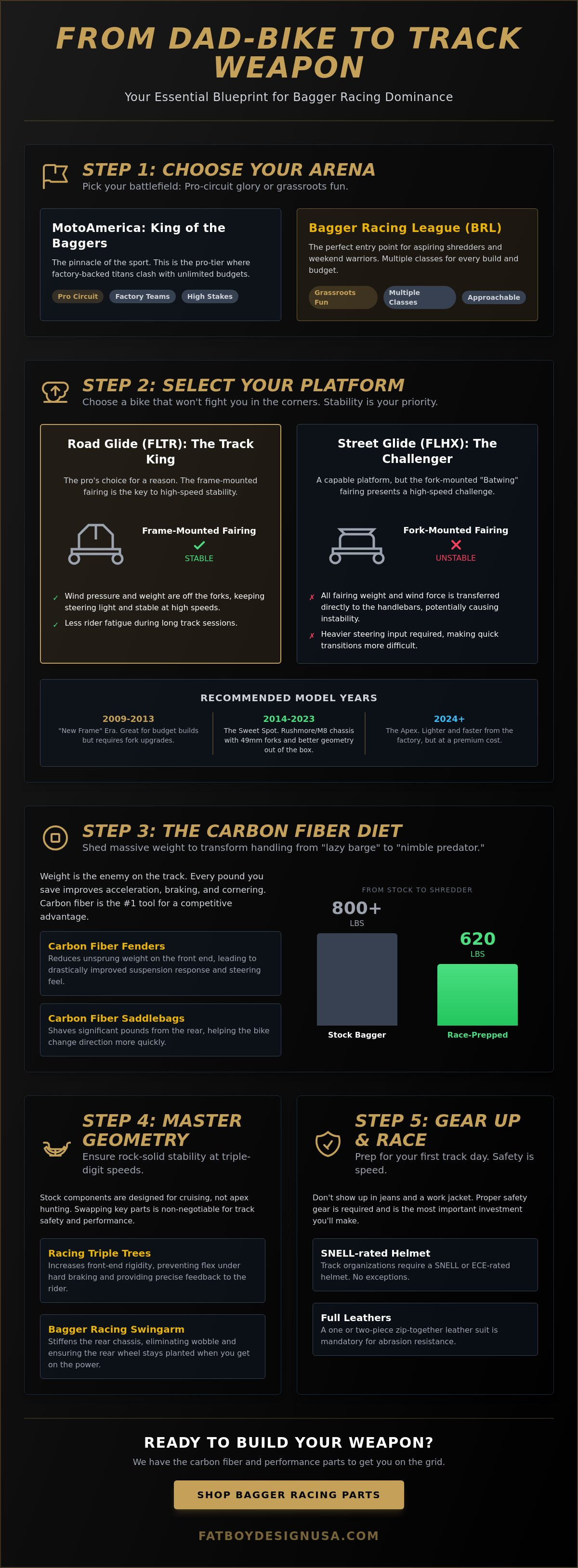
- Pick your arena by understanding the difference between the pro-circuit MotoAmerica King of the Baggers and the grass-roots fun of the Bagger Racing League.
- Select a racing platform that won't fight you back, like the Road Glide, to keep your steering light and your confidence high at triple-digit speeds.
- Slash massive amounts of weight with carbon fiber fenders and saddlebags to transform your bike's handling from "lazy barge" to "nimble predator."
- Master the technical side of how to get into bagger racing by swapping stock components for racing triple trees and swingarms to ensure rock-solid stability.
- Grab your SNELL-rated helmet and full leathers to prep for your first session at a track day that welcomes heavy cruisers with open arms.
The Rise of Bagger Racing: From Street Glide to Track Weapon
Bagger racing is the fastest-growing segment in the V-twin world because it's completely ridiculous. Watching a 620 pound machine scream down the front stretch at Daytona during the 2026 season opener is a sensory overload. It's the ultimate rejection of the mundane. This isn't just about looking cool at the local bike night anymore. It's a high-stakes engineering game. The performance bagger trend has shifted from "all show" to "all go," focusing on how these bikes actually behave when pushed to the limit. If you're figuring out how to get into bagger racing, you need to know the landscape. The pro-tier MotoAmerica's King of the Baggers series is where the titans clash. It's the pinnacle of the sport, featuring factory-backed monsters. For the weekend warriors and aspiring shredders, the Bagger Racing League (BRL) provides a more approachable entry. It's where you learn that your touring bike has a soul that craves the apex.
Understanding the Bagger Racing League (BRL) Classes
BRL keeps things spicy with classes for every build. The Hooligan class is for the rowdy smaller twins, while Big Twin is where the heavy-hitting Road Glides and Street Glides live. If you're just starting, the Stock class is your sanctuary. You can't go wild with engine mods, but you can definitely upgrade your stability with high-quality bagger racing parts. The "Lite" classes offer a budget-friendly entry point, proving you don't need a $30,000 engine to have a blast. It's about getting on the grid and enjoying the chaos.
- Hooligan: The entry point for smaller, nimbler V-twins.
- Big Twin: The playground for the heavyweights. This is where your Road Glide belongs.
- Stock Class: Strict rules on engine mods keep the playing field level. It's about the rider, not the wallet.
- BRL Lite: A budget-conscious way to hit the track without selling a kidney.
Mental Preparation: Racing an 800lb Motorcycle
Forget the "flickability" of a 600cc sportbike. You're piloting a cruise ship that wants to go fast. Managing corner entry speed is your new religion. Because of the sheer mass, you have to finish your braking early. Trail braking a heavy bike requires a delicate touch and nerves of steel. Body position is your best friend. You'll be hanging off that saddle like your life depends on it. This keeps the bike more upright, preserving your precious lean angle. On a bagger, smooth is the only way to be fast. Abrupt inputs are a recipe for disaster. Embrace the flow, trust your tires, and stop taking the speed limit so seriously. Your first track day will be a blur of adrenaline and scraping floorboards, but once you feel that heavy chassis settle into a groove, you'll be hooked for life.
Choosing Your Platform: Road Glide vs. Street Glide for the Track
Start with the frame. Don't get distracted by shiny paint or fancy infotainment systems. Learning how to get into bagger racing starts with picking a platform that won't fight you in every corner. While the factory teams have unlimited budgets, you can find used market gems that make incredible racers. Look for 2014 or newer models. These "Rushmore" bikes came with 49mm forks and a stiffer chassis right out of the box. If you find a high-mileage 2017 Road Glide with a solid frame, you've found your ticket to the grid. You want a donor bike that you aren't afraid to push to the absolute limit.
- 2009 to 2013: The "New Frame" era. This is a great entry point for budget builds, though you'll definitely need to upgrade the older fork style.
- 2014 to 2023: The Rushmore and M8 era. This is the sweet spot. You get better geometry and more engine potential without the new-bike price tag.
- 2024 and Newer: The Apex. These are lighter and faster from the factory, but they'll cost you a premium.
Road Glide (FLTR): The King of the Track
There's a reason the pros flock to the shark-nose. The fairing is frame-mounted. This means all that wind pressure and plastic weight isn't fighting your handlebars. When you're tucked in at 130 mph, you'll appreciate the stability. Removing weight from the fork assembly is the first step to a bike that actually turns. Check out the technical specifications of a race-ready bagger to see how the elite teams optimize these frames. Most racers swap the stock floorboards for mid-controls immediately to gain that extra degree of lean. It's about clearing the deck so you can tilt the world on its side.
Street Glide (FLHX): The Underdog Build
Don't count the batwing out just yet. Some riders love the "connected" feel of a fork-mounted fairing. It tells you exactly what the front tire is doing in real time. However, it's a beast to manage at triple-digit speeds. You'll feel every gust of wind through your grips. To make an FLHX competitive, you have to be obsessed with front-end weight. Every ounce you strip off the forks makes the bike less of a workout in the chicane. It requires a bit more muscle, but the reward is a bike that feels incredibly intuitive in tight, technical sections.
Stability is everything. If your bike feels like a bowl of Jell-O at high speeds, you won't have the confidence to push. This is where your hardware matters. Transitioning from a cruiser to a racer means rethinking your front-end weight. Swapping out heavy stock plastic for harley davidson carbon fiber components is the fastest way to fix a lazy front end. It's about creating a predictable machine. When you know exactly how the bike will react to a mid-corner bump, you can finally stop worrying about the weight and start focusing on the trophy.
The Weight Loss Program: Carbon Fiber for Competitive Advantage
Your bagger is overweight. There, we said it. When you're figuring out how to get into bagger racing, you quickly realize your touring bike is basically a gorgeous, chrome-plated tank. On a light sportbike, a few pounds might not matter much. On an 800 pound beast, every ounce you strip away feels like five. It's about agility. Dropping weight makes the bike tip into corners faster and stops it from wallowing like a barge when you hit a mid-corner bump. This isn't just about aesthetics; it's about survival at triple digits. You want a bike that reacts to your inputs, not one that treats every turn like a suggestion.
Focus on unsprung weight first. This is the hardware that moves with the road, like your wheels and fenders. If your front fender weighs a ton, your suspension has to work twice as hard to keep the tire glued to the asphalt. By switching to harley davidson carbon fiber components, you're giving your suspension a vacation. It can finally do its job properly. This creates a more stable ride and gives you the confidence to push harder into the apex without the front end chattering like a nervous wreck.
Essential Carbon Fiber Upgrades for Racers
Start with the front end. The Performance Bagger Racer Carbon Fiber Front Fender is a non-negotiable upgrade for reduced front-end mass. It sheds significant weight exactly where you feel it most during transitions. Next, look at your storage. Replacing heavy OEM saddlebags with lightweight carbon fiber versions removes weight from the rear of the bike, which is crucial for maintaining a balanced center of gravity. Even smaller items like carbon fiber side covers and dashes contribute to this shift. You're moving the weight away from the extremities and toward the center, making the bike feel much smaller than it actually is. It's like taking the training wheels off your performance potential.
The Math of Speed: Weight vs. Horsepower
Most riders spend thousands on engine builds before they ever look at a scale. That's a mistake. Shedding weight is significantly cheaper than building a 150hp engine, and it helps you in every part of the track, not just the straights. 10lbs of weight loss is roughly equivalent to a 2hp gain in acceleration. Think about that. If you drop 50lbs of plastic and steel, you've effectively "bought" 10 horsepower without even opening the primary cover. Plus, a lighter bike stops faster and turns tighter. It's a win-win for anyone serious about bagger racing parts and podium finishes.
Carbon fiber is also incredibly durable in a high-vibration V-twin environment. It doesn't fatigue like aluminum or crack like cheap fiberglass. It handles the rhythmic thumping of a Milwaukee-Eight with ease while looking absolutely lethal. On the backstretch, sleek bodywork helps you cut through the wind, giving you those extra few miles per hour that make the difference between a pass and a "maybe next time." To ensure your drivetrain is as high-performance as your bodywork, visit Drive Systems USA for professional-grade chains and sprockets that can handle the stress of the track. Stop hauling around your bike's baby fat and start treating it like the track weapon it was meant to be.
Stability and Geometry: Triple Trees and Swingarms
Your bike is currently a 600 pound wet noodle. At 110 mph, that stock geometry starts to protest. It's called the "death wobble," and it is the fastest way to ruin a perfectly good weekend. If you are researching how to get into bagger racing, stop looking at horsepower for a second. Look at your triple trees. The stock units are designed for cruising to the grocery store, not holding a line through a high-speed sweeper. They lack the rigidity needed to keep your forks from twisting under heavy braking. Correcting the trail is the only way to fix the bike's handling DNA. You want a machine that tracks like it is on rails. Learning how to get into bagger racing means realizing that suspension is only half the battle. You need a chassis that doesn't buckle under pressure.
Upgrading to Bagger Racing Triple Trees
Standard trees are thin and have minimal clamping surface area. When you dive into a corner, your forks actually twist inside the trees. This creates a vague, terrifying feeling at the grips. Upgrading to beefier triple trees provides a massive increase in clamping surface. This locks the front end together. Many racing units also offer an adjustable offset. This is a game changer. You can tune your bike for short, technical tracks or set it up for long speedways where stability is king. Explore our Bagger Racing Parts for pro-grade geometry solutions that actually work.
Rigid Control: The Performance Swingarm
The back of your bike is just as guilty. The stock steel swingarm is heavy and prone to flex. Under heavy cornering loads, it literally twists. This prevents you from putting power down effectively coming out of a turn. A performance aluminum Bagger Racing Swingarm is significantly stiffer. It keeps the rear wheel aligned and ensures every bit of torque goes into the pavement. To seal the deal, you must address the front-end feedback. Integrating the Harley Touring Performance Steering Damper Kit provides that final layer of front-end confidence. It prevents high-speed tank slappers before they even start. It is the insurance policy your ego needs when you're pinned in sixth gear. Stop fighting your bike. Grab the right performance bagger parts and dominate the apex.
Your First Race: Logistics, Gear, and Signing Up
You've spent the money. You've shed the weight. Now it's time to actually show up. Discovering how to get into bagger racing isn't reserved for factory legends with semi-trucks full of spares. It's for anyone with enough grit to pin the throttle on a 600 pound beast. First, find a track day organizer that isn't scared of big twins. Most organizations welcome cruisers in the novice groups as long as you can hold a line and respect the flags. Don't show up in your favorite riding jeans and a leather vest. You need full racing leathers. One-piece suits are best, but a zip-together two-piece works too. Your helmet must be SNELL-rated. Your boots need to cover your ankles. This is about looking the part and staying in one piece when you finally find the limit of your lean angle.
The roadmap to the grid is shorter than you think. Follow these steps to ensure you don't get sent home before the first session:
- Step 1: Secure a spot at a cruiser-friendly track day for your initial testing.
- Step 2: Invest in high-end safety gear. No compromises here.
- Step 3: Prep the bike for tech inspection. Safety wire is your new best friend.
- Step 4: Register for a novice class in the Bagger Racing League.
- Step 5: Perform a "Shake Down" session. Test your build before the green flag drops.
Safety Wiring and Track Prep 101
Tech inspection is the gatekeeper. They don't care about your custom paint; they care about your oil staying inside the engine. You'll need to safety wire your oil drain plug, oil filter, and brake caliper bolts. It's a rite of passage for every racer. Swap your engine coolant for distilled water or a track-approved additive like Water Wetter. Glycol is basically ice on the track, and nobody will be your friend if you leak it. Tape up your glass. Pull your mirrors. Your bike should look like a lean, mean, racing machine before it even touches the paddock. This is where your harley davidson carbon fiber parts really shine, keeping the bike light while you're wrestling it through the tech line.
Finding Your Community
You aren't doing this alone. The Bagger Racing League is the perfect home for amateur shredders who want to learn how to get into bagger racing without the pressure of a factory contract. Hit the big stages like Daytona, Laguna Seca, or Road America to feel the history of the sport. Connect with the performance bagger community online to swap setup secrets and tire pressure tips. If you need more build inspiration, check out our Performance Bagger Guide 2026 to see what's possible for your machine. Stop overthinking the logistics. Sign up. Show up. Shut up and ride.
Own the Apex and Leave the Couch Behind
You've got the roadmap. Now it's time to execute. You know that shedding those heavy OEM bags for harley davidson carbon fiber is the ultimate performance hack. You understand that racing triple trees and swingarms are the only thing standing between you and a high-speed wobble. Learning how to get into bagger racing is about more than just buying parts. It's about joining a community that values speed as much as a good time. We don't just sell this gear; we live it. With 13+ years of professional racing experience, we manufacture our components in-house in North Carolina. Every piece is tested at triple-digit speeds on the track to ensure you stay stable when the pressure is on.
Stop taking life so seriously and start taking your corners faster. The grid is waiting for you. It is time to turn that touring bike into a legend. Build your track weapon with our Racer-Tested Bagger Parts. See you at the finish line, champ.
Frequently Asked Questions
Do I need a special license to start bagger racing?
You don't need a professional racing license to hit a track day, but you'll need a competition license from the AMA or BRL for actual racing. Most track day organizers just require a valid driver's license with a motorcycle endorsement and a signed waiver. If you're serious about how to get into bagger racing, start with a local track day to learn the flags before applying for your race credentials.
Can I race my daily driver Street Glide and still ride it on the street?
You can absolutely race your daily driver, but be prepared for some late nights in the garage. Track rules require you to swap your coolant for distilled water and tape up all your lights before every event. While it's possible to ride to the track and back, most racers prefer trailering their bike to avoid getting stranded if they push a little too hard in a corner.
What is the minimum horsepower needed to be competitive in amateur bagger racing?
You don't need a 150 horsepower monster to have fun in amateur classes. Most racers find that 100 to 110 horsepower is plenty if the bike is light and stable. Focus on your power-to-weight ratio instead of just chasing big dyno numbers. Dropping 50 pounds of plastic is often more effective than adding a turbo when you're first learning the lines.
How much does it cost to prep a Harley for its first track day?
Prepping for your first day is more about safety gear than expensive bike mods. You'll need to budget for a full leather suit, a SNELL-rated helmet, and track-day registration fees. The bike prep itself is relatively affordable, requiring just safety wire, a few rolls of painters tape, and a bottle of Water Wetter. It's the most cost-effective way to see if you have the racing bug.
Are mid-controls mandatory for bagger racing, or can I use floorboards?
Floorboards are legal in many entry-level classes, but they will be your biggest enemy. They scrape the asphalt early and limit your lean angle, which can actually lift your rear tire off the ground in a turn. Mid-controls give you much better body position and ground clearance. If you want to stay on two wheels while leaned over, mids are the way to go.
What is the 'King of the Baggers' series and can amateurs enter?
King of the Baggers is a professional series run by MotoAmerica for factory teams and elite privateers. Amateurs should set their sights on the Bagger Racing League (BRL) instead. BRL offers multiple classes specifically designed for riders who are just learning how to get into bagger racing without needing a factory budget or a semi-truck full of mechanics.
How do I stop my Harley from wobbling at high speeds on the track?
Wobbles are usually caused by a combination of stock geometry and chassis flex. Upgrading to rigid triple trees and a performance swingarm fixes the root of the problem by stabilizing the frame. Adding a steering damper is the final touch to prevent tank slappers before they start. It's about making the bike predictable so you can stay pinned on the straights.
Is carbon fiber strong enough to handle the vibrations of a racing V-twin?
High-quality carbon fiber is actually more durable than fiberglass or thin aluminum in high-vibration environments. It doesn't fatigue or crack under the rhythmic thumping of a Milwaukee-Eight or Twin Cam engine. Our carbon fiber parts are designed to handle the abuse of the track while staying feather-light. It's the ultimate material for parts that need to be both beautiful and bulletproof.