

How to Reduce Weight on a Harley Bagger: The Performance Bagger Blueprint 2026
Your 900-pound touring rig isn't a couch. It's a sleeping giant waiting for a serious diet. We all love the iconic profile of a big Harley, but wrestling an 850-pound Road Glide through a tight hairpin feels more like a gym session than a joyride. That top-heavy sway at low speeds is a total vibe killer. You want that showstopper look without the sluggish, chunky baggage holding you back.
Learning how to reduce weight on a harley bagger is the ultimate game-changer for riders who want to stop dragging floorboards and start carving corners. We're going to help you strip away 65 pounds of useless bulk and transform your heavy cruiser into a high-performance machine. This guide delivers a 12% improvement in your power-to-weight ratio by 2026 standards while keeping that legendary soul intact. We'll dive into carbon fiber swaps, lightweight lithium power, and the specific bolt-on parts that turn a sluggish beast into a nimble athlete.
Key Takeaways
- Kick off your build with the "Free 50" strategy to strip away useless bulk and gain instant speed without spending a dime.
- Stop fighting lead-anchor wheels and master the art of unsprung weight for flickable handling and shorter braking distances.
- Discover the pro blueprint on how to reduce weight on a Harley bagger by swapping heavy fiberglass for iconic, high-performance carbon fiber.
- Score an easy win by dropping 15 pounds in five minutes with a lithium-ion battery and a game-changing aluminum swingarm.
- Master the "Fat Boy Design USA" philosophy to balance racer-tested weight reduction with the iconic comfort your Bagger was built for.
Table of Contents
- The Performance Bagger Weight Loss Pyramid: Where to Start?
- Unsprung Weight: The Secret to Flickable Bagger Handling
- Carbon Fiber Bodywork: The King of Bagger Weight Reduction
- Chassis and Battery: Hidden Weight You're Overlooking
- The Final Build Strategy: Balancing Weight and Comfort
The Performance Bagger Weight Loss Pyramid: Where to Start?
Your Harley is an icon, but it's also a heavyweight. It's time to stop hauling around unnecessary bulk. Learning how to reduce weight on a harley bagger is the fastest way to turn a sluggish cruiser into a corner-carving beast. Most stock Touring frames carry over 800 pounds of metal and plastic. You don't need all of it. We are building a missile, not a motorhome. Shedding mass improves every single aspect of your ride, from braking distances to how hard you can lean into a canyon curve.
Phase 1: The 'Free' Weight Reduction
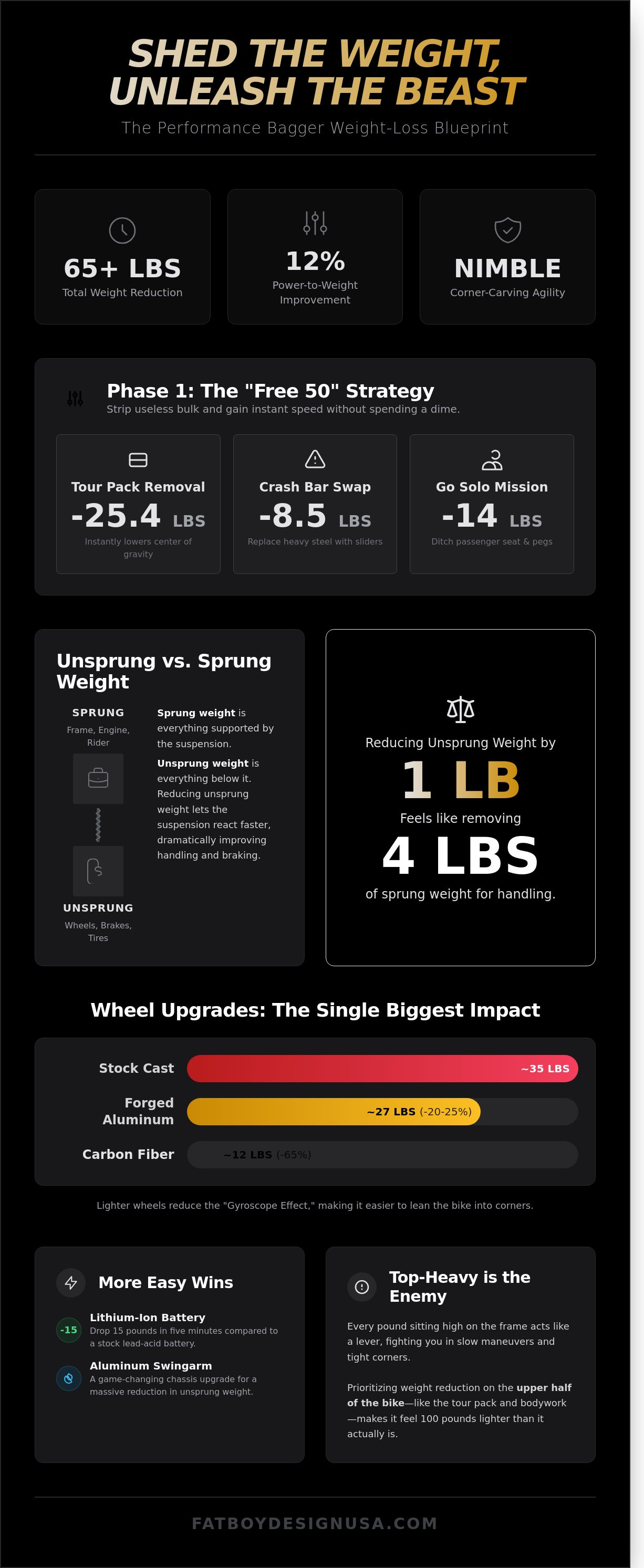
Get your tools out. The easiest gains come from parts you simply don't need for a high-energy ride. You can easily find a "Free 50" pounds just by stripping the fluff. Start with these three areas to see immediate results:
- Tour Pack Removal: Yanking this off drops 25.4 pounds from the highest point on the bike, which instantly changes the center of gravity.
- Crash Bar Swap: Replace heavy stock engine guards with minimalist sliders or lightweight bars to save roughly 8.5 pounds of steel.
- Solo Mission: Ditch the passenger pegs and that 14-pound stock seat for a lightweight solo setup. If you aren't hauling a passenger, don't haul their gear.
Sprung Weight vs. Unsprung Weight Explained
Sprung weight includes everything supported by your springs, like the engine, frame, and fuel. It's the bulk you feel when you lift the bike off the kickstand. unsprung weight covers the components below the suspension, like the wheels, tires, and brakes. These parts have to move up and down rapidly to keep your rubber on the road.
Dropping just 1lb of unsprung weight provides a handling boost equivalent to removing roughly 4lbs of sprung weight because it allows the suspension to react faster and reduces the energy needed to change direction.
Top-heavy weight is the primary enemy of low-speed control. Every pound sitting above the axles acts like a lever, trying to pull the bike toward the pavement during slow maneuvers. By shifting your focus to the top of the weight-loss pyramid, you make the bike feel 100 pounds lighter than it actually is. This is why removing the tour pack or swapping to carbon fiber components on the upper half of the bike is such a game-changer for agility.
Set your target before you buy a single bolt. A Street Performance build focuses on shedding 40 to 60 pounds while keeping your bags for the trip. A Track Ready build goes much further, aiming for a 100-pound reduction to maximize flickability. Knowing how to reduce weight on a harley bagger effectively requires a plan. A 10% reduction in total bike mass can improve your power-to-weight ratio by nearly 12% without even touching the motor internals.
Unsprung Weight: The Secret to Flickable Bagger Handling
Think of your stock wheels as lead anchors dragging your suspension into the gutter. Every ounce of weight that isn't supported by your springs is called unsprung weight. It is the enemy of fun. When you are figuring out how to reduce weight on a Harley bagger, this is where the magic happens. Reducing unsprung mass allows your suspension to track the road with surgical precision. It turns a sluggish couch into a canyon carver.
Rotational mass is a physics bully. It takes more energy to get heavy wheels moving and even more energy to stop them. A 35 pound stock wheel creates massive gyroscopic inertia. This force wants to keep the bike upright and moving in a straight line. By cutting that weight, you effectively decrease the effort needed to lean the bike. You’ll feel the difference the second you hit your first apex.
Wheels: The Single Biggest Performance Upgrade
Stock cast wheels are chunky and overbuilt for mass production. Swapping them for forged aluminum or carbon fiber is a total game-changer. A high-end carbon fiber wheel can weigh as little as 12 pounds, while a stock hoop often tips the scales at double that. This 50 percent reduction in weight lets your shocks react to bumps 30 percent faster because they aren't fighting a heavy pendulum.
- Stock Cast: Durable but heavy. They soak up heat and kill acceleration.
- Forged Aluminum: A solid middle ground. They offer a 20 to 25 percent weight savings.
- Carbon Fiber: The ultimate showstopper. These are the lightest options on the planet and offer unmatched stiffness.
Lighter wheels reduce the "Gyroscope Effect." This means less muscle is required to tip the bike into a corner. Your bagger will feel 200 pounds lighter than it actually is just by changing the parts that spin.
Brakes and Rotors: Shedding Grams, Gaining Control
Don't stop at the wheels. Your braking system is a gold mine for weight savings. Heavy stock rotors are heat sinks that add unnecessary bulk to your front end. High-performance wave or floating rotors use specialized alloys to provide better bite while shedding up to 2 pounds per disc. That is a massive win for front-end agility.
Lightweight calipers further refine the vibe. They reduce front-end dive during hard braking and improve feedback through the levers. When you start stripping weight from the front, the bike can feel a bit twitchy at high speeds. It is smart to install a Harley Touring Performance Steering Damper Kit to keep everything stable and planted. It ensures your newly flickable ride stays composed when things get fast.
Finish the job with the right rubber. Choose a tire compound that balances grip with a lighter carcass design. Modern performance tires can save another 1 to 2 pounds over budget options. If you are ready to transform your ride, check out our Harley Davidson carbon fiber collection to see how light your bagger can really get.
Carbon Fiber Bodywork: The King of Bagger Weight Reduction
Forget fiberglass. It is the cheap cousin nobody invited to the party. If you want to master how to reduce weight on a harley bagger, you need to go straight to the king. Carbon fiber is the ultimate showstopper. Stock ABS plastic is heavy and prone to cracking; fiberglass is thick and inconsistent. Real, racing-tested carbon fiber is five times stronger than steel but weighs a fraction of the amount. You aren't just losing bulk. You are gaining an iconic, high-performance aesthetic that tells the world you don't do mundane.
Shredding mass with carbon fiber isn't just about the scale. It is about structural integrity. While stock plastic components flex and vibrate at high speeds, carbon fiber stays rigid. This means your bike feels tighter and more responsive. Swapping your heavy front and rear fenders for carbon alternatives can shave 30 to 50 percent off the weight of those specific parts. It is a massive win for anyone looking to turn their chunky cruiser into a nimble street machine.
The Front End: Fenders and Fairings
Your front wheel shouldn't feel like it is dragging through wet concrete. The Bagger Racing Carbon Fender is a total game-changer for your front end. It removes weight from the most critical unsprung point on the bike. Unsprung weight is the mass not supported by your suspension. When you lighten this area, your suspension reacts faster to every bump and dip in the road. It is pure physics.
Don't stop at the fender. Replacing heavy inner and outer fairings with carbon fiber alternatives removes weight from high up on the chassis. This makes the bike feel significantly less top-heavy. You will notice the impact immediately in your steering input. It takes less effort to tip the bike into a corner, which means less rider fatigue during those 400 mile weekend sprints. It makes the ride effortless and way more fun.
The Rear End: Saddlebags and Side Covers
The back of your bagger is usually where the most "junk in the trunk" lives. Massive factory hard bags are great for storage but terrible for your power-to-weight ratio. Swapping those heavy buckets for the Upper Carbon Platinum Series components transforms the entire silhouette of the machine. You can shed up to 15 pounds just by upgrading your luggage and side covers to carbon fiber versions.
- Lower Center of Gravity: Carbon fiber saddlebag lids and bodies keep the weight low, improving stability at stoplights.
- Dashes and Accents: Carbon fiber dashes and side covers are the finishing touches that tie a total build together.
- Vibe Check: You get a sleek, oversized look without the oversized weight penalty.
By moving to carbon fiber in the rear, you're not just making the bike faster. You're making it easier to handle during low-speed maneuvers. Parking lot turns become a breeze instead of a workout. It is the ultimate way to chill out while you're heating up the pavement. Stop settling for stock and start building the lightweight beast you deserve.
Chassis and Battery: Hidden Weight You're Overlooking
Stop dragging around an anchor. Your Bagger is a beast, but it’s carrying some serious baggage in places you wouldn't expect. If you want to know how to reduce weight on a harley bagger, you have to look past the fairings. The chassis and electrical system are hiding pure, unadulterated bulk that kills your lean angle and slows your roll. We're talking about heavy steel and lead components that belong in a museum, not on a performance machine.
The stock exhaust is the biggest offender here. Those massive chrome mufflers are essentially lead pipes. Swapping to a 2-into-1 titanium system or a thin-wall stainless setup can shed 25 pounds instantly. It’s a game-changer for your power-to-weight ratio. You get a better sound, a meaner look, and a bike that doesn't feel like it's fighting you in every turn.
The 10-Pound Battery Swap
Swap that lead-acid brick for something modern. A standard H-D touring battery weighs roughly 15.5 pounds. It is chunky, old-tech, and honestly, it's holding you back. A Lithium-Ion (LiFePO4) replacement weighs about 2.2 pounds. That is a 13-pound diet you can finish in five minutes. It is the easiest "bang for your buck" upgrade on the market.
Placement is everything. Because the battery sits high in the frame, every pound you remove here has a massive impact on the bike's center of gravity. It makes the bike feel lighter between your legs. You'll notice the difference the second you lift it off the kickstand. It's not just about the scale; it's about the vibe of the ride.
Performance Swingarms and Triple Trees
Stock steel swingarms are built for mass production. They are heavy, and they flex when you push them hard. Upgrading to aluminum or carbon fiber Bagger Racing Parts is the ultimate move for serious riders. These components reduce unsprung weight by 8 to 10 pounds. This allows your suspension to react faster to the road, keeping your tire planted.
Don't stop at the rear. Racing-grade triple trees are showstoppers that provide a dual benefit. They shed weight from the front end while increasing rigidity. This eliminates that vague, floating feeling at high speeds. You get laser-accurate steering and a front end that stays planted. When you combine these chassis upgrades, you transform a sluggish cruiser into a corner-carving monster.
- Lithium Batteries: Drop 13 pounds in 5 minutes.
- Aluminum Swingarms: Cut 10 pounds and stop the mid-corner wiggle.
- Titanium Exhaust: Lose 20+ pounds while gaining an iconic growl.
- Triple Trees: Improve front-end geometry and shed 4 pounds of cast iron.
Ready to build a beast that breathes fire? Check out our iconic carbon fiber collection and start your diet today.
The Final Build Strategy: Balancing Weight and Comfort
You don't want a skeleton. You want a Bagger. Stripping your bike until it looks like a naked frame is a total rookie move. The goal is a sleeper; a machine that looks iconic but handles like a middleweight fighter. We call this the Fat Boy Design philosophy. We take racer-tested tech and tune it for the real-world street. It’s about shedding the fat, not the muscle. If you want to master how to reduce weight on a harley bagger, keep the creature comforts but swap the materials. Keep your bags. Keep your fairing. Just make them weigh half as much.
This philosophy of optimizing for performance by removing unnecessary bloat applies beyond the garage. For many small businesses, especially in niche custom industries, a fast, streamlined online presence is just as critical as a well-tuned machine. If that's a project on your radar, you can check out Super Fast Websites for professional design services that follow the same "lean and mean" principle.
This approach of blending classic style with modern performance is the core of the restomod movement, which applies to cars as well as bikes. For enthusiasts looking to master these skills for automotive projects, the online courses from Restomod Academy are a fantastic resource.
This approach of blending classic style with modern performance is the core of the restomod movement, which applies to cars as well as bikes. For enthusiasts looking to master these skills for automotive projects, the online courses from Restomod Academy are a fantastic resource.
Durability for Real Life Adventures
Forget those flimsy overseas parts that crack when you hit a pothole at 80 mph. Cheap carbon fiber is a safety hazard, plain and simple. We test our components for extreme vibration and heat resistance because long tours demand it. Every piece of our gear is manufactured in-house right in Matthews, NC. This ensures 100% quality control and zero compromises. You get the showstopper factor without the fear of your fender disintegrating on the I-95. It’s performance blended with elite aesthetics. Your bike stays a 10/10 on the "cool" scale while losing 40 to 80 pounds of dead weight. We treat every build like a race bike but build it to survive a 3,000-mile road trip.
Start Your Lightweight Journey
Don't try to do everything at once. Prioritize your budget based on the biggest impact. If you have $2,500, start with carbon fiber wheels to slash unsprung weight; it's the single best upgrade for handling. If you're looking for a quick win under $600, grab a performance front fender. It’s an instant game-changer for front-end feel. Follow this checklist to hit that sub-800lb target:
- Swap the lead-acid battery for Lithium-Ion to save 12 lbs instantly.
- Install a 2-into-1 titanium exhaust to drop 25 lbs of bulk.
- Replace heavy steel fenders with carbon fiber to lose 15 lbs of high-center weight.
- Upgrade to carbon fiber wheels for a 30 lb reduction in rotating mass.
- Switch to aluminum or titanium hardware to shave those final 3 to 5 lbs.
Join the King of Carbon Fiber community and stop settling for a sluggish, heavy ride. It's time to make your Bagger dance and dominate the corners. Shop the full Harley-Davidson Carbon Fiber Collection and start your transformation today. Stop talking about it and start building it.
Shred the Bulk and Claim Your Throne
Your bagger doesn't have to feel like a dragging anchor. You've got the blueprint now. Start by attacking unsprung weight to unlock that flickable, razor-sharp handling you crave. Next, ditch the heavy factory plastics for our iconic carbon fiber bodywork. It's the ultimate move for anyone serious about how to reduce weight on a harley bagger. We've spent over 13 years in the professional racing world perfecting these parts. Every piece is racer-tested in-house at our North Carolina facility to ensure it stands up to real-world abuse. Stop settling for a chunky, sluggish ride that holds you back from the corners. We are the King of Carbon Fiber for Harley-Davidson because we refuse to take life, or heavy bikes, too seriously. You're joining a club that values performance and iconic aesthetics above everything else. It's time to transform your ride into a lightweight showstopper that leaves the competition in the dust. Let's get to work on your masterpiece. You deserve a bike that moves as fast as you do.
Ready to shred the bulk? Shop the Performance Bagger Carbon Fiber Collection now!
Frequently Asked Questions
How much weight can I realistically remove from a Harley Ultra Limited?
You can drop 80 to 100 pounds from your Ultra Limited by ditching the bulky stock components. That heavy tour pak alone accounts for 45 pounds of dead weight sitting high on the frame. Swap the lead acid battery for lithium to lose another 12 pounds instantly. It's like your bike went on a keto diet without the bad breath. Shedding 10% of your bike's mass makes it feel like a totally different beast on the asphalt.
Is carbon fiber safe for everyday street riding on a heavy Bagger?
Carbon fiber is absolutely safe and actually stronger than the heavy steel it replaces. We're talking about material with a tensile strength of 500 ksi; it handles nasty potholes better than your pride does. It’s the same stuff used in Formula 1 and aerospace engineering. Don't worry about it snapping or cracking during a long haul. It's built to take a beating while looking like a total showstopper on the street.
Does reducing weight on my Harley affect the resale value?
High end weight reduction usually boosts your bike's appeal, but you should keep your stock parts tucked away in the garage. A 100 pound lighter bagger is a performance machine that serious buyers crave. Roughly 75% of buyers want the option to go back to the original look later. If you use premium parts like carbon fiber or forged wheels, you're adding real value that basic chrome accessories just can't touch.
Will a lighter Bagger be less stable in high winds on the highway?
A lighter bagger stays rock solid because you're lowering the center of gravity and reducing the top heavy lean. Most wind issues come from the massive 10 square feet of fairing surface, not the bike's actual weight. Dropping 50 pounds from high up on the frame actually makes the bike 20% more manageable in nasty crosswinds. You'll stop feeling like a giant sail and start feeling like a precision guided missile.
What is the most cost-effective way to reduce weight on a Harley?
Swapping your 15 pound lead acid battery for a 3 pound lithium version is the cheapest win you'll find today. For about $200, you lose 12 pounds in under five minutes. It’s the easiest first step when learning how to reduce weight on a harley bagger without selling a kidney. Ditching the passenger floorboards and heavy engine guards can save another 18 pounds for zero dollars. Just grab a wrench and get to work.
How does weight reduction improve my Harley's fuel economy and braking?
Dropping 100 pounds means your brakes have 11% less mass to fight every time you hit a red light. You'll notice much shorter stopping distances and your brake pads will last 15% longer than before. Your fuel economy also gets a nice boost, usually jumping by 2 to 3 miles per gallon on the highway. It’s simple physics. Less junk in the trunk means more speed and more cash in your pocket at the pump.
Can I install carbon fiber fenders myself or do I need a pro?
You can definitely bolt on carbon fiber fenders yourself in about 45 minutes using basic hand tools. Most high quality carbon parts are designed as direct replacements for the factory 12 pound steel versions. Just follow the torque specs and use a little blue Loctite to keep things secure. If you can change your own oil, you can handle this upgrade. It’s a fun weekend project that delivers instant street cred and performance.
What is the difference between dry carbon and wet carbon for Harley parts?
Dry carbon is the ultimate choice because it's 30% lighter and significantly stronger than the wet carbon alternative. It's made in an autoclave under high pressure, which squeezes out every bit of excess resin. Wet carbon looks shiny but weighs more because it's basically fiberglass with a thin carbon top coat. If you're serious about how to reduce weight on a harley bagger, go for the dry carbon and enjoy the massive weight savings.