

How to Spot Fake Carbon Fiber Motorcycle Parts: The No-Nonsense Guide
That "carbon fiber" fender you just scored for a steal is probably just a heavy fiberglass lie wrapped in a fancy sticker. It looks okay from ten feet away, but it's doing zero favors for your bike's performance or your safety. Learning how to spot fake carbon fiber motorcycle parts is the only way to protect your wallet and your ride. You want the real deal because genuine carbon fiber isn't just about the aesthetics; it's about shedding weight and adding serious structural strength to your Harley.
We've all been there, tempted by a price tag that seems too good to be true. It's frustrating to realize your performance upgrade is actually just dead weight that might shatter at high speeds. I'm going to give you the expert tricks to identify authentic parts instantly so you never get burned by a plastic pretender again. We're breaking down everything from weave imperfections to the "tap test" so you can spot a fraud before you even pull out your credit card. From side covers to saddlebag lids, it's time to upgrade with confidence and join the club of riders who actually know their gear.
Key Takeaways
- Stop getting played by "carbon look" stickers and learn why real 3D weave depth is non-negotiable for your ride.
- Master the 5-point inspection, including the "Tap Test," to understand exactly how to spot fake carbon fiber motorcycle parts in seconds.
- Forget about "carbon-infused" plastic; discover how to test for the high tensile strength and low flex that defines true performance gear.
- Look closer at the mounting points and clear coats to separate professional racer-spec finishes from the "resin ghosting" junk.
- See why authentic carbon fenders and side covers are the ultimate weight-saving upgrades that cheap fiberglass imitations can't touch.
The Carbon Fiber Con: Why "Fake" is a Performance Killer
You have seen it. That "carbon" pattern that looks like it was printed on a home office inkjet. It is everywhere. But here is the cold, hard truth: carbon fiber is not a color. It is a structural engineering miracle. If you are trying to figure out how to spot fake carbon fiber motorcycle parts, you have to realize that real carbon is a Genuine Carbon Fiber Reinforced Polymer. It is a high-tensile polymer reinforced by actual carbon atoms. Anything else is just a costume for your bike. Your Harley deserves better than a plastic disguise.
Most "carbon" parts on the market are just a trap for the unsuspecting rider. We are talking about hydro-dipping, vinyl wraps, or the absolute worst offender: "carbon-infused" plastics. These parts are basically heavy ABS plastic having a mid-life crisis. They give you the weight of a boat anchor without any of the strength. It is a total performance killer. Real racers demand the real deal because they know that every ounce matters when you are chasing speed and stability.
Real Carbon Fiber vs. The "Carbon Look"
Real carbon is about the weave. It is a structural matrix, not a sticker. When you buy a real carbon front fender, you are getting layers of fabric bonded by high-grade resin. Fake parts usually skip the fabric entirely. They use cheap resin that is basically glorified glue. This adds weight. It adds bulk. It adds exactly zero performance. Consider these differences:
- Structural Integrity: Real carbon handles stress; fake plastic snaps under pressure.
- Weight Savings: Genuine parts shed pounds; "carbon-look" parts are just heavy fiberglass.
- Resin Quality: High-end parts use UV-stable resins; cheap fakes turn yellow in the sun.
The High-Speed Stakes for Harley Riders
Riding a Harley means dealing with vibration. Lots of it. A V-Twin engine creates a specific frequency that eats cheap parts for breakfast. This is where vibration fatigue kicks in. Cheap resins used in fake parts cannot handle the buzz. They develop micro-fractures that you cannot see until it is too late. A shattered fake fender at 80 mph is a nightmare scenario. Real carbon fiber holds its shape. It has a specific shatter pattern that resists total failure under impact, keeping you and your bike in one piece. If you want to build a machine that actually performs, check out our Performance Bagger Guide 2026 to see how real parts change the game.
Understanding the physics of why racers demand the real deal is the first step in knowing how to spot fake carbon fiber motorcycle parts. Do not settle for heavy imitations that compromise your safety and your style. Get the strength. Get the weight savings. Get the real deal.
The 5-Point "No Bullsh*t" Inspection for Genuine Carbon
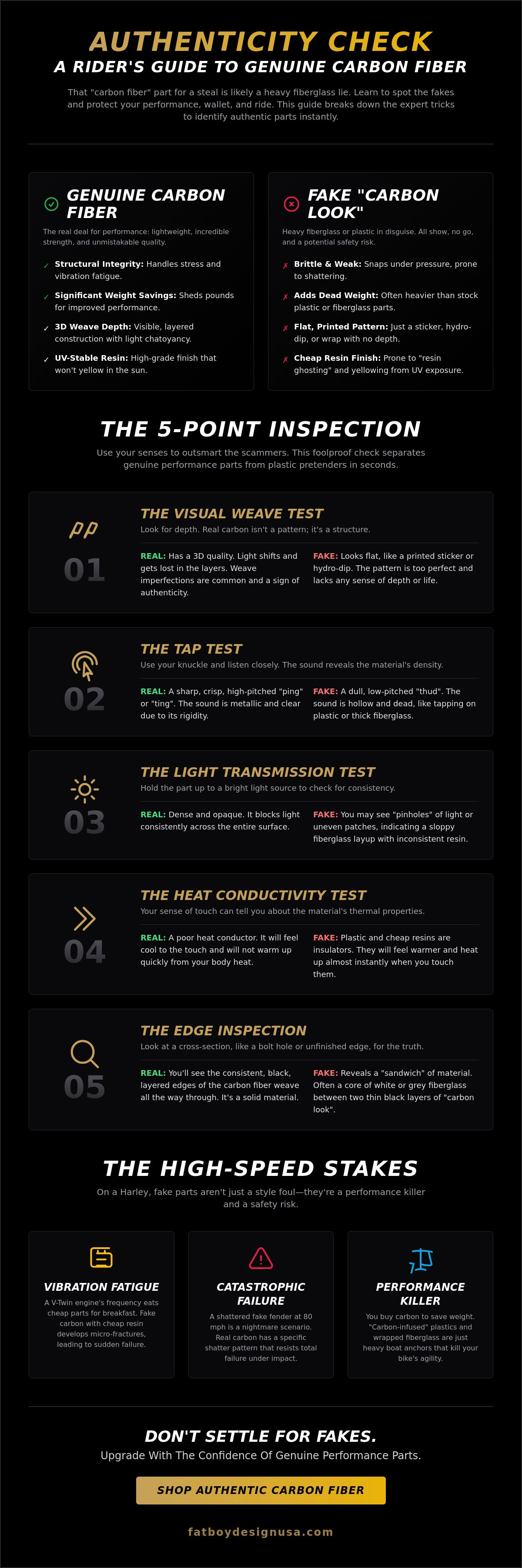
Time to get your hands dirty. Put on your detective hat because we are going deep. Knowing how to spot fake carbon fiber motorcycle parts is about more than just a quick glance. It is about using your senses to outsmart the scammers. This 5-point inspection is your ultimate shield against the plastic pretenders. It is fast. It is easy. It is totally foolproof.
- Step 1: The Visual Weave Test. Look for depth. Real carbon fiber has a 3D quality where the light seems to get lost in the layers. Fake parts look flat and painted on because they usually are.
- Step 2: The Tap Test. Use your knuckles. Give the part a light flick. Genuine carbon produces a sharp, high-pitched "ping" because it is incredibly rigid. Plastic or fiberglass will give you a dull, hollow "thud."
- Step 3: The Light Transmission Test. Hold it up to a bright light. Real carbon is dense. It blocks light consistently. If you see "pinholes" of light or uneven patches, you are looking at a sloppy fiberglass layup.
- Step 4: The Heat Conductivity Test. Touch the surface. Real carbon fiber is a poor heat conductor; it feels cool to the touch and stays that way. Plastic heats up almost instantly from your body heat.
- Step 5: The Edge Inspection. Look at the cross-section near a bolt hole. If you see a "sandwich" of white or grey material between two thin black layers, you found the fiberglass.
Visual Depth: The 3D Effect
Stop falling for the glitter. Hydro-dipped parts are just a pattern printed on a film. They have zero depth. When you move a real carbon part in the sun, the light should "chatoy" or shift across the fibers. It looks alive. Also, don't be afraid of tiny distortions in the weave. Because the manufacturing process of real carbon often involves hand-laying the fabric into a mold, a little "character" is actually a sign of authenticity. Perfection is usually the mark of a machine-printed fake.
The "Flip it Over" Rule
The front might lie, but the back always tells the truth. This is the secret weapon for anyone learning how to spot fake carbon fiber motorcycle parts. Flip that fender over. The backside of a genuine part should show the raw, textured weave of the fabric. If the back is smooth, painted black, or looks like a messy pool of resin, you are holding junk. Cheap manufacturers use "black fiberglass" to trick you, but they rarely bother to finish the inside to match the outside. Check out our harley davidson carbon fiber collection to see what a real, professional finish looks like on both sides.
Weight vs. Flex: The Racer’s Secret to Spotting Imitations
You want your bike to feel like a scalpel, not a sledgehammer. That is why weight matters. But weight is only half the story. If you are trying to master how to spot fake carbon fiber motorcycle parts, you have to look at how that part behaves under pressure. Real carbon fiber is a Diva. It is incredibly strong, remarkably light, and refuses to bend for anyone. If your new "performance" part feels like a wet noodle when you give it a twist, you have been scammed. Genuine parts are built for the track, not the showroom floor.
A real carbon part should feel startlingly light when you pick it up. It is that "wait, is this even in my hand?" feeling. Fake parts often rely on thick layers of fiberglass or heavy ABS plastic to mimic the shape. This creates a part that looks the part but performs like a boat anchor. Knowing how to spot fake carbon fiber motorcycle parts means trusting your hands as much as your eyes. Real carbon has a specific tension to it. It does not just sit there; it is ready for war.
The Scale Doesn’t Lie
Let's talk numbers. A stock Harley steel front fender is a heavy beast, often weighing in at several pounds of unsprung weight. Swapping to one of our Iconic Carbon Fiber Front Fenders can slash that weight by more than half. Fiberglass imitations might save some weight, but they require much thicker walls to achieve even a fraction of the strength. Then there is the "Carbon-Reinforced Plastic" (CRP) trap. This is basically just plastic with a sprinkle of carbon dust for marketing points. It is a middle-ground trap that offers none of the real-world benefits. Pre-preg carbon fiber offers an unmatched weight-to-strength ratio because the resin is precisely pre-impregnated into the fabric, eliminating the heavy, excess pools of glue found in cheap imitations.
Structural Rigidity on the Track
Go ahead and give that part a squeeze. Real carbon fiber has massive tensile strength but very low flex. If you grab a front fender by the tips and try to twist it, it should resist you with everything it has. Cheap plastic or fiberglass parts will twist and bow easily. This is a disaster at 100+ MPH. Wind pressure at high speeds can cause fake parts to deform, leading to the dreaded "fender slap" or, worse, interfering with your tire. We test every part for Bagger racing durability because we know that rigidity equals stability. If it cannot handle the vibration of a high-output V-Twin and the force of the wind, it does not belong on your bike. Real performance requires real materials. Period.
Why Mounting Points and Finish Tell the Real Story
Details matter. You can fake a weave from a distance, but you can't fake the finish of a part built for the long haul. If you are still wondering how to spot fake carbon fiber motorcycle parts, look at the holes. It sounds simple, right? But the way a part is drilled tells you everything about the hands that made it. Genuine carbon is a beast to work with, and it requires a level of respect that cheap manufacturers just won't give it.
Don't let a pretty face fool you. Even the best looking fakes fall apart when you look at the "plumbing" of the part. On a high-performance Harley, these small details are the difference between a sleek upgrade and a part that vibrates itself into a million pieces on the highway. We are looking for precision, not just a carbon-ish sticker.
Precision Machining vs. Drilled Plastic
Real carbon fiber is essentially a rock-hard composite. Trimming it requires CNC precision or specialized diamond-tipped tools. When you look at the mounting holes on a genuine fender or side cover, the edges are crisp. They are sharp. They look like they were meant to be there from day one. Fake parts often look like someone went at them with a dull hand drill in a backyard shed. You will see frayed edges, white dust, or even small stress cracks around the hole. On a high-torque V-Twin, those frayed edges are just a starting point for a total structural failure. Real carbon parts often feature reinforced mounting areas to handle the specific grunt of a heavy bagger.
The Clear Coat Trap
Let's talk about "Resin Ghosting." It is that weird, milky cloudiness that shows up just under the surface of the finish. It happens when cheap resins aren't cured properly or when the manufacturer uses a low-grade clear coat to save a buck. It is the hallmark of a counterfeit. Real performance parts use automotive-grade UV protection to ensure your bike stays looking sharp. Without it, your carbon will turn a nasty shade of yellow after just one season in the sun. It is like your bike is aging in dog years. Check for "pinholes" too. Those tiny little bubbles mean the part wasn't vacuum-sealed correctly during production. It is a one-way ticket to delamination. If you want a finish that actually lasts, check out our Platinum Series Exclusive Parts for racer-spec quality.
Hardware integration is another dead giveaway. Real carbon parts are designed with the bike in mind, meaning brackets and mounts fit like a glove. If the mounting hardware looks like a desperate afterthought glued on with a prayer, run away. Your ride is too fast for "maybe." Stop gambling with your safety and grab some real harley davidson carbon fiber today.
Get the Real Deal: The Fat Boy Design Standard
Stop guessing. Start winning. You have done the homework. You have poked, prodded, and tapped your way through the sea of plastic garbage. Now that you are an expert on how to spot fake carbon fiber motorcycle parts, it is time to choose a source that actually gives a damn about your performance. At Fat Boy Design, we do not just ship boxes. We manufacture greatness right here in North Carolina. From the initial mold to the final UV-protected finish, every step happens under our roof. We are not just making parts; we are crafting the future of your Harley. It is about physical presence. It is about visual dominance. It is about making sure your bike is the loudest, fastest thing on the block.
We are racers at heart. That means we have a very specific hobby: breaking things. We push our prototypes to the absolute limit on the track so you do not have to experience a failure on the street. It is the "King of Carbon" guarantee. When you buy from us, you are not just getting a part. You are joining a club of riders who refuse to settle for "good enough." Real performance is earned through sweat and high-speed testing, not just fancy marketing. We break it, we fix it, and we make it better. Every single time. That is the only way to ensure your carbon fiber side covers or saddlebag lids actually stand up to the vibration of a high-output V-Twin.
Thirteen Years of Racing Expertise
Thirteen years. That is how long we have been obsessing over every single fiber. Professional racing taught us that "show carbon" is for people who like to park. "Race carbon" is for people who like to ride. The difference is in the layup. Our process ensures maximum torsional rigidity and minimum weight. We do not use filler. We do not use shortcuts. If you want the full scoop on our journey from the track to the shop, read The Fat Boy Design Story. It is a tale of speed, grit, and a refusal to use stickers where structural weave belongs. We have spent over a decade perfecting the art of the performance bagger, and we are just getting started.
Your Bike Deserves Better Than a Sticker
Go outside. Look at your bike. If you see yellowing resin or a flat, uninspired weave, it is time for an audit. Investing in quality parts like our carbon fiber saddlebags or racing swingarms saves you money in the long run. You will not be replacing shattered fenders or cracked side covers every season. You deserve a bike that looks as fast as it feels. Your Harley is a massive investment in your lifestyle; do not cheapen it with plastic imitations. Stop settling for the carbon-look trap. It is time to level up and embrace the lifestyle of pure performance. Shop Authentic Harley Carbon Fiber Now and experience the difference that genuine, American-made craftsmanship makes to your ride.
Ditch the Plastic and Dominate the Road
You have the tools. You have the eye. Now that you know how to spot fake carbon fiber motorcycle parts, there is zero excuse for letting a cheap plastic wrap ruin your Harley's performance. Remember the golden rules. Look for that 3D weave depth. Listen for the high-pitched ping. Never ignore the "back-side" truth. Real carbon fiber isn't just a look; it's a structural upgrade that sheds weight and adds the rigidity your high-horsepower bagger demands. Don't let a "carbon-look" sticker be the weak link in your build.
We have spent over 13 years in the racing world breaking parts so we can build them better. Every fender, side cover, and saddlebag we sell is manufactured in-house right here in Matthews, NC. We test for high-horsepower performance because we know you are not just cruising. You are pushing boundaries. It is time to join the club of riders who demand authenticity and pure speed. Your bike is a masterpiece. Treat it like one. Upgrade to Racer-Tested Carbon Fiber Today and feel the difference that real engineering makes. Ride fast. Stay real. Keep the rubber side down.
Frequently Asked Questions
Can I tell if carbon fiber is real by looking at the price?
Price is a massive red flag in the performance world. Real carbon fiber requires expensive raw materials and intense, specialized labor to produce correctly. If a part is priced like a cheap plastic toy, it probably is one. You get what you pay for when you are chasing weight savings and structural strength for your Harley.
What is the "Tap Test" and how do I do it correctly?
Flick the part with your knuckle and listen for the pitch. Genuine carbon fiber is incredibly rigid and produces a sharp, high-pitched "ping" sound. If you hear a dull, hollow "thud," you are likely holding fiberglass or heavy plastic. It is one of the fastest ways to learn how to spot fake carbon fiber motorcycle parts without any special equipment.
Does real carbon fiber always have a glossy finish?
Not at all. The finish depends entirely on the clear coat applied during the final stages of manufacturing. You can find genuine carbon in high-gloss, satin, or matte finishes. The "look" is just for show; the real performance is in the structural weave hidden beneath that protective layer.
Is "Carbon-Look" plastic actually dangerous for motorcycles?
It can be a total disaster on two wheels. "Carbon-look" plastics lack the tensile strength of the real deal and can flex or even shatter under high-speed wind pressure. Real carbon fiber holds its shape and provides the durability needed to survive the intense vibration of a high-output V-Twin engine.
Why does some carbon fiber turn yellow over time?
Yellowing is a sign of cheap resin or a complete lack of UV-stable clear coats. Low-quality parts aren't built to handle the sun. Over time, UV rays break down the resin, turning your "performance" upgrade into a cloudy, yellowed mess. Genuine parts use automotive-grade protection to keep your bike looking sharp for years.
What is the difference between wet carbon and dry (pre-preg) carbon?
Wet carbon is hand-laid with liquid resin, which often leads to excess weight and tiny air bubbles. Dry carbon, or pre-preg, uses fabric already impregnated with the perfect amount of resin. It is cured under high pressure for maximum strength and minimum weight. Dry carbon is the gold standard for serious racing applications.
Can fake carbon fiber be repaired if it cracks?
Not effectively. If your plastic or fiberglass "carbon" part cracks, it is basically garbage. You can try to patch it, but the repair will look like junk and won't stand up to the stress of riding. Real carbon can sometimes be professionally repaired, but fake parts belong in the bin once they fail.
Is weight the only way to tell if a motorcycle part is real carbon?
Weight is a huge hint, but it isn't the only factor to consider. Some fakes use very thin fiberglass to mimic the weight of real carbon. You have to combine the weight check with the tap test and a close inspection of the weave depth. Mastering how to spot fake carbon fiber motorcycle parts means using all your senses to find the truth.