

Is Your Rear End Dancing? 5 Signs of a Bad Motorcycle Swingarm
What if that sketchy "dance" your rear end is doing at 75 mph isn't just you being a bold rider, but a mechanical cry for help? It starts as a subtle wiggle and turns into a full-blown high-speed weave that makes your heart hit your throat. Spotting the early signs of a bad motorcycle swingarm is the difference between a legendary weekend and a $125 per hour date with a mechanic's shop floor. You know that feeling when the bike starts steering itself from the back? It's not a vibe; it's a warning that your machine's backbone is failing.
We've all felt that knot in the stomach when a mysterious creak ruins the rhythm of a perfect sunset cruise. You deserve to feel like the king of the road, not like you're balancing on a wet noodle. We're going to help you master the art of spotting failure before your high-speed cruise turns into a sketchy disaster. You'll get a clear checklist for your bike's health and learn why upgrading to a $3,000 performance billet aluminum swingarm is the ultimate fix for your Bagger's stability. Stop guessing and start riding with total confidence.
Key Takeaways
- Grasp how your swingarm acts as the ultimate hinge for keeping power on the pavement while fighting off sketchy lateral twists.
- Spot the top five red flags, from ghost steering to haunted-house groans, that act as the primary signs of a bad motorcycle swingarm.
- Master the pro-level 12-and-6 lateral stress test to check your bike's health before your next high-speed adventure.
- Learn how heavy saddlebags and structural fails turn the classic Harley Wobble into a sketchy highway disaster.
- Find out why a racer-tested Bagger Racing Swingarm is the ultimate showstopper for boosting rigidity and cutting unnecessary weight.
The Backbone of Your Beast: What Does a Motorcycle Swingarm Actually Do?
Think of your Motorcycle Swingarm as the chunky hinge that keeps your power glued to the pavement. It is the ultimate showstopper of engineering. This part manages the vertical travel that keeps your spine from shattering over every pothole. But there is a catch. It must remain rock-solid against lateral twisting. When you are pushing a 900lb Bagger through a high-speed sweeper, that metal is under massive pressure. "Good enough" is a death wish in this scenario. Vintage cruiser setups were designed for slow rolls and lazy Sundays. Modern performance geometry is a different beast entirely. It is built for the adrenaline-soaked reality of the modern road.
Your swingarm handles several critical jobs at once:
- Vertical travel: Allowing the rear wheel to soak up bumps for a chill ride.
- Power delivery: Transferring every bit of torque from your belt or chain to the wheel.
- Lateral rigidity: Preventing the rear wheel from steering itself when you lean into a corner.
- Alignment: Keeping the rear wheel perfectly centered with the front.
The Pivot Point: Where the Magic (and Trouble) Happens
The pivot bolt and needle bearings are the unsung heroes of your chassis. They live in a high-energy, high-stress environment every single second you are moving. Your built Milwaukee-Eight engine throws down massive torque. All that force tries to shred this specific joint every time you twist the throttle. If these bearings get sloppy or the bolt loses its cool, you will start seeing the first signs of a bad motorcycle swingarm. The pivot point is the critical link between frame and road.
Structural Fatigue: When Metal Gets Tired
Metal has a memory, and eventually, it just gets tired. High-mileage frames or bikes that have survived too many "spirited" launches can develop hairline cracks. You won't see them at first glance. But you will definitely feel them. This is why racing heritage is a game-changer for your street machine. Parts designed for the track don't flex under pressure. A true performance bagger demands a swingarm that laughs at stress. If yours is flexing, you are looking at the most dangerous signs of a bad motorcycle swingarm. Don't wait for a catastrophic snap. Upgrade to something iconic that can actually handle the heat of real-world riding.
Red Flags: 5 Unignorable Signs of a Bad Motorcycle Swingarm
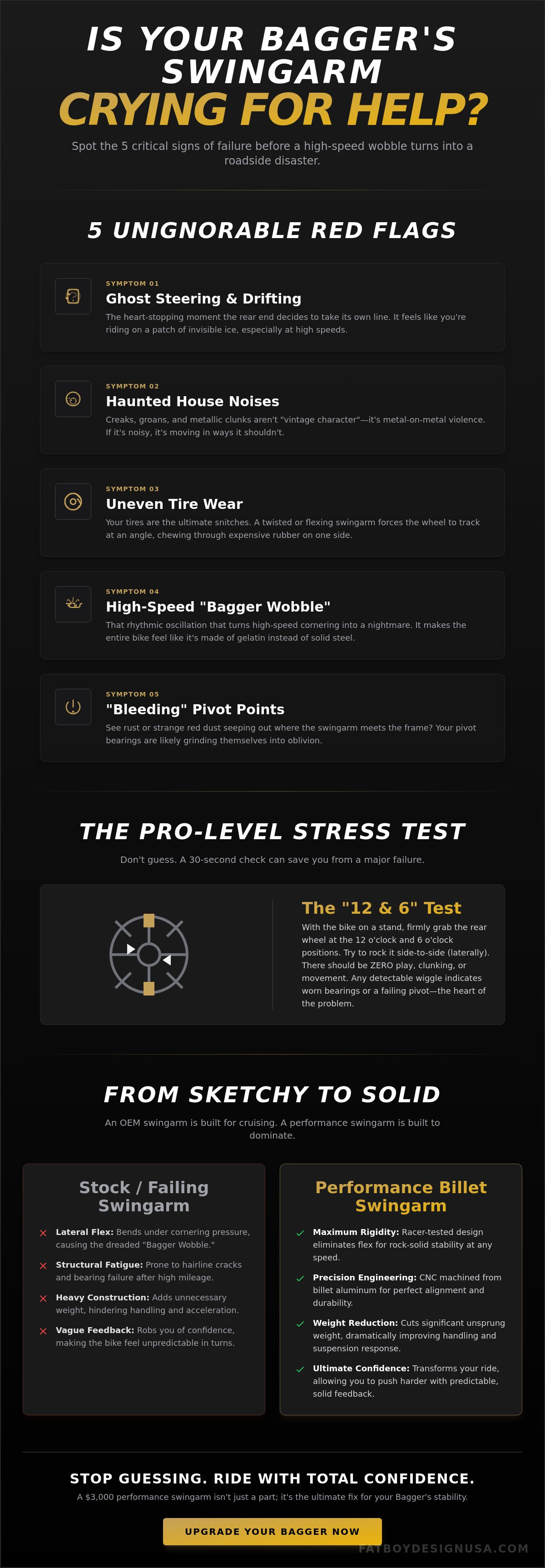
Ever felt like your bike was possessed? Ghost steering is real. It is that heart-stopping moment when the back end decides to take its own line while your front wheel is pointed straight. This is one of the most terrifying signs of a bad motorcycle swingarm. You are riding along, and suddenly, the rear feels like it is drifting on a patch of ice that isn't there. It is not a vibe you want when you are hauling down the interstate at 80 mph.
Listen to your machine. If your bike sounds like a haunted house every time you hit a bump, you have problems. We are talking about creaks, groans, and metallic clunks. This isn't just "vintage character." It is metal-on-metal violence happening inches from your rear tire. A swingarm with any play or damage that adversely affects tracking is a significant safety hazard. If it's noisy, it's likely moving in ways it shouldn't.
Your tires are the ultimate snitches. Check your rubber for uneven wear. If the tread is chewed up on the left side but looks fresh on the right, your alignment is a total lie. A twisted or bent swingarm forces the wheel to track at a funky angle. This eats through expensive rubber faster than a weekend at the track. You should also watch out for the infamous "Bagger Wobble." This is that rhythmic oscillation that turns high-speed cornering into a sketchy disaster. It makes the whole bike feel like it is made of gelatin rather than solid steel.
Finally, look for "bleeding" at the pivot points. If you see rust or a weird red dust seeping out from where the swingarm meets the frame, your bearings are grinding themselves into oblivion. If your current setup feels like it's made of wet noodles, it might be time to look into bagger racing parts that actually hold their shape under pressure.
Sensory Overload: Feeling the Flex
Feeling the flex is like having a hinge in the middle of your frame. It completely ruins your confidence in the twisties. You might notice a vibration that feels deeper and more structural than a simple unbalanced tire. It is a shudder that travels through the seat, telling you the chassis is no longer a single, cohesive unit. This loss of rigidity turns every mid-corner bump into a gamble.
The Visual Inspection: Looking for Trouble
Get close and personal with your frame. Search for powder coat flaking. This is a massive red flag because it often hides stress fractures lurking beneath the surface. To ensure your frame's finish and structural integrity are maintained at a professional level, you can learn more about Mad Auto Design and their specialized body and paint services. Check your alignment marks with a literal magnifying glass. If they do not match perfectly on both sides, your swingarm is likely bent. That red dust mentioned earlier is the ultimate "game-over" indicator for your pivot bearings. It means the hardened surfaces have failed, and you are now riding on ground-up metal. This is one of the clearest signs of a bad motorcycle swingarm that you can spot without any fancy tools.
The Hands-On Diagnostic: How to Test Your Swingarm Like a Pro
Ready to stop guessing? It's time to get your hands dirty. Before you start yanking on parts, get that rear wheel off the ground. Use a sturdy jack or a center stand to get the bike stable. You need the rear suspension totally unloaded to spot the real signs of a bad motorcycle swingarm. Safety is the only rule here. Don't let 900 lbs of American iron crush your toes because you were too lazy to secure the frame. Once the wheel is airborne, you can finally feel what's actually happening beneath the chrome.
Isolate your shocks before you dive in. A blown damper can mimic a bad swingarm by making the rear end feel bouncy or disconnected. Remove the lower shock bolts and swing the dampers out of the way. This lets you move the swingarm through its full arc without any interference. It's a pro move that prevents you from spending thousands on a new arm when you just needed a fresh set of springs.
The 12-Step Push-Pull Method
Grab the rear tire firmly at the 3 o'clock and 9 o'clock positions. Now, give it a violent lateral push and pull. You are looking for any side-to-side movement at the pivot point. Repeat this process at the 12 and 6 positions. Here is the reality: any "clack" sound during this test is an immediate fail. Use these steps to verify your chassis integrity:
- Check for lateral play: There should be zero side-to-side wiggle. Zip. Nada.
- Feel for notched movement: Move the arm up and down slowly to check for "flat spots" in the bearings.
- Listen for grit: A grinding sound means your needle bearings have turned into metal sand.
- Observe the pivot: Watch the gap between the arm and the frame for any shifting.
Pivot Bolt and Bearing Verification
Grab a long pry bar and gently wedge it between the frame and the swingarm near the pivot. Apply light pressure to check for vertical or horizontal shifting. If you see the arm move independently of the frame, your bearings are toast. Don't just "tighten it more" to fix a wobble. Cranking down on a pivot bolt beyond factory specs just crushes the internal spacers and guarantees a catastrophic failure later. If the swingarm seems rock-solid but your bike still feels sketchy, it is time to inspect your performance steering damper kit. Sometimes the front end is the one telling lies about your rear-end stability. Catching these signs of a bad motorcycle swingarm early saves you from a $125 per hour labor bill at the repair shop.
Bagger Wobble vs. Structural Failure: Navigating High-Speed Instability
Let's talk about the elephant in the garage: the Harley Wobble. Is it a design flaw or a maintenance fail? Usually, it is a mix of both. Many touring models use rubber engine mounts that can perish over time. When they go soft, the entire powertrain moves independently of the frame. This creates a "rear-steer" phenomenon that feels like you're riding on a hinge. Your stock swingarm is often the chunky weak link in this performance chain. It simply wasn't built to handle the massive torque of a built Milwaukee-Eight engine without flexing under pressure.
Weight is the enemy of stability. You pack 50 lbs of gear into your saddlebags for a long trip. That weight sits far behind the rear axle, acting like a lever on your chassis. If your bike shows any signs of a bad motorcycle swingarm, this extra load will amplify the problem tenfold. It is like trying to balance a bowling ball on a wet noodle. You need a setup that remains rock-solid regardless of how much gear you are hauling. A flexy rear end turns a relaxing cruise into a high-stress wrestling match with your handlebars.
The Physics of the Wobble
Lateral flex isn't just a vibe; it is a self-sustaining oscillation. When your swingarm twists, the rear wheel stops tracking straight. The bike tries to correct itself, but the flex causes it to overcompensate. High-speed weave typically kicks in at 75 mph and above. It is a slow, rolling wave that feels like the bike is undulating at 2 to 4 cycles per second. This is different from the "Death Wobble," which is a rapid front-end shake usually hitting between 25 and 60 mph. Racers ditch OEM swingarms for something iconic and rigid to keep that rear wheel in line during high-energy maneuvers.
Objection Handling: Tires, Bearings, or Swingarm?
Don't just blame your tires and call it a day. Rule out wheel bearings by checking for hub play before you go shopping for rubber. Many riders fall for the "New Tire Cure" myth. Fresh rubber has a stiffer carcass and a rounder profile that masks the signs of a bad motorcycle swingarm for a few hundred miles. But once that tire wears in, the wobble returns with a vengeance. The tire was just a band-aid for a structural failure. Stop chasing ghosts and check out our bagger racing parts to build a foundation that actually holds its own on the open road.
From Sketchy to Solid: Upgrading to a Performance Bagger Swingarm
You’ve felt the wiggle. You’ve heard the groans. Once you’ve spotted the signs of a bad motorcycle swingarm, the only logical move is to upgrade. Swapping out that flexy factory steel for CNC-machined T6061 billet aluminum is essentially giving your bike a backbone transplant. It is a total game-changer. High-performance billet aluminum swingarms for 2009-2026 Harley-Davidson Touring models typically sit in the $3,000 to $3,800 price range. This investment transforms your ride from a sketchy, undulating mess into a laser-focused machine. It is the ultimate way to reject the mundane and embrace the track.
Rigidity is the goal, but weight reduction is the bonus. Reducing unsprung weight allows your rear suspension to track the pavement with insane precision. Your shocks won't have to fight a chunky, heavy arm just to do their job. This creates a "vibe" of total control. When you install a Bagger Racing Swingarm, you are opting for a part that has been tortured on the race track before it ever touched your street bike. It is built for real-life adventures, whether that is a cross-country tour or a high-speed blast through the canyons. Don't settle for a ride that feels like a wet noodle when you can have a showstopper setup.
The Case for Carbon Fiber and Performance Steel
We don't do "basic." Our Harley carbon fiber components are designed to complement a high-performance chassis by shedding every unnecessary ounce. Reducing weight behind the center of gravity is the holy grail of Bagger performance. It stops the "pendulum effect" that makes the rear end want to steer itself. Combining elite aesthetics with professional racing standards ensures your bike looks as fast as it actually is. It is a larger-than-life upgrade that changes the entire atmosphere of your build.
Next Steps: Stop Lounging, Start Modding
Stop the Shake and Own the Open Road
You’ve mastered the 12-and-6 stress test and learned to listen for those haunted-house groans. Recognizing the signs of a bad motorcycle swingarm is the only way to protect your high-speed peace of mind. A weak, flexy rear end turns your ultimate cruise into a sketchy wrestling match. You don’t have to settle for a chassis that tells lies about your stability. It's time to ditch the mundane OEM setup and embrace a showstopper that actually holds its line.
We bring 13+ years of professional racing experience to every part we create right here in Matthews, NC. Our in-house manufacturing process ensures every component meets racer-tested performance standards for real-world durability. Stop lounging and start modding your machine into the ultimate performance beast. Upgrade your ride with racer-tested Bagger Racing Parts! You deserve a bike that feels as iconic as it looks. Grab your tools, refresh those bearings, and get back to the only thing that matters: pure enjoyment on two wheels. Stay bold and ride hard.
Frequently Asked Questions
Can a bad swingarm cause a motorcycle to wobble at high speeds?
Yes, it is a primary suspect for a high-speed weave. This instability typically kicks in at speeds of 75 mph and above. It feels like a slow, undulating movement of the entire motorcycle rather than a rapid front-end shake. If your rear end starts dancing at highway speeds, you are likely seeing one of the major signs of a bad motorcycle swingarm. Don't ignore it unless you want your cruise to turn into a sketchy disaster.
How much does it cost to replace motorcycle swingarm bearings?
Expect to pay approximately $125 per hour for professional motorcycle repair labor. Parts for aftermarket swingarm kits range from $100 to over $1,000 depending on your bike's model and the quality of the bearings. Total costs climb quickly if the pivot bolt is seized or the housing is damaged. It is often smarter to put that cash toward an iconic billet upgrade that solves the flex problem forever.
What does a failing swingarm sound like?
Listen for rhythmic creaks, metallic groans, or heavy clunks. It sounds like a haunted house is following you down the road every time you hit a bump. These noises usually happen when you load the suspension during acceleration or lean into a corner. If your bike is talking back with a nasty attitude, your pivot bearings are likely grinding themselves into metal dust. Fix it before the vibe gets even worse.
Is it safe to ride with a slightly loose swingarm?
Absolutely not. A loose swingarm is a mechanical failure waiting to happen. In states like Hawaii, a motorcycle will fail its safety inspection if the swingarm has any play or damage that affects tracking. Even a tiny bit of slop turns your rear wheel into a "rear-steer" nightmare at 60 mph. Stop riding and get it sorted before you lose your cool on a high-speed sweeper. Your safety isn't a game.
How do I know if my swingarm is bent or just has bad bearings?
Side-to-side play at the axle usually points to toasted bearings. If the arm feels solid but your alignment marks are off or the bike pulls to one side, the arm itself is likely bent. You might also notice uneven tire wear on just one side of the tread. A bent arm is a game-over situation. It requires a full replacement to keep your tracking true and your ride iconic.
Can I upgrade my stock Harley swingarm to a performance version?
Yes, and it is the ultimate game-changer for your Bagger. High-performance billet aluminum swingarms are designed to increase rigidity and shed unsprung weight. These showstopper parts are racer-tested to handle the massive torque of modern Milwaukee-Eight engines. Upgrading is the best way to eliminate the "Harley Wobble" and reclaim your confidence in the twisties. It is a total vibe shift for your performance build.
How often should I grease my motorcycle swingarm pivot?
Check your pivot every 10,000 miles or at least once per riding season. Some modern sealed bearings don't require regular grease, but high-performance setups often need a fresh shot of lubricant to stay smooth. Ignoring this simple maintenance is one of the fastest ways to see early signs of a bad motorcycle swingarm. Keep it slick to keep your ride silent and your handling razor-sharp.
What happens if a motorcycle swingarm fails while riding?
You lose total control of the rear wheel's tracking. At 75 mph, a snapped pivot or a cracked arm causes the rear end to steer itself independently of the front wheel. This leads to a catastrophic high-speed weave that is almost impossible to recover from. It is a larger-than-life disaster that turns a fun weekend into a wreck. Never gamble with the backbone of your beast.