

OEM vs Aftermarket Harley Saddlebags: Stop Guessing, Start Upgrading
Your stock Harley saddlebags are essentially anchors disguised as luggage. It's a brutal truth, but someone had to say it. You want the storage for your cross-country hauls, yet you're tired of that sluggish, heavy-end feel that turns every corner into a workout. You have likely spent hours weighing the pros and cons of oem vs aftermarket harley saddlebags, feeling caught between paying the Harley tax for heavy plastic or risking your cash on flimsy aftermarket kits that vibrate like a blender at highway speeds.
Stop hauling dead weight and start riding harder. We are diving deep into the reality of saddlebag performance, durability, and the garage engineering headaches you definitely want to avoid. You will discover how to ditch the bulk for high-performance carbon fiber alternatives that offer surgical fitment and a look that commands respect at the next rally. It's time to upgrade your bagger into a lightweight beast that handles as good as it looks. Let's get your bike dialed in for the long haul without the extra baggage.
Key Takeaways
- Stop hauling anchors. Learn how shedding rear-end weight transforms your lean angle and cornering exit from sluggish to surgical.
- Ditch the guesswork. We break down the oem vs aftermarket harley saddlebags debate to help you avoid the "Harley Tax" without settling for flimsy plastic.
- Stop the rattle. Find out how to spot high-quality aftermarket builds that fit perfectly the first time, skipping the "garage engineering" headaches.
- Meet the performance king. See why carbon fiber saddlebags crush traditional ABS by offering zero flex under load and unmatched weight reduction.
- Pick your poison. Determine if your riding style demands the reliability of OEM or the high-speed dominance of lightweight racing parts.
Why Your Harley Saddlebags Matter More Than You Think
Saddlebags are just boxes for your rain gear and extra layers, right? Wrong. In the high-stakes world of motorcycle accessories, your bags are actually the largest unsprung-adjacent mass on your Harley. That is a loud, heavy truth most riders ignore until they try to dive into a corner at speed. When you start comparing oem vs aftermarket harley saddlebags, you are not just looking at style. You are looking at how much dead weight you are willing to let dictate your ride.
The way your rear end behaves during a cornering exit depends entirely on what is hanging off the sides. Heavy bags create a nasty pendulum effect. Imagine a bowling ball swinging behind your rear axle every time you lean. It is not fun; it is physics working against you. The oem vs aftermarket harley saddlebags debate usually focuses on price, but the real cost is in your handling confidence. Performance bagger racing has flipped the script, proving that if you want to ride harder, you have to lose the bulk.
The Center of Gravity Challenge
Positioning weight behind the rear axle is a classic way to lighten your front end. Not the good kind of light, either. This imbalance is a primary culprit behind the dreaded high-speed bagger wobble. Mass centralization is the gold standard for the modern rider. It means keeping the heavy stuff tucked tight and low to the bike's heart so the chassis stays stable. If your bags are packed with heavy ABS plastic and unnecessary bulk, you are basically inviting the bike to dance when you want it to stay planted. Every pound you move closer to the center makes the bike feel twenty pounds lighter.
Aerodynamics at 80mph and Beyond
Air is heavy when you hit it at eighty. Blocky, traditional OEM shapes often act like parachutes, catching drag and pulling on your rear end. Compare that to the sleek, aggressive silhouettes found in the harley davidson carbon fiber collection. Racers don't just use lightweight materials for the scale; they do it because carbon fiber doesn't flex or catch the wind like a sail. Switching from standard, boxy shapes to performance-focused designs cuts through the atmosphere instead of fighting it. You want stability, not a wind-induced wrestling match. Racers strip bags or move to ultra-lightweight alternatives because every millimeter of drag matters when you are pinned in the straightaway.
The OEM Reality: Reliable, Heavy, and Familiar
Let's talk about the Bar and Shield. It is the safe route. It is the familiar choice. But it comes with a price tag that makes your wallet weep. This is the "Harley Tax." You are paying for a logo and the comfort of knowing exactly what you are getting. When you weigh the pros and cons of oem vs aftermarket harley saddlebags, you have to decide if you want a factory look or actual performance. OEM bags are designed for the average cruiser, not the performance addict who wants to flick their bike through a canyon.
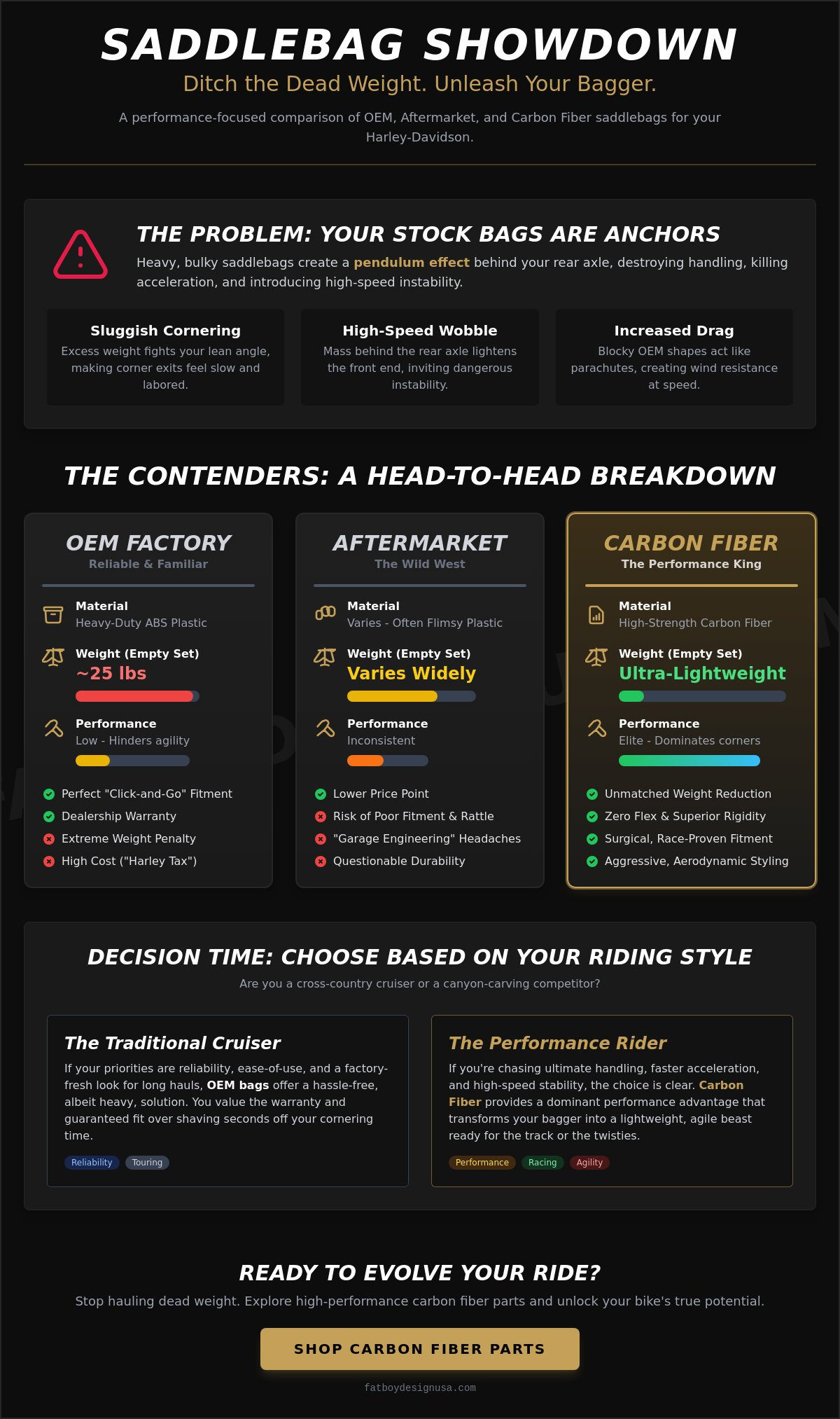
The material of choice for factory bags is heavy-duty ABS plastic. It is tough. It is durable. It is also incredibly chunky. These bags are built to survive years of sun exposure and the occasional driveway tip-over while meeting basic motorcycle safety standards. You get perfect paint matching straight from the factory. You get that satisfying "thud" when the lid closes. But you also get a lot of unnecessary bulk that slows down your response time. If you are looking to shed weight, you might want to consider high-performance carbon fiber instead.
The Fitment Guarantee
Factory bags are the undisputed kings of "click-and-go" ease. The hardware is already there; the holes are perfectly drilled; the latches are weather-sealed to keep your gear dry in a monsoon. There is no "garage engineering" required. Plus, you get the peace of mind that comes with a dealership warranty. If a hinge snaps or a seal leaks, you just roll into the shop and let them handle it. It is predictable. It is easy. It is also exactly what everyone else is riding.
The Weight Penalty
Here is the part that actually hurts your ride. A standard set of empty factory hard bags usually tips the scales at roughly 10 pounds per side. Once you add the lids, the internal liners, and the heavy mounting hardware, you are lugging around nearly 25 pounds of plastic before you even pack a single tool. For a performance build, "overbuilt" is just a polite way of saying "overweight." When you are comparing oem vs aftermarket harley saddlebags, remember that every extra pound hanging off your rear fender is a pound that fights your suspension and kills your acceleration. You are basically hauling around a small boulder for the sake of brand loyalty.
The Aftermarket Jungle: Finding Gold Among the Trash
Welcome to the Wild West of motorcycle parts. The aftermarket is a chaotic mix of absolute trash and pure racing gold. You can find "paper-thin" plastic tubs on auction sites for $200, or you can drop serious coin on $2,000 professional racing setups. When weighing the reality of oem vs aftermarket harley saddlebags, the price tag usually tells the story of the material. Cheap bags feel like Tupperware. High-end bags feel like a structural part of the frame. Understanding the Federal Regulation of Aftermarket Parts is great for legal nerds; however, out on the asphalt, you need to know what actually holds up under pressure.
Let's talk about the "stretched" look. Sure, those floor-dragging bags look killer at the bike wash. They scream "show bike" and grab attention at every stoplight. But try taking a sharp corner in the canyons, and you will hear the expensive sound of fiberglass meeting pavement. Stretched bags are great for the rally, but they are terrible for the ride. If you want performance, you want clearance. You need a setup that lets you lean without the fear of grinding your investment into dust. It is about choosing between looking fast and actually being fast.
ABS vs. Fiberglass: The Middle Ground
ABS plastic is the flexible friend of the motorcycle world. It is cheap to produce and handles minor impacts well. However, on a high-displacement V-twin that vibrates like a jackhammer, ABS can be too floppy. It wobbles. It flexes. Fiberglass is the rigid older brother. It handles high-frequency vibration much better because it does not distort under stress. Plus, if you ever take a slide, fiberglass is actually repairable with a little resin and patience. ABS usually just cracks and ends up in the bin. If you want the ultimate in rigidity without the fiberglass weight, harley davidson carbon fiber is the only real answer.
Identifying High-Quality Hardware
The biggest secret in the aftermarket jungle? The bags might be fine, but the latches are usually garbage. Lousy seals lead to soggy gear and a whistling sound at 80mph. Always check the mounting points before you commit. High-speed stability requires reinforced areas where the bag meets the rail. If the mounting holes look like they were poked with a hot screwdriver, run away. Pro tip: Pair your high-end aftermarket shells with OEM-style hardware for the best of both worlds. It prevents the "garage engineering" headache and keeps your lids from flying off on the interstate. Check out our bagger racing parts to see how real hardware should look.
Decision Time: Choosing Bags Based on Your Riding Style
Stop guessing. It is time to get real about what you actually do with your bike. Choosing between oem vs aftermarket harley saddlebags is not just about the price tag; it is about the mission. Are you a weekend warrior or a canyon carver? Your riding style dictates whether you need a tank-like factory build or a featherweight racing setup. Match the gear to the grind, or you will regret it by the first fuel stop.
The Casual Tourer lives for the open road and the occasional overnight trip. If your idea of a wild ride is cruising at sixty to find the best pie shop in the state, OEM or high-end ABS is probably enough for you. It is familiar. It is sturdy. You don't mind the extra weight because you aren't trying to scrape your floorboards. You want reliability and a paint job that matches your tank perfectly. Simple. Easy. Done.
The Show Stopper wants to be the main event at the rally. This is where radical stretches and custom glass shine. These bags are huge, loud, and visually dominant. They turn heads, but they also turn like a freight ship. If you care more about the trophy than the lap time, go big. Just remember that every inch of stretch is an inch of cornering clearance you will never get back. It is a trade-off between looking fast and actually being fast.
The Performance Bagger is a different beast entirely. This is for the rider who wants a bike that breathes fire and handles like a sportbike. Every ounce of weight savings matters here. You need to balance storage capacity with the clearance required to actually lean into a corner. This is why pros ditch the stock anchors for harley davidson carbon fiber. It is about shedding the "bagger tax" of weight and gaining surgical precision in the twisties.
The Performance Bagger Checklist
- Prioritize ground clearance. Look for the "tucked" bag look that stays high and tight above the exhaust.
- Focus on bike geometry. Check out our Performance Bagger Guide 2026 to see how weight affects your total setup.
- Choose shorty bags or carbon fiber shells. They offer the rigidity you need without the bulk that drags in the turns.
The Long-Haul Reliability Test
Don't let a "cheap deal" ruin a multi-state trip. Evaluate your weather seals before you pack. If they feel like flimsy foam, your gear will be soaked by the first rain cloud. Locking mechanisms are another major point of failure on budget aftermarket kits. They rattle. They jam. Worst of all, they can fail at eighty miles per hour. Run a vibration test on your gear. If your bags feel loose after a quick five-mile sprint, they definitely won't be attached after a five-hundred-mile haul. Ready to stop hauling dead weight? Grab a set of our Carbon Fiber Saddlebags and feel the difference in your next corner.
The Performance King: Why Carbon Fiber Crushes Both
We have waded through the "Harley Tax" and survived the budget plastic jungle. Now, it's time to crown the king. In the high-stakes showdown of oem vs aftermarket harley saddlebags, carbon fiber doesn't just win; it obliterates the competition. If you're still lugging around stock ABS or fiberglass, you're essentially riding with a ball and chain attached to your rear fender. Carbon fiber offers the ultimate weight reduction, slashing pounds where it matters most to keep your bike agile and aggressive.
Structural rigidity is the secret sauce here. Unlike standard plastic that wobbles or fiberglass that can be brittle, carbon fiber bags don't flex under load. When you're pinning the throttle out of a corner, you want your luggage to stay as planted as your tires. This "King of Carbon Fiber" approach turns your bagger into a surgical instrument. You get the storage you need without the handling penalty that usually comes with it. It's the only way to stop hauling dead weight and finally start riding harder.
Racer-Tested, Street-Proven
At Fat Boy Design USA, our philosophy is simple. If a part doesn't make the bike faster or handle better, it has no business being on your machine. Every piece of harley davidson carbon fiber we produce is born from the high-pressure world of bagger racing. These parts are built to handle extreme vibration and high-speed drag without flinching. Additionally, the durability of carbon fiber against road debris is legendary. While your buddies are crying over rock chips in their expensive factory paint, your carbon weave is shrugging off the miles like a pro.
The Aesthetic of Speed
Let's be honest. Performance is priority number one, but looking like a total badass is a close second. The raw carbon weave is the universal language of speed. It tells everyone at the rally that you value technology over tradition. Integrating Carbon Fiber Saddlebags into your build transforms the entire rear-end profile of the bike. It creates a cohesive, high-performance look that screams for attention before you even kick the stand up. It's time to stop settling for the status quo. Stop hauling plastic and upgrade your ride to the Upper Carbon Platinum Series today. Your bike deserves to be a beast.
Ditch the Dead Weight and Dominate
You have done the math. You have seen the carnage of the oem vs aftermarket harley saddlebags debate. Now it is time to choose. Every extra pound of plastic hanging off your rear fender is a pound that fights your suspension and kills your cornering exit. You don't need anchors; you need aerodynamics that cut through the atmosphere. Stop letting "good enough" dictate your ride. Join the club of riders who prioritize high-speed thrills over heavy, blocky factory parts. It is time to embrace a lifestyle of speed and performance.
We have spent over 13 years in the professional racing world perfecting the performance bagger. We don't just sell parts; we engineer high-strength, low-weight composites right here in North Carolina. Our in-house US manufacturing ensures you get surgical precision instead of garage engineering headaches. We are the pioneers of the carbon fiber revolution. We are here to help you transform your bike into a lightweight beast that commands respect at every rally. Stop hauling plastic and start riding harder. Upgrade to Racer-Tested Carbon Fiber Saddlebags and feel the difference in your very first corner. Go out there and carve those canyons like you mean it. Your bike is finally ready to breathe fire.
Frequently Asked Questions
Do aftermarket saddlebags fit with OEM Harley hardware?
Yes, most high-quality aftermarket bags are designed to accept your factory latches and mounting pins. This is the smart way to avoid "garage engineering" headaches. Pairing high-performance shells with OEM hardware gives you a rock-solid seal. It keeps your gear dry and your lids attached at eighty miles per hour. Always double-check the mounting hole alignment before you start your project.
How much weight can I save by switching to carbon fiber saddlebags?
You can typically shed nearly half the weight of your rear end by ditching stock plastic. Factory Touring bags usually weigh about 10 pounds per side without gear. Switching to high-performance carbon fiber drops that number significantly. This weight loss transforms your bike's handling. It makes the rear end feel light, flickable, and ready to dominate the next corner.
Are fiberglass saddlebags better than ABS plastic for Harleys?
Fiberglass is superior for rigidity and vibration resistance but heavier than performance composites. ABS is flexible and cheap, which is why it is the factory standard. Fiberglass handles the shake of a V-twin better and does not distort under stress. Plus, if you ever take a slide, fiberglass is actually repairable. ABS usually just cracks and ends up in the bin.
Will aftermarket bags affect my Harley’s handling?
Weight is the biggest factor when comparing oem vs aftermarket harley saddlebags. Heavy bags act like anchors, creating a pendulum effect that fights you in every turn. If you pick bulky, low-quality aftermarket kits, your handling will suffer. Choosing lightweight, aerodynamic shells keeps your center of gravity tight. It allows for faster cornering exits and better overall stability at high speeds.
Can I paint carbon fiber saddlebags to match my factory Harley color?
Absolutely, carbon fiber takes paint just as well as any other composite. Most riders love the raw racing weave look, but you can scuff and shoot them with any factory color. You get the massive weight savings of carbon with the classic look of your bike's original paint scheme. It is the best of both worlds for a performance-focused build.
What is the most durable material for Harley saddlebags?
Carbon fiber is the undisputed champion of strength-to-weight durability. It resists road debris better than plastic and does not crack under high-frequency vibration. While ABS might survive a driveway tip-over, carbon fiber survives the high-speed stress of the racetrack. It stays rigid and maintains its shape even after years of hard riding in the sun and rain.
Do I need to relocate my turn signals for aftermarket bags?
It depends on the bag's length; radical stretched bags usually require signal relocation. Performance-style bags that stay "tucked" usually clear your factory signals without any extra work. If you go for show-style stretches that drag near the pavement, prepare to move your lights. Always check your clearance before you drill any holes or commit to a specific bag length.
Why are OEM Harley saddlebags so expensive?
The oem vs aftermarket harley saddlebags price gap exists because you are paying for the Bar and Shield logo. You get the guarantee of a perfect factory fit and a dealership warranty. However, it is the classic "Harley Tax" in action. You are paying a massive premium for standard ABS plastic that is heavier and less advanced than high-end racing composites.