

Performance Bagger Handlebars: The Racer’s Guide to Total Control (2026)
Is your Harley a precision instrument or a 900 pound couch that refuses to turn? If you're still wrestling with those vague, lazy stock bars, you're just a passenger on your own bike. Stock setups are built for slow cruises to the local burger joint, not for the aggressive lean angles demanded by the 2026 Bagger World Cup era. You deserve a cockpit that actually responds when you pull the trigger. Finding the right performance bagger handlebars is the first step toward total mechanical telepathy.
We get it. You're tired of shoulder pain from garbage ergonomics and that heavy, sluggish front-end feel during low-speed maneuvers. It's frustrating when your bike feels like it's fighting your every move. It's time to transform your ride into a track-ready beast. This guide breaks down everything you need to know to reclaim your dominance on the asphalt. We will explore how the right setup improves flickability, cleans up your dash visibility, and works in perfect harmony with racing triple trees and carbon fiber weight reduction. Get ready to stop cruising and start carving.
Key Takeaways
- Ditch the lazy cruiser vibes. Learn how the performance movement evolved from "beach bar" laziness to track-shredding precision.
- Master the geometry of speed. Discover why the right leverage and weight balance are the true secrets to flicking a heavy bagger through tight corners.
- Choose your weapon wisely. Compare the iconic West Coast T-Bar look against the modular Moto Bar setup to find your perfect racing cockpit.
- Dial in your setup with precision. We show you how to measure for perfect ergonomics and integrate performance bagger handlebars with carbon fiber dashes for ultimate weight savings.
- Don't waste your money on half-measures. Find out why racing-grade triple trees are the essential foundation for any serious handlebar upgrade.
Stop Steering Your Couch: The Evolution of Performance Bagger Handlebars
The days of lounging back like you're in a recliner are officially over. If your bars look like they belong on a 1950s beach cruiser, you aren't riding a performance machine; you're just piloting a very heavy, very slow parade float. The shift toward performance bagger handlebars isn't just a trend. It's a total rejection of the lazy, vague steering that has defined touring bikes for decades. In 2026, the "King of the Baggers" aesthetic has taken over. It's about high risers, narrow profiles, and a stance that says you're here to hunt apexes, not look for the nearest scenic pull-off.
This look isn't just for show. It’s a functional requirement for anyone pushing their bike to the limit. Narrower bars allow for tighter tucks and less wind resistance, while the increased height of performance risers puts your hands in the attack position. It’s the difference between being a passenger and being the boss of your machine. You need to feel every bit of the road, and that starts with your hands.
The Problem with Stock Harley Bars
Stock bars are built for the lowest common denominator. They're heavy, made from thick-walled steel that adds unnecessary weight right where you don't want it. Worse, the geometry is often mushy. When you're leaning into a high-speed sweeper, you want feedback, not a suggestion of where the front tire might be. Many riders struggle with these common stock issues:
- Vague feedback that makes the front end feel disconnected during hard cornering.
- Wrist angles designed for a nap rather than a canyon carve, leading to quick fatigue.
- A massive weight penalty from generic, heavy steel tubing that slows down your steering response.
Understanding basic motorcycle handlebar types and dimensions reveals why stock setups fail; they prioritize a generic, one size fits all comfort over actual mechanical leverage.
The Performance Bagger Revolution
Track-day technology has finally hit the streets. The 2026 racing season proved that baggers can handle like sportbikes if you stop treating them like tractors. This revolution moved the rider's weight from leaning back to leaning in. You need a cockpit that matches the aggression of your performance bagger engine build. If you've spent thousands on horsepower and carbon fiber, why settle for steering that feels like a wet noodle? Upgrading to performance bagger handlebars gives you the leverage to flick 800 pounds of Milwaukee steel with total confidence. It’s about making sure your bike does exactly what you tell it to do, right now.
The Anatomy of Speed: What Makes a Handlebar "Performance"?
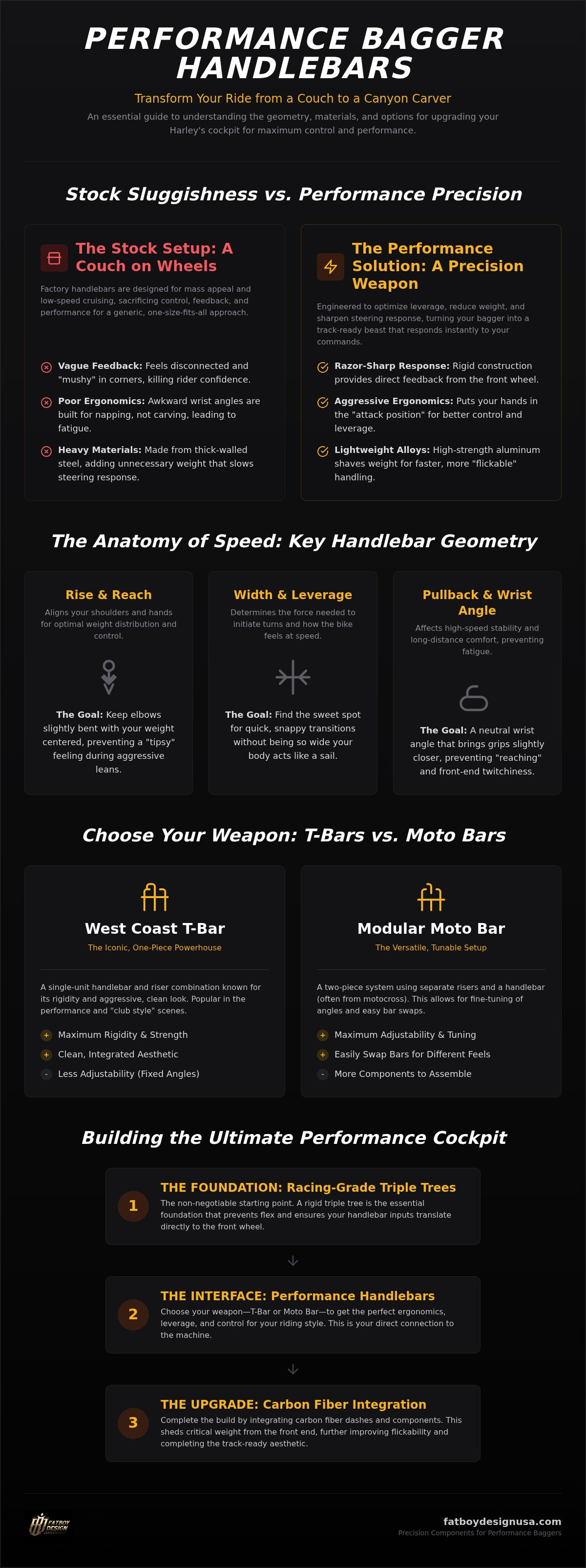
Stop thinking about "handlebars" and start thinking about "control interfaces." A true set of performance bagger handlebars is a weapon. It is specifically engineered to optimize leverage, shave off every gram of unnecessary weight, and sharpen your steering response until it is razor-edged. Traditional mild steel is dead. It is heavy, it flexes, and it is basically the bike equivalent of wet cardboard. Modern racers in 2026 demand high-strength aluminum alloys that stay stiff when you are wrestling 800 pounds of bike through a hairpin. Rigidity is the name of the game. If your bars flex, your confidence fails.
Leverage is king, but don't fall for the "wider is better" trap. Going too wide turns your body into a giant sail, catching wind and upseting the chassis at high speeds. The goal is a width that allows for quick, snappy transitions without leaving you overextended. Pullback also plays a massive role in stability. By bringing the grips slightly closer, you prevent that "reaching" sensation that makes the front end feel twitchy when you are pinned in a straightaway. It is about being tucked in and in total command.
Understanding Rise and Reach
Rise is about more than just looking like a rebel. It is about shoulder-to-grip alignment. If your bars are too high, your center of gravity shifts upward, making the bike feel tipsy and unpredictable during an aggressive lean. You want a height that keeps your elbows slightly bent and your weight centered. Reach is the horizontal distance from the steering axis to the grips, dictating how far you must stretch to maintain control. Finding that sweet spot ensures you aren't fighting the bike's natural geometry. While you are dialing in that perfect height, make sure to check the handlebar height safety regulations to keep your build on the right side of the law.
The Science of Wrist Angle
Wrist fatigue is a race killer. A neutral wrist position is great for long, fast rides where comfort prevents mistakes. However, for the track, you want an aggressive angle that facilitates better "push-pull" steering input. This allows you to manhandle the machine through chicanes with minimal effort. Even those sharp "meat hook" points on modern bars serve a purpose. They aren't just for style; they often provide structural gusseting that prevents bar collapse under extreme torque. If you want to see how these bars integrate with a pro-level setup, take a look at our latest bagger racing parts to build a cockpit that actually works.
T-Bars vs. Moto Bars: Choosing Your Weapon for the Track
Choose your weapon. In the world of performance bagger handlebars, you've got two major camps fighting for dominance: the welded-up T-Bar and the modular Moto Bar setup. This isn't just about which one looks cooler at the gas station. It's about how you want that 800-pound beast to talk back to you when you're deep in a corner. The T-Bar is the classic West Coast choice, born from lane-splitting hooligans and perfected on the track. Moto Bars are the modern, high-tech alternative for riders who want a cockpit that looks like it was ripped straight off a factory racing machine.
Rigidity is the primary divider here. T-Bars are typically one-piece welded units. Welds don't move. They don't slip. When you yank on those bars to stand the bike up, every ounce of energy goes straight into the triple trees. Moto setups rely on a clamped interface between the bars and the risers. While modern clamping tech is incredibly strong, a welded T-Bar will always have the edge in pure, unadulterated stiffness. If you're a Road Glide pilot, T-Bars are almost a rite of passage. They clear the fixed fairing with ease. Street Glide riders often find Moto Bars more accommodating, as the modularity helps keep the dash and gauges visible behind that batwing fairing.
The T-Bar Advantage
T-Bars offer maximum rigidity and a direct steering response that feels like you're hard-wired to the front axle. They provide a simplified, narrow profile that makes the bike feel much smaller than it actually is. This clean look also clears a massive amount of visual space, making it the perfect partner for a high-visibility carbon fiber dash. The only downside? What you see is what you get. There's zero adjustability once they're bolted down, so you better be sure about your height and pullback before you pull the trigger.
The Moto Bar + Riser Combo
If you're a control freak, the Moto Bar and riser combo is your best friend. This is the modular choice for the ultimate "King of Carbon Fiber" build. It offers infinite adjustability for every rider height and reach. You can swap out the bars for different sweeps or pair them with various handlebar risers to dial in the perfect pullback. It's a "Pro-Racer" look that screams high-performance and gives you the freedom to tweak your ergonomics until the bike feels like an extension of your own arms. It’s the ultimate setup for the rider who never stops chasing the perfect fit.
Dialing It In: How to Configure Your Performance Cockpit
Setting up your performance bagger handlebars is a total personal mission. You aren't building a bike for "some guy." You're building it for you. Start by sitting on your bike in your actual riding gear. Close your eyes. Reach out to where your hands naturally want to be. That is your target. Measuring bar height and pullback isn't rocket science. It just requires honesty about how you ride. Don't let your buddies talk you into bars that are too tall just for the look. If you're constantly reaching, you're losing leverage. If you're hunched over, your back will scream before the first fuel stop. Aim for a 90-degree angle at your elbows. This keeps your inputs sharp and your fatigue low.
Cable management is the secret sauce of a pro-level racing cockpit. Nothing says "amateur hour" like a bird's nest of wires flapping in the wind at 100 mph. Route your wires internally whenever possible. It keeps the look clean and prevents snags during aggressive maneuvers. A clean cockpit isn't just about aesthetics. It's about removing distractions so you can focus on the next apex. Once the bars are set, it's time to address the dead weight sitting right in front of you. Amateurs leave it stock. Pros go lighter.
The Foundation: Carbon Fiber and Weight
Weight is the enemy of speed. Most riders ignore the front-end weight penalty of stock steel components. Reducing mass here makes your steering feel telepathic. Swapping out a heavy OEM dash for a precision-engineered carbon fiber unit is a game changer. It changes the entire rotational inertia of your front end. Pair your new bar setup with a performance bagger racer carbon fiber front fender to drop even more unsprung weight. Our FBD Dash upgrades provide that final "King of Carbon Fiber" touch. Your bike will feel lighter because it actually is.
Adding the Steering Damper
High-performance bars give you more leverage. They also make you more sensitive to road feedback. This can lead to the dreaded high-speed wobble if your chassis isn't stabilized. You absolutely need a steering damper kit for any serious bagger build. It acts as a safety net. It soaks up micro-vibrations and keeps the front wheel tracking straight when you're pinned. Installation is straightforward and provides rock-solid stability for track-day adventures. Don't leave your safety to chance. Get the parts that keep you on the track at Fat Boy Design USA today.
The FBD Edge: Why Your Bars Need Racing-Grade Support
Stop putting lipstick on a pig. You can go out and buy the most expensive, most aggressive set of performance bagger handlebars on the market, but if you bolt them to stock triple trees, you are wasting your time. Most riders ignore the foundation. They think the bars do all the heavy lifting. Wrong. Your stock triple trees are the weak link in the chain. They are designed for casual cruising, not for the high-torque demands of aggressive racing. When you pull on those high-leverage bars to dive into a corner, stock trees flex. That flex translates to a vague, disconnected feeling at the grips. It is like trying to steer a boat with a pool noodle. You get the look, but the feedback is still mushy.
You need a setup that can actually handle the physical forces you are putting through the cockpit. A true performance machine requires a structural foundation that stays rigid under pressure. This is about mechanical integrity. It is about making sure every ounce of rider input goes directly to the front tire without getting lost in the "mush" of factory components. If you want that razor-sharp steering response we have been talking about, you have to look deeper than just the bars themselves. You have to look at what is holding them together.
FBD Bagger Racing Triple Trees
This is where the FBD Bagger Racing Triple Tree comes in. It is the missing link in your steering geometry. We have spent over 13 years on the professional racing circuit perfecting this hardware in Matthews, North Carolina. Our trees provide a massive increase in clamping surface area compared to stock units. This means zero flex. When you yank on those performance bagger handlebars to stand the bike up, the front end actually listens. It is engineered specifically for the brutal demands of high-horsepower bagger racing. Check out the full bagger racing parts collection to see how we anchor the front end of the world's fastest baggers.
The Final Word on Performance Cockpits
Don’t settle for "pretty" bars. Build for the win. A true performance machine is a symphony of parts working together in perfect harmony. It starts with the bars, it is anchored by the trees, and it is lightened by the carbon fiber. We are the undisputed King of Carbon Fiber because we understand the synergy of speed. We don't hide behind corporate jargon. We just build parts that work. From the track to the street, we give you the tools to dominate the asphalt. Ready to build your beast? Shop Fat Boy Design USA today. Stop being a passenger. Start being the pilot.
Own the Apex: Stop Cruising and Start Racing
You've done the homework. You know that stock bars are for napping and real performance bagger handlebars are for hunting down every corner with lethal precision. But remember, the bars are just the handshake. To truly transform your ride, you need that rigid foundation of racing triple trees and the surgical weight savings of carbon fiber components. It is the difference between fighting your heavy machine and wearing it like a second skin. Total control isn't just a feeling; it is a mechanical reality you build piece by piece.
We don't just talk about speed; we live it. With over 13 years of professional racing experience and in-house North Carolina fabrication, we build the hardware used by professional bagger racers to dominate the track. Don't settle for a "good enough" setup when you can have a track-dominating cockpit that responds to your every whim. It is time to stop being a passenger on your own Harley. Upgrade your cockpit with FBD Racing Parts! Your beast is waiting for its final form. Get out there and show the asphalt who is actually in charge.
Frequently Asked Questions
Do I need to extend my cables for performance bagger handlebars?
Yes, you'll likely need extensions if you're jumping up from stock. Most 2026 models can handle a small height increase, but anything over 12 inches usually requires a dedicated cable kit. Don't try to stretch your stock lines. It's a recipe for a snapped throttle cable or a locked brake mid-turn. Do it right the first time so you can focus on the ride, not your hardware failing.
Will 14-inch bars fit my Road Glide without hitting the fairing?
You bet they will. Road Glides are the kings of bar swaps because that fairing stays put while you turn. You've got plenty of room to roll 14-inch bars forward for a super aggressive stance. Just do a quick dummy fit to make sure your master cylinders don't smack the inner fairing at full lock. It's the easiest way to get that pro-racer look without any major surgery.
What is the best handlebar height for performance riding?
The magic number usually sits between 10 and 14 inches. You want your hands slightly below your shoulders to maintain maximum leverage. This height ensures your performance bagger handlebars don't turn the bike into a tipsy mess. It keeps your center of gravity low enough for deep leans while giving you enough oomph to flick the bike through a chicane. If your hands are above your head, you're just a sail.
Can I install performance bagger bars myself?
If you've got a decent set of tools and a lot of patience, go for it. Just know that you'll be digging deep into your bike's electrical and hydraulic systems. You'll need to de-pin connectors and bleed your brakes. If the thought of a basket case bike in your garage makes you nervous, take it to a shop. It's better to pay a pro than to fry your expensive wiring or ECM.
Why are T-Bars so popular for performance bagger builds?
T-Bars are the gold standard because they are incredibly rigid. Since they are usually one-piece welded units, they don't have the slip or flex points found in traditional setups. They give you a narrow profile that's perfect for lane splitting and aggressive carving. When you combine that stiffness with a carbon fiber dash, you get a front end that feels solid as a rock. It's the ultimate no-nonsense performance choice.
Do performance handlebars really improve handling?
They absolutely do. It's not just about the look; it's about the physics of leverage. Stock bars are designed for a couch-like experience that feels vague and sluggish. Upgrading to performance bagger handlebars moves you into an attack position. This gives you more control over the front end and makes the bike feel 200 pounds lighter. You'll feel the difference the very first time you dive into a tight corner.
What is the difference between pullback and rise?
Rise is all about how high the grips sit from the triple trees. Pullback is how far those grips reach back toward your seat. Think of rise as your height and pullback as your personal space. For performance, you want enough rise to stay comfortable but enough forward positioning to keep your weight over the front wheel. Too much pullback turns your racing machine back into a lazy cruiser.
Should I use a steering damper with my new handlebar setup?
Yes, and don't even think about skipping it. When you add high-leverage bars, you make the front end more reactive to every pebble on the track. A steering damper is your best friend for killing high-speed wobbles and keeping the bike tracking straight. It's the ultimate safety net for aggressive builds. If you're pushing your bagger to the limit, a damper is the only way to stay shiny-side up.