

Performance Crankshaft for Harley M8: Build a Foundation That Breathes Fire
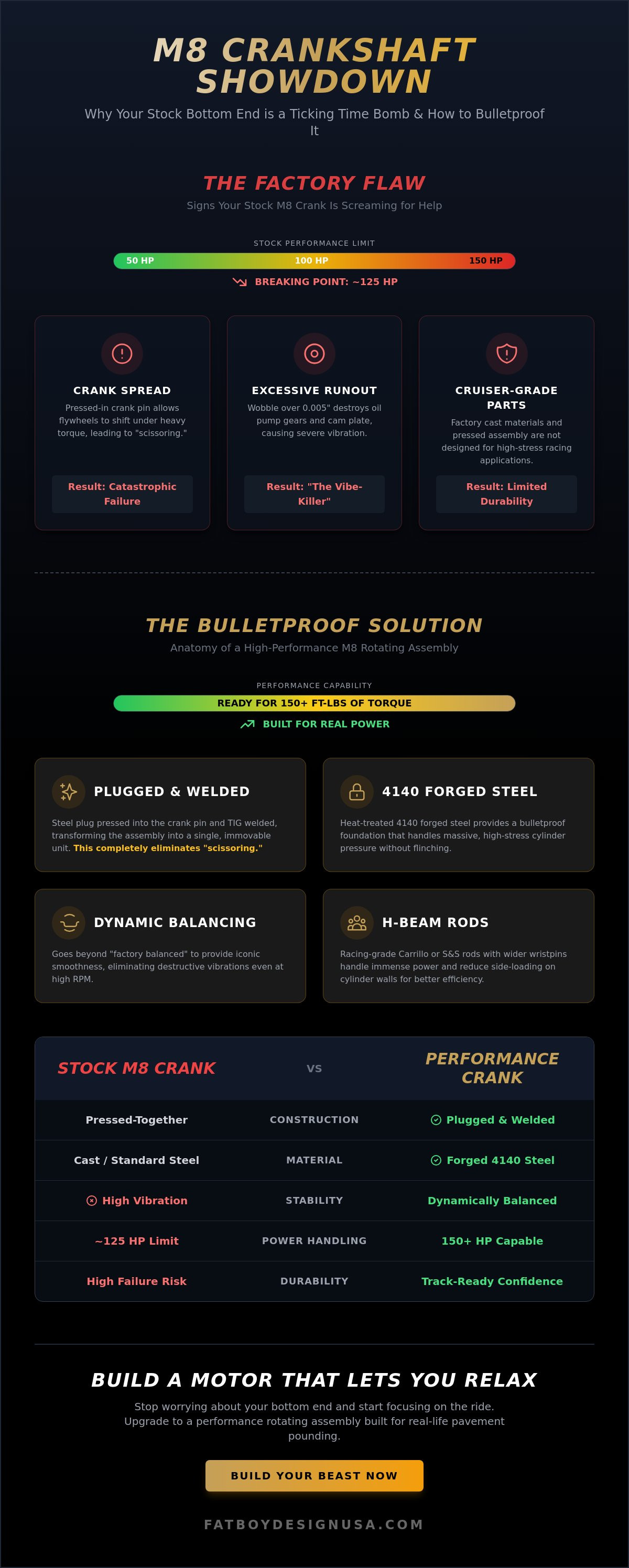
Your stock M8 bottom end is a ticking time bomb once you cross the 125 horsepower mark. Most riders think they're safe until that 4.375-inch stroke decides to scissor at 5,500 RPM, turning your expensive engine into a chunky, vibrating paperweight. Finding the right performance crankshaft for harley m8 is the only way to escape this total vibe killer. You want soul-shaking torque, but the fear of crank spread keeps your right hand from pinning the throttle. It's frustrating to build a beast only to have it shake like a paint mixer at every stoplight.
Stop playing it safe and start playing for keeps. You'll learn how to pick a foundation that stays true and handles 150 foot-pounds of torque without flinching. This guide breaks down the gritty details of forged steel, stroker lengths, and why a precision-balanced unit is the ultimate game-changer for your Bagger racing dreams. Get ready to build an engine that's as iconic as your ride and tough enough for real-life pavement pounding. It's time to build a motor that lets you relax and enjoy the speed.
Key Takeaways
- Stop the "crank spread" nightmare before it turns your engine into a paperweight and learn why factory runout is the ultimate vibe-killer for your oil pump.
- Build a bulletproof bottom end with a performance crankshaft for harley m8 forged from heat-treated 4140 steel for massive, high-stress durability.
- Pick your performance poison by breaking down the 2026 stroke lengths that transform standard displacement into a torque-heavy masterpiece.
- Discover why "factory balanced" isn't enough and how dynamic balancing provides the iconic smoothness your high-performance beast demands.
- Leverage racing-grade fabrication and H-Beam rods to create a showstopper assembly that handles massive power without breaking a sweat.
Why Your Stock M8 Crankshaft is a Ticking Time Bomb
Your Milwaukee-Eight is a beast, but it’s got a dirty little secret hidden deep in the cases. That factory crank? It’s basically a cruiser-grade part trying to do a pro-athlete’s job. Once you start chasing real power, that pressed-together assembly starts to protest. We’re talking about the dreaded crank spread. It’s not just a technical buzzword. It’s the sound of your engine eating itself from the inside out. If you’re building a bike to push 100+ horsepower, a straightened stock unit is just a band-aid on a bullet wound. You need a real performance crankshaft for harley m8 to handle the heat. Stop playing it safe with stock parts. Your bike deserves to be a showstopper, not a shop-dweller.
What is Crank Spread?
Imagine your flywheels as a pair of heavy-duty cymbals. In a perfect world, they stay perfectly parallel. But under heavy torque, the factory Crankshaft design can actually shift. This spread happens because the pin is only pressed in, not welded or keyed. When you’re pinning the throttle on a 900-pound Bagger, that twisting force is massive. Bagger racing puts 40% more stress on the bottom end compared to casual cruising. If those flywheels move even 0.012 inches, your engine is on borrowed time. Check out our bagger racing parts to see how the pros keep things aligned. It’s the ultimate way to ensure your build stays together when the light turns green.
Signs Your Bottom End is Screaming for Help
Your bike talks to you. Listen. If you feel an aggressive, high-frequency vibration through the floorboards at 3,500 RPM, that’s not just character. That’s a cry for help. Watch your oil pressure gauge too. If it’s dancing like a strobe light at a rave, your oil pump might be getting hammered by a wobbly crank. Runout is the silent killer of M8 engines, defined as the amount of wobble or deviation from a perfectly centered rotation. When runout exceeds 0.005 inches, it starts chewing through your oil pump gears and cam plate. It’s messy. It’s expensive. And it’s totally avoidable with the right performance crankshaft for harley m8. Don't wait for a catastrophic failure to upgrade your vibe. Grab the good stuff and ride hard.
Anatomy of a High-Performance M8 Rotating Assembly
Forget the factory cast junk. If you want a performance crankshaft for harley m8 that doesn't fold like a lawn chair, you need 4140 heat-treated steel. This isn't just a fancy number. It's a forged promise of durability. This material handles the explosive pressure of a high-compression build without breaking a sweat. Understanding how an internal combustion engine works helps you realize that every stroke is a mini-explosion. You need a backbone that actually likes the heat. A solid foundation lets you chill out while your bike screams with 150 lb-ft of torque. It turns a nervous ride into a confident blast down the highway.
The Role of Connecting Rods
Rods are the muscle of your bottom end. Carrillo and S&S are the heavyweights in this arena. Carrillo typically brings that iconic H-Beam profile. It's perfect for resisting the bending forces found in long-stroke M8 engines. S&S offers beefy I-Beam options that thrive in high-RPM chaos. Pay attention to your wristpin width. If you're running big bore pistons, a wider wristpin, like the 0.927 inch standard, distributes the load much better than stock components. Rod length is the secret sauce for your torque curve. Longer rods reduce side-loading on cylinder walls. This keeps your engine running cooler and more efficiently during those aggressive sprints. It's about making big power without the internal friction drama.
Welding and Pro-Plugging Explained
Stock cranks are merely pressed together. That's fine for a grocery getter. For a performance crankshaft for harley m8, it's a disaster waiting to happen. "Scissoring" occurs when the crank halves shift under load, leading to catastrophic engine failure. We fix this by plugging and welding. The process involves pressing a solid steel plug into the crank pin and TIG welding the joint. This transforms the assembly into a single, immovable unit. It's non-negotiable for track builds or anyone who likes to dump the clutch at every green light. At Fatboy Design, we think "over-engineered" is just another word for "done right." We don't do subtle; we do indestructible.
Building a high-stress engine requires parts that can keep up with your ambition. If you're ready to stop worrying about your bottom end and start focusing on the win, check out our latest bagger racing parts to complete your transformation. Don't let a weak crank ruin your vibe.
Stroker vs. Standard: Picking Your Performance Poison
Don't settle for a lazy engine. Choosing a performance crankshaft for harley m8 is about deciding how much torque you want to rip through the rear tire. It's a choice between a snappy street machine and a long-stroke monster. In 2026, the engineering has peaked. You have three main paths to glory. The 4.375-inch standard is your baseline. The 4.500-inch is the heavy hitter. The 4.625-inch is the absolute legend. Each one changes the vibe of your ride completely.
- 4.375-inch: The original factory length, perfect for high-revving 117ci or 124ci builds that love the redline.
- 4.500-inch: The sweet spot for 128ci and 131ci kits that dominate the street with massive roll-on power.
- 4.625-inch: The extreme choice for 135ci to 143ci monsters that live on the drag strip or the track.
Increasing your stroke transforms the bike. It's not just about displacement numbers; it's about how that power feels at the stoplight. A longer stroke adds mechanical leverage. That leverage turns into immediate, chunky torque that pulls like a freight train. But watch out for the trade-offs. Longer strokes mean higher piston speeds. At 6,000 RPM, a 4.625-inch stroke moves the piston 5.7 percent faster than a 4.375-inch setup. This creates more heat and side-loading stress. It's a trade-off between ultimate output and 100,000-mile longevity. Match your stroke to your lifestyle. A street brawler needs the 4.500-inch balance, while a dedicated racer demands the 4.625-inch edge.
The 4.500-inch Sweet Spot
The 4.500-inch stroke is the undisputed champion of the 2026 scene. It's the heart of most 128ci and 131ci builds. This setup offers a massive jump in power without turning your daily rider into a high-maintenance diva. It balances reliability with show-stopping performance. Best of all, it works perfectly with standard M8 cases and oiling systems. You get that iconic big-inch feel without the headache of total engine reconstruction. It's the ultimate upgrade for riders who want to chill out on the highway but still embarrass people at the lights.
Extreme Strokers for Bagger Racing
When "enough" isn't in your vocabulary, go big. The 4.625-inch stroke is the go-to for dedicated bagger racing. It pushes the performance crankshaft for harley m8 platform to its absolute limit. You'll need to machine the cases to fit this oversized rotating assembly. It's a serious commitment for serious riders who want a game-changer on the track. If you're building a track-ready beast, Check out our Bagger Racing Parts for your next build. This is where you find the gear that handles the stress of extreme stroker builds and high-speed vibration.
The Secret Sauce: Dynamic Balancing for Maximum Flow
Factory balancing is a "one size fits most" solution. It works for the masses, but you aren't the masses. When you install a high-lift cam and big-bore cylinders, that stock balance job starts to sweat. A performance crankshaft for harley m8 requires more than just "good enough" specs. It needs the ultimate precision of dynamic balancing to survive the high-stress environment of a performance build. While static balancing just looks at the weight of the parts while they're sitting still, dynamic balancing measures the forces at play while the assembly is spinning at 6,000 RPM or higher.
Think of it like this: a washing machine is fine until you throw a heavy rug in one side. Suddenly, the whole house is shaking. In your M8 engine, that vibration is parasitic power loss. Every ounce of energy spent shaking your mirrors is energy that isn't reaching the rear tire. Electronic balancing takes it a step further by using sensors to pinpoint heavy spots, but dynamic balancing is the true showstopper. It creates a rotational harmony that allows the engine to rev faster and smoother. It's a total game-changer for riders who want that "glass-smooth" feel even when they're pinning the throttle on the interstate.
- Static Balancing: Basic weight matching of components.
- Electronic Balancing: Uses digital sensors for higher accuracy than manual scales.
- Dynamic Balancing: The gold standard; balances the assembly while in motion to eliminate rotational whip.
Piston Weights and Precision
Your builder isn't just being nosy when they ask for your exact piston weights. They're trying to save your engine from a very expensive funeral. A performance crankshaft for harley m8 is a finely tuned instrument. If your new pistons are even 3 grams heavier than the ones the crank was balanced for, you're inviting a vibration party that ends in catastrophic bearing failure. At Fat Boy Design, we believe precision is the ultimate vibe. We don't do "close enough." We do "spot on." Mismatched weights create uneven loading on the rod bearings, which leads to heat, friction, and eventually, a very chunky sound coming from your primary. Get your weights right, or don't start the build.
Counterbalancer Gear: To Delete or Not?
This is where the rebellious builds separate themselves from the pack. Removing the M8 counterbalancer is a classic racing move that sheds about 4.5 pounds of rotating mass. That is a massive reduction. It allows the engine to snap to redline with zero hesitation. However, there is a trade-off. Without that gear, the "M" in M8 stands for "Major Shaking" at idle. It's a choice between raw, unadulterated speed and long-distance rider comfort. If you are building a dedicated track beast for the Bagger Racing League, ditch it. If you plan on riding 500 miles a day, keep it. You can see how these choices impact the scene in this guide on how performance baggers are evolving in 2026.
Ready to turn your ride into an iconic showstopper? Grab the gear the pros use and explore our high-performance bagger racing parts today.
Build Your Beast with Fat Boy Design USA
Stop playing small. The road is full of stock bikes that look, sound, and perform exactly the same. It is boring. At Fat Boy Design USA, we live for the loud, the fast, and the unapologetically bold. Our racing heritage isn't just a marketing slogan. It is the reason our parts don't fail when you're pinning the throttle. Every performance crankshaft for harley m8 we touch gets the same obsessive attention to detail as our championship-winning track bikes. For enthusiasts who also want to unlock the full potential of their American performance vehicles, N2 Speed offers specialized custom calibration and tuning. We've moved beyond the pretension of high-end shops to focus on one thing: pure, unadulterated speed.
Our headquarters in Matthews, NC, serves as the ultimate playground for custom performance fabrication. We aren't just assembly monkeys. We're creators. From bulletproof bottom ends to carbon fiber weight savings, we build the foundation your M8 needs to breathe fire. Don't settle for "good enough" from a generic catalog. Join the club of showstoppers who know that 100% American-made quality is the only way to ride. We've spent 15 years pushing limits on the track so you don't have to guess on the street. It's time to build a bike that actually matches your ambition.
Complete Performance Solutions
Balance is everything in a high-output build. You can't just throw a heavy-duty crank in a boat anchor and expect it to dance. You need to integrate your new engine guts with High-Performance Carbon Fiber Parts to shed the dead weight. When you pair a balanced, blueprinted engine with a chassis that's 20% lighter than stock, the physics change instantly. Your M8 stops being a cruiser and starts being a weapon. Our custom fabrication services allow us to tailor every bespoke racing project to your specific goals. Whether you're chasing trophies or just want to humble the guy in the next lane, we've got the hardware to make it happen. Our performance crankshaft for harley m8 options are designed to handle 150+ horsepower without breaking a sweat, ensuring your bottom end stays together while the rest of the bike flies.
Next Steps for Your M8 Build
Don't wing it. Your engine architecture deserves a professional eye and a steady hand. Consult with our team to map out your build from the flywheels up. We'll look at your displacement, your riding style, and your power goals to ensure every component works in harmony. Custom-built crankshaft assemblies typically have a 4 to 6 week lead time because perfection can't be rushed. We're ready to help you build the iconic, chunky, oversized beast that everyone else will stare at. It's time to stop dreaming and start wrenching. Get the racer-tested parts you need at Fat Boy Design USA and start your transformation today. Your M8 is waiting to be unleashed.
Stop Settling for a Ticking Time Bomb
Your stock motor is begging for mercy, so give it the backbone it deserves. A high-quality performance crankshaft for harley m8 isn't just an upgrade; it's the absolute game-changer your bike needs to survive the streets. We've proven our mettle with 13+ years of professional racing experience, perfecting the art of dynamic balancing and custom fabrication. Every piece we craft in our Matthews, North Carolina shop is built to handle the heat of the track. We don't do boring, and we definitely don't do weak. It's time to ditch the mundane stock parts and embrace a build that actually breathes fire. You've seen how dynamic balancing and the right rotating assembly change the entire vibe of your ride. Your bike should be a chunky, oversized beast, not a liability. Let's get that Bagger ready to dominate the asphalt and turn every head on the street. Grab the parts that the pros actually use and feel the difference of real American craftsmanship. It's time to stop taking life so seriously and start taking your horsepower personally.
Upgrade Your Ride with Racer-Tested Parts at Fat Boy Design USA
Go ahead, twist that throttle and let the world hear you coming.
Frequently Asked Questions
What is the maximum runout allowed on a Harley M8 crankshaft?
The official Harley service wear limit is 0.012 inches, but that is a recipe for a trashed oil pump. High-performance builds require a runout of 0.002 inches or less to keep everything spinning smooth and reliable. If your measurements hit the 0.005-inch mark, you are already flirting with a catastrophic engine failure. Keep it tight to avoid the crank walk that kills big-bore dreams.
Do I really need to weld my M8 crankshaft for a Stage 2 build?
You don't absolutely need to weld your crank for a basic Stage 2 setup that stays under 120 foot-pounds of torque. However, a welded crank is the ultimate insurance policy once you start chasing real heat on the pavement. For a performance crankshaft for harley m8, welding ensures your flywheels stay pinned at 180 degrees. It's a game-changer for riders who love aggressive downshifts and heavy-handed launches.
What is the difference between an H-beam and an I-beam connecting rod?
H-beam rods are the chunky choice for massive torque and heavy-duty abuse, while I-beam rods focus on being lightweight and stiff for high-RPM stability. Most M8 monsters thrive on H-beams because they handle the 400-plus gram weight of oversized pistons without breaking a sweat. If you want a high-revving showstopper, I-beams might be your vibe. For pure grunt, the H-beam is the undisputed king of the streets.
How much horsepower can a stock M8 crankshaft actually handle?
A stock M8 crankshaft typically handles up to 125 horsepower before the risk of scissoring becomes a serious threat to your cases. Once you push past the 140-horsepower barrier, the factory press-fit design starts to feel the pressure. Upgrading to a performance crankshaft for harley m8 gives you the freedom to chase 150-plus figures. Don't let your bottom end turn into a pile of scrap metal because of factory limitations.
Will a stroker crankshaft require me to machine my engine cases?
Most stroker crankshafts with a throw longer than 4.5 inches require you to machine the engine cases for proper internal clearance. You must carve out enough space so the connecting rods don't smash into the inner case walls during their rotation. It is a precision job that moves your build from a simple bolt-on project to a professional-grade powerhouse. Skipping this step means your first start will be your last.
How does crankshaft weight affect the performance of a Bagger?
Heavier crankshafts provide more rotating inertia, which makes a 900-pound Bagger feel smoother and more stable at highway cruising speeds. A lighter crank lets the engine rev with lightning speed, but it can make low-speed crawling feel twitchy and nervous. Choosing a balanced, heavy-duty crank ensures your long-distance rides stay chill. You still get that iconic Harley punch every time you twist the throttle for a pass.
Can I use my stock pistons with a performance stroker crank?
You cannot use stock pistons with a performance stroker crank because the increased stroke changes exactly where the piston sits at the top of the cylinder. A stroker setup requires custom pistons with a shorter compression height to prevent them from hitting the heads. Most kits use a 1.050-inch or 1.100-inch pin height to accommodate the extra travel. Always match your slugs to your stroke for a perfect, fire-breathing fit.
Why is dynamic balancing so much better than the factory setup?
Dynamic balancing is superior because it accounts for the specific weight of your individual rods and pistons rather than using a generic factory average. While the factory allows a balance factor variance of up to 50 grams, a custom dynamic balance narrows that down to within 0.5 grams. This eliminates 95% of the high-frequency vibrations that numb your hands. It saves your internal bearings from premature wear during high-speed runs.