

The Best Suspension Setup for Performance Baggers: A Racer’s Guide to Handling
Stop treating your Harley like a motorized recliner. Your 800-pound machine was built for more than just straight lines and highway naps. If you’ve ever felt the "Bagger Wobble" hit at 90 mph or cringed as your floorboards scraped on a basic exit ramp, you know the factory settings aren't cutting it. Dialing in the best suspension setup for performance bagger builds is the ultimate game-changer for riders who crave speed. Since the King of the Baggers series took off in 2020, we’ve learned that heavy bikes can actually handle like sportbikes if you give them the right bones.
You want that chunky beast to feel light, flickable, and bold. We agree that bottoming out on a performance ride is a total buzzkill that ruins the vibe. This guide will show you how to master geometry and weight distribution to transform your ride into a corner-carving showstopper. We’re breaking down everything from high-performance fork cartridges to the specific rear shock heights that give you that iconic, aggressive stance. Get ready to stop taking life so seriously and start taking corners like a pro.
Key Takeaways
- Stop settling for the soft "Touring Trap" and learn how high-clearance geometry turns your heavy cruiser into a corner-carving beast.
- Discover why inverted forks and high-flow cartridges are non-negotiable for the best suspension setup for performance bagger builds that crave high-speed stability.
- Master the "plus-one" rule for rear shocks to maximize your lean angle and keep your ride planted with remote reservoir heat dissipation.
- Uncover the unsprung weight secret to make your front end react faster and ditch the sluggish feel of heavy factory components.
- Follow the FBD-spec roadmap to phase in the ultimate control upgrades, from performance triple trees to precision steering dampers.
Why Stock Suspension Fails the Performance Bagger
Your stock bagger is a couch. It's built for a lazy 65 mph cruise to the nearest diner, not for dragging floorboards through a mountain switchback. Factory setups fall headfirst into the Touring Trap. Manufacturers prioritize a squishy, cloud-like ride that feels great on a straight highway but turns into a wet noodle the second you see a curve. When you're pushing 800 lbs of steel, that lack of composure isn't just annoying; it's a performance killer. To build the best suspension setup for performance bagger builds, you have to reject the "soft is better" lie.
A true performance suspension is a high-clearance, rigid-tracking system. It's designed to keep your tires glued to the asphalt while providing enough ground clearance to actually lean the bike. Stock setups use cheap components that heat up and fade within 20 minutes of hard riding. You need a setup that handles the 15% increase in cornering forces found in modern bagger racing. This starts with understanding how motorcycle suspension systems manage weight transfer and chassis flex.
The infamous "Death Wobble" is the ultimate stock-suspension nightmare. It happens because the factory frame and swingarm aren't braced for high-speed stability. When you hit a mid-corner bump, the rubber-mounted engine and thin swingarm start a tug-of-war that creates a terrifying oscillation. You can't tune that out with a "comfort" shock. You need high-end bagger racing parts that turn that heavy frame into a responsive, predictable machine. We're talking about total control, not just surviving the ride.
The Lean Angle Problem
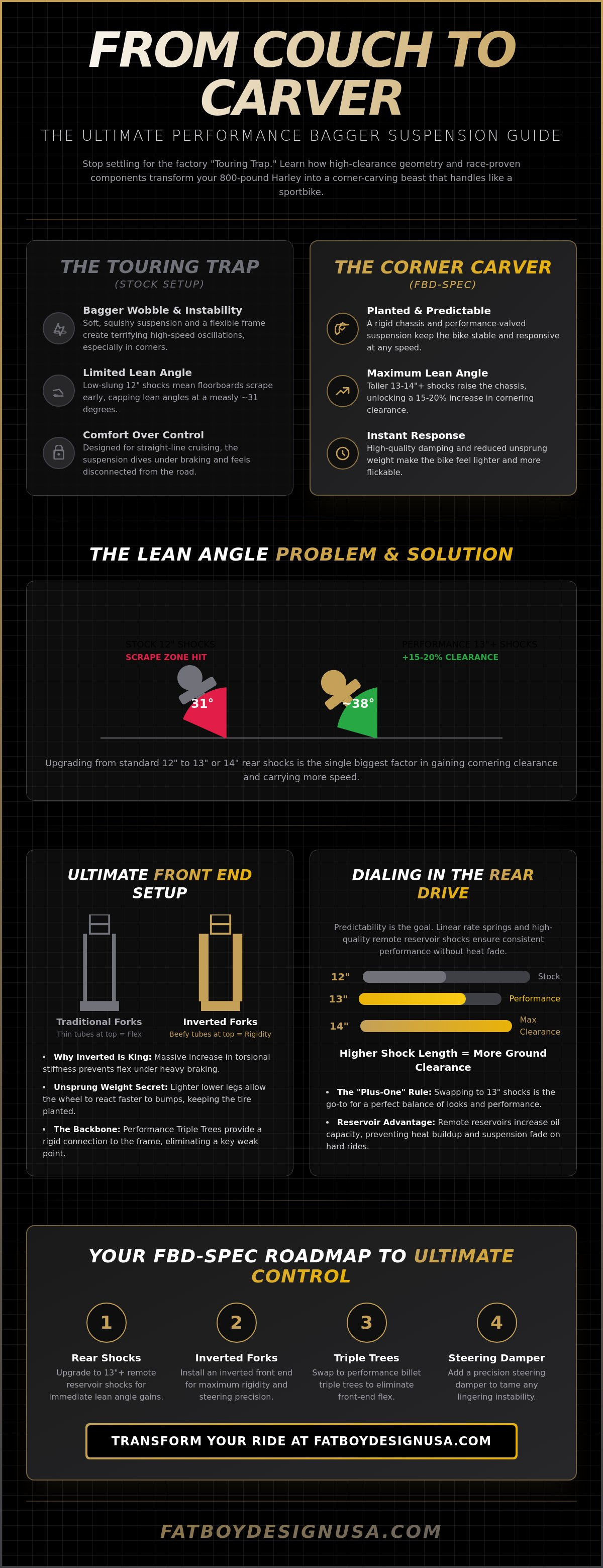
Standard 12-inch shocks are the enemy. They keep the bike low for a 26-inch seat height, but they kill your cornering. Most stock touring bikes tap out at a measly 31 degrees of lean. Swap those for 13-inch or 14-inch rear shocks and you instantly move the pivot point higher. This creates a 15% to 20% increase in usable lean angle. It moves your floorboards out of the "Scrape Zone" and lets you carry real speed through the apex without throwing sparks like a Fourth of July finale.
Stability vs. Comfort: The Trade-off Myth
Don't believe the myth that a performance bike has to ride like a jackhammer. Stiff doesn't mean harsh. High-quality valving allows the shock to move quickly over small bumps while staying firm during heavy braking. It's all about sag and preload. Racers choose linear springs over progressive ones because they offer 100% predictability. You know exactly how the bike will react every single time you tip it in. It’s about a planted feel that gives you the confidence to twist the throttle sooner.
Anatomy of the Ultimate Front-End Setup
Stop settling for that soggy, 1970s front-end feel. If you want the best suspension setup for performance bagger builds, you start with rigidity. Your front end is the handshake between you and the asphalt. If that handshake is weak, your confidence will be too. We're talking about transforming an 800-pound beast into a laser-guided missile. It requires a mix of brute strength and surgical precision. You don't just want it to look fast; you want it to handle like it's on rails when you're carving through a canyon or pushing the limits on a closed course.
The move to inverted forks is the biggest power play you can make. Why? Because rigidity is king. Traditional forks put the thin part of the tube at the top where the stress is highest. That's a recipe for flex. By flipping the script, you put the beefy, oversized outer tubes into the triple trees. This creates a massive increase in torsional stiffness. It means when you grab a handful of front brake, the bike stays composed instead of diving and twisting like a wet noodle. It’s a total game-changer for riders who actually use their machines.
Inverted Forks vs. Traditional Tubes
Inverted forks aren't just for show, though they do nail that "King of the Baggers" race aesthetic perfectly. The technical breakdown is simple. Putting the heavy part of the fork at the top reduces unsprung weight. This allows the front wheel to react faster to bumps. You get better oil flow and more precise damping control because the cartridges inside are typically larger and more sophisticated. This is how motorcycle suspension explained by industry experts translates to real-world traction. You'll feel the difference in the first corner. The front tire stays glued to the ground, giving you the grip you need to lean deeper and go faster.
The Role of High-Performance Triple Trees
Your triple trees are the literal backbone of your steering. Stock cast-aluminum trees are built for a budget, not for a podium. They flex under heavy loads, which blurs the feedback coming through the bars. To get the best suspension setup for performance bagger results, you need CNC-machined 6061-T6 aluminum. This material is incredibly strong and lightweight. It provides a direct line of communication between the road and your hands. You can feel every pebble and every bit of traction. Check out our Bagger Racing Triple Trees to see how we over-engineer the flex right out of the equation for maximum stability.
- Rigidity: Zero flex under hard braking from 100+ mph.
- Precision: Tighter tolerances for better bearing alignment.
- Feedback: Feel exactly what your front tire is doing at all times.
- Style: That chunky, high-end look that screams performance.
Don't forget the steering damper. It's the non-negotiable insurance policy against high-speed tank-slappers. When you're pushing a heavy bagger to its limits, things can get spicy. A high-quality damper keeps the front end calm when the road gets rough. If you're ready to stop playing it safe, take a look at our Performance Steering Damper Kit to keep your ride steady and your vibes high.
Rear Suspension: Dialing in the Drive
Stop treating your rear end like an afterthought. Your shocks are the backbone of your ride. They handle the weight, the torque, and every aggressive lean you throw at the pavement. If you want the best suspension setup for performance bagger dominance, you need parts that work as hard as you play. Standard shocks quit when the going gets hot. You need hardware that stays cool under pressure and keeps your tire glued to the asphalt.
Remote Reservoir Shocks: Performance Benefits
Those gold canisters hanging off your frame aren't just for show. They are functional masterpieces. External reservoirs increase oil volume significantly. More oil means better heat dissipation. When you are carving through mountain passes for 45 minutes straight, standard shocks turn into pogo sticks because the oil thins out. Remote reservoirs keep the damping consistent. Look for independent compression and rebound clickers to fine-tune your experience. Brands like Öhlins, Legend, and Fox Racing are the gold standard here. They allow you to tune the vibe of your ride for every road surface. Hard for the track, plush for the cruise. It is a total game-changer for your comfort and control.
Don't settle for stock length. The +1 Factor is the secret to unlocking your bike's potential. Standard bagger shocks often sit at 12 inches. That is fine for looking cool at a stoplight, but it kills your lean angle. Upgrade to 13-inch or even 14-inch shocks. That extra inch provides the ground clearance you need to keep your floorboards from scraping at a 35-degree lean. It is the simplest way to transform a heavy cruiser into a corner-carving beast without sacrificing your spine.
The Swingarm and Engine Mount Connection
Your rear wheel needs to track straight to keep you safe. Most touring bikes suffer from the dreaded bagger hinge effect. This is that terrifying side-to-side wiggle when you are mid-corner at 75 mph. It happens because the factory rubber mounts and thin swingarm pivots allow too much flex under load. You cannot have the best suspension setup for performance bagger glory if your chassis is doing the hula while you are trying to apex.
Eliminating this wiggle requires a rigid connection. Upgrading to high-performance bushings or a beefier aluminum swingarm eliminates that flex instantly. Every ounce of power then goes directly to the pavement. Check out our Bagger Racing Parts to find the gear that stiffens your chassis and keeps your bike planted. A rigid rear end means no wiggle and no drama. Just pure, iconic speed and the confidence to push your limits on every exit.
The Unsprung Secret: Weight vs. Suspension
Stop obsessing over just the springs for a second. Look lower. Everything hanging off the bottom of your suspension is your unsprung weight. This includes your wheels, tires, brakes, and that chunky factory fender. If these parts are heavy, your suspension spends all its energy just trying to move the hardware instead of absorbing the road. It's a total vibe killer. A heavy front fender slows down your fork’s reaction time by several milliseconds. That feels like an eternity when you're diving into a sharp corner. You want a setup that's snappy, not sluggish. Reducing this mass is the ultimate game-changer for any serious rider.
Carbon Fiber as a Performance Tool
Physics doesn't lie. Lighter components move faster. When you reduce the mass of your front end, you let your suspension breathe. This is why the Bagger Racing Carbon Fender is a suspension upgrade in disguise. By swapping out heavy steel for high-grade carbon, you're cutting weight by over 50% in a critical area. Unsprung weight is the mass of everything not supported by your springs, and reducing it is the fastest way to keep your tire contact patch glued to the asphalt. This mass reduction allows your forks to track the ground with iconic precision. It turns a jittery ride into a smooth, controlled showstopper.
Focusing on these specific components will yield the best results:
- Forged aluminum or carbon wheels to slash rotational mass
- High-performance lightweight brake rotors
- Carbon fiber fenders to reduce front-end pendulum effects
- Titanium hardware for those marginal gains
Balancing the Build
Throwing expensive shocks at a bloated bike only solves half the problem. You can't expect a 900-lb touring rig to handle like a racer if it's still carrying unnecessary baggage. There's a vital synergy between Harley Performance Parts and your internal tuning. When you combine high-end valving with lighter wheels, you slash the energy required to change direction. This makes the bike feel light on its feet and ready to party. The best suspension setup for performance bagger enthusiasts always accounts for this balance. It’s about making sure your hardware isn't fighting your software. Get the weight down and let those shocks do what they were born to do.
Building Your FBD-Spec Performance Setup
Stop settling for a bike that handles like a wet sponge. Building the best suspension setup for performance bagger dominance happens in four distinct stages. This isn't just a list of parts. It's your ticket to the front of the pack. Reject the mundane and embrace a ride that actually listens to your inputs. Grab a wrench and get to work.
Phase 1 starts with the foundation. Swap those lazy stock rear shocks for high-performance units, ideally 13-inch or 14-inch setups for better lean angle. Pair them with high-flow fork cartridges to handle the 800-pound weight of a loaded touring bike. This combination keeps your tires planted when you're carving through the canyons. It turns a wallowing couch into a precision instrument.
Phase 2 focuses on control. Flex is for yoga, not your front end. Performance triple trees provide the rigidity you need to eliminate the dreaded bagger wobble. These components stop the front-end flex that makes fast sweepers feel like a boat ride. This stage is about making sure the bike goes exactly where you point it without the chassis complaining.
Phase 3 is the diet. Weight is the enemy of speed and agility. Carbon fiber fenders and lightweight bodywork reduce unsprung weight. This allows your suspension to react 25% faster because it isn't fighting the massive inertia of heavy steel components. It's a showstopper move that provides real-world performance gains on every corner entry.
Phase 4 is the tune. Even the most expensive parts won't save a bad setup. Set your sag to roughly 25% or 30% of your total travel. Adjust your compression and rebound clickers to match your specific body weight. If you skip this step, you're just riding an expensive pogo stick.
The "Must-Have" Shopping List
- Grab the Harley Touring Performance Steering Damper Kit for high-speed confidence. It's a total game-changer for stability.
- Select the right fork spring rate. If you're a 230-pound rider, don't try to use springs designed for a 160-pounder. Match the rate to your actual weight.
- The Performance Bagger Racer Carbon Fiber Front Fender is the final touch for front-end perfection. It looks iconic and sheds significant weight from the front axle.
Final Setup and Testing
Don't just bolt everything on and go full throttle. Perform a bounce test. Push down hard on the seat and let it go. The bike should rise and settle in one smooth motion without extra oscillations. If it bounces twice, you need more rebound damping. Check your rear wheel alignment after any major overhaul. Even a 2-millimeter error can cause a weird pull at high speeds. Ready to build a beast? Shop Fat Boy Design Bagger Racing Parts and join the club.
Stop Fighting Your Bike and Start Owning the Asphalt
Your factory setup was built for a casual Sunday stroll, not for carving corners. Real performance starts with a front end that refuses to dive and a rear drive that stays glued to the pavement. Dialing in the best suspension setup for performance bagger builds means cutting the dead weight and trusting components that have actually survived the track. We've spent over 13 years refining our professional racing expertise to ensure your ride feels like a total showstopper. We are The Original rebels of the road, and we're here to help you ditch the mundane once and for all.
We don't do mediocre. Every piece of hardware is racer-tested in North Carolina and produced through in-house manufacturing to maintain absolute quality control. It's about getting that iconic, chunky feel without the sketchy wobbles. You deserve a bike that's as bold as your riding style. Stop settling for a mushy ride and give your machine the upgrade it's been begging for. It's time to vibe with a setup that actually performs under pressure.
Maintaining performance isn't just for motorcycles; your high-end vehicles deserve the same level of precision. For those who value expert care for their European cars, Euro Performance Auto Shop LLC offers specialized services to ensure every machine in your garage is ready for the road.
Upgrade Your Ride with Racer-Tested Bagger Parts
Get out there and show the road who's boss.
Frequently Asked Questions
What is the best suspension height for a performance bagger?
Go tall or go home. Most pros run 13 inch or 14 inch rear shocks to get the ground clearance they need. Standard Harley shocks are usually 12 inches, so adding that extra inch or two gives you a 30 percent better lean angle. It's a total game changer for carving corners. This height is the foundation for the best suspension setup for performance bagger builds that actually see track time.
Do I really need a steering damper on my Road Glide or Street Glide?
You absolutely need one if you plan on pushing your bike past the speed limit. High speed wobbles are a total buzzkill. A Kraus or Ohlins damper stabilizes the front end when you hit 90 mph. It acts like a safety net for your handlebars. Stop the shake and keep the vibe smooth. It's an iconic upgrade for anyone chasing high speed stability.
How much does a full performance bagger suspension setup cost?
A complete high end setup generally runs between $1,800 and $5,000 according to current aftermarket retail catalogs. This range covers front cartridges and rear reservoir shocks. If you decide to go for a full inverted front end, the price can climb higher. It's a solid investment for a bike that handles like a dream. No more pogo sticking on the highway for you.
Can I install inverted forks on a stock Harley frame?
Yes, you can bolt them right on with a conversion kit. You'll need a new triple tree set from a brand like Alloy Art or Kraus. These kits allow 55mm forks to fit stock 1997 to 2024 Harley touring frames. It's a chunky, iconic look that delivers massive rigidity. Your front end will feel like it's on rails after this swap.
What is the difference between sag, preload, and damping?
Preload is the tension you put on the spring, sag is how much the bike squishes when you sit on it, and damping is the oil control. Think of sag as your baseline. Race Tech recommends setting your sag at 25 percent of total travel. Damping keeps the bike from bouncing like a basketball. Get these right to dial in the best suspension setup for performance bagger riding.
Will a carbon fiber fender actually make my suspension feel better?
It definitely helps. Reducing unsprung weight makes your suspension react faster to every bump in the road. A Hofmann Designs carbon fender weighs only 1.2 pounds. Compare that to the 5.8 pound stock steel unit. That 4.6 pound difference lets your forks breathe. It's a lightweight showstopper that improves your front end feel immediately.
Why does my bagger wobble at 80 mph and how do I fix it?
Your bagger wobbles because the engine and swingarm are rubber mounted and can move independently. This often happens at 80 mph or higher when the chassis gets stressed. Check your swingarm bushings and motor mounts first. Installing a stabilizer link from a company like True Track can reduce lateral movement by 90 percent. Fix the wiggle and enjoy the ride.
Is Legend or Öhlins better for a performance bagger build?
Legend is perfect for the "set it and forget it" crowd while Öhlins is for the tuning nerds. Legend Revo A shocks offer easy 7 position clickers for quick adjustments. Öhlins HD 044 shocks give you professional grade compression and rebound control. Both are iconic choices. Choose Legend for simple comfort or Öhlins for ultimate racetrack precision.