

The Dangers of Poor Quality Motorcycle Components: Don't Gamble with Your Life
That "bargain" carbon fiber dash you found on a sketchy auction site isn't a steal. It's a structural liability waiting to shatter the moment you hit eighty on the open road. You want your Harley to look mean and move fast without draining your entire life savings. We totally get that. Nobody likes overpaying for a fancy logo when a knock-off looks "good enough" in the driveway. But the dangers of poor quality motorcycle components go way beyond a rattling side cover or a mismatched paint job. In a year where 2026 has already seen massive recalls for engine seizures and oil ejection, the margin for error on your machine is razor thin.
Wasting cash on "trash" parts is annoying, but watching your bike sit in the shop during prime riding season is a total heartbreak. Discover why "cheap" parts are a literal death sentence for your performance bagger and how to spot the high-performance gear that actually keeps you upright. We're showing you how to achieve total confidence in your bike's structural integrity. It's time to build a ride that looks as fast as it actually is while ensuring every turn is smooth, safe, and unapologetically bold.
Key Takeaways
- Stop falling for "eBay Specials" and learn how to identify aesthetic clones that look fast but fail hard when the throttle opens.
- Unmask the dangers of poor quality motorcycle components by seeing the science behind why cheap resins and plastic wraps are a recipe for high-speed disaster.
- Upgrade your ride's soul with racing-grade triple trees and swingarms designed to handle massive power without the terrifying "death wobble."
- Use our pro-level "BS Detector" to sniff out trash parts using simple finish and weight checks that reveal what's really under the hood.
- Join the club of riders who prioritize structural integrity with gear that's been broken, tested, and perfected in Matthews, NC.
The High Cost of 'Cheap': Why Bargain Parts Are Your Bike's Worst Enemy
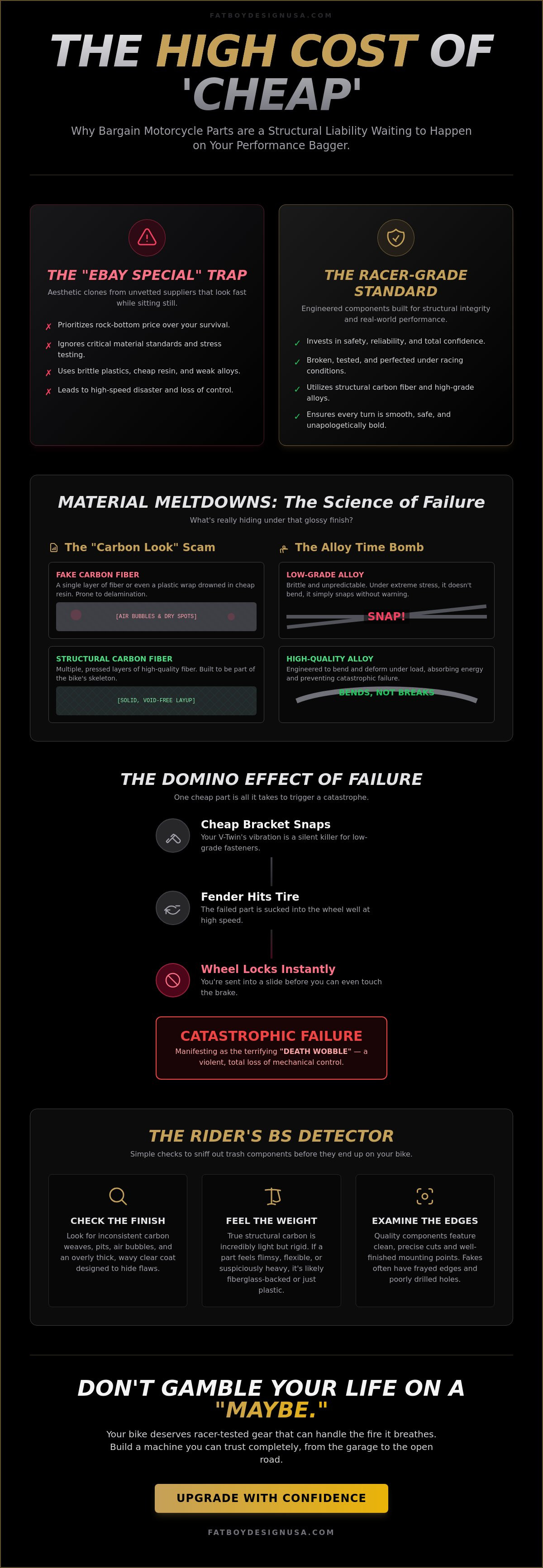
Let's be real for a second. We all love a good deal. But when you’re screaming down the asphalt at eighty miles per hour, that thirty-dollar "carbon" dash you found on a late-night auction site starts to look a lot less like a bargain. Poor quality components are parts that prioritize a rock-bottom price over your actual survival. They ignore structural integrity. They laugh at material standards. They are essentially aesthetic clones designed to look fast while sitting still. The dangers of poor quality motorcycle components aren't just about a part looking "off" or fitting poorly. It’s about the fact that these items are built by unvetted global suppliers who wouldn't know a stress test if it hit them in the face.
In 2026, the risk is higher than ever. With the rise of massive global marketplaces, the market is flooded with parts that look like high-end harley davidson carbon fiber but are actually brittle plastic or low-grade resin. Your V-Twin is a paint shaker on steroids. It creates a unique frequency of vibration that acts as a silent killer for low-grade fasteners and brackets. If a bolt isn't graded for that kind of rhythmic abuse, it’s going to back out or snap. Period. Bringing "average" parts to a performance bagger build is like bringing a plastic knife to a gunfight. You’re going to lose, and it’s going to hurt.
The Domino Effect of Component Failure
One snapped bracket. That is all it takes to turn a Saturday cruise into a nightmare. When a cheap fender mount fails, it doesn't just fall off. It gets sucked into the tire. It locks the wheel. It sends you into a slide before you can even reach for the brake. This is why following Motorcycle safety standards is about more than just your helmet choice. It’s about the structural soul of your machine. There is also a massive psychological toll. Once you’ve felt a part wiggle or snap at speed, you lose trust. You stop leaning into the corners. You stop enjoying the ride because you’re waiting for the next "crack" to happen. Even "just street riding" puts massive G-forces on your frame. Your bike deserves better than a question mark held on by hope.
Why Your Harley Demands More Than 'Average'
Your Harley is a heavy beast. A fully loaded Bagger can easily tip the scales at 800 pounds, and that weight punishes low-grade suspension and steering parts. When you combine that mass with a high-torque engine, you create a recipe for disaster if your hardware is weak. Catastrophic failure in the world of heavy bikes is the sudden, total loss of mechanical control, often manifesting as a violent high-speed wobble that leaves the rider as a mere passenger on a collision course. You need bagger racing parts that are engineered for the strain. Don't gamble your life on a "maybe." Build a bike that can actually handle the fire it breathes.
Material Meltdowns: The Science Behind Component Failure
Let's talk about the "carbon look." You've seen it. That shiny, geometric weave that looks like it belongs on a fighter jet. But here’s the kicker: most of that budget gear is just a plastic wrap or a single layer of fiber drowned in cheap resin. The dangers of poor quality motorcycle components aren't always visible to the naked eye. Underneath that glossy finish, air bubbles and "dry spots" are waiting to delaminate the moment you hit triple digits. When you choose our Platinum Series, you’re getting structural carbon fiber. It’s built to be part of the bike’s skeleton, not just a pretty face.
It’s not just about the plastic bits. Think about your front end. Low-grade aluminum triple trees are a ticking time bomb. High-quality alloy is designed to bend under extreme stress; cheap alloy simply snaps. Industry experts have highlighted The Real Risk of Fake Parts, noting how counterfeit or sub-par components can lead to catastrophic failure without a single warning sign. One minute you're carving a canyon; the next, your steering is a memory because a cast part decided to give up the ghost.
The Truth About Cheap Carbon Fiber
Cheap carbon is a total scam. Often, it’s actually heavier than the stock plastic it’s replacing because manufacturers use boatloads of heavy, low-grade resin to hide manufacturing flaws. Those tiny air bubbles trapped inside? They expand when they get hot. Suddenly, your fender is peeling apart like a cheap sunburn. Plus, without high-end UV inhibitors, that "black" weave will turn a nasty, brittle yellow after one summer in the North Carolina sun. The dangers of poor quality motorcycle components become painfully obvious when your "performance" gear starts to disintegrate under the pressure of actual riding.
Forged vs. Cast: The Battle for Your Front End
Cast parts are the "fast food" of the metal world. They are poured into a mold, which often creates "porosity." These are tiny, hidden air pockets inside the metal. You can’t see them, but they act like a perforated line on a notebook. When you hit a nasty pothole, the part snaps right along those bubbles. That’s why we stick to CNC machining from high-grade billets for our Bagger racing parts. We break things in our Matthews, NC lab so you don't have to break them on the road.
Heat cycles are the ultimate test. Your engine gets hot, the sun beats down, and cheap gaskets or fuel lines turn to dust. If you want a bike that survives the real world, stop buying parts made for the showroom floor. Check out our harley davidson carbon fiber lineup to see what real durability looks like.
Performance Baggers Don't Do 'Average': Handling the Heat
Building a high-end performance bagger is about more than just slapping on a loud pipe and a flashy air cleaner. When you’re pushing 100+ horsepower through a frame designed for cruising, you're entering a different league of physics. The dangers of poor quality motorcycle components become terrifyingly clear when that power meets a sub-par front end. If your hardware can't handle the torque, it won't just fail; it will disintegrate. This isn't just brand hype. Even the U.S. Department of Transportation has issued an official government safety advisory regarding the surge in counterfeit and substandard vehicle safety devices. Your bike is a high-speed machine. Treating it like a budget craft project is a gamble you won't win.
Your Harley demands respect, and that means using bagger racing parts engineered for the strain. When you're braking under pressure, cheap rotors will warp and leave you hanging, proving that the dangers of poor quality motorcycle components aren't just theoretical when you're staring down a guardrail. You need gear that stays cool and straight when the heat is on.
Stability at the Limit
Let's talk about the "Death Wobble." It’s that heart-stopping oscillation that starts in your handlebars and ends with you praying to a god you haven't spoken to in years. This usually happens because "style-first" triple trees or weak swingarms have trash geometry. They flex when they should stay rigid. Adding a steering damper kit is a massive step toward preventing those high-speed shakes, but it can't fix a fundamentally broken setup. A rigid swingarm is the backbone of a safe Bagger. It keeps your rear wheel tracking straight while you’re laying down power. If your parts are designed for "the look" instead of the limit, you’re just a passenger on an unstable rocket.
The Racer's Edge on the Street
Why do we care so much about racing? Because the track is the ultimate filter for garbage. If a part can survive twelve rounds of Bagger racing, it can handle your cross-country trip with ease. Our 13-year FBD legacy is built on the idea that racing technology makes for the safest street components. Shaving pounds off your machine isn't just about winning a drag race; it's about reducing the kinetic energy your brakes have to fight during an emergency stop, making weight reduction a critical safety feature rather than just a speed hack.
Poorly made front fenders are another hidden trap. At 90mph, a low-grade fender can act like a wing, creating lift and making your front end feel floaty and disconnected. You want downforce and stability, not a bike that tries to fly. Don't settle for average. Your life is worth more than a discount code. Check out our harley davidson carbon fiber to see parts that actually perform.
The Rider's BS Detector: How to Spot Trash Components
You’ve spent months perfecting your build. You’ve sweated over every detail. Don't ruin that hard work by bolting on parts that belong in a dumpster. The dangers of poor quality motorcycle components often hide behind a shiny coat of paint or a clever marketing render. You need to develop a "BS Detector" to protect your bike and your skin. Start with the "Finish Test." Take a close look at the machining marks. If you see rough edges, jagged cuts, or tool chatter on the surface, imagine how sloppy the internal structure is. If a manufacturer didn't care enough to clean up the outside, they definitely didn't care about the integrity of the metal inside.
Next, do a weight check. We love carbon fiber because it's light, but metal parts shouldn't feel like toys. If a triple tree or a swingarm feels suspiciously light and flimsy, it's probably made from a low-grade cast alloy full of air pockets. High-grade billet aluminum has a specific heft that screams "I won't snap when you hit a pothole." Also, demand documentation. Does the brand show real-world testing? Do they show parts being pushed to the breaking point? If all they have are pretty computer-generated renders, you’re buying a guess, not a guarantee. Our "In-House" USA manufacturing in Matthews, NC isn't just a patriotic flex. It means we own the process from the first cut to the final polish.
Inspecting Carbon Fiber Like a Pro
Real carbon fiber is a work of art. To spot the fakes, look for "dry spots" or "pooling." Dry spots look like white, hazy patches where the resin didn't soak in. Pooling looks like thick, wavy globs of plastic. Both are weak points that will fail. Try the tap test. Give the part a flick with your fingernail. A high-quality composite should have a crisp, sharp ring. If it sounds like a dull thud, you’re looking at air bubbles and delamination. Clean, smooth edges are the hallmark of a King of Carbon Fiber. If the edges are furry or sharp enough to cut you, it’s trash.
Hardware and Fitment Red Flags
If a part "almost fits," it doesn't fit at all. Forcing a bracket or a cover creates internal stress that eventually leads to a crack. This is a major factor in the dangers of poor quality motorcycle components. Cheap kits often come with low-grade bolts that have the shear strength of a wet noodle. These bolts will snap the first time you hit a bump or apply real torque. That’s why we obsess over verified fitment for our Harley Davidson carbon fiber kits. Everything should click into place like it was born there.
Ready to stop gambling and start winning? Upgrade your machine with gear that actually passes the test. Shop the Fat Boy Design collection now and ride with total confidence.
The Fat Boy Standard: Why Racer-Tested Gear is the Only Way to Fly
We’ve spent the last thirteen years in a committed relationship with destruction. It sounds crazy, but it’s the only way to ensure your ride stays in one piece. While other companies are busy looking at pretty computer renders, we’re out on the track trying to find the breaking point of every bracket, bolt, and fender we make. This obsession with failure is exactly what keeps you safe. We’ve already seen the dangers of poor quality motorcycle components firsthand at high speeds, and we decided long ago that "good enough" wasn't going to cut it for our club. We break things in our lab and on the tarmac so you never have to experience a mechanical nightmare on the open road.
Our promise is simple. We provide gear that doesn't compromise on your life just to save a few pennies. Joining the Fat Boy Design family means you’re more than just a customer; you’re a rider who demands a bike that looks as fast as it actually is. We strip away the corporate fluff and focus on the raw physics of performance. When you bolt on our gear, you aren't just getting a part. You’re getting thirteen years of racing heritage and a refusal to accept anything less than perfection. It's about riding with a rebellious spirit and the absolute certainty that your machine is rock solid.
In-House Excellence
Total control is our secret weapon. We design, test, and manufacture every single part right here in Matthews, NC. This isn't just about local pride; it’s about quality control that never sleeps. Most brands outsource their production to global factories that have never even seen a Harley, let alone felt the torque of a performance Bagger. Our team is made of actual racers. They are our toughest critics and our most brutal quality control department. If a part can’t survive a season of racing abuse, it never makes it to our catalog. Inside the FBD factory, we blend cutting-edge technology with old-school grit to create parts that redefine what your bike can do. We own the process so you can own the road.
Your Next Move: Upgrade with Confidence
Stop settling for parts that treat your safety like a suggestion. The dangers of poor quality motorcycle components are real, but they don't have to be your reality. It is time to leave the trash behind and give your Harley the structural soul it deserves. Start your transformation with our Racer Carbon Fiber Front Fender for ultimate stability and a look that commands respect. Don't wait for a failure to tell you it's time for an upgrade. Gear up with Fat Boy Design and leave the trash behind. Your next adventure is calling, and it's time to answer with a bike that is truly built to last.
Stop Gambling and Start Winning
Your Harley is a fire-breathing masterpiece of torque and steel. Why insult it with parts that surrender the second you open the throttle? We’ve pulled back the curtain on the dangers of poor quality motorcycle components, showing you exactly how brittle resin and cast air pockets invite disaster into your driveway. You’ve got the 'BS Detector' now. Use it. Stop settling for aesthetic clones and demand the structural integrity your machine deserves.
Fat Boy Design isn't just another parts shop. We’re a club of riders who prioritize pure enjoyment and absolute safety. With 13+ years of professional racing expertise, we design, test, and break things in Matthews, NC, so you never have to. From racer-tested carbon fiber to performance billet parts that handle the heat, we build the gear that keeps you in the saddle.
Build a Beast You Can Trust—Shop Fat Boy Design Now
It’s time to reject the mundane and embrace a lifestyle where you never have to take life too seriously because you know your hardware is built to last. Your bike is ready to be the legend it was meant to be. Go out there and ride like you mean it.
Frequently Asked Questions
Are cheap motorcycle parts ever worth the risk for casual street riding?
Cheap parts are never worth the gamble because street riding isn't "easy" on a machine. Even at forty miles per hour, a snapped bracket can lock your wheel and send you sliding. The dangers of poor quality motorcycle components apply to every single mile you ride, not just track days. Your Harley’s vibration profile will shred low-grade hardware faster than you can say "refund."
How can I tell if a carbon fiber part is actually structural or just for looks?
Check the edges and listen to the sound. A structural part has clean, finished edges and a crisp, high-pitched ring when you tap it with a fingernail. If it sounds like a dull thud or has "hairy" edges, it’s just a decorative skin. Real structural carbon fiber is designed to handle a load, not just look pretty at the local bike night.
What are the most common motorcycle parts to fail due to poor quality?
Fasteners and cast aluminum components are the biggest offenders. Cheap bolts shear under torque, while cast triple trees often hide internal air bubbles that snap under heavy braking. These failures are the most common dangers of poor quality motorcycle components because they happen suddenly and without a single warning sign. Stick to billet parts to avoid the snap.
Why is American-made motorcycle gear safer than generic imports?
It’s about accountability and the people behind the machine. American-made gear, especially when produced in-house like our Matthews, NC facility, undergoes rigorous quality control by people who actually ride. Generic imports are often made in factories that have never felt the torque of a performance Bagger. We break our own parts so you don't have to.
Can poor quality triple trees really cause a high-speed wobble?
Absolutely, they are often the primary culprit. If a triple tree is made from weak material or has sloppy geometry, it will flex under load. That flex creates an oscillation that grows into a terrifying high-speed wobble. Rigid, billet-machined triple trees are the only way to ensure your front end stays planted and predictable at high speeds.
What should I look for when buying used performance Bagger parts?
Look for tool chatter and stress marks around the mounting points. If a part was machined poorly, those tiny ridges can become cracks over time. Check the brand’s logo and finish quality to ensure you aren't buying a knock-off. If a used part feels suspiciously light or shows signs of "pooling" in the resin, walk away immediately.
Is carbon fiber more durable than the stock plastic on my Harley?
High-quality structural carbon fiber is significantly tougher than the factory ABS plastic. It handles heat better, resists UV damage longer, and won't get brittle after a few seasons in the sun. It’s built to take a beating while looking incredible, unlike stock plastic that eventually fades and cracks under the pressure of the elements.
How does weight reduction from high-quality parts improve bike safety?
Losing weight makes your bike much easier to stop and turn. Less mass means less kinetic energy for your brakes to fight during an emergency. It also improves your power-to-weight ratio, making the bike more responsive when you need to power out of a dangerous situation. It’s a safety upgrade disguised as a speed hack.