

The Definitive Guide to Chopper Handlebars: Style, Soul, and Speed
Your handlebars are the handshake between you and the asphalt; don't settle for a weak, shaky grip that leaves your fingers tingling before you even hit third gear. We all want that iconic, lane-splitter silhouette that turns heads at every light, but the reality of vintage chopper handlebars can sometimes be a literal pain in the neck. You've felt it before. There's the arm numbness that sets in during long hauls, the vibrating buzz that rattles your teeth, and the absolute headache of guessing cable lengths. Plus, with state laws like Alabama's 15-inch limit or Washington's 30-inch cap, staying legal while looking cool is a total balancing act.
It's time to stop treating your front end like an afterthought and start treating it like the command center it is. You deserve a ride that's unapologetically bold and racer-sharp, not a bike that feels like a chore to steer. This guide is your ticket to mastering the art of the perfect chopper profile. We're breaking down how to achieve better leverage for aggressive riding while keeping your stance comfortable enough for cross-country cruising. Get ready to dive into the geometry, style, and soul of the bars that define your build.
Key Takeaways
- See why your bars are the ultimate "attitude" adjustment. Transform your stock Harley into a lane-splitting custom icon instantly.
- Compare the classic reach of Ape Hangers against high-speed T-Bars. Pick the perfect vintage chopper handlebars for your specific riding style.
- Dial in the "holy trinity" of rise, pullback, and width. Keep your wrists happy and your silhouette sharp on those 500-mile days.
- Nail your control setup without the guesswork. Master cable lengths and wiring extensions for zero-BS reliability on every twist.
- Balance the beast for better handling. Pair your new command center with lightweight carbon fiber components to keep your front end racer-sharp.
What Are Chopper Handlebars and Why Do They Rule?
Chopper bars aren't just bent tubes of steel. They're the soul of your machine. Swapping out a boring stock Harley setup for a set of vintage chopper handlebars is the fastest way to kill the mundane and embrace a life of unapologetic style. It's the defining silhouette that transforms a standard cruiser into a custom icon. This is about more than just height. It is about that aggressive, "get-out-of-my-way" attitude that screams before you even thumb the starter. Your handlebars are the ergonomic and aesthetic centerpiece of a custom build, serving as the primary command center where your personality meets the pavement.
Don't settle for off-the-shelf junk that flexes under pressure or vibrates like a haunted house. Real riders know the difference between mass-produced clutter and racer-tested geometry. At Fat Boy Design USA, we develop our components in Matthews, NC, with a focus on zero-BS reliability. With over 13 years of professional racing background, we know that a fraction of an inch in width or rise can change your entire ride. Your bars should feel like a natural extension of your arms, not a source of fatigue. It's about physical presence. When you roll up with a set of bars that actually match the scale of your bike, you're making a statement. You're joining a club where the only rule is to stop taking life so seriously and start enjoying the wind.
The Cockpit of Freedom
A Brief History of the High-Rise
This obsession didn't start yesterday. It began with post-war bobbers where veterans stripped their bikes down to the bare essentials for speed. By the 1960s, the chopper explosion pushed bars higher and styles wilder. Then came the "Frisco" movement. California riders needed to split lanes through thick traffic, so they pioneered narrow, tall bars for surgical precision. You can explore various Motorcycle handlebar styles like buckhorns and z-bars to see how they've evolved over decades. Today, that legacy lives on in modern bagger racing parts that prioritize high-speed stability without sacrificing that classic chopper soul. From the street to the track, the evolution never stops.
The Iconic Styles: Apes, T-Bars, and Rabbit Ears
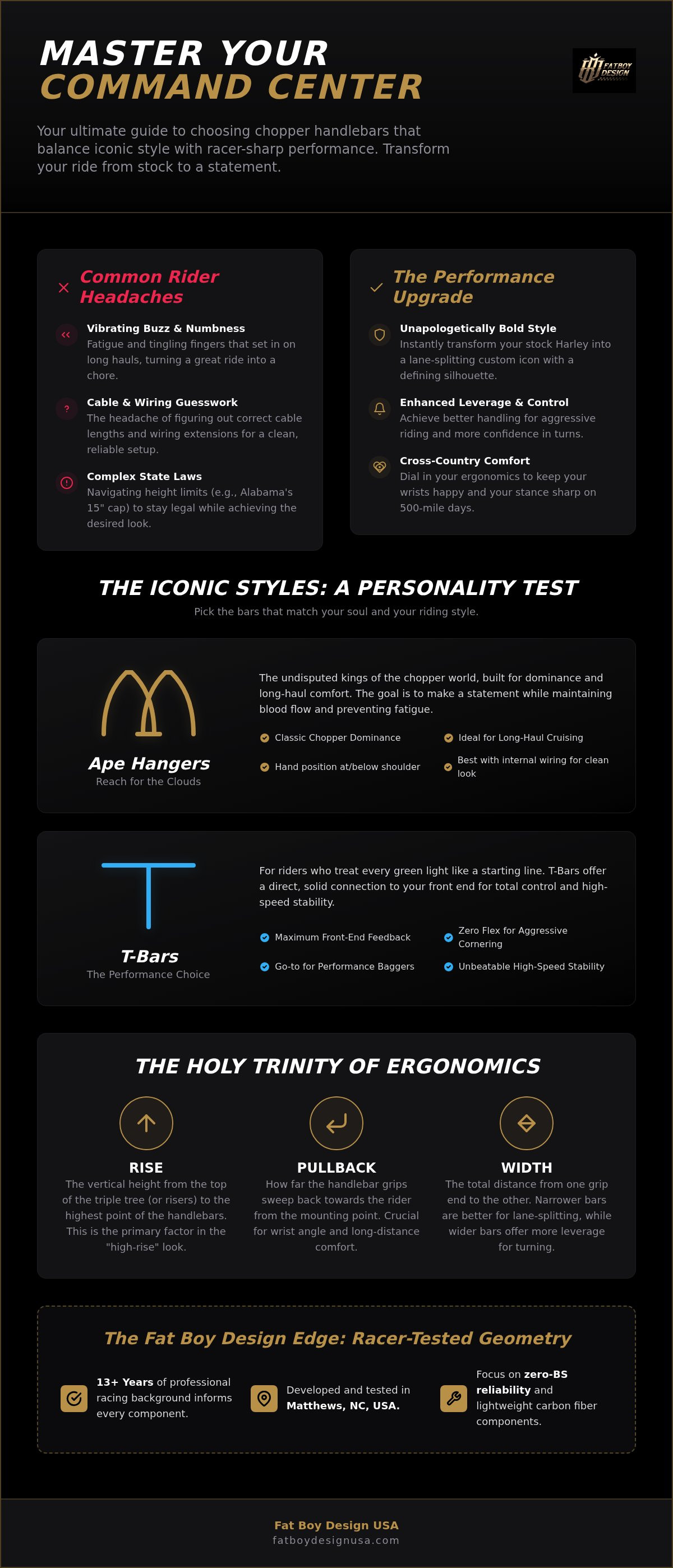
Choosing your bars is the ultimate personality test for any rider. It’s the difference between a laid-back cruiser and a lane-splitting rebel. When you're hunting for the perfect set of vintage chopper handlebars, you aren't just buying metal; you're buying an attitude. From the towering presence of Apes to the surgical precision of T-Bars, each style demands a different respect from the road. Let’s break down the heavy hitters that have defined custom culture for decades. Don't just pick what looks cool in a catalog. Pick what matches your soul and your riding style.
Ape Hangers: Reach for the Clouds
These are the undisputed kings of the chopper world. Whether you're rocking 10-inch mini-apes or 20-inch monsters, the goal is the same: dominance. For the best long-haul comfort, aim for the sweet spot where your hands are at or just below shoulder height. This keeps your blood flowing and prevents that annoying sleeping arm sensation. Always go for internal wiring if you can. It keeps your cockpit looking clean and protects your connections from the elements. Nobody wants a rat’s nest of wires cluttering up a beautiful set of chrome or black powder-coated bars.
T-Bars: The Performance Choice
If you’re the type who treats every green light like a starting line, T-Bars are your best friend. The performance crowd loves them for a reason. They offer direct front-end feedback and zero flex, which is crucial for aggressive cornering. This isn't just about looks; it's about total control. They are the go-to for performance bagger builds that breathe fire and demand high-speed stability. When you’re pushing a heavy machine through tight turns, you need a solid connection to your triple trees. It's about feeling every vibration of the road while you're pinning the throttle.
Rabbit Ears and Buckhorns
Rabbit Ears are the old school vibe that refuses to die. These narrow, pulled-back bars are perfect for rigid frames and skinny front ends. They change your center of gravity, making low-speed maneuverability a breeze. If your goal is the tight, Frisco lane-splitting look, these are for you. They allow you to squeeze through gaps that would leave wider bars snagged on side mirrors. It’s about agility and vintage soul. To keep that front end feeling light and responsive while you're flicking through traffic, consider upgrading to high-performance bagger racing parts that complement your new stance.
Z-Bars and Drag Bars
Z-Bars bring an angular, aggressive look that’s perfect for street-fighter or club-style builds. They’re mean, sharp, and unapologetic. On the flip side, Drag Bars are for the riders who want to stay tucked and fast. They’re low, lean, and demand a forward-leaning posture that’s all about speed. No matter which path you choose, make sure your geometry is racer-tested for the best experience on the asphalt. Your bars are your handshake with the road; make sure it's a firm one.
Geometry and Ergonomics: The Science of the Reach
Mastering the holy trinity of rise, pullback, and width is what separates the masters from the amateurs. You might find a set of vintage chopper handlebars that looks killer on a garage wall, but if the geometry is off, your first long ride will be a total nightmare. We are talking about the difference between a 500-mile day of pure bliss and an expensive trip to the chiropractor. It is all about physics and leverage. Leverage is king, especially when you are wrestling a heavy Harley-Davidson big twin through gridlock or carving through a canyon. If your bars are too narrow, you lose that vital mechanical advantage. If they are too wide, you become a human sail catching every gust of wind on the interstate.
Wrist angle is the silent killer of custom builds. If your grips force your wrists into an unnatural, kinked twist, you will feel the burn within twenty minutes. You want a neutral position that allows you to operate the clutch and brake without thinking. This isn't just about comfort; it's about survival. When things get hairy on the road, your hands need to be exactly where they belong. While some shops focus only on the handmade look, we focus on the racer-tested geometry that keeps you in the saddle longer. Your command center should feel like a natural extension of your body, not a torture rack designed for aesthetic points.
Calculating Your Ideal Rise
Forget the ruler for a second. Try the seated reach test. Sit on your bike, close your eyes, and reach out to where your hands naturally want to go. That is your target. Open your eyes and see where that lands. Remember that your total height isn't just the bars themselves. You must factor in your handlebar risers to get the full ergonomic picture. Mixing the right riser with the right bar height is the secret sauce for a safe, aggressive setup that doesn't compromise your front-end stability.
Pullback: Bringing the Controls to You
Stop slouching like a teenager. The right pullback brings the controls to you, saving your lower back and neck from that agonizing ache. There is a massive difference between an aggressive "attack" stance and a relaxed cruising position. Racers typically prefer less pullback because it offers better front-end feedback and more direct control over the triple trees. It keeps you connected to the asphalt. If you want to feel every nuance of the road while you are pinning the throttle, keep those bars straighter. If you want to lounge while you eat up the miles, bring them back a bit further toward your chest. Your vintage chopper handlebars should match your mission.
The Setup: Cables, Controls, and Risers
Picking out your bars is the fun part. Installing them? That is where the "how-to" friction usually starts. Many riders forget to budget for the hidden costs of a swap. We are talking about brake lines, clutch cables, and wiring extensions. If you are bolting on a set of vintage chopper handlebars with a significant rise, your stock cables are suddenly going to be way too short. Don't try to stretch them. That is a one-way ticket to a snapped line and a very bad day. Never cheap out on your throttle-by-wire sensors or connectors either. Use high-quality components that can handle the vibration of a big twin. Reliability is the only thing that matters when you are miles from home.
Let's talk about knurling. This is that textured pattern on the center of the bars. It provides the grip your risers need to stay put. Without good knurling, your bars can slip under heavy torque, which is terrifying at highway speeds. You also need to look at your bushings. Stock rubber bushings are fine for low bars, but for high-rise setups, they are too mushy. Switch to polyurethane or solid bushings to eliminate bar wiggle. You want your front end to feel like a single, solid unit. Wiggle is for Jello. Your cockpit should feel like a command center that responds instantly to every input.
Measuring for New Cables
Don't guess. Use the string method. It is the only foolproof way to measure for any bar height. Run a piece of string from your controls, down the frame, to the connection point. Mark it. Measure it. Now, here is the vital part: check the full lock turn. Turn your forks all the way to the left and then all the way to the right. If that string gets tight, you need more length. Typically, you will be looking at +2, +4, or +6 inches over stock depending on your new rise. It is better to have an extra inch of slack than a cable that binds when you are trying to park.
Risers: The Foundation of Your Bars
Your risers dictate your baseline stance. Standard risers keep the bars centered over the forks, while pullback risers bring the grips closer to your body for a more relaxed reach. For tall ape hangers, we always recommend heavy-duty clamping. The more height you have, the more leverage you are putting on those bolts. You need a foundation that can take the heat. To truly lock down your front end, upgrade your setup with our Bagger Racing Triple Trees for ultimate stability and precision. Stop settling for a shaky ride and start building a beast that handles as good as it looks. Upgrade your performance bagger parts today and feel the difference of racer-tested gear.
The Fat Boy Design Edge: Completing the Custom Build
Handlebars are just one piece of the performance puzzle. You have finally dialed in your reach with those vintage chopper handlebars, but don't stop there. A custom build is about total balance. When you add high-rise bars, you change the leverage and the weight distribution of your front end. This is where the racer’s secret comes into play. You need to offset that weight by reducing unsprung mass. Our Carbon Fiber Front Fender is the ultimate cheat code. It sheds pounds where it matters most, keeping your steering light and your suspension responsive. It is the difference between a bike that looks fast and a bike that actually is fast.
We aren't called the "King of Carbon Fiber" for nothing. Every part we manufacture in Matthews, NC, is track-tested for zero-BS reliability. It is about more than just looking cool at the stoplight. It is about how your Harley feels when you are pushing it through a tight corner. High-quality carbon fiber ensures your bike remains balanced, even with aggressive control setups. You want a machine that breathes fire and handles like a dream. Don't settle for a front end that feels heavy and sluggish. Upgrade the whole package to match your new command center. Our 13 years of professional racing background means we know exactly how to make a bike feel racer-sharp and unapologetically bold.
Balancing Style and Performance
Create a visual flow that starts at the grips and ends at the pavement. Pairing aggressive T-Bars with Harley Carbon Fiber fairings is a guaranteed win for both aesthetics and aerodynamics. Continue that pro finish by looking down at a custom Carbon Fiber Dash. It ties the whole cockpit together. These racer-tested parts belong on every street-driven chopper, not just the track. They provide the durability for everyday adventures while maintaining that high-end, custom-shop look. Your bike should be a reflection of your refusal to be boring. It is time to embrace a lifestyle of pure enjoyment and sensory satisfaction.
Ready to Transform Your Ride?
Stop dreaming about the perfect build and start wrenching in your garage. Life is too short to ride a stock bike that feels like a rental. The FBD promise is simple: we provide parts that work as hard as they look, every single mile. Join the club of riders who demand the best and stop taking life so seriously. Whether you are hunting for that classic lane-splitter silhouette or a high-performance bagger stance, we have the gear to make it happen. Grab your tools and get to work. It is time to build a legend that dominates the road. Your vintage chopper handlebars were just the beginning of this transformation.
Claim Your Command Center
Stop dreaming about that perfect lane-splitter silhouette and start building it. You now know that picking the right vintage chopper handlebars is about more than just raw height. It is about mastering the science of the reach and ensuring your controls respond instantly when you pin the throttle. You've learned how to balance an aggressive stance with lightweight components to keep your front end flickable and racer-sharp. It is time to reject the mundane stock setup and join the club of riders who prioritize pure enjoyment and sensory satisfaction on every mile.
At Fat Boy Design USA, we've spent over 13 years refining the art of the custom Harley. Every component we manufacture is racer-tested in Matthews, North Carolina, to ensure zero-BS reliability. As the King of Carbon Fiber, we don't just sell parts; we provide the transformative elements that turn a standard ride into a legendary machine. Your bike deserves a command center that works as hard as it looks. Upgrade Your Cockpit with Fat Boy Design USA and feel the difference of gear built with soul and speed. Get out there, start wrenching, and make the road your own.
Frequently Asked Questions
Are ape hanger handlebars legal in my state in 2026?
Laws vary wildly by state because there is no federal standard for bar height. In Alabama and Connecticut, your bars can't go higher than 15 inches above the seat. Maryland gives you a bit more room at 20 inches, while Washington is the wild west with a 30-inch limit. At least 10 states, including New York and Arizona, require handgrips to stay below your shoulders. Always check your local statutes before bolting on 20-inch monsters to avoid a ticket.
What is the best handlebar height for a Harley Sportster chopper?
Aim for a height that keeps your hands level with your shoulders for the best balance of style and control. For most Sportster riders, 10-inch to 12-inch mini-apes or Z-bars hit that ergonomic sweet spot. This setup provides enough leverage to flick the bike through corners without cutting off your circulation. If you're going for a skinny lane-splitter look, keep the width narrow to match the slim profile of the Sporty frame.
Do I need to change my cables if I install 10-inch mini apes?
You will almost certainly need longer cables and brake lines if you're jumping from stock bars to 10-inch apes. Most factory Harley cables only have an inch or two of slack. Stretching them to fit vintage chopper handlebars is a recipe for disaster. Use the string method to find your exact length. Usually, you'll need at least a +4 inch extension to prevent binding during full-lock turns or aggressive maneuvers.
How do I stop my handlebars from vibrating at high speeds?
Upgrade to polyurethane or solid bushings to kill that annoying high-speed buzz. Stock rubber bushings are too soft and allow the bars to flex, which amplifies engine vibration. You should also check your riser bolts and ensure they are torqued to spec. Heavier bar-end weights or internal dampeners can also help. If you're still feeling the rattle, it might be time to look at your front-end alignment or tire balance to ensure everything is true.
What is the difference between 1-inch and 1.25-inch handlebars for Harleys?
The main difference is the visual "beefiness" and the clamping area. Traditional vintage chopper handlebars often use a 1-inch diameter to match classic controls and vintage aesthetics. Modern performance builds prefer 1.25-inch bars because they look more substantial on big touring bikes. Just remember that many 1.25-inch bars still step down to 1 inch at the grips and risers. Double-check your riser clamp size before you buy to avoid a compatibility headache in the garage.
Can I install chopper handlebars myself or do I need a pro shop?
You can definitely handle this in your garage if you're comfortable with basic tools and wiring. The hardest part is usually internal wiring and bleeding the brakes after installing longer lines. If your bike has ABS or complex throttle-by-wire sensors, the job gets a bit more technical. Take your time and follow a service manual. If the idea of soldering wires and bleeding lines makes you sweat, call a pro shop to ensure it's done right.
What are the best handlebars for a Cholo Softail build?
High-rise Ape Hangers are the absolute standard for that classic Cholo or Vicla style. We're talking 14-inch to 18-inch bars with a slight forward tilt for that aggressive reach. Combine these with long fishtail pipes and a 21-inch front wheel for the ultimate boulevard look. The goal is a tall, proud stance that demands attention. Make sure to use heavy-duty risers to keep those massive bars from slipping when you're cruising through town.
How does handlebar width affect motorcycle handling in corners?
Wider bars give you more leverage, making it easier to muscle a heavy bike through tight turns. It's basic physics. However, bars that are too wide can make you feel like a human sail at highway speeds. Narrower bars are better for high-speed stability and lane-splitting but require more physical effort to steer at low speeds. Find a balance that matches your wingspan and your favorite riding environment to keep your bike feeling racer-sharp.