

Upgrades to Make Your Harley Feel More Stable: Kill the Wobble in 2026
Your heavy-duty cruiser should feel like a heat-seeking missile, not a bowl of overcooked linguine. We have all been there. You are hitting that sweet spot on the highway when the dreaded Bagger Wobble decides to crash the party. It is terrifying, frustrating, and frankly, it is a total vibe killer. If you are searching for the best upgrades to make my harley feel more stable, you are likely tired of that vague steering and the chassis flex that makes aggressive cornering feel like a high-stakes gamble. You deserve a ride that matches your ambition.
Stop settling for a wet noodle chassis and start riding a laser-focused machine. We are stripping away the factory-standard fluff to give you the racer-tested secrets for total dominance. You are about to learn how to stiffen your core and lighten your extremities to kill the flex for good. We will dive into high-performance Bagger Racing Triple Trees, beefy racing swingarms, and why swapping for carbon fiber fenders and saddlebags is the ultimate hack for sharper turn-ins. It is time to reclaim your confidence at 80 mph and leave the wobble in your rearview mirror.
Key Takeaways
- Identify the "Bagger Wobble" and why your stock rubber mounts are basically acting like a bunch of nervous jelly.
- Learn how Bagger Racing Triple Trees and Swingarms provide the rigid backbone your chassis needs for aggressive cornering.
- Discover how carbon fiber fenders and side covers slash unsprung weight to make your steering feel impossibly sharp.
- Explore the best upgrades to make my harley feel more stable so you can finally relax at highway speeds.
- Master the final setup with steering dampers that act as the ultimate insurance policy against vague feedback and high-speed jitters.
Understanding the "Bagger Wobble" and Harley Instability
The "Bagger Wobble" is that terrifying moment when your heavy-duty cruiser decides it wants to be a hula dancer. It is not just a "Harley thing." It is a physics thing. Technically, it is a harmonic oscillation. This happens when your chassis flexes under pressure. When you are pushing 80 mph, aerodynamic loads start pushing back hard. If your frame cannot handle that pressure, it starts to hunt for a path. This instability is the core reason riders hunt for upgrades to make my harley feel more stable. You want a bike that tracks like it is on rails, not one that feels like it is made of wet cardboard.
Stock components are often built for the average rider cruising to a coffee shop. They are not designed for the racer who wants to carve canyons or the touring enthusiast who carries a full load at high speeds. This is where structural flex becomes your worst enemy. It is vital to distinguish between a simple tire issue and a structural one. A bad tire might vibrate, but structural flex makes the entire bike feel like it is hinged in the middle. You are fighting the very motorcycle dynamics that are supposed to keep you upright.
The Rubber-Mount Dilemma
Harley designed these bikes to be smooth. They used rubber mounts to isolate engine vibration. It feels great at a stoplight. It feels terrible in a high-speed sweeper. Why? Because the engine and the swingarm are connected. They move as one unit. When those rubber bushings get old or soft, they let the whole drivetrain twist inside the frame. It is like trying to run a marathon in flip-flops. If you have added more horsepower, you are just stressing those soft mounts even harder. You are basically asking a marshmallow to hold back a freight train. You need rigidity, not just dampening.
Symptoms of an Unstable Chassis
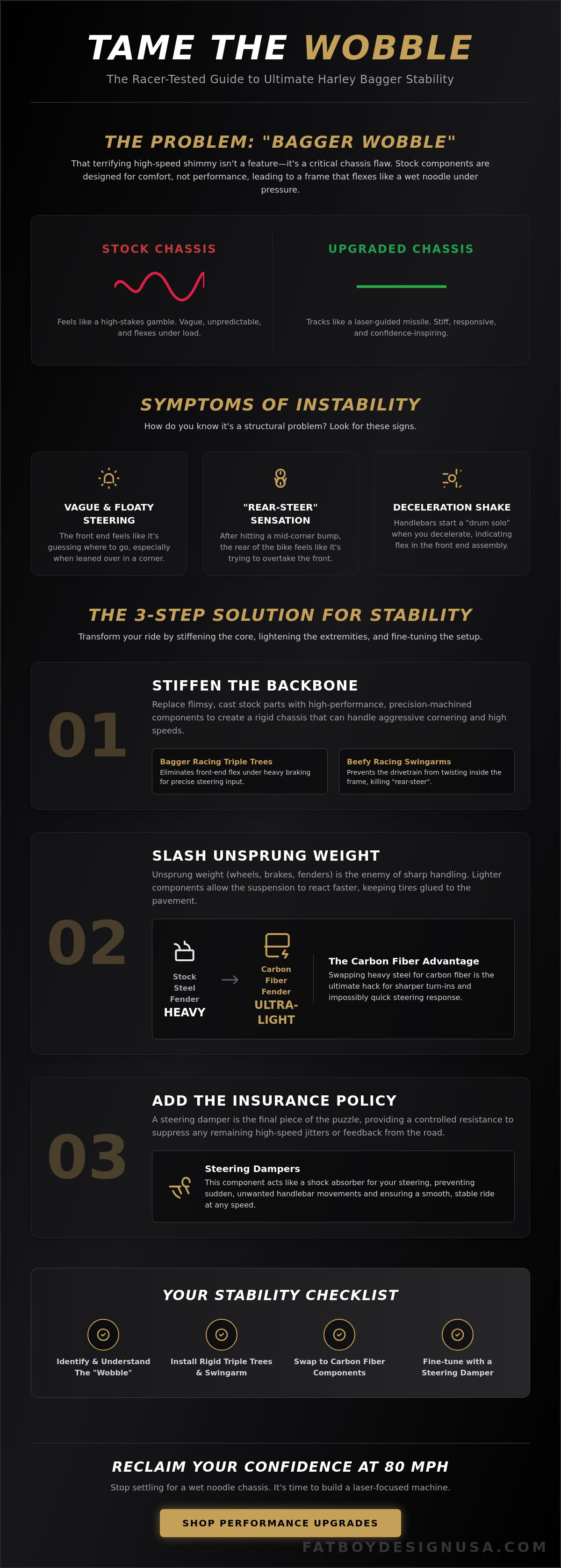
How do you know it is the chassis and not just a flat tire? Look for these signs. First, look for a vague, "floaty" feeling in the bars when you are leaned over. It feels like the front end is guessing where to go. Second, watch out for the "rear-steer" sensation. You hit a mid-corner bump and the back of the bike feels like it is trying to overtake the front. Finally, check for handlebar shake during deceleration. If you let go at 40 mph and the bars start a drum solo, you have a structural problem. Stock triple trees are often the culprit. They are cast pieces that flex under heavy braking. When you combine that with a heavy front fender, you are fighting a losing battle against inertia. It is time to stop the guessing game and fix the foundation.
The Physics of Stability: Unsprung Weight and Mass Centralization
Physics is a cold-hearted beast. It does not care about your chrome or your custom paint. It only cares about mass and where you put it. If you are hunting for upgrades to make my harley feel more stable, you have to start thinking like a racer. Most riders focus on the engine, but the real battle happens at the wheels. When your bike oscillates, it is often because the weight is working against the suspension. You want your suspension to react to the road, not fight the weight of the bike itself. It is a game of millimeters and ounces that determines whether you feel like a pro or a passenger.
The secret lies in reducing unsprung weight and centralizing mass. Think of your Harley as a giant pendulum. If you have heavy components hanging off the far ends, every bump creates a massive amount of leverage. That leverage turns into a wobble. Scientific research into frame and chassis stiffness proves that the connection between your wheels and the frame is the ground zero for stability. If that connection is weak or the components are too heavy, the bike simply cannot settle. You need to shed the dead weight to let the chassis do its job.
Unsprung Mass vs. Sprung Mass
Unsprung mass is everything your suspension does not support. This includes your wheels, brakes, and that chunky steel front fender. When you hit a pothole, the suspension has to move that weight up and then shove it back down. Heavy parts have massive inertia. They want to keep moving up long after the bump is gone. This creates a harmonic vibration that travels straight into your handlebars. A lighter front end reacts faster. It stays glued to the pavement. Swapping to a carbon fiber front fender is one of the fastest ways to kill that "pendulum effect" and sharpen your steering response.
Centralizing Your Harley’s Weight
Mass centralization is about moving the weight toward the center of the bike. When weight is tucked in tight, the bike becomes "flickable." It turns in faster and holds a line with less effort. Heavy steel saddlebags and dashes are the enemies of stability. They sit high and wide, making the bike feel top-heavy and vague. By switching to harley davidson carbon fiber components, you are not just losing weight. You are moving the center of gravity. This improves rear-wheel traction and stops the "wet noodle" sensation in high-speed sweepers. For a deeper dive into how this works, check out The Ultimate Guide to Harley Carbon Fiber Parts. Stop fighting the bike and start commanding it.
Ready to transform your ride? Take a look at our Platinum Series Carbon Fiber and feel the difference that mass centralization makes on your next canyon run.
Structural Rigidity: Triple Trees and Swingarms
Stop pretending your stock setup is "fine" for triple-digit speeds. It isn’t. If you want to kill the wobble, you have to stiffen the skeleton of your machine. Most riders throw money at shocks and call it a day. That is like putting a silk tie on a pig. To truly transform your ride, you need to address the structural flex that makes your Bagger feel like a hinged bus. Finding the right upgrades to make my harley feel more stable means looking at the metal that holds everything together. In 2026, the standard for performance has shifted. We aren't just cruising; we are carving.
Competitors will tell you that stock frames are sufficient for most riders. They are wrong. They focus on "comfort" suspension while ignoring the mechanical root of the problem. If your frame is twisting, no amount of fancy valving in your shocks will save you. You need to eliminate lateral flex to get that "on rails" cornering experience. This is about building a foundation that can handle the massive torque and aerodynamic loads of a modern performance Bagger. It is time to stop the wiggle and start the winning.
Upgrading Your Triple Trees
Cast iron belongs in a kitchen, not on your front end. Stock triple trees are heavy, cast pieces that love to flex under pressure. When you dive into a corner or slam the brakes, those trees twist. That twist travels down your forks and creates that vague, "where am I going?" feeling. CNC-machined Bagger Racing Triple Trees are the solution. They are carved from billet aluminum for maximum rigidity. These trees provide a massive increase in clamping surface area. This locks your forks in place and prevents the twist that leads to a front-end wash. It is the difference between steering with a wet noodle and a surgical scalpel. You get immediate feedback. You get total control.
Performance Swingarms for Maximum Tracking
Your swingarm is the backbone of your bike. On most Touring models, it acts more like a hinge. This is the "hinge in the middle" sensation that makes your rear end feel like it is steering itself. It is unsettling. It is dangerous. A high-performance Bagger Racing Swingarm eliminates that lateral flex. These aren't just pretty pieces of aluminum; they are engineered for a superior weight-to-strength ratio. Racers prioritize swingarm stiffness over almost anything else because it keeps the rear wheel tracking perfectly behind the front. When your backbone is stiff, the bike stops hunting for a line. It just holds the one you give it. This upgrade ensures that your rear tire follows your front tire with zero drama, even when you are pinned in a high-speed sweeper.
How Carbon Fiber Upgrades Improve Steering Precision
Weight is the enemy of fun. It is that simple. When you are looking for upgrades to make my harley feel more stable, you have to look at the dead weight hanging off your front end. Most guides tell you to swap your wheels and call it a day. They are missing the bigger picture. A heavy steel fender acts like a lead weight at the end of a stick. Every time you try to turn, you are fighting rotational inertia. It makes your steering feel sluggish and vague. Carbon fiber changes the game by stripping away the bulk without sacrificing an ounce of strength. It is the ultimate shortcut to a laser-focused ride.
Beyond just being lighter, carbon fiber is a master of vibration damping. It soaks up those high-frequency road jitters that steel just transmits straight to your palms. This keeps your front wheel planted and your hands happy. Plus, performance-designed fenders are shaped to slice through the air like a hot knife. At 80 mph, aerodynamic lift can make your front end feel light and twitchy. A carbon fiber setup keeps the wind working for you, not against you. You get total control from the pavement up without the high-speed drama.
The Front Fender Factor
Your front fender is a massive point of leverage. Swapping that chunky factory steel for a Performance Bagger Racer Carbon Fiber Front Fender is like taking a backpack full of rocks off your fork’s shoulders. This reduction in unsprung mass allows your suspension to track the road surface with insane precision. The wheel can move up and down faster because it isn't carrying a heavy anchor. You get better grip, sharper turn-in, and a bike that actually listens when you tell it to move. It is a transformation you will feel in the very first corner.
Lightening the Dash and Side Covers
Stability isn't just about the wheels. It is about where the weight sits. High-mounted weight is a disaster for handling. Heavy dashes and side covers create a "top-heavy" feel that makes the bike want to flop over in slow corners. It also adds to that annoying "floppy" fairing sensation at speed. By switching to harley davidson carbon fiber side covers and dashes, you are pulling that weight down toward the center of gravity. You get a balanced, neutral feel that makes your Bagger feel half its size. Stop hauling around extra baggage and start riding a machine that feels as light as it looks.
Ready to shed the pounds and reclaim your confidence? Grab your Platinum Series Carbon Fiber parts today and transform your steering from sluggish to surgical.
The Final Piece: Steering Dampers and Setup
You have already done the heavy lifting. You have ditched the factory steel and stiffened the chassis with billet. Now it is time to lock it all down. When you are hunting for the ultimate upgrades to make my harley feel more stable, the steering damper is your final boss. It is the piece that turns a great-handling bike into a surgical weapon. It is the difference between surviving a high-speed sweeper and owning it. Without this final touch, you are leaving your safety to chance. Don't be that rider.
Choosing the right tech matters for your front end. Hydraulic damping is the king of the mountain. Unlike old-school friction dampers that just make the bars hard to turn like you are steering through molasses, a hydraulic unit is smart. It is speed-sensitive. It ignores your slow, deliberate steering inputs but slams the door on rapid, violent oscillations. It is the safety net that catches the Bagger Wobble before it turns into a tank-slapper. It gives you the freedom to relax your grip and let the bike do its job while you enjoy the scenery at 90 mph.
The Steering Damper: Your Safety Net
Think of a damper as a bodyguard for your handlebars. It kills high-speed jitters before they can travel up the forks and into your brain. Whether you are navigating city potholes or pinning it on a track day, adjustability is key. You want to be able to dial in the resistance to match your riding style. Our Harley Touring Performance Steering Damper Kit offers that precision control. It is the ultimate insurance policy against the "wet noodle" feel we have spent this whole article trying to kill. Install it and feel the immediate boost in front-end authority.
The FBD Racing Philosophy
We don't do "good enough" at Fat Boy Design. Our FBD Racing philosophy means every component is born on the track. We have pushed these parts to the absolute limit in the most demanding environments so you can push yours with total confidence. We are here to help you bridge the gap between a standard street cruiser and a true performance machine. It is a transformation that changes how you approach every curve. It is time to stop dreaming about stability and start feeling it in your soul. Shop Fat Boy Design USA for racer-tested stability and join the club of riders who refuse to settle for a shaky ride.
Your Rock-Solid Setup Checklist:
- Tire Pressure: Check it cold. Even a 3-psi drop can trigger a wobble.
- Alignment: Ensure your rear wheel is laser-straight. A crooked axle is a recipe for rear-steer.
- Pivot Points: Inspect your swingarm pivot bolts for wear or play.
- Damping: Dial in your steering damper to suit your specific weight and load.
Dominate the Asphalt and Leave the Wobble Behind
You are no longer just a passenger on a vibrating couch. By stiffening your chassis with billet components and slashing front-end weight with carbon fiber, you have reclaimed total control. It is about transforming that vague, "wet noodle" feel into a surgical instrument that listens to your every command. Whether it is the rock-solid backbone of a racing swingarm or the lightning-fast response of a carbon fender, these are the essential upgrades to make my harley feel more stable in any corner. We don't just sell parts; we build confidence.
Every piece we create is born from 13+ years of professional racing experience and manufactured right in our shop in Matthews, NC. We push these racer-tested performance standards on the track so you can rip the streets without a single second thought. It is time to join the club of riders who value performance as much as pure aesthetics. Stop shaking and start carving. Your machine is ready for its next evolution.
Upgrade Your Stability with Racer-Tested Carbon Fiber
Frequently Asked Questions
What is the #1 cause of Harley Bagger wobble?
The primary culprit is the inherent flex in the factory chassis combined with squishy rubber engine mounts. While those mounts keep your hands from numbing at a stoplight, they allow the entire drivetrain to twist like a pretzel at highway speeds. This creates a harmonic oscillation that travels through the frame. You feel it as that terrifying, hinged-in-the-middle weave during high-speed sweepers.
Can carbon fiber parts actually make my motorcycle more stable?
Yes, carbon fiber is a total stability cheat code. By swapping heavy steel for carbon, you slash unsprung weight and rotational inertia. This allows your front wheel to track the pavement with surgical precision rather than fighting the weight of a heavy anchor. It is one of the most effective upgrades to make my harley feel more stable because it lets the suspension react to the road instantly.
Do I need to upgrade my suspension before my triple trees?
Not necessarily. Starting with rigid triple trees actually builds a better foundation for any suspension work you do later. Think of it like building a house on a rock instead of a swamp. Billet triple trees stop the fork twist that ruins the performance of even the most expensive shocks. If your frame is flexing, your new suspension is just trying to polish a turd. Fix the skeleton first.
How does a steering damper improve Harley handling?
A steering damper acts as a high-speed bodyguard for your handlebars. It uses hydraulic resistance to snatch up tiny vibrations before they multiply into a full-blown tank-slapper. It doesn't interfere with your casual, slow-speed cruising. It only kicks in when the bike tries to start an unprompted drum solo at highway speeds. It is the ultimate insurance policy for your front end.
Is reducing unsprung weight worth the investment for a street rider?
It is worth every penny if you enjoy actually commanding your bike. Reducing unsprung weight makes the entire machine feel 100 pounds lighter in the corners. You get faster turn-ins and way more feedback through the grips. Even if you aren't hitting the track, a lighter bike is easier to flick through traffic and significantly more fun on your favorite canyon road.
What is the difference between a "comfort" and "performance" Bagger setup?
Comfort setups focus on soft springs and squishy seats for a lazy, cloud-like ride. Performance setups are all about structural rigidity, weight reduction, and precision. A performance Bagger uses carbon fiber and billet aluminum to eliminate the "wet noodle" chassis feel. It is the difference between floating on a raft and driving a precision-guided missile. We prefer the missile.
How do I know if my Harley swingarm bushings are shot?
If your bike feels like it is steering from the rear during a turn, your bushings are likely toast. You will feel a disconnected, spooky sensation where the back end tries to take its own path. It makes the bike hunt for a line rather than holding one. Check for any lateral movement in the swingarm while the bike is on a lift to confirm the play.
Will a lighter front fender help with wind buffeting?
Absolutely. A performance carbon fiber fender is shaped to slice the air rather than catch it like a sail. Heavy stock fenders can create lift at high speeds, which makes the front end feel light and twitchy. A lighter, aerodynamic fender keeps the front wheel planted. It reduces the chaos caused by dirty air from semi-trucks and nasty crosswinds on the open highway.