

What Judges Look for in a Custom Bike Show: The Winning Blueprint
A $30,000 custom paint job won't save a bike that handles like a shopping cart with a broken wheel. If you think winning is just about the flashiest chrome, you're already losing. Truly understanding what judges look for in a custom bike show is the secret to moving past the participation trophy phase and straight onto the podium. It's not just about looking pretty. It's about the unseen technical execution that separates a garage project from a masterpiece.
We know the frustration of feeling like judging is purely subjective. You've poured your soul into a build only to get docked points for a show part that isn't actually race-ready. Forget the confusion. We're handing you the winning blueprint to transform your machine into a beast that demands respect. You'll gain a clear understanding of the scorecard and learn how to nail the perfect stance. We're diving into everything from carbon fiber side covers to racing triple trees so you can walk into the 2026 Colorado Motorcycle Expo with total confidence. Stop taking life so seriously. Start building bikes that win.
Key Takeaways
- Nail the foundational stance and visual flow that turns your build into a 360-degree masterpiece.
- Discover exactly what judges look for in a custom bike show to ensure your racer-tested engineering doesn't get overlooked.
- Master the "King of Carbon" look by prioritizing weave alignment across your fenders and side covers for a flawless finish.
- Kill the clutter by internalizing your wiring and plumbing to pass the most rigorous white-glove inspections.
- Boost your show-day impact with pro-level presentation and lighting tactics that make your build the undisputed star of the floor.
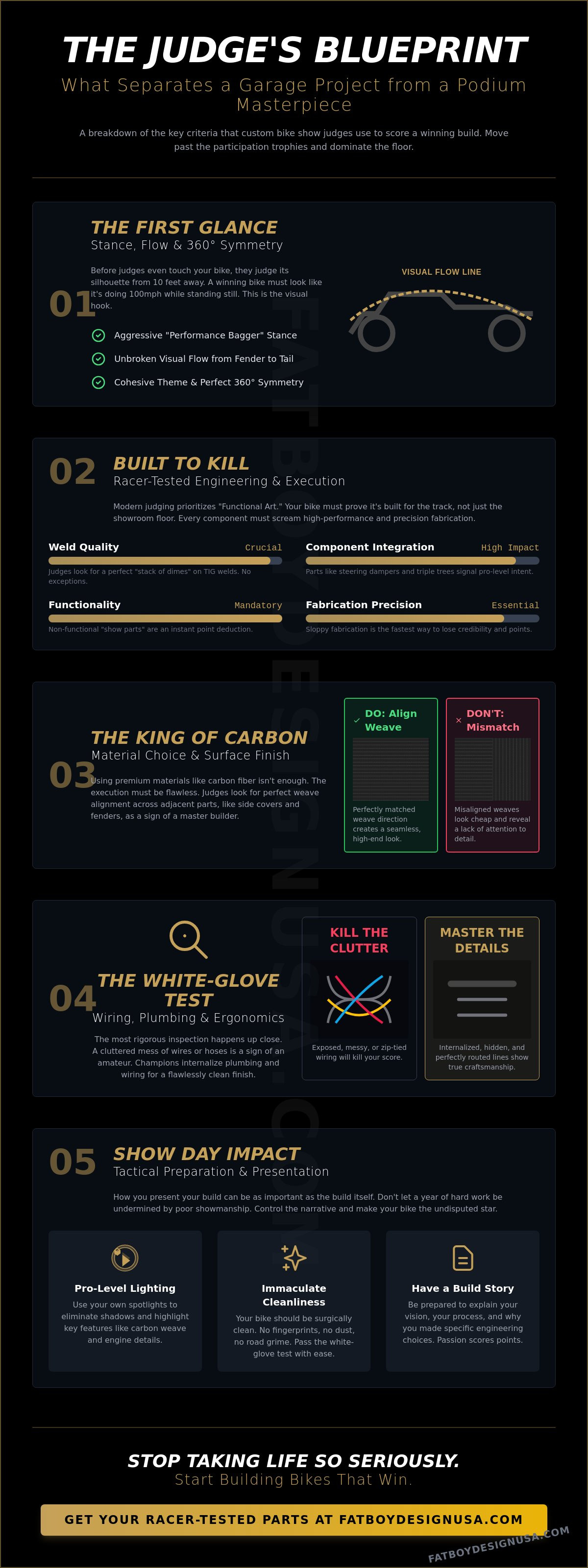
The First Glance: Stance, Flow, and 360-Degree Symmetry
Judges don't start their inspection with a magnifying glass. They start from ten feet away. This is the "make or break" moment. If your bike doesn't scream "look at me" from across the arena, they'll walk right past without a second thought. Truly understanding what judges look for in a custom bike show begins with the silhouette. It's about stance. It's about flow. It's about making sure your machine looks like it's doing 100 mph while it's parked on a kickstand. It's the visual hook that draws them in for the kill.
Stance is the foundational geometry that signals your bike's intent. It's the attitude of the frame. Does it look like a lazy cruiser or a track-ready monster? Flow is the rhythmic visual line that connects your carbon fiber front fender all the way to the rear tail section. If that line is broken by a clunky seat or a misplaced tank, the story of the bike falls apart. Throughout the history of custom motorcycles, legendary builders have obsessed over these lines because they define the very soul of the machine. If the flow is right, the eye moves effortlessly across the build. If it's wrong, the whole thing feels like a collection of random parts.
The Geometry of a Winner
Rake and trail aren't just technical specs for the highway. They define the visual aggression of your build. A bike with too much rake looks dated. Too little, and it looks nervous. You want that "Performance Bagger" silhouette that's dominating the scene right now. This requires balancing wheel size with frame scale. You need components that scream speed and authority. This is exactly where high-end bagger racing parts like triple trees and swingarms come into play. They provide the structural integrity and the aggressive angle that judges crave. If the proportions are off, the whole bike feels like a lie. Don't let your geometry kill your chances before you even get a score.
Visual Continuity and Theme
Avoid the "parts catalog" look at all costs. It's the hallmark of a lazy build. Judges want to see a cohesive theme that flows through every square inch. Every bolt, bracket, and piece of Harley carbon fiber must serve the same design god. Color theory plays a huge role here too. A loud, high-energy paint job can highlight your engineering genius or hide a sloppy weld. You choose. Symmetry is your best friend. If the left side tells a different story than the right, you've failed the 360-degree rule. Every angle must reinforce the same bold message. Don't be boring. Reject the mundane and be consistent. If you want to win, your bike needs to look perfect from the front, the back, and everywhere in between.
This level of dedication to a unified aesthetic is exactly what separates top-tier builds from the rest, a philosophy shared by the curators at 78+ Designers who focus on how every element of an ensemble must work together. Whether you are building a bike or refining your personal style, the goal is the same: a cohesive, high-impact presentation that leaves no doubt about your attention to detail.
Built to Kill: Engineering and Racer-Tested Execution
Flashy paint is a distraction. If your bike looks like a million bucks but handles like a wet noodle, you're toast. Modern judging has moved past the era of non-functional sculptures. Today, the elite panel is obsessed with "Functional Art." They want to see parts that look like they belong in a gallery but are actually built to survive the track. When you're trying to figure out what judges look for in a custom bike show, remember one word: functionality. This is where high-performance bagger racing parts make the difference between a runner-up and a champion. Every component should scream that this machine is ready to shred, not just sit on a carpet.
Engineering isn't just about the big stuff. It’s hidden in the details. Integrating a steering damper kit isn't just a safety move; it's a massive signal to the judges. It tells them you understand high-speed stability and professional-level control. They'll also be hunting for weld quality. If those TIG welds don't look like a perfect stack of dimes, don't expect top-tier points. Sloppy fabrication is the fastest way to get laughed out of the arena. Precision is the only language that wins trophies.
The Performance Bagger Standard
The bar has been raised. Integrating racing components like triple trees and swingarms shows you’re building for the future of the sport. For structural inspiration that actually wins shows, check out the Performance Bagger Guide 2026 to see how to build a beast that breathes fire. Judges are suckers for radial mounts and oversized rotors. These aren't just for show. They represent a commitment to stopping power that matches your engine's output. It's about creating a balanced machine that respects the physics of the ride.
Fabrication Finesse
Let's talk brackets. An amateur uses an "it works" bracket from the local hardware store. A master fabricates a piece that looks like it was born from the frame. This is the level of finesse required to stay competitive. Hidden hardware is the ultimate flex. Making bolts disappear creates a clean, uninterrupted surface that judges adore. Using racer-tested parts is the best way to eliminate the "trailer queen" stigma once and for all. It proves your build has the guts to back up its looks. If you want to dominate the next event, start by upgrading to performance bagger parts that are actually built for the podium.
The King of Carbon: Material Choice and Surface Finish
If the first glance was the hook, the finish is the sinker. You can have the most aggressive stance in the building, but if your materials feel cheap, the judges will gut you. Understanding what judges look for in a custom bike show means looking past the shine and into the weave. In the modern custom scene, Harley carbon fiber has become the undisputed gold standard. It signals a commitment to weight reduction and high-tech aesthetics that fiberglass just can't touch. When a judge leans in, they aren't just looking for carbon. They’re looking for weave alignment. If the 45-degree pattern on your side covers doesn't perfectly mirror the angle on your saddlebags, you've already lost points. It’s about obsessive consistency.
The "Depth Test" is where the amateurs are separated from the legends. A show-winning finish on carbon fiber should look like you could reach your hand six inches into the part. It needs a glass-like clarity that highlights the structural beauty of the material. Judges will deduct points for inferior materials like fiberglass or, god forbid, a carbon wrap. Wraps are for people who take life too seriously and don't want to do the work. Real carbon fiber is a statement of authenticity. It’s durable, it’s beautiful, and it shows you aren't cutting corners. While high-end paint costs are significant, spraying over a material that deserves it makes the investment count.
Mastering Carbon Fiber Execution
Consistency is your weapon. To win, every part must match the King of Carbon Fiber standard. This means matching the weave density and the resin tint across the entire build. Transition points where carbon meets metal or paint are under the highest scrutiny. Judges want to see seamless integration, not a clunky overlap. This is why vacuum-infused parts beat hand-laid alternatives every single time. They provide a uniform resin-to-fiber ratio that prevents those nasty air bubbles or "dry spots" that kill a scorecard. Demand perfection from your parts or don't enter the show.
Paint and Polish Perfection
Orange peel is the ultimate point-killer. It’s that bumpy, textured look in the clear coat that screams "rushed job." A judge’s eye will catch it instantly, especially under the harsh lights of a major arena. Your surface prep is 90% of the battle. If the sanding isn't perfect before the first drop of paint hits the carbon, it’ll show in the final product. Pinstriping and graphics should enhance your lines, not distract from the build. Keep it clean. Keep it bold. Reject the mundane and make sure your finish is as loud as your engine.
The Details That Matter: Wiring, Plumbing, and Ergonomics
Wiring is the graveyard of custom builds. It's where the "looks good from far" bikes go to die. If you want to master what judges look for in a custom bike show, you have to look behind the curtain. Or better yet, make sure there's nothing behind the curtain to see. Amateurs treat electrical as a chore, but winners treat it like an art form. It's all about "Internalized Everything." This means hiding every single wire, cable, and hose inside the handlebars and frame. If a judge spots a stray connector or a plastic loop, you've already lost the top spot. They'll even run their hands along the frame to feel for hidden lumps or sloppy routing.
Ergonomic logic is your next hurdle. Judges aren't just looking; they're imagining the ride. If your foot controls are at an impossible angle or your levers require a giant's reach, you're losing points. The bike has to make sense for a human rider. Plumbing follows the same rule. Your fuel lines and brake routing should be clean, tight, and intentional. Don't just slap them on as an afterthought. If the brake line rubs the fender or a fuel line hangs too low, you're done. Use them as design elements that follow the natural lines of your frame and engine. This creates a cohesive look that signals professional-grade fabrication.
Cockpit and Controls
Your cockpit is the Command Center. Handlebar and riser alignment must be laser-perfect. Any slight tilt or asymmetry will be caught by a seasoned judge instantly. The alignment of your mirrors and levers should be a mirror image from one side to the other. This is the perfect place to integrate digital gauges directly into a sleek Carbon Fiber Dash for a seamless, high-tech look. Swap out those bulky OEM plastic switches for custom, minimalist versions. It’s about reducing visual noise and maximizing the impact of your core design. Every button should feel deliberate and high-end.
The "Invisible" Build
Professionalize your electrical system with heat shrink and braided looms. This isn't just about safety; it's about a high-end aesthetic that screams quality. The "Clean Build" philosophy is the radical removal of all visual clutter to let the engineering shine. If it doesn't need to be seen, hide it. If it must be seen, make it look like a masterpiece. Use high-quality mounting solutions instead of cheap plastic ties that fail under pressure. Ready to clean up your act? Grab some performance bagger parts and start deleting the mess today.
Tactical Preparation: How to Win on Show Day
The hard work is done. Your machine is a beast. But show day isn't just about the bike; it's a high-stakes performance. If you think you can just roll in and wait for the trophy, you’re dreaming. Understanding what judges look for in a custom bike show means knowing that presentation is 50% of the battle. You’ve invested in the best harley davidson carbon fiber, so don't let a layer of dust ruin the vibe. Use the arena lights to your advantage. Position your build so the overhead spots hit the weave of your platinum series parts at the perfect angle. Make it impossible for them to look away.
Bring a "Build Book." This is your secret weapon. It provides undeniable proof of your fabrication journey and the specialized parts you’ve integrated. Judges love seeing the raw TIG welds before they were polished or the vacuum-infusion process of your carbon components. It proves you aren't just a guy with a credit card. When the judges approach, be the expert. Don't be a pushy salesman. Answer their technical questions with confidence and stay humble. They want to know the "why" behind your choices, especially when it comes to high-performance bagger racing parts. It’s about being the charismatic leader of your own fan club.
The Detailing Deep Dive
Detailing for a show is a different animal. You need to remove road grime from the spots nobody ever sees. We’re talking under the engine and inside the carbon fiber fenders. If a judge runs a finger inside your wheel well and comes back with grease, you're done. Use fresh microfiber towels for every surface. One for the chrome, one for the carbon. And here is a pro tip: never use tire shine. It’s an amateur move that looks greasy and can be a safety hazard on the show floor. Real racers want clean, matte rubber that looks ready for the track. Keep it authentic.
The Presentation Strategy
Your display board should be punchy and bold. Don't write a novel. Highlight the key performance upgrades and the "Story" of the build. Move from the initial concept to the racer-tested reality of the final machine. Before the doors open, do a final walkthrough. See your bike through the eyes of a total skeptic. Look for the tiny flaws you’ve been ignoring. Fix them now. Reject the mundane and embrace the perfection required to win. If you’ve followed the blueprint, that trophy is practically yours. Now, go get it and stop taking life so seriously.
Take the Podium: Your Path to Custom Dominance
Winning isn't about luck. It's about the relentless pursuit of perfection. You've mastered the stance. You've hidden the clutter. You've learned to respect the weave. Knowing exactly what judges look for in a custom bike show is your final weapon. It's the difference between a garage project and a show-stopping legend. Now, it's time to stop reading and start wrenching. Reject the mundane. Build something that demands respect.
Don't settle for "good enough" when you can have racer-tested dominance. We've spent 13+ years in the professional racing world perfecting the parts that win. Every piece of carbon fiber is manufactured in-house right here in Matthews, NC. We're the brand trusted by the elite Bagger Racing community for a reason. We don't do boring. We do fire-breathing performance that looks as good as it handles. It's high-energy engineering for people who actually ride.
Upgrade your build with racer-tested Carbon Fiber at Fat Boy Design USA and give the judges something to talk about. Your beast is waiting for its moment in the spotlight. Go out there, embrace the whimsy of the ride, and take that trophy home. You've got the blueprint. Now go build the beast.
Frequently Asked Questions
Do I need a massive budget to win a custom bike show?
You don't need a massive bank account to win if your execution is flawless. A well-thought-out build using strategic performance bagger parts often beats a $100,000 "catalog bike" that lacks a soul. Judges value creativity and technical precision over raw spending. Focus on high-impact areas like your stance and finish to maximize your points without breaking the bank.
How much does "rideability" actually count toward the final score?
Rideability is a massive factor in 2026. For example, the Ireland BikeFest Killarney requires all entrants to be capable of running and being ridden into the show area. On a standard 100-point scorecard, safety and functionality often account for a significant chunk of the grade. If it doesn't work on the road, it won't work for the judges. A bike that can't handle a corner isn't a masterpiece; it's a paperweight.
What is the biggest mistake first-time show entrants make?
The biggest mistake is ignoring the "invisible" details that hide in plain sight. Amateur builders often obsess over the paint but leave messy wiring or visible zip-ties under the frame. When you understand what judges look for in a custom bike show, you realize they are hunting for these technical flaws. One sloppy weld or a dirty engine case can cost you the entire competition before the first round of scoring is even finished.
Do judges prefer "bolt-on" parts or one-off custom fabrication?
Judges generally prefer one-off fabrication, but they have deep respect for racer-tested performance parts that improve the ride. High-quality bagger racing triple trees or a performance swingarm signal that your bike is built for the track. The key is how you integrate these parts into your unique design. It’s about the marriage of engineering and aesthetics. Don't just bolt it on; make it yours.
How do I handle a bike with a mix of carbon fiber and paint?
Treat the carbon fiber as a design element, not just a material to be covered up. When mixing paint with harley davidson carbon fiber, ensure your weave alignment is perfect and use the paint to highlight the bike's natural flow. Transition points should be seamless and clean. Don't hide the carbon under thick layers of paint; let that high-tech texture shine through in the right spots to create visual depth.
Is it better to enter a specific class or the general "Best in Show" category?
It's usually smarter to enter a specific class where your bike’s strengths can truly shine. If you have a performance-heavy build, entering the Bagger class gives you a better shot than competing in a general category against 50 different styles. Winning your class often makes you eligible for the big title anyway. Play it tactical and enter the room where you have the most authority.
What should I include in my build documentation or display board?
Your display board should be a punchy summary of your build’s soul. Include progress photos of the fabrication and a list of your most impressive upgrades, like carbon fiber saddlebags or specialized racing components. This acts as your technical resume. It proves the work happened in the shop and wasn't just bought off a shelf. Keep the text short and let the photos tell the story of the grind.
How do judges view modern electronic upgrades on vintage-style builds?
Modern upgrades on vintage builds are a red-hot trend known as "Restomodding." Judges love seeing digital dashes or LED lighting integrated into classic silhouettes as long as the execution is clean. It shows you can bridge the gap between heritage and technology without losing the bike's identity. Just make sure the modern tech doesn't clash with the overall theme. It should look like it was always meant to be there.