

What to Look for in Performance Bagger Parts: The 2026 Racer’s Blueprint
Is your bagger a high-performance machine or just a very shiny, very heavy paperweight? If you’re still wrestling with wobbly handling in the corners or sluggish acceleration, you’ve likely fallen for "parking lot" chrome instead of actual racing engineering. Knowing what to look for in performance bagger parts is the difference between leading the pack at the 2026 Bagger World Cup and getting gapped by a bike half your size. It’s frustrating to watch your buddies disappear while your heavy stock parts hold you back. You deserve a ride that feels as light as a feather but hits like a sledgehammer.
This guide is your ticket to separating the racing-grade essentials from the useless fluff. We’ll show you how to swap out that bulky mass for carbon fiber components and racing swingarms that offer surgical precision at 100 mph. You’re about to learn the secrets of weight reduction and structural rigidity that the pros use to dominate the track. We’re breaking down the 2026 Racer’s Blueprint so you can build a bike that doesn't just look fast; it actually breathes fire. Let’s stop taking life so seriously and start building something legendary.
Key Takeaways
- Ditch the "couch" vibes and embrace aggressive geometry that lets you lean like a pro while shedding every unnecessary ounce of stock weight.
- Learn exactly what to look for in performance bagger parts to balance the "Holy Trinity" of shedding mass, boosting rigidity, and killing rotating weight.
- Use the "tap test" to spot fake carbon fiber and ensure your bike is armored with track-ready bodywork that actually survives the heat.
- Secure your front end with racing-grade triple trees and swingarms that turn your 120+ HP beast into a stable, fire-breathing monster.
- Build like a champion by checking for real-world racing results and in-house manufacturing before you drop a single dime on new gear.
The Death of the 'Couch': Defining the 2026 Performance Bagger
Stop treating your Harley like a floating recliner. The era of the "couch" is officially dead. In 2026, the performance bagger scene has shifted from lazy touring comfort to aggressive, sportbike-inspired geometry that demands respect. If you aren't prioritizing lean angle and power-to-weight ratios, you're just riding a very expensive anchor. Real riders are looking for a bike that handles like a scalpel. This shift is driven by the 2026 Bagger Racing League standards, where minimum weights have plummeted to 230 kg for engines under 1800cc. When you're figuring out what to look for in performance bagger parts, you need to think like a racer, not a tourist. Street upgrades are fine for the local coffee shop, but racing-grade components are built to survive the brutal physics of a 100 mph corner.
The biggest enemy of a high-speed bagger is the "wobble." This terrifying flex happens because stock components simply weren't designed for the torque of a 132 ci Pro Stock engine. To understand why your bike feels like a wet noodle at high speeds, you have to look at the fundamentals of motorcycle frame design and how it interacts with suspension. Stock steel is heavy. It's lazy. It's the reason your bike fights you in every turn.
Anatomy of a Fire-Breathing Bagger
A true performance machine stands on three pillars: Suspension, Weight, and Power. Top speed is a vanity metric; control is the only measurement that matters. You want a bike that responds to your every whim without hesitation. This is where harley davidson carbon fiber becomes your best friend. It’s the gold standard for 2026 builds because it offers extreme rigidity without the penalty of heavy mass. When you swap out stock parts for high-end bagger racing parts, you aren't just making the bike look meaner. You're engineering a machine that breathes fire on the track and stays glued to the asphalt on the street.
Why Stock Parts are Holding You Back
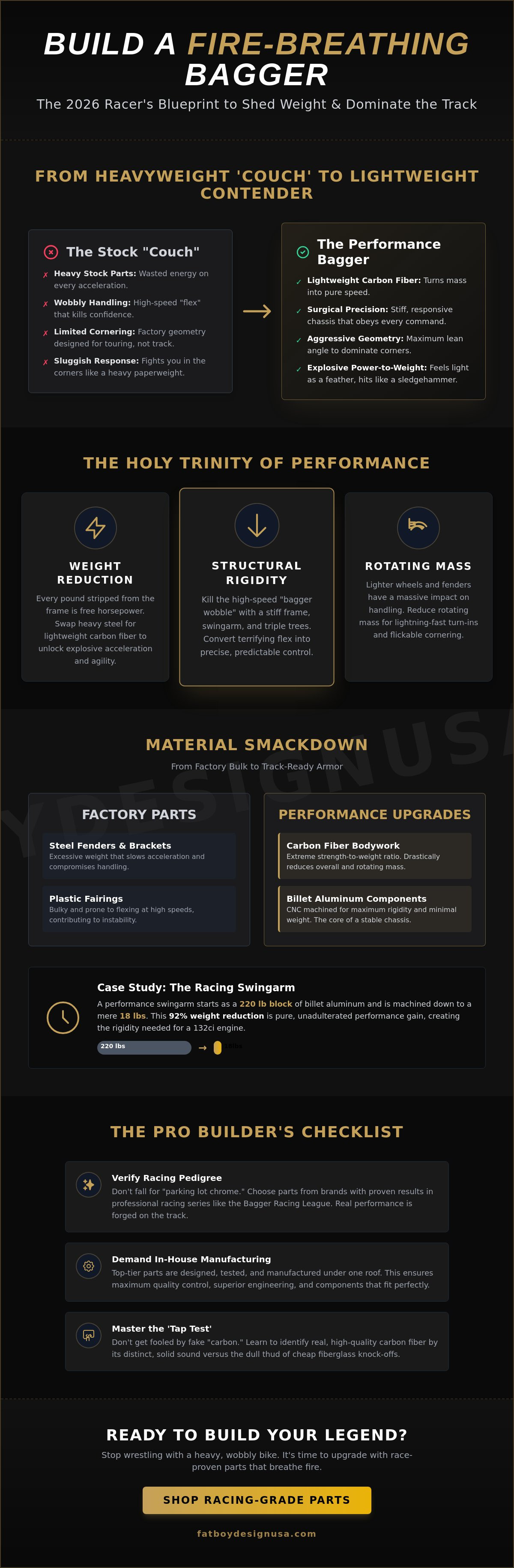
Every OEM steel fender and heavy plastic fairing is a weight tax you're paying on every acceleration. Factory tolerances are designed for the average rider, meaning they limit your cornering clearance to keep things "safe." But you aren't average. The racer’s mindset is about shedding the "couch" mentality. For example, a high-performance swingarm can be machined from a massive 220 lb block of billet aluminum down to a mere 18 lbs. That’s the kind of weight reduction that transforms a sluggish bagger into a dominant force. Don't let heavy, outdated parts dictate how you ride. It's time to reject the mundane and embrace the whimsy of pure speed.
The Holy Trinity of Performance: Weight, Rigidity, and Rotating Mass
Physics doesn't care about your feelings. It only cares about math. If you want to dominate the street, you need to understand the "Holy Trinity" of speed: shedding weight, killing flex, and minimizing rotating mass. When you’re hunting for what to look for in performance bagger parts, stop looking at the shiny bits and start looking at the scales. Every single pound you strip off that frame is essentially free horsepower. It’s the easiest way to make your bike breathe fire without even touching the engine. Heavy bikes are slow bikes. It's time to reject the bulk and embrace the lean, mean racing machine hiding under all that stock steel.
Rigidity is your next obsession. Your frame and swingarm shouldn't flex like a wet noodle when you're hitting triple digits. If your bike starts doing the "bagger boogie" in a high-speed sweeper, your components are failing you. You need parts that stay stiff under pressure. This ensures your tires stay planted and your line stays true. Then there’s rotating mass. This is the weight that actually has to spin, like your wheels and fenders. Reducing weight here has a massive impact on how fast your bike tips into a corner. It’s all about flickability. A lighter front end means you aren't wrestling a buffalo every time the road gets twisty.
Extreme Weight Reduction via Carbon Fiber
Carbon fiber is the ultimate weapon in the war against gravity. It’s not just for looks; it’s about survival on the track. When you compare high-end carbon fiber fenders to heavy stock steel, the difference is staggering. Removing that dead weight from the front end drastically improves your steering response. Your bike stops fighting you and starts listening. If you want to join the club of riders who actually know how to handle a machine, check out our harley davidson carbon fiber collection to see how light your ride can really be.
Crankshaft Balancing: The Secret to High-HP Longevity
High-torque M8 and Twin Cam engines are absolute beasts, but they can be their own worst enemies. If your crankshaft isn't precision balanced, it will literally try to shake your engine apart from the inside out. This isn't just about comfort. Excessive vibration leads to rider fatigue and catastrophic component failure. When evaluating performance-grade crankshafts, look for precision machining that can handle 150+ HP without breaking a sweat. A balanced engine is a happy engine, and a happy engine stays on the track longer. Don't settle for "good enough" when your engine's life is on the line. Precision is the rule; everything else is just noise.
Carbon Fiber vs. Fiberglass: Choosing the Right Armor
Don't get tricked by a pretty face. In the world of high-speed racing, looking fast is easy. Actually being fast? That’s where the engineering kicks in. When you’re hunting for what to look for in performance bagger parts, you need to know the difference between actual armor and cheap plastic masquerading as quality. Fiberglass is the ultimate imposter. It’s heavy, it’s brittle, and it shatters like glass when things get spicy on the track. Real carbon fiber is a whole different beast. It’s the difference between a champion and a chump. If you want to join the club of elite riders, you have to stop settling for "parking lot" chrome and start demanding structural integrity.
Try the "tap test" next time you're at a show. Give that fender a flick. If it sounds like a dull, wet cardboard box, you’re looking at cheap fiberglass. Real carbon fiber has a sharp, metallic ring to it. That sound is the vibration of high-tensile strength. In 2026, we’ve moved beyond the days of yellowing resins. Modern performance parts use UV-stable resins that stay crystal clear and rock hard for years. Don't buy a sticker when you need a structure. You want impact resistance that survives the track, not plastic that shatters the moment a pebble hits it at 80 mph. Embrace the whimsy of speed, but keep your armor serious.
Strength-to-Weight Ratios Explained
Carbon fiber boasts a tensile strength nearly five times that of steel while weighing only a fraction as much. This isn't just a fun fact for your next bike night. It’s the reason harley davidson carbon fiber side covers and dashes are essential for a 2026 build. They provide structural integrity that keeps your electronics safe while cutting the fat. Even better? Carbon fiber saddlebags are the cure for that annoying rear-end "wag" in high-speed sweepers. By reducing the mass hanging off the back of your frame, you keep the bike stable when you're pushing the limits. It's about total dominance of the road.
The FBD Difference: Racer-Tested Carbon
We don't do "good enough." At our headquarters in Matthews, NC, we’ve pioneered the art of the perfect build. Most guys use hand-laid fiberglass because it’s cheap and easy. We use vacuum-bagged construction because it’s the only way to ensure maximum strength. This process pulls out every bit of excess resin, leaving you with a part that is pure muscle and zero fluff. Our Platinum Series is the industry benchmark for a reason. It’s racer-tested and built for those who refuse to take life seriously but take their performance very, very personally. Stop taking the mundane path and upgrade to the gold standard.
Stability and Control: Evaluating Triple Trees and Swingarms
Stop fighting your bike. If your front end feels like it’s making its own decisions at 90 mph, your stock triple trees are likely the culprit. They’re the bridge between your hands and the asphalt. Don't settle for flex. When you're figuring out what to look for in performance bagger parts, rigidity is your best friend. In 2026, the game has changed. We aren't just cruising; we're carving. You need a setup that locks your forks into place and refuses to budge, no matter how hard you twist the throttle. It’s about total control. It’s about making the bike an extension of your own body. Don't let a lazy front end ruin your fun.
Triple Trees: Correcting the Geometry
Your stock trees are designed for comfort. They’re built to soak up bumps, not to handle the aggressive clamping required for high-speed stability. Increased clamping area is the secret sauce here. It prevents fork twist and keeps your front wheel exactly where you pointed it. This isn't just a minor tweak. It’s a foundational change that transforms how the bike tracks through a corner. For those ready to stop taking life so seriously and start taking corners faster, upgrading to structural bagger racing parts is the only way to go. Precision geometry is the difference between a wobbly ride and a rock-solid line.
The Performance Swingarm: Putting Power to the Pavement
If you're pushing over 120 HP, your stock swingarm is officially the weak link. It’s a stamped-steel relic that flexes under torque, leading to the dreaded "rear-steer" in corners. You need something rigid. The 2026 standard for performance is a billet aluminum swingarm. These beauties are often machined from a massive 220 lb block of aluminum down to a featherweight 18 lbs. This massive reduction in weight combined with extreme rigidity keeps your rear wheel planted. Look for race-spec bushings and bearings that can handle the heat. This is how you ensure every bit of that Screamin' Eagle 135ci power actually reaches the pavement. When you are narrowing down what to look for in performance bagger parts for your rear end, the swingarm is the ultimate upgrade.
Finally, let’s talk about your insurance policy. A high-speed tank slapper will ruin your day faster than a rainstorm at a bike show. Every performance build needs a steering damper. It’s the ultimate safety net for your 100+ mph adventures. Ensure your 2026 build has "true" compatibility. The new Road Glides and Street Glides require precise fitment that generic parts just can't match. Grab a harley touring performance steering damper kit to keep your front end steady and your confidence high. You deserve a ride that’s as stable as it is wild. It's time to reject the mundane and embrace the speed.
The Build Checklist: How to Spot Junk Before You Buy
Stop throwing money at "influencer" brands that just slap a logo on an overseas import. Understanding what to look for in performance bagger parts means looking past the marketing fluff. You need to be a skeptic. If a part looks like it was made for a showroom floor instead of a race track, it probably was. Don't let your bike become a victim of "parking lot" engineering. Real speed requires real vetting. Use this checklist to ensure your 2026 build actually performs when the light turns green. Reject the mundane. Demand the best.
- Verify the Pedigree: Has the manufacturer actually won on the track? If they aren't on the podium, they shouldn't be on your bike.
- Hunt for In-House Quality: Check if the parts are made in a local shop or just reboxed from overseas. Precision matters.
- Demand Real Data: Look for "racer-tested" claims backed by actual telemetry or track results, not just pretty photos.
- Test the Support: Can you talk to the person who actually engineered the part? Technical support should be a conversation, not a ticket.
- Function Over Chrome: If a part prioritizes "bling" over weight reduction or rigidity, walk away. Speed is the only aesthetic that counts.
The 13-Year Rule: Why Experience Matters
We've been at this for over 13 years. That’s over a decade of breaking things so you don't have to. There is a massive difference between a "designer" who likes how carbon looks and a "racer-engineer" who knows how it behaves at 140 mph. Every FBD design is born from a professional racing background. We test our bagger racing parts at the absolute limit before they ever hit the store. This ensures that when you're pushing your machine, your hardware isn't the weak link. Experience isn't just a number; it’s your safety net at high speeds.
Final Build Integration
A true performance bagger isn't a collection of random parts. It’s a cohesive ecosystem. You can’t just bolt on a massive engine and hope for the best. You need to balance that power with control. Combine our lightweight carbon fiber fenders with a high-performance steering damper kit for a total front-end overhaul. This strategy reduces front-end dive and eliminates high-speed wobbles simultaneously. It’s about building a machine that works together. Ready to stop taking life so seriously and start dominating the asphalt? Start your performance build with Fat Boy Design USA today!
Dominate the Asphalt: Your 2026 Racing Legacy Starts Now
You’ve got the blueprint. Now, it’s time to execute. We’ve covered why shedding that "couch" weight and choosing rigid, racer-tested components are the only ways to survive at triple digits. Remember, knowing what to look for in performance bagger parts isn't just about reading a spec sheet. It's about the soul of the machine. You need parts that have survived the heat of the track, not just a flashy marketing meeting. From the "Holy Trinity" of mass reduction to the precision of billet swingarms, every choice you make defines your presence on the road. Don't let your bike be another generic clone in the parking lot.
Stop settling for mediocre imports when you can have gear born from 13+ years of professional racing experience. We manufacture every piece right here in Matthews, NC, ensuring quality that actually holds up under fire. As the King of Carbon Fiber, we deliver the unmatched strength-to-weight ratios that turn heavy touring bikes into fire-breathing monsters. It’s time to stop taking life so seriously and start taking your build personally. Grab your gear, twist the throttle, and leave the mundane in your rearview mirror.
Build Your Fire-Breathing Bagger with FBD Parts
See you at the finish line. It’s going to be a wild ride.
Frequently Asked Questions
What is the single most important performance upgrade for a Harley Bagger?
Shedding weight is the absolute king of upgrades. Swapping out your heavy stock steel for carbon fiber bodywork is the fastest way to transform how your bike feels. It improves acceleration, braking, and flickability all at once. When you are researching what to look for in performance bagger parts, always prioritize components that slash mass while boosting rigidity. Less bulk means more fire on the asphalt.
Does carbon fiber really make a difference on a heavy touring bike?
Absolutely. Carbon fiber isn't just for tiny sportbikes; it transforms heavy tourers by killing mass where it hurts most. Removing weight from high points like the dash or front fender lowers your center of gravity significantly. It makes a 900 pound beast feel like a nimble dancer in the twisties. Stop lugging around dead weight and start enjoying a bike that actually responds to your input.
Why do performance baggers need different triple trees than stock?
Stock trees are built for lazy cruising, not aggressive carving. Performance racing triple trees provide a massive increase in clamping area to prevent fork twist under heavy loads. This keeps your front end rock solid during high speed cornering or hard braking. You want surgical precision, not a front end that feels like a vague suggestion. It’s the bridge between your hands and total road dominance.
How much weight can I actually save with carbon fiber parts?
You can strip off dozens of pounds by ditching OEM steel and plastic. A billet racing swingarm can weigh as little as 18 pounds, which is a massive reduction from the heavy stock units. Complete carbon fiber kits for 2024 to 2026 models can drop significant weight across the entire chassis. Every ounce you remove is a direct victory for your power to weight ratio and overall speed.
Can I install performance bagger parts myself or do I need a shop?
It depends on your wrenching skills and the tools in your garage. Bolting on carbon fiber side covers or a dash is usually a fun afternoon project for most riders. However, critical structural components like racing swingarms or triple trees require precision and specific torque settings. Check your own comfort level and local technical resources before diving into the more complex mechanical upgrades on your machine.
What is the 'wobble' people talk about in Harley performance builds?
The "bagger wobble" is a terrifying high speed oscillation caused by chassis flex. It usually happens when stock rubber mounts and thin swingarms can't handle the torque of a high horsepower engine. Upgrading to rigid racing parts like a performance swingarm kills this ghost in the machine. Stay steady and stay fast by ensuring your bike has the structural integrity to handle the heat.
Is a performance swingarm necessary for a street-only bike?
Yes, if you value your safety and your cornering precision. Even on the street, a performance swingarm eliminates "rear steer" and keeps the bike tracking straight through high speed sweepers. It is an essential piece of what to look for in performance bagger parts for anyone pushing over 120 horsepower. Don't let a flexy rear end dictate your line when you are trying to have a good time.