

When to Replace a Damaged Carbon Fiber Fender: Safety vs. Style
In the world of high-performance baggers, "good enough" is a death wish. If your carbon fiber weave is breached at a mounting point, it is trash; period. You love that shimmering weave, but that new spiderweb crack is haunting your dreams. You are likely wondering exactly when to replace a damaged carbon fiber fender before it decides to exit the chat at 80 mph. It is a classic dilemma. Do you drop $400 on a professional repair? Or do you pull the trigger on a brand-new piece of eye candy?
I know the feeling. You want to ride hard without worrying about your fender shattering into expensive shrapnel. You deserve a bike that looks as fast as it feels. This article will teach you how to spot the difference between a simple surface scuff and a total structural failure. We will break down a clear decision-making framework based on 2026 safety standards. Get ready to ride with total confidence or finally find the perfect excuse to upgrade your beast.
Key Takeaways
- Spot the difference between a harmless scuff and a lethal structural breach that turns your fender into a liability.
- Master the "Tap Test" and light-shadow tricks to reveal hidden delamination before it shatters at highway speeds.
- Use the 50% Rule to determine exactly when to replace a damaged carbon fiber fender instead of settling for a sketchy repair.
- Learn how V-twin vibrations act like a ticking clock for micro-cracks, making structural integrity non-negotiable for Baggers.
- Upgrade with confidence by choosing performance parts engineered for high-speed racing and maximum visual dominance.
Battle Scars or Fatal Blows? Diagnosing Carbon Fiber Fender Damage
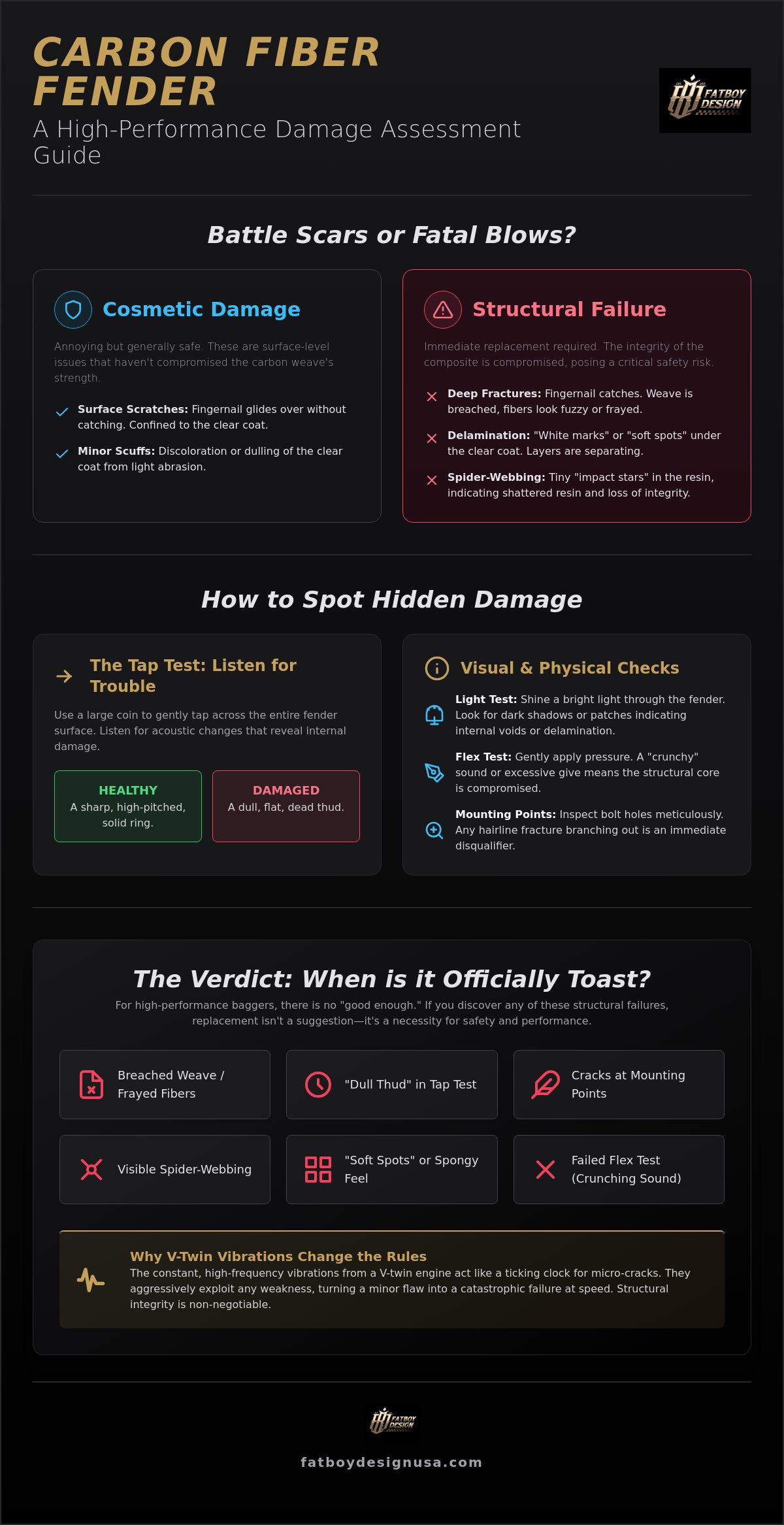
Your bike is a masterpiece, but that rock chip just tried to ruin your vibe. Don't panic yet. Most riders freak out over a tiny nick, but you need to know the difference between "patina" and "impending doom." If you see a "white mark" hiding under the clear coat, that isn't just a smudge. It is a sign that the layers are quitting on you. This is called delamination, which is the separation of internal layers within the composite. If you press on the weave and feel a "soft spot," your fender is effectively a noodle. It is no longer a structural component; it is a safety hazard. Knowing when to replace a damaged carbon fiber fender starts with admitting that looks aren't everything. Safety is the real king of the road.
Surface Scratches vs. Deep Fractures
Run your fingernail across the mark. Does it catch? You have breached the clear coat. This is annoying, but it is usually fixable with some buffing and a prayer. However, if you see the actual black fibers looking fuzzy or frayed, you have a breach of the carbon cloth. At this point, moisture and road grime start eating the part from the inside out. While some Composite repair techniques can patch things up, they often add weight and look like a bad scar. If you are pushing a performance bagger racer carbon fiber front fender to its limits, "patched" isn't in your vocabulary. You want perfection, not a Frankenstein part.
The Danger of Spider-Webbing
Spider-webbing in the resin is like a warning shot. Those tiny "impact stars" mean the resin has shattered even if the fibers are still holding on. In the brutal heat of a North Carolina summer, those cracks expand. They breathe. They grow. UV rays are the silent killer here, too. They sneak into those cracks and degrade the bond between the resin and the fiber. Before you know it, that "little crack" becomes the reason your fender decides to part ways with your bike at triple-digit speeds. Deciding when to replace a damaged carbon fiber fender comes down to one question: do you trust your life to a spider web? If the resin is compromised, the structural integrity is gone. Don't wait for a catastrophic failure to tell you what you already know. Upgrade the beast and ride without the anxiety.
The Tap Test and Beyond: How to Spot Hidden Delamination
Your fender might look like a million bucks on the surface, but carbon fiber is a master of disguise. It hides its trauma deep within the layers. You need to become a detective to find those invisible killers before they find you. Start with the "Tap Test." Grab a large coin, maybe a quarter, and start tapping. A healthy carbon fiber part will give you a sharp, high-pitched ring. It sounds alive. If you hit a spot that gives you a dull, flat thud, you have found a void. That is delamination. It means the internal layers have quit talking to each other. Deciding when to replace a damaged carbon fiber fender often comes down to these acoustic secrets. If it sounds dead, it is dead.
Don't stop at the sounds. Your mounting holes are the absolute danger zone. These areas handle the most stress and vibration from your V-twin beast. Inspect them with a magnifying glass if you have to. Any hairline fracture branching out from a bolt hole is an immediate disqualifier. While some academic research on composite repair methods highlights the complexity of fixing these stress points, the reality for a rider is simple. A compromised mount will eventually fail. You don't want your fender ghosting you in the middle of a tight corner. Give the part a firm flex test, too. If the fender gives too much or makes a "crunchy" sound under pressure, the structural core is toast.
Acoustic Testing for the Garage Mechanic
Mapping the damage is a pro move. Use a silver Sharpie to lightly circle the areas where the sound changes from a ring to a thud. Compare the damaged side of your fender to the healthy side. The complex curves of a front fender can change the pitch, but the "quality" of the sound should remain crisp. If you find a large "dead zone" that spans more than an inch, you are looking at a serious structural compromise. It is time to stop gambling with your safety and start looking at a fresh bagger racing carbon fender to restore your peace of mind.
Visual Translucency Checks
Grab the brightest flashlight you own. Turn off the shop lights and shine that beam through the underside of the fender. You are looking for "shadows" or dark patches where the light doesn't pass through evenly. These are often internal air pockets or "dry spots" where the resin never bonded correctly or has since failed. Consistent, beautiful weave patterns that let light through uniformly are the hallmark of King of Carbon Fiber quality. If your current part looks like a cloudy mess under the light, it is a sign of poor manufacturing or hidden impact damage. Don't settle for "maybe" when it comes to your gear. If you see shadows, it is time to move on.
Repair vs. Replace: When Your Harley Fender is Officially Toast
Let's talk money and ego. You have diagnosed the damage. Now you're staring at a repair bill that looks like a mortgage payment. Here is the golden rule: the 50% Rule. If the cost of professional repair labor hits half the price of a brand-new part, stop. Just stop. You are throwing good money after bad. Professional carbon repair for a major fracture can cost between $700 and $1,200 or more. Meanwhile, a top-tier Platinum Series part gives you that factory-fresh glow without the headache of a "patched" look. Choosing when to replace a damaged carbon fiber fender is about math as much as it is about style.
Thin-wall fenders are notorious for looking like "franken-parts" after a structural fix. To restore strength, technicians have to add layers. This adds bulk. It ruins the sleek profile you paid for. Then there is "ghosting." Even if the repair is smooth, the sun will eventually reveal the patch through the clear coat. It looks cheap. It looks like you're trying too hard. If you care about visual dominance, a repair is often a dead end. Your bike deserves better than a second-hand look. Don't settle for a compromise that stares back at you every time you park.
The 'Point of No Return' Checklist
Some damage is simply non-negotiable. If your fender hits any of these marks, it's garbage. Don't argue. Just replace it. Your safety is worth more than a few saved bucks.
- Edge Cracks: If a crack reaches the edge of the part, the structural "hoop" is broken. It will keep spreading no matter how much epoxy you slap on it.
- Hardware Inserts: If the metal mounting inserts are loose or the carbon around them is crushed, the part is done. You can't safely torque a bolt into a crushed core.
- Multi-directional Fractures: Impact damage that looks like a starburst means the internal fibers are shattered in every direction. It is a ticking time bomb.
Cosmetic Fixes You Can Actually Live With
Not every nick is a death sentence. If you have light clear coat scuffs that don't catch your fingernail, buff them out. A professional re-clear can even breathe new life into a dull, sun-faded part. But here is the catch: never hide a crack with a sticker or paint. That's a coward's move. It doesn't fix the structural failure; it just hides the evidence until the part shatters at high speeds. If the damage is deeper than the clear coat, it is time to realize when to replace a damaged carbon fiber fender for the sake of your own skin. Level up to a harley davidson carbon fiber upgrade and leave the "franken-parts" for the amateurs.
Why Racing Stress and V-Twin Vibrations Change the Rules
Harley engines aren't subtle. They are big, loud, and they shake with a purpose. Whether you're rocking a Milwaukee-Eight or a classic Twin Cam, that V-twin rhythm creates a massive amount of harmonic energy. To a carbon fiber part, your bike is basically a giant tuning fork. This is why deciding when to replace a damaged carbon fiber fender is so critical for Bagger riders. A micro-crack that might survive on a smooth-as-glass sportbike will be hammered into a total structural failure by Harley vibrations within a few hundred miles. The constant thumping acts like a wedge, driving that crack deeper with every stroke of the piston.
When you hit 100 mph on the track or the highway, the physics change. Your front fender isn't just sitting there looking pretty. It is fighting against a wall of air. At high speeds, a compromised fender can flutter. This flutter leads to rapid fatigue. Unlike aluminum or steel, carbon fiber doesn't give you the courtesy of a dent. It is a brittle material. When it fails, it shatters. You don't want a cloud of carbon shards entering your front tire at triple-digit speeds. That is a one-way ticket to a very bad day. If you see structural damage, the clock is ticking.
Harmonic Resonance and Carbon Fatigue
Every part has a natural frequency where it likes to vibrate. When you patch a fender, you change its density in one specific spot. Now, the repaired section has a different resonance than the rest of the part. As the engine revs, those two sections fight each other. This creates internal stress right at the bond line. Add in the thermal expansion of a hot summer day, and that repair can literally "pop" off. It's not just about the crack; it's about the entire part losing its ability to handle the bike's natural rhythm.
Performance Bagger Safety Standards
In a competitive environment, "good enough" gets people hurt. We build our bagger racing parts to withstand extreme loads that would turn cheap knock-offs into dust. Racer-tested parts must be 100% defect-free to handle the G-forces of hard cornering and high-speed stability. Knowing when to replace a damaged carbon fiber fender in a racing context is the difference between a podium and a tow truck. If you're running a performance bagger racer carbon fiber front fender with even a hint of structural damage, you are inviting a disaster. The liability of a mid-race failure is too high. Stop gambling with your skin and upgrade to harley davidson carbon fiber components that are actually engineered for the abuse.
Level Up: Replacing Your Fender with FBD Platinum Series Carbon
You have done the tap tests. You have checked the shadows. Now you are standing at the finish line of the decision-making process. Admitting when to replace a damaged carbon fiber fender is the first step toward reclaiming your bike's dignity. Don't let a "franken-part" repair kill your vibe or your resale value. It is time to graduate to something that actually belongs on a high-performance machine. We don't just sell parts; we engineer them in Matthews, NC. This isn't some mystery weave from a factory that also makes lawn furniture. Our in-house manufacturing means we control every single thread of that carbon. You get a part designed to handle the brutal vibrations of a Harley-Davidson without breaking a sweat.
Installation is where most people mess up. If your new fender is slightly crooked, you are pre-loading it with stress. Alignment is everything. Ensure your mounting points are clean and your hardware is torqued to spec. Once that shimmering weave is bolted on, protect it like your life depends on it. A high-quality ceramic coating will block UV rays from degrading the resin. For the real road warriors, a layer of paint protection film (PPF) is a game changer. It stops rock chips before they turn into the "impact stars" we discussed earlier. Treat your carbon like the investment it is.
The Platinum Series Advantage
Aesthetics matter. If the weave is wonky, your whole bike looks off. Our Upper Carbon Platinum Series offers perfect symmetry that hits like a shot of adrenaline. It is visual dominance in its purest form. Plus, we offer pre-drilled precision for a "no-headache" install. You shouldn't need a dremel and a prayer to fit an aftermarket part. Our fenders are designed to drop on and bolt up. This ensures the structural integrity remains 100% intact from the moment you leave the garage.
Ditch the Junk, Join the Club
Repaired carbon is a massive red flag for any future buyer. It screams that you went cheap on a critical safety component. This kills your bike's resale value and your street cred. Joining the FBD club means you value performance over "good enough." You get the peace of mind that comes with a racer-tested component that won't shatter when you hit a pothole at speed. Stop gambling with your skin and your style. Knowing when to replace a damaged carbon fiber fender is about knowing your worth as a rider. Ready to stop worrying? Grab a fresh Carbon Fiber Front Fender here.
Stop Gambling and Start Riding
You have the tools now. You know the "dead thud" of a delaminated part and the danger of those spider-web resin cracks. Don't let your V-twin's harmonics turn a minor flaw into a highway disaster. Deciding when to replace a damaged carbon fiber fender isn't just about preserving your bike's resale value. It's about trusting your machine when you're pinned at triple digits. We have spent over 13 years in the professional racing world proving that "good enough" is a myth. Our gear is racer-tested for high-speed stability and manufactured right here in North Carolina to ensure every weave is a masterpiece.
Ditch the anxiety and the sketchy epoxy patches. You deserve a fender that looks as aggressive as it performs. Join the club of riders who refuse to settle for second-best. It's time to upgrade your front end with the confidence only a pioneer can provide. Upgrade to a FBD Performance Bagger Carbon Fender Today and get back to what really matters. Your bike is waiting for its crown. Let's get to work and keep the rubber side down.
Frequently Asked Questions
Can I use epoxy to fix a cracked carbon fiber fender myself?
You can buy a DIY kit for $50 to $200, but don't expect a miracle. These kits are fine for small cosmetic patches on non-critical parts. However, they rarely restore the structural integrity needed for high-speed riding. If you are debating when to replace a damaged carbon fiber fender, remember that a home-made epoxy job usually looks like a mess and can fail under the heavy vibrations of your Harley.
How much does it cost to professionally repair carbon fiber?
Professional repairs typically range from $350 to over $1,200 depending on how bad you beat it up. Minor surface scratches usually sit at the lower end of that scale. If you have a major fracture, you are looking at a bill that often exceeds the cost of a brand-new part. Always get a quote first; but if the repair hits 50% of the replacement cost, it's time to upgrade.
Is it safe to ride with a scratched carbon fiber fender?
Scratches in the clear coat are perfectly safe and purely an eyesore. Use the fingernail test we mentioned earlier. If your nail doesn't catch, you are just looking at a scuff. If the scratch is deep enough to reveal fuzzy black fibers, the structural core is exposed to moisture and UV rays. That is a safety hazard that needs immediate attention before it shatters.
What does delamination look like on a Harley fender?
Look for weird white "ghost" marks or cloudy patches hiding under the clear coat. This is a sign that the internal layers have separated. It often feels soft when you press on it or gives off a dull thud during a tap test. Since Harley engines create massive harmonic resonance, delamination is a one-way ticket to a catastrophic part failure on the highway.
Will a damaged fender affect my bike's stability at high speeds?
Absolutely. A cracked or fluttering fender changes the aerodynamics of your front end. At 100 mph, that damaged part is fighting a wall of air. If it loses its stiffness, it can catch wind in unpredictable ways or even contact your tire. Knowing when to replace a damaged carbon fiber fender is vital because a mid-ride failure can lead to an immediate loss of control.
How do I know if my carbon fiber fender is structural or just decorative?
On a performance bagger, your fender is always structural. It is bolted directly to your forks and acts as a bridge that handles wind load and vibration. If the part helps hold your bike's profile together or protects your tire from debris, it isn't just for show. Decorative parts are things like dash inserts; fenders are hard-working components that must be 100% intact.
Does insurance usually cover carbon fiber part replacement?
Most policies cover carbon fiber if it was damaged in a documented accident. However, you should check if you have "Custom Parts and Equipment" (CPE) coverage. Standard policies might only cover the cost of a basic plastic OEM fender. In states like California, property damage liability minimums are $15,000 as of 2025, so make sure your expensive carbon is specifically listed on your plan.
Why is carbon fiber better than fiberglass for Harley fenders?
Carbon fiber offers a much higher stiffness-to-weight ratio than fiberglass. This means it can handle the brutal thumping of a V-twin engine without the extra bulk. Fiberglass is heavy and tends to spider-web and crack much faster under high-frequency vibrations. Carbon fiber stays rigid and lightweight, which is why it is the gold standard for anyone serious about bagger racing or high-end style.