

Why Use Carbon Fiber for Bagger Racing? The Secret to Dominating the Track
A 900-pound bagger has no business leaning 50 degrees into a corner, yet here we are. You’re wrestling a literal couch around the track. You're fighting the physics of a machine built for interstate cruising rather than aggressive apex hunting. So, why use carbon fiber for bagger racing? Because you’re sick of your bike feeling like a wet noodle when you’re hunting for a podium. Stock components are heavy. They're lazy. They're prone to the kind of high-speed flex that turns a sweeper into a terrifying prayer session.
We know the struggle. You want the soul of a Harley but the agility of a scalpel. This article promises to show you how high-performance carbon fiber transforms your touring beast into a track-shredding monster. We'll explore the magic of slashing dead weight and amping up rigidity. We’ll dive into how cutting-edge parts like carbon fiber saddlebags and racing triple trees deliver faster lap times and that aggressive factory racer aesthetic. Stop fighting your bike’s bulk. Start dominating the competition with gear that’s actually racer-tested and built for pure, high-speed enjoyment.
Key Takeaways
- Slash the bulk and fix your power-to-weight ratio; losing 50lbs of dead weight often beats chasing 10 extra horsepower.
- Master the physics of unsprung weight to stop your suspension from fighting the road and start hunting apexes.
- Stop settling for "cheap" fiberglass and learn why use carbon fiber for bagger racing to kill mid-corner flex and vague steering.
- Follow our front-end-first blueprint to upgrade fenders and fairings for immediate, track-ready flickability.
- Trust the "King of Carbon Fiber" with racer-tested parts baked in-house in North Carolina for maximum durability.
Weight is the Enemy: Why Racing 900lb Motorcycles Demands Carbon Fiber
Let's be real. Taking a 900-pound Harley to a racetrack is objectively hilarious. It's like bringing a couch to a knife fight. These bikes were engineered to eat interstate miles while you cruise in comfort, not to scrape floorboards at 100 mph. But when you strip away the fluff and replace it with Carbon-fiber-reinforced polymer, the physics of the entire machine shifts. Suddenly, that "lazy" touring bike starts acting like a caffeinated predator.
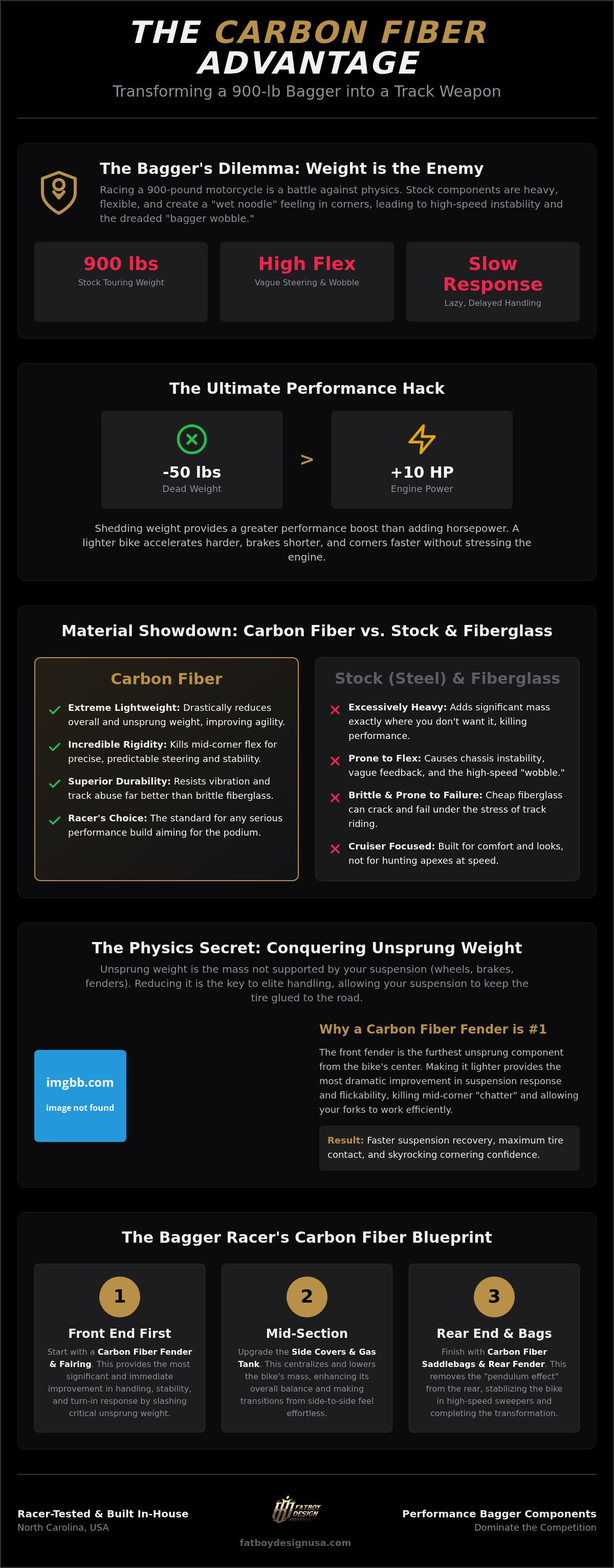
Most guys think the answer to speed is always more horsepower. They'll spend thousands on cams and big bore kits just to squeeze out another 10 ponies. Here is the secret: losing weight is significantly better than adding power. It's the ultimate power-to-weight ratio hack. When you ask why use carbon fiber for bagger racing, it's because every pound you shed makes your bike accelerate harder, stop shorter, and turn faster without stressing the engine. Research shows a complete carbon fiber kit can save over 11 pounds on a Harley-Davidson Touring model, which is a massive win when you're fighting gravity in a high-speed turn.
Excess weight is a tire and brake killer. When you're diving into a hairpin, that 900-pound momentum wants to keep going straight. Your brake pads turn into charcoal and your front tire begs for mercy. Reducing that mass with harley davidson carbon fiber components saves your consumables and keeps you on the track longer. We’re embracing the "stupid" fun of this sport, but we’re doing it with serious North Carolina engineering.
Breaking the Touring Bike Stereotype
"Heavy" is a choice, not a life sentence. You don't have to accept a sluggish ride just because you have saddlebags. A lightweight, responsive machine gives you a massive psychological edge. When you flick the bars and the bike actually moves without a half-second delay, your confidence skyrockets. We're rejecting the mundane cruising lifestyle. We're here for the high-speed adrenaline that only a diet of carbon fiber can provide. It's about turning a "bagger" into a "racer" without losing the soul of the bike.
The Physics of the Bagger 'Wobble'
Ever felt that terrifying high-speed shimmy? That's the "pendulum effect" of heavy stock parts oscillating under stress. Reducing mass at the ends of your bike stops that oscillation before it starts. This is why carbon fiber is the mandatory first step for any serious performance bagger build. It kills the wobble and lets you focus on the finish line. By replacing a heavy stock fender with a racer-tested carbon version, you're not just saving weight; you're stabilizing your entire front end for the most aggressive cornering possible.
The Physics of Performance: Unsprung Weight and Rotational Mass
Physics is a cold, hard mistress. She doesn't care how much chrome you’ve polished or how loud your exhaust screams. She only cares about mass and where it sits on your machine. When you ask why use carbon fiber for bagger racing, the answer starts at the axles. Most riders obsess over total bike weight, but the real magic happens when you target unsprung weight. This is the stuff hanging off your suspension rather than sitting on top of it. If these parts are heavy, your bike handles like a shopping cart with a bad wheel.
Unsprung weight is every component not supported by your springs, and reducing it dramatically slashes suspension recovery time, allowing your tires to track the pavement with surgical precision. Every ounce you shave from the front end allows your forks to work less. It lets them focus on keeping the rubber on the road instead of wrestling with a heavy steel fender. This is exactly why a performance bagger racer carbon fiber front fender is the single most important upgrade for any track build. It’s the furthest point forward and the first thing that has to move when you hit a bump.
Suspension Synergy
Your high-end suspension upgrades are only as good as the parts they’re controlling. If you’ve spent thousands on racing cartridges but kept the stock heavy fenders, you’re sabotaging your own lap times. A lightweight carbon fender helps your forks keep the tire glued to the track during high-speed sweepers. It kills that annoying mid-corner "chatter" that makes you want to roll off the throttle. Scientific breakthroughs in strengthening carbon-fiber composites mean these parts are now tough enough to handle the brutal vibrations of a racing environment without cracking. You get all the rigidity of steel with a fraction of the burden.
Flickability: Making a Giant Dance
Then there’s the "Gyroscope Effect." Even though a fender doesn't spin like a wheel, it’s part of the front-end assembly that has to pivot every time you steer. Heavy front ends want to stay upright. They fight you at the entrance of every turn. By swapping to carbon fiber, you reduce the effort required to tip that 900-pound beast into a corner. It makes the bike feel 200 pounds lighter than it actually is. You stop wrestling the bars and start guiding them. If you want to see how this feels on your own build, check out our collection of bagger racing parts to start shedding the dead weight that’s holding you back.
Carbon Fiber vs. Fiberglass: Why 'Cheap' Parts Fail on the Track
Don't get it twisted. There is "look-at-me" carbon and "win-at-all-costs" carbon. If you're buying cheap fiberglass parts or thin overlays from a random auction site, you're just adding glitter to a grenade. Fiberglass is the king of flex. When you're pinned mid-corner, that cheap fairing or fender is twisting like a licorice stick. That flex translates to vague, mushy steering feedback that makes you guess where your front tire actually is. This is exactly why use carbon fiber for bagger racing. You need rigidity that doesn't quit when the G-loads get real.
Racing isn't a parking lot show; it's violent. Impacts that would shatter plastic or cheap composites barely phase high-grade carbon fiber. Then there's the heat issue. Your V-twin is a literal furnace. Engine-adjacent parts like side covers or dashes take a thermal beating. While fiberglass starts to bake and become brittle, carbon fiber maintains its structural integrity and dissipates heat like a pro. It stays cool, stays light, and stays in one piece when you’re pushing the limits.
The Strength-to-Weight Showdown
Carbon fiber is roughly five times stronger than steel but weighs a mere fraction of it. We're talking about incredible tensile strength that keeps your bike stable under massive pressure. When you're leaned over at 45 degrees, every component is screaming under the load. Understanding the physics of carbon fiber helps you realize why it’s the only choice for survival on the circuit. Our harley davidson carbon fiber isn't just for aesthetics; it's racer-tested to ensure your bike stays stiff and predictable when the track gets nasty.
Vibration Damping: The Racer's Secret
Metal is a snitch. It amplifies every high-frequency vibration from the engine and the track, sending it straight into your palms. Carbon fiber acts like a natural filter. It absorbs that high-speed buzz, significantly reducing rider fatigue during long, grueling track sessions. Think of it as high-fidelity audio for your hands. You get better feedback through the bars without the bone-shaking numbness that kills your grip. It turns the track into a clear conversation rather than a shouting match, allowing you to feel the exact moment your tire starts to slide.
The Bagger Racer's Blueprint: Where Carbon Fiber Matters Most
Building a race bike isn't just about throwing a catalog at your Harley and hoping for the best. You need a plan. You need to start where the weight is most offensive. If you're still asking why use carbon fiber for bagger racing, it's because you want to be surgical about where you shed the pounds. We follow the "Front-End First" rule. If the front of your bike is heavy, your steering is lazy. It’s that simple. By swapping out stock fenders and fairings, you’re fixing the bike’s personality before you even touch the engine.
But the blueprint doesn't stop at the forks. For a truly balanced machine, you have to look at structural upgrades. Integrating bagger racing parts like a carbon-integrated swingarm or high-performance triple trees provides the rigidity needed to hold a line when the pavement gets rough. It’s about creating a cohesive unit that doesn't flex, doesn't wobble, and doesn't quit. You can find everything you need to start your transformation by browsing our full range of performance bagger racing parts today.
The Front Fender: The Ultimate Gateway Drug
The Performance Bagger Racer Front Fender is the undisputed #1 upgrade for any builder. It’s the gateway drug to a full carbon addiction. Beyond the massive weight savings we’ve already covered, you’re getting serious aerodynamic benefits. A tight, racing-profile fender reduces drag and keeps the air moving exactly where it needs to go. It’s instant gratification. You see the weave. You feel the flickability. You suddenly realize that your bike was holding you back this whole time.
Saddlebags: From Luggage to Aero-Foil
Stock saddlebags are heavy, clunky, and honestly, they're in the way. Swapping to carbon fiber saddlebags and lids can drop 20 or more pounds from the rear of the bike. This isn't just about total weight. It's about moving that mass away from the rear center of gravity. Lightweight bags improve your lean angle clearance. They let you get lower in the corners without grinding your expensive paint into the asphalt. Plus, that exposed carbon weave is a badge of honor. It tells everyone in the paddock that you’re not just here for the cruise; you’re here to win.
Fat Boy Design USA: The King of Carbon Fiber for a Reason
Fat Boy Design USA isn't just another name in a crowded catalog. We're the "King of Carbon Fiber" because we actually live in the paddock. While other companies are busy drafting spreadsheets, we're in Matthews, North Carolina, getting our hands dirty. We don't just sell this stuff. We bake it. Every part we produce is manufactured in-house to ensure it meets the brutal standards of professional competition. When you ask why use carbon fiber for bagger racing, you're asking for a part that won't quit when you're pinned at 120 mph. We deliver exactly that.
Our team brings over 13 years of professional racing experience to the table. This isn't a hobby; it's a heritage. We've taken everything we learned on the track and poured it into our Upper Carbon Platinum Series. These are exclusive components for the riders who refuse to lose. We've already talked about slashing weight and killing the wobble. Now, it's about trusting the source. You want gear that has been proven on tracks across the country by guys who actually know what a high-side feels like.
Racer-Tested, Not Just 'Show' Approved
There is a massive difference between looking fast and being fast. Most carbon on the market is built for the parking lot. It's thin, it's brittle, and it's purely for show. Fat Boy Design builds for the finish line. Our racing background is your biggest performance advantage because we know where parts fail under pressure. FBD's in-house testing makes their carbon fiber 'King' of the track because every component is born from 13 years of professional racing abuse and refined under the heat of actual competition in Matthews, NC. We break things so you don't have to.
Join the Club: Stop Taking Life So Seriously
Racing a 900-pound bagger is supposed to be fun. It’s loud. It’s chaotic. It’s glorious. We’re here to help you build a bike that makes you grin every time you twist the throttle. The FBD community is irreverent, bold, and consistently faster than the guy next to them. This is your formal invitation to join the club. Reject the mundane cruising life. Embrace the carbon revolution. Stop settling for stock parts that hold you back and start running the gear that turns your touring bike into a track-shredding monster. The podium is waiting; let’s go get it.
Stop Racing a Couch and Start Hunting Podiums
Physics is a bully, but you finally have the tools to fight back. We’ve covered how slashing unsprung weight turns your front end into a laser-guided weapon. We’ve exposed why "cheap" fiberglass is just a recipe for mid-corner wobbles. Now you know exactly why use carbon fiber for bagger racing: because you’re done wrestling a 900-pound beast and ready to actually ride it. It’s about the surgical precision that only comes from losing the dead weight.
Don't settle for generic junk. Our gear is hand-crafted right here in Matthews, North Carolina. We back every weave with 13+ years of professional racing expertise. Whether you’re eyeing our Platinum Series exclusive performance or a full track overhaul, we’ve got the racer-tested parts to make it happen. Stop taking life so seriously and start taking your lap times personally. Upgrade to the King of Carbon Fiber: Shop FBD Racing Parts Now! Go out there, twist that throttle, and leave the competition in your dust. You’ve got a podium to claim.
Frequently Asked Questions
Is carbon fiber safe for a Harley that I also ride on the street?
Carbon fiber is perfectly safe for street use and often exceeds the strength of OEM plastics. Our parts are born in a racing environment, so they're engineered to survive more than just a casual Sunday cruise. They handle vibrations and road debris with ease. You get the benefit of a lighter bike without sacrificing the structural integrity needed for daily adventures on the pavement.
How much weight can I actually save by switching to carbon fiber saddlebags?
You can typically save over 20 pounds by ditching heavy stock luggage for carbon fiber saddlebags and lids. This is a massive reduction in rear-end mass. By shedding that weight, you stop the "tail-wagging-the-dog" effect during aggressive cornering. It makes your Harley feel much more balanced and responsive when you're transitioning between turns on the track or the street.
Does carbon fiber require special maintenance compared to painted parts?
Maintenance is simple and mostly involves protecting the high-gloss finish from UV rays. Treat your carbon parts like a premium paint job by using a high-quality wax or ceramic coating. This prevents the resin from yellowing over years of sun exposure. Avoid using harsh, abrasive chemicals that could scratch the surface. A little basic care keeps that "factory racer" look shining for the long haul.
Why is carbon fiber so much more expensive than fiberglass?
Carbon fiber costs more because the manufacturing process is vastly more complex and energy-intensive than fiberglass. We use an autoclave to "bake" the parts under high pressure, ensuring maximum strength and zero air bubbles. Fiberglass is a budget-friendly alternative, but it's heavy and prone to flexing. If you want the best power-to-weight ratio, carbon fiber is the only serious choice for performance.
Can carbon fiber parts be painted, or do I have to leave the weave exposed?
You can absolutely paint carbon fiber parts if you prefer a specific color scheme over the raw weave. Many builders choose to paint the majority of the part while leaving small "windows" of exposed carbon to prove it's the real deal. It takes primer and automotive paint just like any other composite material. Just make sure your painter knows it's carbon to ensure the best possible adhesion.
What happens if I crash with carbon fiber parts—can they be repaired?
Structural damage usually requires a full replacement to maintain safety, but surface scratches are easily repairable. Unlike metal, carbon fiber doesn't bend or dent; it maintains its shape until it reaches a breaking point. In a racing crash, this material is designed to absorb energy. If you see cracks or delamination, it's time to swap the part out to ensure your bike remains track-legal and safe.
Do I need to adjust my suspension after installing lightweight carbon parts?
You should absolutely recalibrate your suspension settings to account for the significant loss of unsprung weight. Your forks and shocks will rebound much faster because they aren't fighting the momentum of heavy stock components. A quick session with a suspension tuner will help you dial in the damping. This ensures your tires stay glued to the track after you've lightened the load.
Which carbon fiber part gives the best 'bang for the buck' performance-wise?
The front fender is the hands-down winner for the best performance-per-dollar upgrade on any bike. This is the primary reason why use carbon fiber for bagger racing as your first move. It slashes unsprung weight at the most sensitive part of the steering geometry. You'll feel the difference in flickability and front-end feedback the second you tip into your first corner.